



Chemical Export Documentation Checklist: A Complete Guide for International Shipments
By vanchor
2026-07-11Related Posts

Custom Packaging Solutions from an Anhydrous Sodium Acetate Supplier in China
2026-09-23

Application Trends in Anhydrous Sodium Acetate for Special Chemical Manufacturing
2026-09-23

Anhydrous Sodium Acetate for Leather Tanning: Improve Dyeing Uniformity
2026-09-22

Formic Acid 85% for Textile Dyeing: Industrial Applications, Technical Benefits and Future Trends
2026-09-22
A complete Chemical Export Documentation Checklist should cover four areas:
- Commercial and customs documents
- Product quality and safety documents
- Dangerous goods transport documents
- Destination-specific regulatory documents
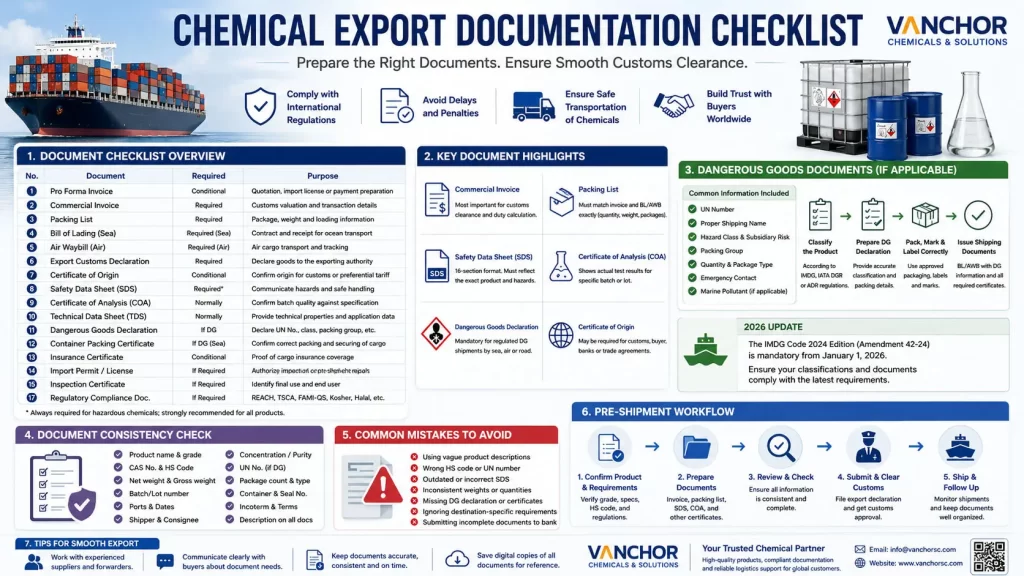
For most chemical exports, the basic document package includes a commercial invoice, packing list, bill of lading or air waybill, export customs declaration, Safety Data Sheet and Certificate of Analysis.
Hazardous chemicals may also require a dangerous goods declaration, container packing certificate, UN transport classification, approved packaging information and correctly prepared hazard labels.
The exact requirements depend on the chemical, concentration, HS code, transport mode, country of origin, destination market and intended application. Exporters should confirm the final document list with the importer, customs broker, carrier and freight forwarder before loading.
Chemical Export Documentation Checklist at a Glance
| Document | Typical Status | Main Purpose |
|---|---|---|
| Pro Forma Invoice | Pre-order or conditional | Quotation, import-license or payment preparation |
| Commercial Invoice | Core document | Customs valuation and transaction details |
| Packing List | Core document | Package, weight and loading information |
| Bill of Lading | Core for sea freight | Contract and receipt for ocean transport |
| Air Waybill | Core for air freight | Air cargo transport and tracking |
| Export Customs Declaration | Usually required | Declares goods to the exporting authority |
| Certificate of Origin | Destination-dependent | Confirms non-preferential or preferential origin |
| Safety Data Sheet | Essential for hazardous chemicals | Communicates hazards and handling requirements |
| Certificate of Analysis | Normally requested | Confirms batch quality against specification |
| Technical Data Sheet | Normally requested | Describes properties and recommended applications |
| Dangerous Goods Declaration | Required for regulated DG shipments | Declares transport classification and packaging |
| Container Packing Certificate | Required for applicable sea DG shipments | Confirms correct container loading and securing |
| Insurance Certificate | Incoterm or payment-dependent | Confirms cargo insurance coverage |
| Import Permit | Product and country-dependent | Authorizes import of controlled chemicals |
| Inspection Certificate | Contract or country-dependent | Confirms third-party inspection results |
| End-Use Statement | Controlled-product dependent | Identifies buyer, application and final use |
| Regulatory Compliance Declaration | Market-dependent | Supports REACH, TSCA or other market requirements |
Commercial invoices, packing lists, certificates of origin and transport documents are among the most common export documents. However, importing countries may require additional certificates covering product safety, health, standards or pre-shipment inspection.
1. Pro Forma Invoice
A pro forma invoice is normally issued before the final sale or shipment. It provides the buyer with the commercial information required to approve the order, arrange payment or apply for an import permit.
It commonly includes:
- Seller and buyer details
- Product name
- Chemical concentration or grade
- Quantity
- Unit and total price
- Currency
- Packaging
- Incoterm
- Port of loading
- Destination
- Payment terms
- Estimated production time
- Offer-validity period
The pro forma invoice is not normally used as the final customs invoice. Once the goods are shipped, it should be replaced by a commercial invoice reflecting the actual transaction.
2. Commercial Invoice
The commercial invoice is one of the most important documents in chemical export customs clearance. Customs authorities use it to identify the transaction and determine the customs value, duties and taxes.
A chemical commercial invoice should normally include:
- Invoice number and date
- Exporter’s legal name and address
- Importer and consignee details
- Buyer details when different from the consignee
- Precise product description
- Chemical name
- Concentration or grade
- CAS number where useful
- HS code
- Quantity and unit of measure
- Number and type of packages
- Net and gross weight
- Unit price and total value
- Currency
- Country of origin
- Incoterm and named place
- Shipping method
- Payment terms
- Contract or purchase-order number
Avoid vague descriptions such as:
- Chemical material
- Industrial additive
- White powder
- Liquid chemical
- Water-treatment product
A more useful description would be:
Calcium Formate, Industrial Grade, 98% Minimum, CAS 544-17-2, Packed in 25 kg Bags
Precise descriptions help customs authorities identify the chemical and reduce the risk of document queries or clearance delays. Customs authorities may reject descriptions that do not clearly identify the nature and characteristics of the merchandise.
3. Packing List
The export packing list provides detailed information about how the shipment is packed.
It should match the commercial invoice and normally include:
- Exporter and consignee
- Invoice number
- Purchase-order number
- Product description
- Number of drums, bags, IBCs or pallets
- Quantity in each package
- Net weight
- Gross weight
- Package dimensions
- Shipping marks
- Container number
- Seal number
- Pallet information
- Total shipment weight and volume
The packing list is not a substitute for the commercial invoice. Customs officials may compare both documents, so product quantities, weights and package counts should be consistent.
4. Bill of Lading or Air Waybill
The transport document depends on the shipping mode.
Bill of Lading
A bill of lading is used for ocean freight. It functions as a transport contract and carrier receipt. Depending on the form used, it may also function as a document of title.
The bill of lading should be checked for:
- Shipper
- Consignee
- Notify party
- Port of loading
- Port of discharge
- Cargo description
- Package count
- Gross weight
- Container and seal numbers
- Freight terms
- Dangerous goods information where applicable
Air Waybill
An air waybill accompanies an international air shipment and provides shipment and tracking information. Unlike a negotiable ocean bill of lading, an air waybill is generally non-negotiable.
The shipping description on the bill of lading or air waybill must remain consistent with the invoice, packing list and dangerous goods declaration.
5. Export Customs Declaration
The exporter or its authorized customs agent must submit the required export declaration according to the laws of the country of export.
The declaration normally contains:
- Exporter and importer information
- Customs registration details
- HS code
- Product description
- Declared customs value
- Country of origin
- Destination
- Transport mode
- Package count
- Net and gross weight
- License information where applicable
The exporting country may require electronic filing through its national customs platform. Importing countries also require their own entry or import customs declarations. For example, EU customs procedures use electronic customs declarations and related entry or exit data.
6. Certificate of Origin
A Certificate of Origin confirms where the goods were manufactured or obtained.
Two common forms are:
Non-Preferential Certificate of Origin
This confirms the ordinary origin of the product. It may be requested by:
- Destination customs
- The importer
- A bank under a letter of credit
- A government procurement project
- A chamber of commerce
- The customer’s internal compliance department
Preferential Certificate or Origin Declaration
This supports a claim for reduced or zero customs duty under an applicable trade agreement.
Not every shipment requires a Certificate of Origin. Requirements vary by destination, HS code, trade agreement and customer. Some certificates must be certified by a chamber of commerce, while preferential-origin documents may follow separate self-certification or customs procedures.
7. Safety Data Sheet
The Safety Data Sheet communicates a chemical’s identity, hazards, composition, first-aid measures, firefighting measures, handling, storage and transport information.
A standard SDS is organized into 16 sections, including:
- Identification
- Hazard identification
- Composition and ingredient information
- First-aid measures
- Firefighting measures
- Accidental-release measures
- Handling and storage
- Exposure controls and personal protection
- Physical and chemical properties
- Stability and reactivity
- Toxicological information
- Ecological information
- Disposal considerations
- Transport information
- Regulatory information
- Other information
OSHA requires manufacturers, distributors and importers of hazardous chemicals to provide SDS information in a standardized section format.
Before shipment, verify that the SDS:
- Matches the exact product and concentration
- Uses the correct supplier information
- Contains the current revision date
- Shows the correct CAS number
- Includes the correct transport classification
- Matches the product label
- Is available in a language accepted by the destination market
- Includes a suitable emergency contact number
The SDS supports safety communication, but it does not replace a dangerous goods declaration.
8. Certificate of Analysis
The Certificate of Analysis, or COA, confirms the actual test results for a specific production batch.
A chemical COA should normally show:
- Product name
- Grade and concentration
- Batch or lot number
- Manufacturing date
- Test date
- Specification limits
- Actual test results
- Test methods where applicable
- Conclusion or approval status
- Authorized quality-control signature
Typical parameters may include:
- Assay or purity
- Moisture
- pH
- Color
- Chloride
- Sulphate
- Iron
- Heavy metals
- Insoluble matter
- Density
- Particle size
The COA should correspond to the batch numbers shown on the packaging and shipment records.
9. Technical Data Sheet
A Technical Data Sheet, or TDS, provides general product information rather than batch-specific laboratory results.
It may include:
- Chemical and physical properties
- Typical specification
- Product functions
- Recommended applications
- Solubility
- Density
- Storage conditions
- Shelf life
- Packaging
- General handling guidance
The COA and TDS serve different purposes:
| Document | Main Function |
|---|---|
| COA | Reports actual results for a specific batch |
| TDS | Describes general technical characteristics |
| SDS | Communicates hazards and safe handling |
10. Dangerous Goods Declaration
A Dangerous Goods Declaration is required when a chemical is regulated as dangerous goods under the applicable transport rules.
The transport description may include:
- UN number
- Proper Shipping Name
- Hazard class
- Subsidiary hazard
- Packing group
- Number and type of packages
- Quantity
- Marine pollutant status
- Flash point where required
- Emergency contact
- Additional regulatory statements
For air transport, the consignor prepares a Shipper’s Declaration certifying that the goods have been correctly classified, packed, marked, labeled and declared under the applicable IATA Dangerous Goods Regulations.
For ocean transport, dangerous goods in packaged form must comply with the IMDG Code, which covers classification, packaging, container transport, stowage and segregation.
2026 compliance note: the IMDG Code 2024 Edition incorporating Amendment 42-24 became mandatory on January 1, 2026. Exporters and freight forwarders should therefore ensure that shipping classifications and documentation are prepared under the current edition.
11. Container Packing Certificate
For applicable sea-freight dangerous goods shipments, a container or vehicle packing certificate confirms that:
- The container was clean and suitable.
- Packages were inspected for visible damage.
- Incompatible substances were properly segregated.
- Packages were correctly loaded and secured.
- Hazard marks and placards were applied.
- The cargo was packed according to transport requirements.
The certificate may be combined with a multimodal dangerous goods form when the approved format and applicable requirements are followed.
12. Chemical Labels and Package Marks
Chemical packaging should be reviewed separately for:
Supply Labels
These communicate workplace or product hazards and may include:
- Product identifier
- Signal word
- Hazard pictograms
- Hazard statements
- Precautionary statements
- Supplier details
Transport Marks and Labels
These may include:
- UN number
- Proper Shipping Name
- Hazard-class label
- Orientation arrows
- Marine pollutant mark
- Limited-quantity mark
- Overpack mark
- Package specification marking
A product may be hazardous under workplace rules but not regulated as dangerous goods for a particular mode of transport—or the reverse. Classification should therefore be confirmed under both supply and transport regulations.
13. Product- and Market-Specific Documents
Depending on the chemical and destination, additional documents may include:
- Import license
- Export license
- Chemical registration statement
- REACH compliance documentation
- Only Representative information
- TSCA compliance statement
- K-REACH or other national chemical inventory documentation
- Food-grade declaration
- Feed-grade declaration
- GMP, HACCP or FAMI-QS certificate
- Kosher or Halal certificate
- Pharmaceutical or excipient documentation
- Allergen statement
- GMO statement
- Animal-origin statement
- Heavy-metal report
- Pre-shipment inspection certificate
- Certificate of Free Sale
- End-use or end-user declaration
The destination country determines which import procedures, product rules and supporting documents apply. Exporters should check requirements by HS code and product before accepting the order.
14. Insurance and Payment Documents
Depending on the Incoterm and payment method, the shipment may also require:
- Cargo insurance policy
- Insurance certificate
- Letter of credit
- Bill of exchange
- Beneficiary certificate
- Inspection certificate
- Bank presentation documents
- Certificate of shipment
- Courier receipt
When payment is made under a letter of credit, spelling, dates, package counts, weights and descriptions must comply with the credit terms. Even small inconsistencies can cause a bank discrepancy.
Chemical Export Document Consistency Check
Before documents are released, verify that the following information is consistent across the invoice, packing list, customs declaration, transport document and dangerous goods documents:
| Information | Consistency Check |
|---|---|
| Product name | Same chemical identity and grade |
| Concentration | Same percentage on all documents |
| CAS number | Correct for the shipped substance |
| HS code | Confirmed with customs adviser |
| UN number | Correct transport classification |
| Package count | Matches loaded cargo |
| Net weight | Matches actual product weight |
| Gross weight | Matches packaging and pallets |
| Batch number | Matches COA and labels |
| Consignee | Correct legal entity and address |
| Port information | Matches booking |
| Incoterm | Matches sales contract |
| Container number | Matches packing and bill of lading |
| Seal number | Matches physical container |
| Shipping marks | Match the packages |
Common Chemical Export Documentation Mistakes
Using an Incomplete Product Description
“Chemical powder” is not sufficient. Include the recognized chemical name, grade and concentration.
Confusing the HS Code with the UN Number
The HS code is used for customs classification. The UN number is used for dangerous goods transport classification. They perform different functions.
Using an Outdated SDS
An old SDS may contain an incorrect supplier address, transport classification or regulatory statement.
Sending a Generic COA
The COA should identify the actual shipment batch rather than only showing a typical specification.
Inconsistent Weight or Package Counts
Differences between the invoice, packing list and bill of lading can result in customs questions or amendment fees.
Assuming Every Chemical Is Dangerous Goods
Dangerous goods status depends on the product’s composition, concentration, physical properties and transport mode. The classification should be confirmed rather than assumed from the product name.
Ignoring Destination-Specific Requirements
A document package accepted in one country may be insufficient in another. Some markets require legalization, local-language documents, chemical registration or import permits.
Recommended Pre-Shipment Workflow
A practical chemical export documentation process is:
- Confirm the product, grade and concentration.
- Verify the HS code and destination import requirements.
- Confirm whether the product is regulated as dangerous goods.
- Review packaging and labeling requirements.
- Collect the current SDS, TDS and product specification.
- Complete production and issue the batch COA.
- Prepare the invoice, packing list and origin documents.
- Submit customs and transport declarations.
- Cross-check all document fields against the actual cargo.
- Send draft documents to the buyer before final issuance.
- Load, seal and record the container.
- Issue the final transport and shipping document package.
Chemical Export Documentation Support from Vanchor
Vanchor supports international chemical shipments with coordinated production, quality documentation, packaging and export logistics.
Depending on the product and destination, our documentation package can include:
- Commercial invoice
- Export packing list
- Batch-specific COA
- SDS
- Technical Data Sheet
- Product specification
- Certificate of Origin
- Dangerous goods documentation
- Packing and labeling information
- Inspection documentation
- Food- or feed-grade supporting documents
- Customs and shipping coordination
When requesting a quotation, buyers should provide:
- Product name
- Grade and concentration
- Required quantity
- Packaging
- Intended application
- Destination country and port
- Delivery term
- Required certificates
- Import-license or registration requirements
Providing these details at the beginning of the transaction helps prevent document changes, booking delays and customs problems later.
Frequently Asked Questions
What documents are normally required to export chemicals?
The basic documents normally include a commercial invoice, packing list, transport document, customs declaration, SDS and batch COA.
Is an SDS required for every chemical export?
An SDS is essential for hazardous chemical communication and is frequently requested for chemical shipments. Exact legal requirements depend on the product and market.
Is a COA required for customs clearance?
A COA is not universally a customs requirement, but it is commonly required by chemical buyers and may support product identification or regulatory review.
What is the difference between an SDS and a dangerous goods declaration?
An SDS provides broad hazard and handling information. A dangerous goods declaration certifies that a regulated shipment has been classified, packed, marked and labeled for transport.
Is a Certificate of Origin mandatory?
Not for every shipment. It may be required by the destination country, buyer, bank or a preferential trade agreement.
What is the difference between an HS code and a UN number?
An HS code classifies goods for customs and tariff purposes. A UN number identifies dangerous goods for transport.
Does every hazardous chemical require a UN number?
No. A chemical may be hazardous in the workplace without meeting the criteria for dangerous goods transport.
Which documents are required for sea freight?
Typical documents include a commercial invoice, packing list, bill of lading and customs declaration. Dangerous goods may also require a dangerous goods declaration and container packing certificate.
Which documents are required for air freight?
Typical documents include a commercial invoice, packing list, air waybill and customs declaration. Regulated dangerous goods may require an IATA Shipper’s Declaration.
Who should confirm the final documentation requirements?
The exporter should coordinate with the importer, customs broker, carrier, freight forwarder and relevant regulatory specialists before shipment.
Prepare Documents Before the Cargo Is Loaded
A reliable Chemical Export Documentation Checklist is more than an administrative formality. It connects the sales contract, product identity, quality results, customs declaration and transport classification.
The most effective approach is to confirm documentation requirements before production and booking—not after the container has already been loaded.
Accurate invoices, consistent packing data, current safety documentation and correct dangerous goods declarations help reduce customs delays, carrier rejection, amendment charges and delivery risk.
Contact Vanchor for chemical specifications, batch documentation, export packaging and coordinated international shipping support.


Contact Us
In This Article
Related Posts
Custom Packaging Solutions from an Anhydrous Sodium Acetate Supplier in China
2026-09-23
Application Trends in Anhydrous Sodium Acetate for Special Chemical Manufacturing
2026-09-23
Anhydrous Sodium Acetate for Leather Tanning: Improve Dyeing Uniformity
2026-09-22
Formic Acid 85% for Textile Dyeing: Industrial Applications, Technical Benefits and Future Trends
2026-09-22


