



Glacial Acetic Acid Food Grade vs Industrial Grade
By vanchor
2026-07-11Related Posts
Custom Packaging Solutions from an Anhydrous Sodium Acetate Supplier in China
2026-09-23

Application Trends in Anhydrous Sodium Acetate for Special Chemical Manufacturing
2026-09-23
Anhydrous Sodium Acetate for Leather Tanning: Improve Dyeing Uniformity
2026-09-22
Formic Acid 85% for Textile Dyeing: Industrial Applications, Technical Benefits and Future Trends
2026-09-22
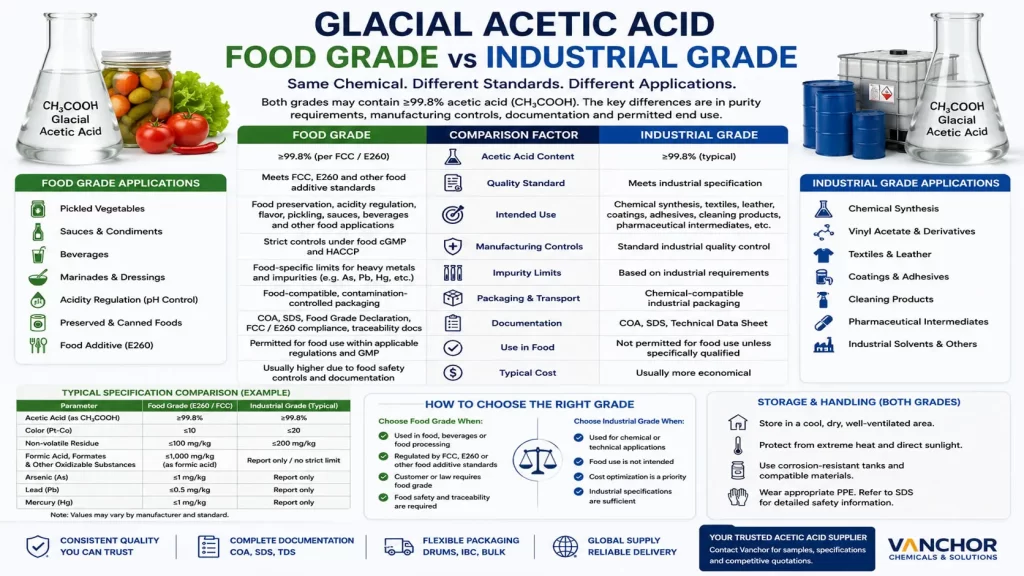
The main difference between Glacial Acetic Acid Food Grade vs Industrial Grade is not necessarily the acetic acid concentration. Both products may contain at least 99.8% acetic acid and have the same chemical formula, CH₃COOH.
The real differences involve:
- Permitted end use
- Impurity limits
- Food-safety controls
- Manufacturing practices
- Batch traceability
- Packaging and transport hygiene
- Regulatory documentation
Food-grade glacial acetic acid must comply with the food-additive specifications and manufacturing requirements applicable to the destination market. Industrial-grade glacial acetic acid is manufactured for chemical synthesis, textiles, coatings, adhesives, cleaning products and other technical applications.
As a practical rule:
- Choose food-grade glacial acetic acid for food ingredients, acidity regulation, food preservation and qualified food-processing applications.
- Choose industrial-grade glacial acetic acid for chemical manufacturing, textiles, leather, coatings, adhesives and industrial cleaning.
- Never use industrial grade in food solely because its assay is listed as 99.8%.
What Is Glacial Acetic Acid?
Glacial acetic acid is a highly concentrated form of acetic acid containing very little water.
| Property | General Information |
|---|---|
| Chemical name | Acetic acid |
| Alternative name | Ethanoic acid |
| Chemical formula | CH₃COOH or C₂H₄O₂ |
| CAS number | 64-19-7 |
| Molecular weight | Approximately 60.05 g/mol |
| Appearance | Clear, colorless liquid |
| Odor | Strong, pungent, vinegar-like odor |
| Boiling point | Approximately 118°C |
| Main grades | Food, feed, pharmaceutical, reagent and industrial |
The European Union specification for E260 acetic acid identifies a minimum assay of 99.8%, a specific gravity of approximately 1.049 and a solidification point of at least 14.5°C.
The word glacial refers to the fact that concentrated acetic acid can solidify into ice-like crystals at temperatures around 16°C. OSHA lists a freezing or melting point of approximately 62°F, or 16.7°C, for glacial acetic acid.
Food Grade vs Industrial Grade: Quick Comparison
| Selection Factor | Food-Grade Glacial Acetic Acid | Industrial-Grade Glacial Acetic Acid |
|---|---|---|
| Chemical formula | CH₃COOH | CH₃COOH |
| CAS number | 64-19-7 | 64-19-7 |
| Typical concentration | Often ≥99.8%, depending on standard | May also be ≥99.8% |
| Intended use | Food processing and food ingredients | Chemical and technical applications |
| Main quality focus | Food safety and regulated impurity limits | Industrial process performance |
| Manufacturing controls | Food cGMP and hygiene controls | Industrial quality management |
| Contaminant testing | Food-standard heavy metals and specified impurities | Based on industrial specification |
| Traceability | Food-chain batch traceability | Standard industrial traceability |
| Packaging | Food-compatible and contamination-controlled | Chemical-compatible industrial packaging |
| Documentation | COA, SDS, food-grade declaration and compliance documents | COA, SDS and Technical Data Sheet |
| Use in food | Permitted only under applicable food regulations | Not automatically permitted |
| Typical cost | Usually higher | Usually more economical |
The comparison shows why assay alone cannot establish grade. A 99.8% industrial product may not have been produced, tested, packed or transported under food-safety controls.
What Is Food-Grade Glacial Acetic Acid?
Food-grade glacial acetic acid is concentrated acetic acid manufactured and documented for use in food production.
In the United States, the FDA identifies acetic acid as having several technical functions in food:
- Antimicrobial agent
- Flavor enhancer
- Flavoring agent or adjuvant
- pH-control agent
The FDA also states that acetic acid is generally recognized as safe for food use when it is food grade and used according to good manufacturing practices.
A commercial food-grade glacial acetic acid may be produced to comply with requirements such as:
- Food Chemicals Codex specifications
- EU E260 requirements
- Applicable national food-additive standards
- Current Good Manufacturing Practices
- Customer-specific food-safety requirements
Eastman, for example, describes its food-grade glacial acetic acid as complying with Food Chemicals Codex requirements and being manufactured under appropriate current good manufacturing practices for food-additive use.
Typical Food Applications
Food-grade glacial acetic acid may be used in qualified formulations involving:
- Pickled vegetables
- Sauces and condiments
- Marinades
- Canned and preserved foods
- Food flavor systems
- Acidity adjustment
- Food-processing solutions
- Selected antimicrobial applications
- Production of food-grade acetate salts
The exact permitted use and dosage depend on the food category, national regulations and good manufacturing practice.
Is Food-Grade Acetic Acid the Same as Vinegar?
No.
Vinegar is a fermented food containing water, acetic acid and other naturally produced compounds. Food-grade glacial acetic acid is a highly concentrated chemical ingredient.
The FDA specifically states that diluted acetic acid is not vinegar. When diluted acetic acid is used as a food ingredient, it should be identified as “acetic acid” or “diluted acetic acid” rather than represented as vinegar.
This distinction is important for:
- Product labeling
- Consumer expectations
- Pickled-food standards
- Flavor profiles
- Regulatory compliance
A food manufacturer should not replace vinegar with diluted glacial acetic acid in a product where doing so would mislead consumers.
What Is Industrial-Grade Glacial Acetic Acid?
Industrial-grade glacial acetic acid is designed for chemical manufacturing and other technical processes.
Typical applications include:
- Vinyl acetate monomer production
- Cellulose acetate production
- Acetic anhydride manufacturing
- Acetate ester production
- Adhesives and sealants
- Paints and coatings
- Textile processing
- Leather processing
- Industrial cleaning
- Oil and gas chemicals
- Agricultural intermediates
- Pharmaceutical intermediate production
Celanese identifies acetic acid as a raw material for vinyl acetate, cellulose acetate, acetic anhydride and numerous other industrial products.
Industrial glacial acetic acid may have excellent chemical purity and consistent process performance. However, it may not include the contaminant testing, food-facility controls or documentation needed for food use.
Is Food Grade More Pure Than Industrial Grade?
Not necessarily.
Both grades may have an acetic acid assay of at least 99.8%. The key distinction is which impurities are controlled and how the product is manufactured and handled.
For example, the EU E260 specification requires:
- Acetic acid content of at least 99.8%
- Non-volatile residue not exceeding 100 mg/kg
- Formic acid, formates and other oxidizable substances not exceeding 1,000 mg/kg, expressed as formic acid
- Arsenic not exceeding 1 mg/kg
- Lead not exceeding 0.5 mg/kg
- Mercury not exceeding 1 mg/kg
These requirements illustrate that a food-grade standard covers more than total acetic acid content.
An industrial Certificate of Analysis may instead focus on parameters such as:
- Acetic acid assay
- Water
- Formic acid
- Acetaldehyde
- Iron
- Color
- Permanganate time
- Evaporation residue
The product may fully satisfy an industrial process while lacking the testing or declarations required for food production.
Why Industrial Grade Should Not Be Used in Food
Industrial-grade glacial acetic acid should not be added to food unless the specific product and batch are qualified for that use.
Potential issues include:
- Raw materials not approved for food production
- Shared production systems with non-food chemicals
- Insufficient cross-contamination controls
- Missing heavy-metal testing
- Industrial rather than food-compatible packaging
- Contaminated tankers or intermediate containers
- Missing food-grade declarations
- Incomplete food-chain traceability
- Lack of destination-market compliance
A suitable assay and matching CAS number do not address these risks.
Can Food Grade Be Used for Industrial Applications?
Food-grade glacial acetic acid can technically be used in many industrial processes when its specification is compatible with the application.
However, this is not always economical. Food-grade material may cost more because of:
- Additional impurity testing
- Food-safety management
- Segregated storage
- Traceability requirements
- Approved packaging
- Regulatory documentation
- Cleaning and hygiene controls
For coatings, chemical synthesis or textile processing, an appropriate industrial grade normally provides the more practical cost-performance balance.
How to Verify Food-Grade Glacial Acetic Acid
Before approving a supplier, request a complete qualification file.
Important documents may include:
- Batch-specific Certificate of Analysis
- Food-grade specification
- Safety Data Sheet
- Food-grade declaration
- FCC compliance statement
- E260 compliance statement
- Manufacturing-site information
- Current GMP declaration
- HACCP or food-safety certification
- Heavy-metal test results
- Allergen declaration
- GMO declaration
- Animal-origin statement
- Kosher or Halal certificate where required
- Country of origin
- Batch traceability information
- Packaging and transport-cleanliness declaration
Required documents vary between countries and customers. Compliance with one national standard does not automatically establish approval in every destination market.
How to Select Industrial-Grade Glacial Acetic Acid
Industrial buyers should match the product specification to the production process.
Important parameters include:
| Parameter | Why It Matters |
|---|---|
| Acetic acid assay | Determines active acid content |
| Water content | Affects reactions and product concentration |
| Formic acid | Important in sensitive chemical synthesis |
| Acetaldehyde | May affect downstream reactions and odor |
| Iron | Relevant to color-sensitive products |
| Color | Important for clear coatings and intermediates |
| Permanganate time | Indicates readily oxidizable impurities |
| Evaporation residue | Measures non-volatile contamination |
| Solidification point | Supports concentration verification |
| Packaging | Affects safety and product integrity |
The most suitable grade is the one that meets the actual process limits—not necessarily the product with the longest specification sheet.
Packaging and Transport Differences
Both food and industrial grades require chemical-compatible, corrosion-resistant packaging.
Common options include:
- 30 kg chemical drums
- 200 kg drums
- Intermediate bulk containers
- ISO tanks
- Bulk tanker delivery
Food-grade shipments may require additional controls, including:
- Food-compatible contact materials
- Dedicated or properly cleaned tanks
- Previous-cargo declarations
- Tamper-evident seals
- Cleaning certificates
- Traceable container numbers
- Protection from cross-contamination
Industrial packaging must still be safe and compatible, but it may not satisfy food-chain hygiene requirements.
Storage and Safety
Both grades present essentially the same chemical hazards at the same concentration.
Glacial acetic acid is corrosive and can damage the eyes, skin and respiratory system. NIOSH recommends preventing skin and eye contact and providing immediate flushing facilities in workplaces handling concentrated acetic acid.
Storage systems should include:
- Corrosion-resistant tanks and pipelines
- Effective ventilation
- Secondary containment
- Temperature monitoring
- Closed transfer where practical
- Emergency eyewash and safety showers
- Suitable chemical-resistant PPE
- Spill-control procedures
- Separation from incompatible chemicals
Because glacial acetic acid can crystallize near ordinary room temperature, tanks and transfer lines may require insulation or controlled heating in cold climates. Heating procedures must follow the supplier’s SDS and facility engineering requirements.
Glacial Acetic Acid Supply from Vanchor
Vanchor supplies glacial acetic acid for food processing, textiles, leather, chemical manufacturing and other qualified applications.
Supply support can include:
- Food-grade glacial acetic acid
- Industrial-grade glacial acetic acid
- High-purity specifications
- Batch-specific COA
- SDS and Technical Data Sheet
- Food-grade compliance documentation
- Drums, IBCs and bulk shipments
- Customized labeling
- International warehousing and logistics
- Samples and pre-shipment inspection
Vanchor also supports food-grade glacial acetic acid applications in pickled foods, preserved vegetables, sauces and other acidified products.
When requesting a quotation, provide:
- Required grade
- Applicable standard
- Intended application
- Annual quantity
- Packaging preference
- Destination country and port
- Required certifications
- Maximum impurity limits
Frequently Asked Questions
What is the difference between food-grade and industrial glacial acetic acid?
They have the same chemical identity, but food grade is produced, tested, packed and documented according to applicable food-safety requirements.
Are both grades 99.8% pure?
They can be. However, an assay of 99.8% does not automatically make industrial acetic acid food grade.
Can industrial glacial acetic acid be used in food?
Not unless the specific product, production system and documentation comply with the applicable food regulations.
What is the food additive number for acetic acid?
Acetic acid is identified as E260 in the European Union.
What does food-grade acetic acid do in food?
It can function as an antimicrobial agent, flavor enhancer, flavoring agent and pH-control agent.
Is glacial acetic acid vinegar?
No. Vinegar is produced through fermentation and contains additional components. Diluted acetic acid should not be labeled as vinegar.
Can food-grade acetic acid be used industrially?
Yes, when its specification is compatible, although it may be more expensive than industrial grade.
Why does glacial acetic acid crystallize?
Concentrated acetic acid freezes at approximately 16°C, forming clear, ice-like crystals.
What documents should a food manufacturer request?
Typical documents include a COA, SDS, food-grade declaration, applicable FCC or E260 statement, traceability records and food-safety certifications.
How should buyers select the correct grade?
Start with the end use and destination regulations. Then evaluate impurity limits, manufacturing controls, packaging, transport hygiene and supporting documents.
Choose Grade by End Use, Not Assay Alone
The key lesson from Glacial Acetic Acid Food Grade vs Industrial Grade is that chemical concentration alone does not determine suitability.
Food-grade glacial acetic acid must meet appropriate food-additive specifications and be supported by food-safety controls, traceability and documentation. Industrial grade is designed for technical performance in chemical synthesis, coatings, textiles, leather and other manufacturing processes.
Selecting the correct grade helps protect consumer safety, regulatory compliance, production stability and supply-chain reliability.
Contact Vanchor for food-grade or industrial-grade glacial acetic acid specifications, compliance documents, packaging options and export quotations.


Contact Us
In This Article
Related Posts
Custom Packaging Solutions from an Anhydrous Sodium Acetate Supplier in China
2026-09-23
Application Trends in Anhydrous Sodium Acetate for Special Chemical Manufacturing
2026-09-23
Anhydrous Sodium Acetate for Leather Tanning: Improve Dyeing Uniformity
2026-09-22
Formic Acid 85% for Textile Dyeing: Industrial Applications, Technical Benefits and Future Trends
2026-09-22


