



China Chemical Supplier Audit Checklist: How to Verify a Reliable Supplier
By vanchor
2026-07-11Related Posts
Custom Packaging Solutions from an Anhydrous Sodium Acetate Supplier in China
2026-09-23
Application Trends in Anhydrous Sodium Acetate for Special Chemical Manufacturing
2026-09-23
Anhydrous Sodium Acetate for Leather Tanning: Improve Dyeing Uniformity
2026-09-22
Formic Acid 85% for Textile Dyeing: Industrial Applications, Technical Benefits and Future Trends
2026-09-22
A practical China Chemical Supplier Audit Checklist should verify more than product price, an ISO certificate or a sample Certificate of Analysis.
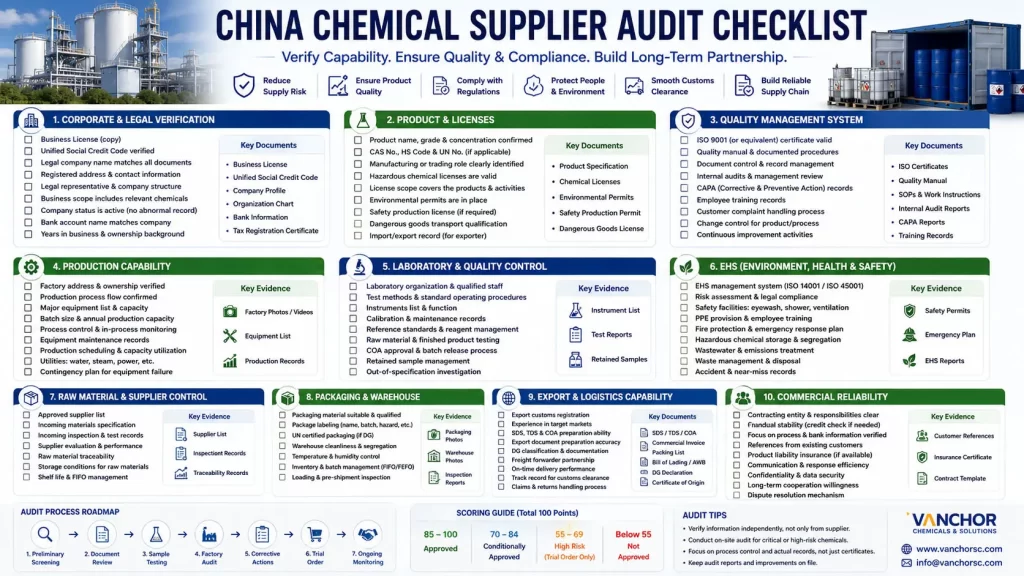
Chemical buyers need to confirm that the supplier:
- Is a legally registered and active business
- Has the right to manufacture or trade the product
- Controls the actual production facility
- Can consistently meet the agreed specification
- Operates suitable laboratory and traceability systems
- Holds the required chemical and safety permits
- Uses appropriate packaging, storage and transportation
- Can prepare compliant export documentation
- Has sufficient capacity and contingency planning
- Responds effectively when quality problems occur
The strongest supplier assessments combine document review, database verification, sample testing, a factory audit and a controlled trial order.
China Chemical Supplier Audit Checklist at a Glance
| Audit Area | Key Verification Points |
|---|---|
| Corporate identity | Business license, legal name, Unified Social Credit Code and registration status |
| Supplier type | Manufacturer, trader, distributor or export company |
| Product authorization | Approved business scope and relevant chemical licenses |
| Quality management | Procedures, records, internal audits and corrective actions |
| Production capability | Equipment, capacity, process control and maintenance |
| Laboratory capability | Test methods, instruments, calibration and retained samples |
| Raw-material control | Approved suppliers, incoming inspection and traceability |
| Finished-product control | Batch testing, COA approval and release procedures |
| EHS management | Safety permits, PPE, emergency response and environmental controls |
| Packaging and storage | Compatibility, labeling, segregation and moisture control |
| Export capability | Customs registration, SDS, COA, origin and dangerous goods documents |
| Commercial reliability | Contracting entity, bank account, references and complaint handling |
1. Verify the Supplier’s Legal Identity
Start by confirming the supplier’s exact Chinese legal identity.
Request a current copy of the business license and check:
- Full Chinese legal company name
- Unified Social Credit Code
- Legal representative
- Registered address
- Date of establishment
- Registered capital
- Business status
- Approved business scope
- Registration authority
The Unified Social Credit Code is the principal identification number assigned to a registered Chinese enterprise and is shown on its business license.
The information should be checked against China’s official enterprise-credit registration records rather than relying only on a scanned license supplied by the sales representative.
Confirm That the Names Match
Compare the legal company name on:
- Business license
- Sales contract
- Commercial invoice
- Bank account
- Export declaration
- Certificate of Origin
- Quality certificates
- Supplier website
- Email signature
A payment request to an unrelated company or personal account requires additional investigation.
There may be legitimate reasons for different entities. For example, a factory may use an affiliated export company. In that situation, request documentation explaining the relationship and identify which entity is responsible for:
- Manufacturing
- Product quality
- Export customs declaration
- Payment collection
- Warranty and claims
- Regulatory compliance
2. Determine Whether the Supplier Is a Manufacturer or Trader
Many chemical suppliers use terms such as “factory,” “manufacturer” or “production base” without clearly explaining their operating model.
Ask the supplier to identify whether it is:
- The actual manufacturer
- A contract manufacturer
- A trading company
- An authorized distributor
- A supply-chain company working with several factories
- A manufacturer with a separate export entity
A trader is not automatically a poor supplier. A capable trading or supply-chain company may offer broader sourcing, export expertise, smaller minimum orders and stronger logistics support.
The important point is transparency.
Evidence of Manufacturing Control
Request:
- Factory business license
- Factory address
- Site ownership or lease information
- Production-flow diagram
- Equipment list
- Annual production capacity
- Production photographs or live video
- Utility and warehouse information
- Environmental and safety permits
- Recent batch-production records
- Relationship agreement when the exporter and manufacturer differ
During an audit, confirm that the facility actually produces the chemical rather than only repacking or storing material purchased elsewhere.
3. Verify Business Scope and Chemical Licenses
The business license should include activities relevant to the supplied product.
For hazardous chemicals, verify all licenses applicable to the supplier’s role, which may include:
- Hazardous chemical production authorization
- Hazardous chemical operating license
- Storage authorization
- Safety-use permit
- Environmental permits
- Dangerous goods transport qualifications
- Port or warehouse approvals
China applies licensing controls to hazardous chemical operations, and the authorized scope should cover the chemicals and activities performed by the company. Government guidance states that hazardous chemical business activities generally require an operating license, subject to defined exceptions.
Do not only check whether a license exists. Verify:
- Issuing authority
- License number
- Company name
- Facility address
- Authorized chemical categories
- Authorized operating activities
- Storage permissions
- Issue and expiry dates
A valid permit for trading without storage does not necessarily authorize the company to operate its own hazardous chemical warehouse.
4. Review the Quality Management System
ISO 9001 certification can provide useful evidence that a supplier has implemented a quality-management framework. ISO describes ISO 9001 as a standard for establishing, maintaining and continually improving a quality-management system.
However, a certificate alone does not prove that the factory consistently follows its procedures.
Check the Certificate Carefully
Verify:
- Certified legal entity
- Manufacturing-site address
- Certification scope
- Product categories covered
- Standard edition
- Issue and expiry dates
- Certification body
- Accreditation mark
- Certificate status through the certification body
A certificate for “chemical trading services” should not be presented as evidence that a manufacturing facility is certified.
Review Actual Quality Records
During the audit, sample records covering:
- Document control
- Raw-material approval
- Incoming inspection
- Production instructions
- Batch records
- In-process testing
- Finished-product release
- Nonconforming material
- Customer complaints
- Corrective and preventive action
- Change control
- Internal audits
- Management review
The records should show that procedures are used in normal production rather than created only for customer audits.
5. Evaluate Production Capability
Ask the supplier to demonstrate how the product is manufactured from incoming raw materials to final packaging.
Production Audit Questions
- Which raw materials determine final product quality?
- Are raw materials purchased from approved suppliers?
- Which process parameters are critical?
- How are temperature, pressure, pH or reaction time controlled?
- Which stages are automated?
- Which stages depend on manual operation?
- How are batch numbers assigned?
- What is the normal batch size?
- What is the annual installed capacity?
- What is the current capacity utilization?
- How are production changes approved?
- What happens during equipment failure or power interruption?
Review Equipment Condition
Inspect:
- Reactors and processing vessels
- Pumps, valves and pipelines
- Filtration systems
- Dryers and crystallizers
- Filling and packing machines
- Dust-control equipment
- Temperature and pressure instruments
- Weighing systems
- Preventive-maintenance records
- Equipment-cleaning records
Look for leakage, corrosion, improvised repairs, damaged insulation, cross-contamination risks and poorly identified pipelines.
6. Audit Raw-Material Control
Stable finished-product quality begins with controlled raw materials.
The supplier should maintain:
- Approved supplier list
- Raw-material specifications
- Supplier qualification records
- Incoming COAs
- Incoming inspection results
- Supplier performance evaluations
- Nonconforming-material procedures
- Lot traceability
- Storage and shelf-life controls
Select one finished-product batch and trace it backward to its principal raw materials.
Then select one raw-material batch and trace it forward to the finished products in which it was used.
A supplier that cannot complete both directions of traceability may struggle to isolate affected material during a quality incident.
7. Review Laboratory and Testing Capability
The factory laboratory should be capable of testing the parameters shown on the product specification and COA.
Inspect:
- Laboratory organization
- Analyst qualifications
- Written test methods
- Instrument operating procedures
- Reference standards
- Reagent management
- Calibration and verification records
- Sample preparation
- Data recording
- Result review and approval
- Out-of-specification investigations
- Retained samples
ISO/IEC 17025 is the international standard addressing competence, impartiality and consistent operation in testing and calibration laboratories. A factory laboratory does not have to be accredited for every routine test, but accredited external laboratories can add confidence for specialized or regulatory testing.
Match Instruments to COA Parameters
For example:
| COA Parameter | Possible Test Equipment |
|---|---|
| Assay or concentration | Titration equipment, HPLC or GC |
| Moisture | Karl Fischer titrator or drying oven |
| Iron | Spectrophotometer, ICP or atomic absorption |
| Chloride | Titration or ion chromatography |
| Sulphate | Gravimetric or instrumental method |
| Color | Colorimeter |
| Particle size | Sieve set or laser particle-size analyzer |
| Density | Density meter or hydrometer |
| pH | Calibrated pH meter |
If the supplier reports a parameter that it cannot test internally, ask which external laboratory performs the analysis and review a recent test report.
8. Verify COA Accuracy and Batch Traceability
A Certificate of Analysis should report actual results for the shipped batch.
Check that the COA includes:
- Product name
- Grade
- Batch number
- Manufacturing date
- Test date
- Specification limits
- Actual results
- Test methods where applicable
- Approval signature
- Manufacturer identity
Avoid suppliers that issue identical results for every batch. Repeated results may indicate that the COA contains typical values rather than actual test data.
Conduct a Traceability Test
Select a recent COA and ask the supplier to provide:
- Batch-production record
- Raw-material lot numbers
- In-process test data
- Final laboratory worksheet
- Packaging record
- Warehouse entry
- Shipment information
- Retained sample
The information should connect without unexplained gaps or inconsistent dates.
9. Control Sample Approval
A high-quality sample does not guarantee that future bulk shipments will match it.
Ask:
- Was the sample taken from normal production?
- Does it represent the proposed commercial grade?
- Was it specially purified or prepared?
- Which batch number does it belong to?
- Is the sample specification identical to the contract specification?
- Can the supplier retain a duplicate sealed sample?
A practical approval process is:
- Approve the written specification.
- Test the supplier’s sample.
- Retain an approved reference sample.
- Place a controlled trial order.
- Test the commercial shipment.
- Compare results with the approved sample and specification.
- Increase order volume only after consistent performance.
Where quality risk is high, use independent pre-shipment sampling rather than accepting a sample selected solely by the supplier.
10. Audit Environmental, Health and Safety Controls
Chemical manufacturing requires stronger EHS controls than ordinary consumer-goods production.
ISO 14001 provides a framework for managing environmental impacts and legal obligations, while ISO 45001 addresses occupational health and safety risks.
Review:
- Safety responsibilities
- Chemical-risk assessments
- Employee training
- Personal protective equipment
- Ventilation
- Gas detection
- Fire-protection equipment
- Emergency showers and eyewash stations
- Spill-control materials
- Emergency-response plans
- Accident and near-miss records
- Hazardous waste storage
- Wastewater treatment
- Air-emission controls
- Contractor safety
- Emergency drills
Key Factory Observations
Watch for:
- Unlabeled containers
- Open chemical transfer
- Blocked emergency exits
- Missing protective equipment
- Incompatible chemicals stored together
- Leaking drums or pipelines
- Uncontrolled dust
- Wastewater discharged without treatment
- Workers performing unsafe manual operations
- Expired fire equipment
A clean meeting room and complete certificates should not outweigh unsafe conditions observed in the production area.
11. Inspect Packaging and Warehouse Management
Packaging must protect the chemical throughout storage and international transportation.
Verify:
- Packaging material compatibility
- Package weight and dimensional consistency
- Closure and sealing method
- Inner liners
- Moisture resistance
- Pallet quality
- Batch labels
- Product name and grade
- Hazard labels
- Production date
- Net weight
- Storage instructions
- UN packaging certification where required
Warehouse Audit Points
Check:
- Product segregation
- Hazard-class segregation
- Batch identification
- First-in-first-out or first-expired-first-out management
- Temperature and humidity monitoring
- Spill containment
- Pest control for food- or feed-grade products
- Damaged-package control
- Returned-goods area
- Quarantine area
- Loading inspection
For hygroscopic products such as polyacrylamide or formate salts, packaging integrity and warehouse humidity can materially affect flow and performance.
12. Verify Export and Logistics Capability
A chemical supplier should demonstrate that it can prepare documents consistent with the product, grade and transport classification.
Review examples of:
- Commercial invoice
- Packing list
- Bill of lading
- Certificate of Origin
- Export declaration
- SDS
- Batch COA
- Technical Data Sheet
- Dangerous Goods Declaration
- Container Packing Certificate
- Inspection certificate
- Food- or feed-grade declarations
For dangerous goods, check whether the supplier understands:
- UN number
- Proper Shipping Name
- Hazard class
- Packing group
- Marine pollutant status
- Approved packaging
- Marks and labels
- Segregation requirements
- Emergency information
AEO Status
China Customs recognizes certified enterprises as Authorized Economic Operators. AEO status can provide evidence of customs and trade-compliance systems, but it should not be treated as proof of product quality or manufacturing capability.
13. Review Commercial and Supply Reliability
The supplier audit should also consider whether the company can support a long-term supply agreement.
Review:
- Years in business
- Ownership and company structure
- Major markets
- Customer concentration
- Export experience
- Capacity utilization
- Raw-material dependency
- Alternative raw-material sources
- Backup production arrangements
- Inventory policy
- Lead-time performance
- Product-liability insurance
- Complaint-response procedure
- Customer references
Confirm Payment Details
The beneficiary name should normally match the contracting or invoicing entity.
Additional verification is advisable when:
- The account is personal.
- The account is in an unrelated company name.
- Bank details change immediately before payment.
- Payment is requested in a different country without explanation.
- The sales representative refuses to provide company documents.
Verify changed bank information through a previously confirmed communication channel rather than relying only on a new email.
14. Use a Weighted Supplier Audit Score
The following is a practical internal scoring model rather than an official regulatory standard:
| Audit Category | Suggested Weight |
|---|---|
| Legal identity and licenses | 15 points |
| Quality-management system | 15 points |
| Production and process control | 15 points |
| Laboratory and traceability | 15 points |
| EHS and regulatory compliance | 15 points |
| Raw-material and supplier control | 10 points |
| Packaging, warehouse and logistics | 10 points |
| Commercial reliability | 5 points |
| Total | 100 points |
Suggested Decision Levels
| Score | Suggested Decision |
|---|---|
| 85–100 | Approved, subject to product validation |
| 70–84 | Conditionally approved with corrective actions |
| 55–69 | High risk; limited trial order only |
| Below 55 | Not approved |
Certain findings should result in automatic rejection or escalation regardless of total score, including:
- False business documents
- Invalid safety permits
- Product substitution
- Fabricated COAs
- Serious uncontrolled safety hazards
- Refusal to disclose the actual manufacturer
- Intentional concealment of major quality incidents
15. Common Chemical Supplier Red Flags
The Supplier Refuses a Factory Audit
Confidential process areas may be restricted, but a complete refusal to verify any production or quality activity is a major concern.
The Factory Name Differs Without Explanation
An exporter and manufacturer may legitimately be separate companies, but the relationship should be documented.
Every COA Shows Identical Results
This can indicate copied typical data rather than batch-specific analysis.
Production Capacity Is Not Supported by Equipment
Compare claimed annual capacity with reactor size, batch cycle, operating days, raw-material storage and utility capacity.
Certificates Cover the Wrong Address
A certificate for a head office or trading company may not cover the production facility.
The Supplier Cannot Explain Test Methods
A supplier should be able to describe how each critical specification is verified.
Pricing Is Far Below the Market
Unusually low pricing may result from lower purity, inconsistent raw materials, undeclared substitution, weak packaging or an unrealistic quotation.
The Supplier Changes Product Origin
Confirm whether the material is self-manufactured, sourced from another factory or imported and repacked.
16. Recommended Supplier Qualification Process
A controlled qualification process can follow these stages:
Stage 1: Preliminary Screening
Collect:
- Business license
- Product specification
- TDS and SDS
- Sample COA
- ISO certificates
- Product and safety licenses
- Factory introduction
- Capacity information
- Export references
Stage 2: Document Verification
Verify:
- Legal registration
- Certificate validity
- Factory address
- Authorized business scope
- Chemical-license scope
- Exporter-manufacturer relationship
Stage 3: Sample Testing
Test the sample internally or through an independent laboratory against the agreed specification.
Stage 4: Factory Audit
Conduct an on-site audit or structured live-video assessment covering production, laboratory, warehouse and EHS systems.
ISO 19011:2026 provides current international guidance on management-system audit principles, audit-program management and auditor competence.
Stage 5: Corrective Actions
Record each finding with:
- Risk level
- Required action
- Responsible person
- Completion date
- Supporting evidence
- Verification status
Stage 6: Trial Order
Use a controlled commercial shipment to assess:
- Batch consistency
- Packaging
- Document accuracy
- Lead time
- Loading quality
- Logistics communication
- Product performance
Stage 7: Ongoing Monitoring
Track:
- On-time delivery
- Specification compliance
- Complaint rate
- Documentation errors
- Corrective-action response
- Changes in production or ownership
- Certificate and license expiry
High-risk suppliers should be reassessed more frequently than suppliers with stable performance.
China Chemical Supplier Audit Support from Vanchor
Vanchor combines chemical manufacturing resources, quality control, supplier management, export documentation and international logistics support.
Our supplier and production-management processes can include:
- Factory qualification
- Raw-material supplier review
- Batch-specific quality control
- Laboratory testing
- Retained samples
- Pre-shipment inspection
- COA, SDS and TDS preparation
- Customized export packaging
- Dangerous goods coordination
- Certificate of Origin support
- Warehouse and port logistics
- Shipment tracking
For buyers sourcing chemicals that are not produced directly within Vanchor’s own manufacturing base, the supplier relationship, manufacturing location and quality-control responsibilities should be clearly identified before order approval.
Frequently Asked Questions
How do I verify a Chinese chemical supplier?
Check the business license, Unified Social Credit Code, company status, business scope, manufacturing site, certificates, chemical licenses and bank-account identity.
Is ISO 9001 enough to approve a supplier?
No. ISO 9001 can support the evaluation, but buyers should also review production records, laboratory capability, traceability and actual implementation.
How can I tell whether a supplier is a factory or trader?
Request the factory license, facility address, equipment list, production records and evidence connecting the selling company to the production site.
What documents should a chemical supplier provide?
Core documents normally include a business license, product specification, SDS, TDS, batch COA, quality certificates and relevant chemical licenses.
Should I visit the factory before ordering?
An on-site audit is recommended for high-value, regulated, hazardous or quality-critical products. Lower-risk purchases may begin with remote verification and a trial order.
How do I verify a chemical COA?
Match its batch number to production, laboratory, packaging and warehouse records. Independently test a sample when necessary.
What should be checked in a factory laboratory?
Review instruments, methods, calibration, analyst competence, raw data, retained samples and out-of-specification procedures.
Does AEO status guarantee chemical quality?
No. AEO status relates primarily to customs compliance and supply-chain security rather than product quality.
How often should a chemical supplier be audited?
The frequency should be risk-based. High-risk suppliers and critical products require more frequent reassessment than stable, low-risk suppliers.
What is the biggest supplier-audit mistake?
Relying on certificates and sales presentations without verifying the actual factory, batch records, laboratory data and operating conditions.
Audit the System Behind the Product
A reliable China Chemical Supplier Audit Checklist does not ask only whether the sample passes.
It asks whether the supplier has a repeatable system capable of producing, testing, packing and exporting the same quality over time.
Legal verification, production review, laboratory assessment, EHS inspection and batch traceability help buyers distinguish between a supplier that can provide one acceptable sample and a supplier that can support a stable international chemical supply chain.
Contact Vanchor for chemical specifications, factory information, quality documentation, samples and international sourcing support.


Contact Us
In This Article
Related Posts
Custom Packaging Solutions from an Anhydrous Sodium Acetate Supplier in China
2026-09-23
Application Trends in Anhydrous Sodium Acetate for Special Chemical Manufacturing
2026-09-23
Anhydrous Sodium Acetate for Leather Tanning: Improve Dyeing Uniformity
2026-09-22
Formic Acid 85% for Textile Dyeing: Industrial Applications, Technical Benefits and Future Trends
2026-09-22


