



Completion Fluid Chemicals Supplier: Products, Applications, Selection, and Purchasing Guide
By vanchor
2026-07-21Related Posts
How to Choose a Reliable 2-Ethylhexanol (2-EH) Supplier in China: Quality, Packaging and Shipping
2026-10-22
Natural vs Synthetic Sodium Sulfate Anhydrous: Which Is Better for Industrial Applications?
2026-10-22
Isobutanol 99.3% Price and Supply in 2026: A Guide for Chemical Importers
2026-10-22
Sodium Sulfate Anhydrous 99% for Detergent Manufacturing: Benefits, Specifications and Bulk Supply
2026-10-22
A reliable Completion Fluid Chemicals Supplier ought to offer more than a typical chemical catalog or competitive quotation. Oil and gas operators, completion contractors, workover companies, drilling-fluid service providers, and chemical distributors require products that match reservoir conditions, completion-fluid density and brine chemistry, formation sensitivity, temperature, pressure, metallurgy, and environmental requirements.
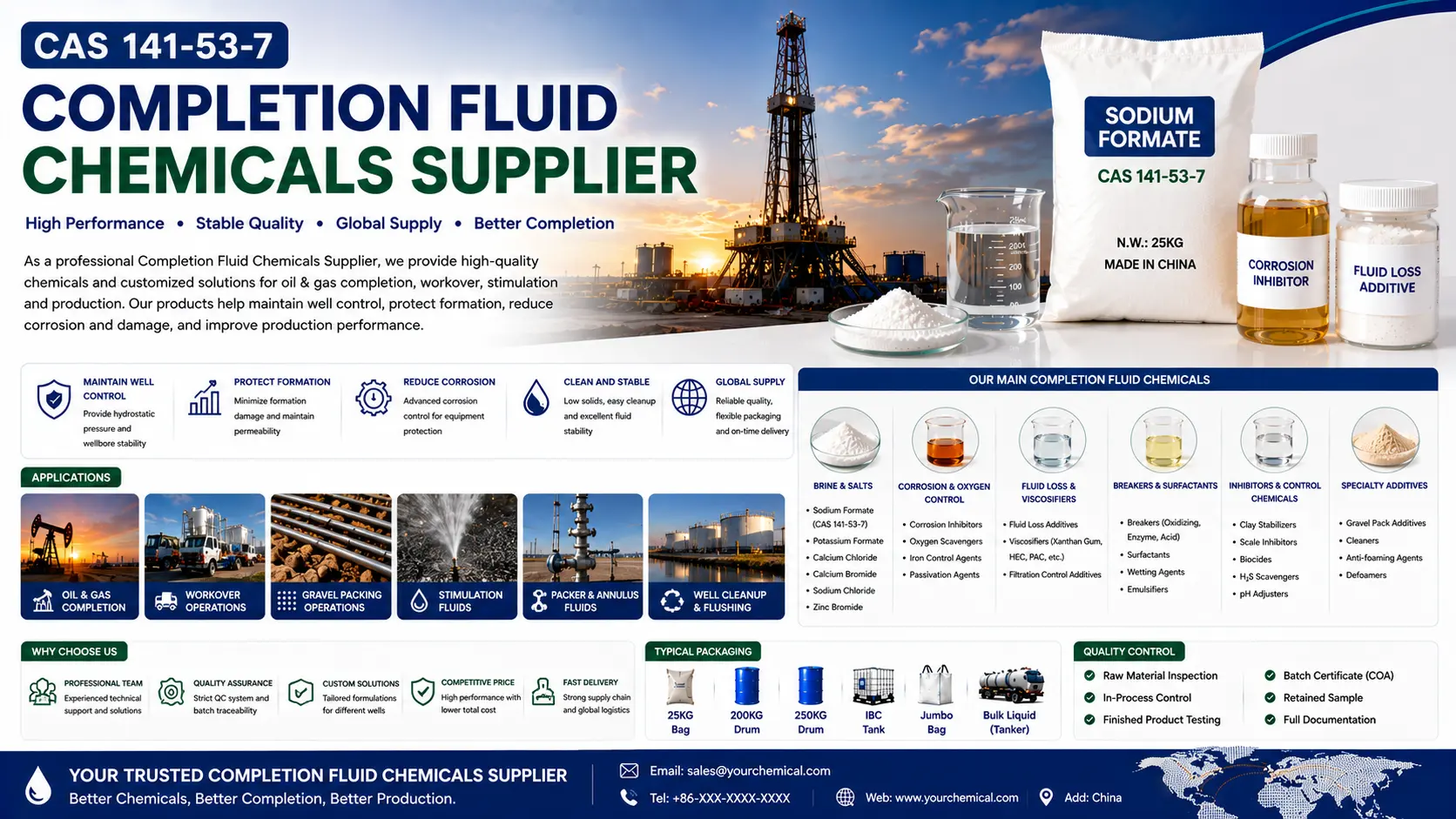
Completion fluids is used after drilling and before completion, perforation, gravel packing, well workover, stimulation and well startup. They are primarily used to keep the well under control, without causing excessive formation damage and protecting completion equipment.
All of these components – brine salts, corrosion inhibitors, oxygen scavengers, biocides, fluid-loss additives, viscosifiers, breakers, surfactants, scale inhibitors, clay stabilizers, iron-control agents, pH adjusters, filtration aids, and H₂S scavengers – may be part of a complete chemical program.
The different wells may require different chemicals, and buyers must choose the chemicals based on laboratory testing and field performance, not just the name of the product or the price per kg.
What Are Completion Fluid Chemicals?
Completion fluid chemicals are products used to formulate and maintain clean, stable, and formation-compatible fluids during well-completion and workover operations.
Their main functions may include:
- Maintaining hydrostatic pressure
- Controlling fluid density
- Preventing corrosion
- Removing dissolved oxygen
- Stabilizing shale and clay
- Reducing fluid loss
- Protecting reservoir permeability
- Controlling microorganisms
- Preventing scale
- Improving gravel-pack performance
- Supporting filter-cake removal
- Controlling iron
- Reducing interfacial tension
- Supporting well cleanup
- Treating completion wastewater
The correct treatment package depends on the completion design, reservoir mineralogy, permeability, formation water, brine type, temperature, pressure, and production objective.
Why Completion Fluid Quality Matters
Completion fluids contact the reservoir at a critical stage of well construction.
Poorly selected or contaminated fluids may cause:
- Formation damage
- Reduced permeability
- Clay swelling
- Solids plugging
- Scale deposition
- Emulsion blockage
- Corrosion
- Bacterial contamination
- Iron precipitation
- Incomplete filter-cake removal
- Delayed well cleanup
- Reduced production
A properly designed completion fluid should provide sufficient density and operational stability while remaining clean, compatible, and easy to remove from the formation.
Main Types of Completion Fluids
Clear Brine Fluids
Clear brines are widely used because they can provide hydrostatic pressure without suspended weighting solids.
Common brine systems include:
- Sodium chloride brine
- Potassium chloride brine
- Calcium chloride brine
- Calcium bromide brine
- Sodium bromide brine
- Zinc bromide brine
- Formate brines
- Blended high-density brines
Potential benefits include:
- Low suspended-solids content
- Adjustable density
- Good filtration
- Reduced solids-related formation damage
- Compatibility with many completion operations
- Easier cleanup than weighted drilling mud
Brine selection depends on required density, crystallization temperature, corrosion risk, formation compatibility, environmental requirements, and cost.
Sodium Formate
Sodium formate has the CAS number 141-53-7.
It may be used in formate-based completion and workover fluids.
Potential advantages include:
- Useful brine density
- Low solids
- Good thermal stability
- Lower corrosion potential than some halide brines
- Compatibility with selected high-temperature wells
- Reduced environmental impact in certain applications
- Potential formation-protection benefits
Sodium formate may be used alone or blended with potassium formate or cesium formate, depending on required fluid density.
Important specifications include:
- Purity
- Moisture
- Insoluble matter
- Chloride
- Iron
- Solution density
- pH
- Crystallization behavior
Potassium Formate
Potassium formate is widely used in high-performance completion, workover, and drilling-fluid systems.
Potential benefits include:
- High brine density
- Good thermal stability
- Low solids
- Strong shale-inhibition performance
- Lower crystallization risk in selected formulations
- Reduced formation damage
- Compatibility with high-temperature applications
Potassium formate may be selected for sensitive reservoirs, high-angle wells, and high-temperature operations.
Calcium Chloride Brine
Calcium chloride is commonly used where moderate brine density is required.
Potential applications include:
- Completion fluids
- Workover fluids
- Packer fluids
- Well-kill fluids
- Gravel-pack fluids
Important considerations include:
- Corrosion
- Calcium compatibility
- Sulfate precipitation
- Crystallization temperature
- Formation-water compatibility
- Fluid cleanliness
Calcium Bromide and Zinc Bromide
Calcium bromide and zinc bromide can provide higher fluid densities.
They may be used in high-pressure wells where solids-free hydrostatic control is required.
However, these brines may present:
- Higher corrosion risk
- Greater handling requirements
- Higher cost
- Compatibility concerns
- Environmental restrictions
- Crystallization challenges
A suitable corrosion-control and fluid-management program is essential.
Main Completion Fluid Chemicals
Corrosion Inhibitors
Completion brines may be highly corrosive because of chlorides, bromides, dissolved oxygen, high temperatures, and acidic contaminants.
Corrosion inhibitors help protect:
- Tubing
- Casing
- Completion strings
- Packer assemblies
- Surface tanks
- Pumps
- Pipelines
- Downhole tools
Common inhibitor chemistries may include:
- Imidazolines
- Amines
- Quaternary ammonium compounds
- Film-forming inhibitors
- Organic blends
- High-temperature inhibitor packages
The correct product depends on:
- Brine type
- Density
- Temperature
- Pressure
- Metallurgy
- Oxygen content
- Contact time
- Flow conditions
Laboratory corrosion tests should use the actual brine formulation and target temperature.
Oxygen Scavengers
Dissolved oxygen accelerates corrosion and can reduce the stability of certain polymers.
Oxygen scavengers may include:
- Sodium sulfite
- Sodium bisulfite
- Ammonium bisulfite
- Carbohydrazide
- Organic scavenger formulations
Potential benefits include:
- Reduced oxygen corrosion
- Lower iron contamination
- Improved brine stability
- Protection of completion equipment
- Better polymer performance
Dosage should be based on dissolved-oxygen concentration, brine volume, temperature, and product activity.
Fluid-Loss Additives
Fluid-loss additives reduce the invasion of completion fluid into permeable formations.
Potential benefits include:
- Lower filtrate invasion
- Reduced formation damage
- Improved well control
- Better filter-cake formation
- Reduced completion-fluid loss
- Improved cleanup
Products may include:
- Modified starch
- Cellulose derivatives
- Polyacrylamide derivatives
- Synthetic polymers
- Sized calcium carbonate
- Specialty bridging blends
The fluid-loss system should form a removable or degradable filter cake.
Viscosifiers
Viscosifiers increase fluid viscosity and support:
- Fluid-loss control
- Proppant or gravel transport
- Suspension
- Well cleanup
- Diversion
- Stable fluid placement
Common viscosifiers may include:
- Xanthan gum
- Guar derivatives
- Hydroxyethyl cellulose
- Synthetic polymers
- Modified polysaccharides
The selected product should hydrate effectively in the intended brine.
High-salinity and high-density brines may reduce polymer hydration and viscosity.
Breakers
Breakers reduce polymer viscosity or degrade filter cakes after the completion operation.
Potential breaker types include:
- Oxidizing breakers
- Enzyme breakers
- Acid breakers
- Delayed-release breakers
- Encapsulated breakers
A suitable breaker program may help:
- Improve well cleanup
- Restore formation permeability
- Remove polymer residue
- Break filter cakes
- Reduce startup pressure
- Improve production
Breaker selection depends on temperature, polymer type, treatment time, reservoir mineralogy, and desired delay.
Surfactants
Completion-fluid surfactants may be used to:
- Reduce surface tension
- Reduce interfacial tension
- Improve water wetting
- Prevent emulsions
- Support cleanup
- Improve fluid recovery
- Reduce capillary trapping
The product should be tested with actual crude oil, formation water, completion brine, and reservoir rock.
An unsuitable surfactant may create stable emulsions or alter formation wettability.
Clay Stabilizers
Clay stabilizers reduce swelling, migration, and dispersion of formation clays.
Common products may include:
- Potassium chloride
- Ammonium chloride
- Choline chloride
- Quaternary ammonium compounds
- Amine-based stabilizers
- Polymer clay-control products
Potential benefits include:
- Reduced permeability damage
- Lower fines migration
- Improved wellbore stability
- Better completion-fluid compatibility
- More stable production
Clay-control testing should use representative formation samples.
Scale Inhibitors
Scale may form when completion fluids contact incompatible formation water.
Common scale types include:
- Calcium carbonate
- Calcium sulfate
- Barium sulfate
- Strontium sulfate
- Iron compounds
Scale inhibitors may be based on:
- Phosphonates
- Polyacrylates
- Copolymers
- Phosphate esters
- Specialized high-temperature formulations
The product should be selected according to water analysis, temperature, pressure, and mixing simulations.
Iron-Control Agents
Iron can enter completion fluids through corrosion, formation minerals, acid treatments, or contaminated water.
Iron may precipitate and cause:
- Formation plugging
- Deposits
- Filter blockage
- Reduced permeability
- Fluid discoloration
- Scale formation
Iron-control products may include:
- Chelating agents
- Reducing agents
- Acid-compatible stabilizers
- Organic sequestrants
The treatment should be matched to iron concentration, oxidation state, pH, temperature, and fluid chemistry.
Biocides
Microorganisms may grow in water-storage tanks, brines, surface equipment, and downhole systems.
Potential problems include:
- Slime
- Microbiologically influenced corrosion
- Polymer degradation
- Reservoir souring
- H₂S generation
- Injection impairment
Common biocides may include:
- Glutaraldehyde
- THPS
- Quaternary ammonium compounds
- DBNPA
- Isothiazolinones
- Specialty blends
Biocide selection should consider contact time, temperature, brine chemistry, environmental requirements, and compatibility with other additives.
H₂S Scavengers
Hydrogen sulfide creates severe safety, corrosion, and environmental risks.
H₂S scavengers may be used in:
- Completion brines
- Workover fluids
- Well-kill fluids
- Produced water
- Surface tanks
- Pipeline systems
Potential chemistries include:
- Triazine-based scavengers
- Metal-based products
- Aldehyde formulations
- Non-triazine specialty products
Important selection factors include:
- Reaction rate
- Temperature
- H₂S concentration
- Fluid phase
- By-products
- Disposal requirements
- Materials compatibility
pH Buffers and Adjusters
Completion-fluid pH affects corrosion, polymer hydration, scale tendency, and additive stability.
Common products may include:
- Sodium hydroxide
- Potassium hydroxide
- Soda ash
- Organic buffers
- Acids for controlled pH reduction
The target pH should be selected according to brine type, metallurgy, reservoir compatibility, and chemical program.
Completion Fluid Density
Fluid density must provide sufficient hydrostatic pressure to control the well.
Density selection depends on:
- Reservoir pressure
- Well depth
- Temperature
- Safety margin
- Fracture gradient
- Completion operation
- Fluid losses
Using excessively dense fluid may increase formation invasion and lost-circulation risk.
Using insufficient density may create well-control problems.
Clear brine blends allow density adjustment without suspended weighting solids.
Crystallization Temperature
Completion brines can crystallize when exposed to low temperatures or changes in composition.
Important temperature parameters may include:
- True crystallization temperature
- First crystal to appear
- Last crystal to dissolve
- Pour point
Crystallization can block:
- Lines
- Valves
- Pumps
- Filters
- Downhole equipment
The brine formulation should remain stable during storage, transport, surface handling, and downhole use.
Formation Compatibility
Completion fluid should be compatible with:
- Formation water
- Reservoir minerals
- Crude oil
- Clay
- Cement
- Completion hardware
- Other treatment chemicals
Compatibility testing may evaluate:
- Precipitation
- Scale formation
- Emulsion tendency
- Wettability
- Clay swelling
- Fines migration
- Permeability retention
- Corrosion
Actual field samples should be used whenever possible.
Fluid Cleanliness and Filtration
Completion fluids should have low suspended-solids content.
Fine solids may plug:
- Reservoir pores
- Screens
- Gravel packs
- Perforations
- Downhole filters
- Injection zones
Filtration systems may include:
- Cartridge filters
- Bag filters
- Plate filters
- Diatomaceous-earth filters
- High-pressure filtration units
Important cleanliness indicators include:
- Turbidity
- Particle count
- Filterability
- Insoluble solids
- Iron
- Oil contamination
Chemical products should dissolve cleanly and should not introduce excessive insoluble material.
Gravel-Pack Fluids
Gravel-pack fluids transport gravel into the annular space around a screen.
The fluid should provide:
- Suitable viscosity
- Stable gravel suspension
- Low fluid loss
- Good cleanup
- Formation compatibility
- Low residue
- Controlled breaker performance
Common additives may include:
- Viscosifiers
- Fluid-loss agents
- Breakers
- Surfactants
- Clay stabilizers
- Biocides
- Corrosion inhibitors
The complete system should be tested with the selected gravel size and completion equipment.
Packer Fluids
Packer fluids remain in the annulus above the packer and may remain in contact with tubing and casing for long periods.
Important requirements include:
- Stable density
- Low corrosion
- Thermal stability
- Low solids
- Compatibility with elastomers
- Long-term chemical stability
Treatment may include corrosion inhibitors, oxygen scavengers, biocides, pH buffers, and scale-control products.
Workover and Well-Kill Fluids
Workover fluids are used during repair, stimulation, recompletion, and well-control operations.
Potential requirements include:
- Adjustable density
- Fast preparation
- Corrosion protection
- Formation compatibility
- Low solids
- Easy cleanup
- Stable storage
- Reliable filtration
The selected chemical system should match the expected operation and contact time.
High-Temperature Wells
High temperatures can affect:
- Polymer viscosity
- Corrosion rate
- breaker activity
- Biocide stability
- Scale tendency
- Brine crystallization
- Additive compatibility
High-temperature completion fluids may require:
- Thermally stable polymers
- High-temperature corrosion inhibitors
- Stable scale inhibitors
- Controlled breakers
- Formate brines
- Specialized surfactants
Laboratory aging tests should reflect expected bottom-hole temperature and exposure time.
High-Salinity and High-Hardness Conditions
High concentrations of sodium, calcium, magnesium, chloride, bromide, and formate can influence chemical performance.
Potential effects include:
- Reduced polymer hydration
- Lower viscosity
- Precipitation
- Scale formation
- Emulsion changes
- Reduced surfactant efficiency
- Increased corrosion
All additives should be tested in the final completion-brine formulation.
Laboratory Testing
A professional Completion Fluid Chemicals Supplier should support or provide data for:
- Brine density
- Crystallization temperature
- Turbidity
- Filterability
- Corrosion
- Fluid loss
- Polymer viscosity
- Thermal aging
- Scale compatibility
- Emulsion tendency
- Clay swelling
- Core flow
- Permeability return
- Breaker performance
- Microbial control
- H₂S scavenging
Laboratory tests should use representative field water, formation water, crude oil, rock, and target temperature.
Field Trials
After laboratory screening, controlled field trials may evaluate:
- Mixing behavior
- Dissolution
- Actual dosage
- Fluid density
- Filtration
- Corrosion control
- Fluid loss
- Well cleanup
- Equipment compatibility
- Production response
- Chemical consumption
- Total completion cost
Long-term product selection should not rely only on technical data sheets.
Important Product Specifications
Depending on the product, important specifications may include:
- Active content
- Purity
- Density
- pH
- Viscosity
- Moisture
- Insoluble matter
- Chloride
- Iron
- Calcium
- Bromide
- Formate content
- Crystallization temperature
- Solubility
- Thermal stability
- Corrosion rate
- Shelf life
General descriptions such as “completion grade” are not enough for technical procurement.
Quality Control
A dependable supplier or manufacturer should maintain quality control through:
- Raw-material inspection
- In-process monitoring
- Concentration adjustment
- Purity testing
- Density testing
- Insoluble-matter testing
- Filtration checks
- Finished-product inspection
- Packaging inspection
- Batch release
- Retained samples
Stable batch quality is especially important for high-density brines and sensitive reservoir applications.
Batch Traceability
Each shipment should be traceable through:
- Raw-material lots
- Production date
- Batch number
- Laboratory results
- Packaging records
- Retained samples
- Warehouse records
- Loading information
- Shipping documents
Traceability supports fast investigation when a quality issue occurs.
Packaging Options
Completion fluid chemicals may be supplied in:
- 25 kg bags
- 20 kg or 25 kg pails
- 200 kg drums
- 250 kg drums
- 500 kg bulk bags
- 1,000 kg jumbo bags
- IBC tanks
- ISO tanks
- Bulk tankers
- Customized export packaging
Powder salts should be protected from moisture.
Concentrated liquids and brines should use chemically compatible containers.
Storage and Handling
General storage precautions include:
- Keep powders dry.
- Protect liquids from contamination.
- Avoid extreme heat or freezing.
- Use compatible tanks and containers.
- Separate incompatible chemicals.
- Maintain secondary containment.
- Keep labels clearly visible.
- Follow the current safety data sheet.
- Use suitable personal protective equipment.
- Provide emergency eyewash and shower equipment where required.
Dense brines can create significant handling loads, so tanks, pumps, pallets, and lifting equipment should be appropriately rated.
Required Documents
A professional supplier should provide:
- Technical data sheet
- Safety data sheet
- Batch-specific certificate of analysis
- Product specification
- Brine-density information
- Crystallization data where applicable
- Commercial invoice
- Packing list
- Certificate of origin
- Bill of lading
- Transport documentation
- Inspection reports when required
All documents should use consistent product names, concentrations, batch numbers, quantities, and packaging information.
How to Evaluate a Completion Fluid Chemicals Supplier
Buyers should assess:
- Product range
- Brine experience
- Formation-compatibility knowledge
- Laboratory capability
- Technical specifications
- Batch consistency
- Customized-formulation capability
- Production or supply capacity
- Packaging options
- Export experience
- Technical support
- Delivery reliability
A qualified supplier should request detailed completion and reservoir information before recommending a product.
How to Request an Accurate Quotation
A complete inquiry should include:
- Completion operation
- Well type
- Required fluid density
- Bottom-hole temperature
- Reservoir pressure
- Formation permeability
- Formation-water composition
- Brine type
- Crystallization-temperature requirement
- Metallurgy
- Current additive package
- Required performance
- Order quantity
- Packaging
- Destination
- Incoterm
- Delivery schedule
For example:
“Please recommend and quote sodium formate and potassium formate for a low-solids completion brine, together with corrosion inhibitor, oxygen scavenger, biocide, and fluid-loss additive, including samples, TDS, SDS, COA, density data, and crystallization information.”
Detailed technical information allows the supplier to recommend a safer and more suitable system.
Comparing Supplier Quotations
Buyers should compare:
- Product purity
- Active content
- Fluid density
- Crystallization temperature
- Insoluble matter
- Corrosion performance
- Effective dosage
- Formation compatibility
- Packaging
- Freight
- Documentation
- Technical support
- Batch consistency
- Delivery reliability
A lower price per kilogram may lead to higher costs if the product introduces solids, increases corrosion, or requires more treatment.
Total Completion Cost
The total cost includes more than chemical purchase price.
Buyers should consider:
- Effective chemical dosage
- Brine preparation
- Filtration
- Fluid losses
- Corrosion control
- Well cleanup
- Formation damage
- Production delay
- Fluid recovery
- Waste treatment
- Equipment cleaning
- Nonproductive time
- Technical support
A higher-quality completion-fluid system may protect reservoir permeability and improve production enough to provide significantly better total value.
Common Purchasing Risks
Potential risks include:
- Selecting chemicals only by price
- Using an incompatible brine
- Ignoring crystallization temperature
- Failing to test formation water
- Poor filtration
- Excessive insoluble matter
- Inadequate corrosion control
- Unsuitable breaker performance
- Low active content
- Inconsistent batch quality
- Damaged packaging
- Missing technical documents
- Delayed delivery
- Limited technical support
These risks can be reduced through detailed specifications, representative samples, laboratory testing, compatibility studies, batch-specific documentation, and supplier qualification.
Questions to Ask Before Ordering
Buyers should confirm:
- Which brine system is recommended for the required density?
- What crystallization temperature can be guaranteed?
- What purity and insoluble-matter limits apply?
- Is the fluid compatible with formation water?
- What corrosion inhibitor is recommended?
- Can high-temperature data be supplied?
- Can fluid-loss and breaker systems be customized?
- Can representative samples be provided?
- Can laboratory compatibility testing be supported?
- Can recent batch COAs be supplied?
- What packaging options are available?
- What is the normal lead time?
- What is the monthly supply capacity?
- Which export documents are included?
- How are quality complaints handled?
Conclusion
To select a reliable Completion Fluid Chemicals supplier, it is necessary to make a comprehensive assessment of the brine type, fluid density, crystallization temperature, formation compatibility, corrosion control, fluid-loss performance, chemical purity, batch consistency, packaging, documentation, technical support, and delivery reliability.
The chemicals used for completion fluid include those used for density control, corrosion protection, oxygen removal, clay stabilisation, fluid loss, filtration, scale prevention, microbial control, gravel packing, workover activities and well cleannup.
Before buying buyers should supply all information relative to the reservoir, brine, temperature, pressure and completion-design, request representative samples, give a complete technical document, perform laboratory compatibility tests and complete controlled field trials.
A reliable supplier should offer adequate completion fluid salts and additives, quality of products, measurable results, sturdy packaging, technical assistance when needed, comprehensive documentation for export, and timely delivery throughout the world.


Contact Us
In This Article
Related Posts
How to Choose a Reliable 2-Ethylhexanol (2-EH) Supplier in China: Quality, Packaging and Shipping
2026-10-22
Natural vs Synthetic Sodium Sulfate Anhydrous: Which Is Better for Industrial Applications?
2026-10-22
Isobutanol 99.3% Price and Supply in 2026: A Guide for Chemical Importers
2026-10-22
Sodium Sulfate Anhydrous 99% for Detergent Manufacturing: Benefits, Specifications and Bulk Supply
2026-10-22


