


Sodium Sulfate Anhydrous 99% for Detergent Manufacturing: Benefits, Specifications and Bulk Supply
By Vanchorsc
2026-10-22Related Posts

How to Choose a Reliable 2-Ethylhexanol (2-EH) Supplier in China: Quality, Packaging and Shipping
2026-10-22

Natural vs Synthetic Sodium Sulfate Anhydrous: Which Is Better for Industrial Applications?
2026-10-22

Isobutanol 99.3% Price and Supply in 2026: A Guide for Chemical Importers
2026-10-22
Sodium Sulfate Anhydrous 99% for Detergent Manufacturing: Benefits, Specifications and Bulk Supply
2026-10-22
A detergent manufacturer receives sodium sulfate that meets its 99% purity requirement, yet the material bridges inside storage hoppers and produces excessive dust during blending. The chemical assay is acceptable. The particle characteristics are not.
For production of powdered detergent, sodium sulfate must meet certain requirements, both from the standpoint of composition and behavior during the manufacturing process. The ability of a given batch to run consistently is a function of particle size, residual moisture, impurities and other components of the detergent, as well as their compatibility with other ingredients.
We supply the anhydrous sodium sulfate at a purity level of sodium sulfate (Na₂SO₄) of ≥99% and a maximum moisture of 0.2% (as published). During our assessments of process suitability, we may discover physical variations, which would allow us to make further process adjustments.
What Other Functions Does Sodium Sulfate Serve in Detergent Formulations?
In laundry powder formulations, anhydrous sodium sulfate is a common inorganic filler that, when used in appropriate amounts, adjusts the level of active ingredients without increasing the alkalinity or surfactant activity of the formulation. From a formulation cost perspective, it plays a key role.
Beyond the cost perspective, sodium sulfate can impact the other formulation ingredients in the detergent. Given its unique particle characteristics relative to the other ingredients of the detergent, it can impact the bulk density and the flow characteristics of the formulation.
In dry blended formulations, differences in size of sulfate crystals can lead to separation from lower density surfactant crystals during transport (e.g., pneumatic or vibratory conveying) resulting in differences in the composition of the blend, even with satisfactory initial mixing.
Increasing sulfate levels also decreases surfactant levels at a constant detergent dosage. Thus, a reduction in raw materials cost/tonne does not necessarily reduce cost/effective wash.
Prioritizing bulk density and filling accuracy allows formulators to optimize sulfate loading based on the target cleaning performance.
Which Sodium Sulfate Specifications Affect Manufacturing Performance?
Vanchor has ≥99% purity and ≤0.2% moisture as white crystalline powder/granules with GB/T 6009-2014 as the referred industrial standard.
The parameters above define a few key chemical characteristics of the product, but for manufacturing detergent, additional limits may be required.
| Parameter | Specification or Verification | Production Significance |
| Na₂SO₄ content | ≥99%, Vanchor value | Controls inorganic filler concentration |
| Moisture | ≤0.2%, Vanchor value | Limits incoming water and associated storage risks |
| Particle size distribution | Grade-specific data required | Affects dust, flow, segregation, and dissolution |
| Chloride and iron | Confirm COA limits | Controls impurity-related formulation and appearance risks |
| Water-insoluble matter | Confirm test results | Helps prevent insoluble residues |
| Bulk density | Measure under agreed conditions | Influences hopper capacity and volumetric filling |
For continuous detergent production, batch-to-batch particle consistency can matter as much as meeting the minimum chemical assay.
How Does Processing Method Impact the Requirements of Sodium Sulfate?
Production of Spray-Dried Detergents
In the production of spray-dried detergents, sodium sulfate can be included in the aqueous slurry prior to atomization.
Its behavior is related to the water content of the slurry, temperature, and concentrations of other dissolved salts.
Not all sulfate salts completely dissolve, and can be present as suspended crystals. Poor dispersal and/or large crystals will settle during the holding time. Changes in rheology of the slurry can affect the behavior of the pump and the spray drying.
During the drying process, the dissolved sulfate crystallizes in the detergent matrix. Undissolved sulfate can be embedded within the detergent granules. Morphology and dissolution behavior of the particles is affected by the various structures embedded within the granules.
Research on spray-dried detergent powders has shown that the water and slurry content affect the crystals, porosity and flow of powders.
To avoid these problems, manufacturers should research slurry sedimentation and viscosity as well as final granule structure.
Dry Blending and Agglomeration of Detergents
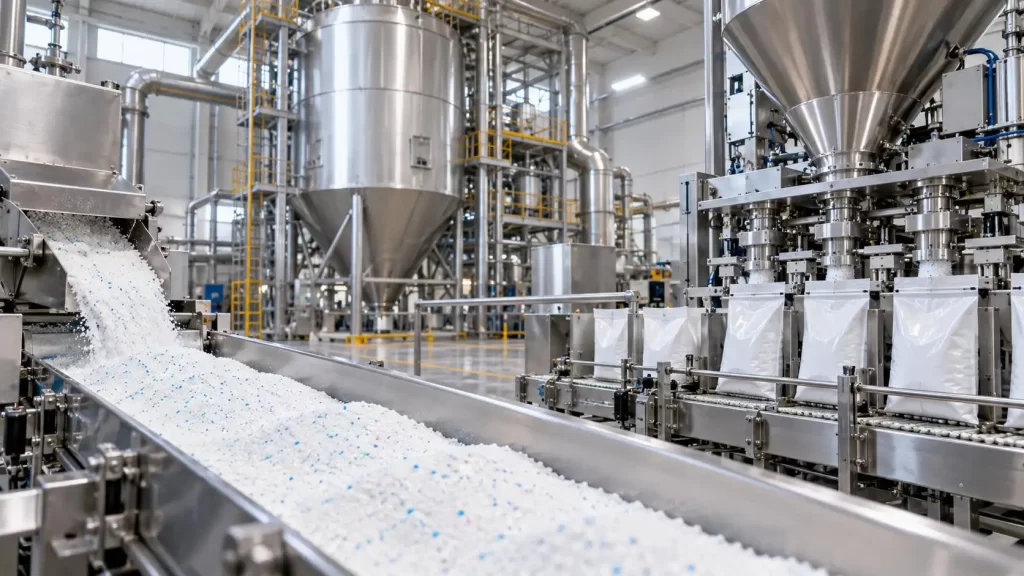
For dry blending, the main consideration for sodium sulfate is particle size, and finer particles can lead to more dust and poor powder flow. Coarser particles lead to less dust.
The density and size of particles can affect how evenly the particles are distributed.
A supplier claiming that a product is a fine powder or granules does not help design a reliable feeding system.
Screen analysis or laser diffraction can establish the particle-size distribution. Flowability should be evaluated under representative consolidation stress, particularly where storage silos discharge through narrow outlets.
Why Can Anhydrous Sodium Sulfate Cause Caking or Dissolution Problems?
Anhydrous sodium sulfate contains no water of crystallization. That does not eliminate moisture-related problems.
When water becomes available at particle contact areas, it can cause localized dissolution and recrystallization and result in the formation of solid bridges. Other ingredients in detergent mixtures such as surfactants and sodium silicate also influence moisture sorption and particle adhesion.
Sodium sulfate hydrate formation and surface restructuring have been reported for model detergent powders exposed to elevated relative humidity.
Temperature introduces another consideration.
The sodium sulfate–water system exhibits a phase transition near 32.4°C, involving anhydrous sodium sulfate and its decahydrate. However, this equilibrium cannot be applied directly to multicomponent detergent formulations.
Low-temperature dissolution tests should therefore use the actual detergent formulation and intended wash-water conditions.
Vanchor recommends dry, sealed storage for its anhydrous sulfate. Our published moisture limit helps control incoming material quality but does not replace finished-product caking and dissolution tests.
How Should Buyers Qualify Bulk Sodium Sulfate Supply?
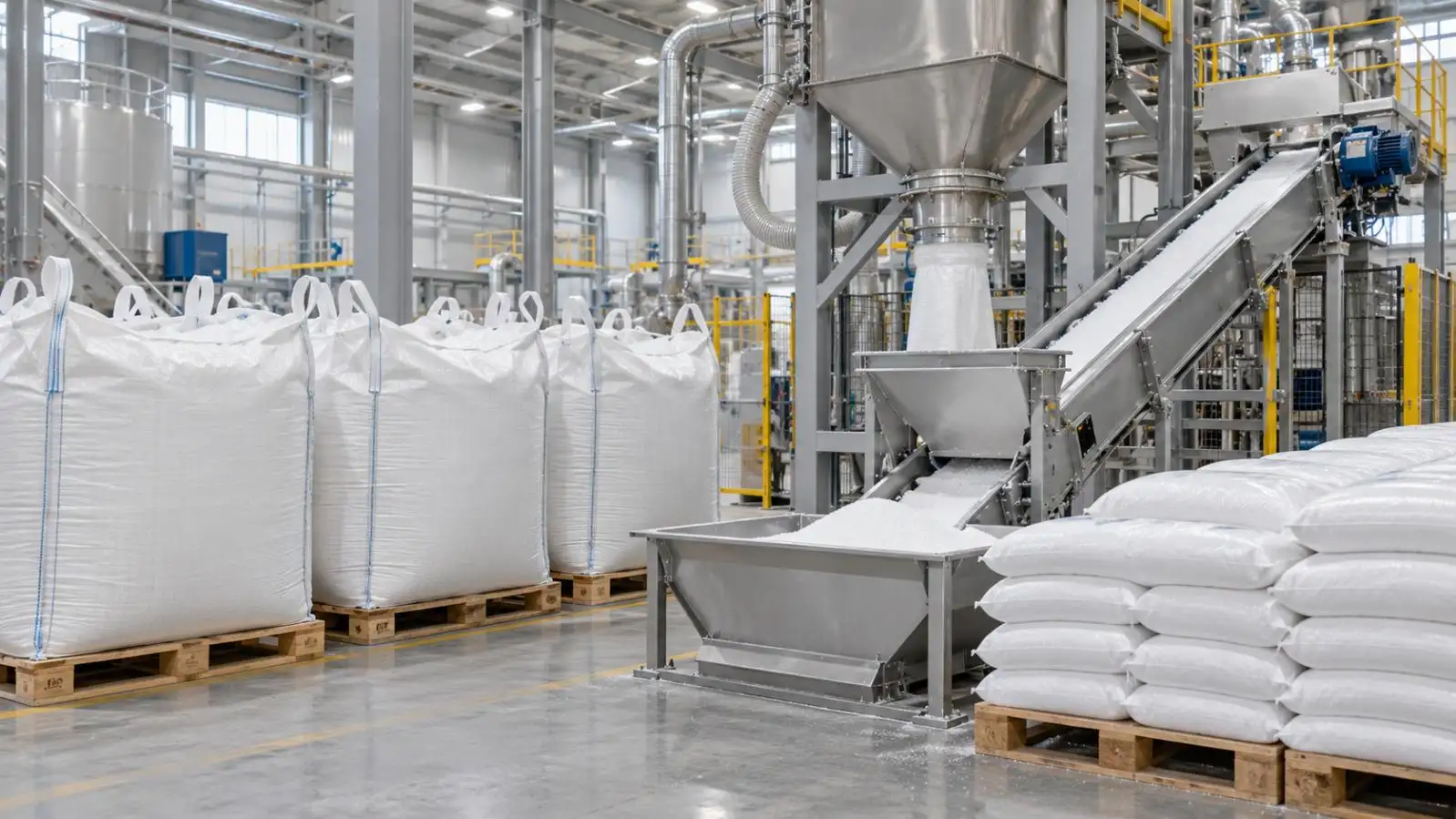
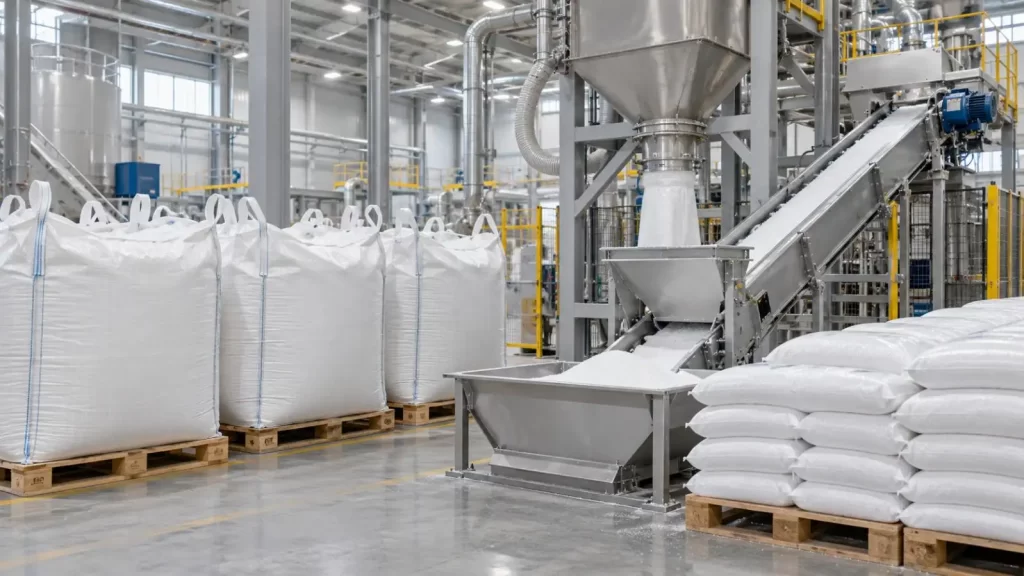
Vanchor provides standard packaging options for 50 kg PP Woven Bags with PE Liners and 1,000 kg FIBC bulk bags. The option that is preferable for you depends upon the unloading equipment, humidity in the warehouse, and the rate of consumption of the material.
Our larger production capacity covers 50,000 m². Our published quality control procedures cover incoming inspection, in-process control, and pre-shipment inspection, and we retain a sample of each shipment for three months. These should not be construed to mean any of our capabilities cover the production of sodium sulfate to the stated purity and precision.
Prior to approving a series of bulk orders, customers go through the following:
•BATCH ACCEPTANCE: Establish acceptance criteria for assay, moisture, impurities, particle size distribution, and the test methods.
•PROCESS QUALIFICATION: Demonstrate the material's ability to be incorporated into the system by testing it in the mixer, feeder, and/or slurry preparation system.
•FINISHED PRODUCT VERIFICATION: Examine finished product for caking and determine how well the product satisfies the requirement of dissolving in water.
•SUPPLY CONFIRMATION: Confirm the monthly quantity, packaging, lead time, terms of shipment and the commercial documents accompanying the shipment.
A certificate of analysis provides information about the test results for chemical properties. It does not attest to the suitability of the product to be used with detergent lines.
Upon your request, Vanchor will provide you with your quotation, your sample and the documentation you require, to process your request for the bulk purchase of Anhydrous Sodium Sulfate (99%).
FAQs
Q1. What Is the Purity of Vanchor's Sodium Sulfate Anhydrous?
Vanchor supplies industrial anhydrous sodium sulfate with a minimum Na₂SO₄ purity of 99%, referencing GB/T 6009-2014.
Q2. Is Vanchor's Sodium Sulfate Suitable for Detergent Manufacturing?
Yes. Vanchor offers Sodium Sulfate Anhydrous 99% for powdered detergent formulations. Suitability for a specific production line should be confirmed through formulation and handling tests.
Q3. What Is the Moisture Content of Vanchor's Sodium Sulfate?
Vanchor specifies a maximum moisture content of 0.2%. Finished detergent caking resistance still depends on formulation, packaging, and storage humidity.
Q4. How Does Sodium Sulfate Affect Detergent Powder Performance?
It functions mainly as an inorganic filler, adjusting formulation concentration and powder bulk. Particle characteristics can also affect flow, segregation, and filling consistency.
Q5. Can Vanchor's Sodium Sulfate Be Used in Spray-Dried Detergents?
It can be evaluated for spray-dried formulations. Slurry solubility, viscosity, sedimentation, and crystallization behavior must be checked under actual processing conditions.


Contact Us
Related Posts
How to Choose a Reliable 2-Ethylhexanol (2-EH) Supplier in China: Quality, Packaging and Shipping
2026-10-22
Natural vs Synthetic Sodium Sulfate Anhydrous: Which Is Better for Industrial Applications?
2026-10-22
Isobutanol 99.3% Price and Supply in 2026: A Guide for Chemical Importers
2026-10-22
Sodium Sulfate Anhydrous 99% for Detergent Manufacturing: Benefits, Specifications and Bulk Supply
2026-10-22


