



Sodium Formate vs Potassium Formate: How to Choose the Right Formate Salt
By vanchor
2026-07-11Related Posts
Custom Packaging Solutions from an Anhydrous Sodium Acetate Supplier in China
2026-09-23
Application Trends in Anhydrous Sodium Acetate for Special Chemical Manufacturing
2026-09-23

Anhydrous Sodium Acetate for Leather Tanning: Improve Dyeing Uniformity
2026-09-22

Formic Acid 85% for Textile Dyeing: Industrial Applications, Technical Benefits and Future Trends
2026-09-22
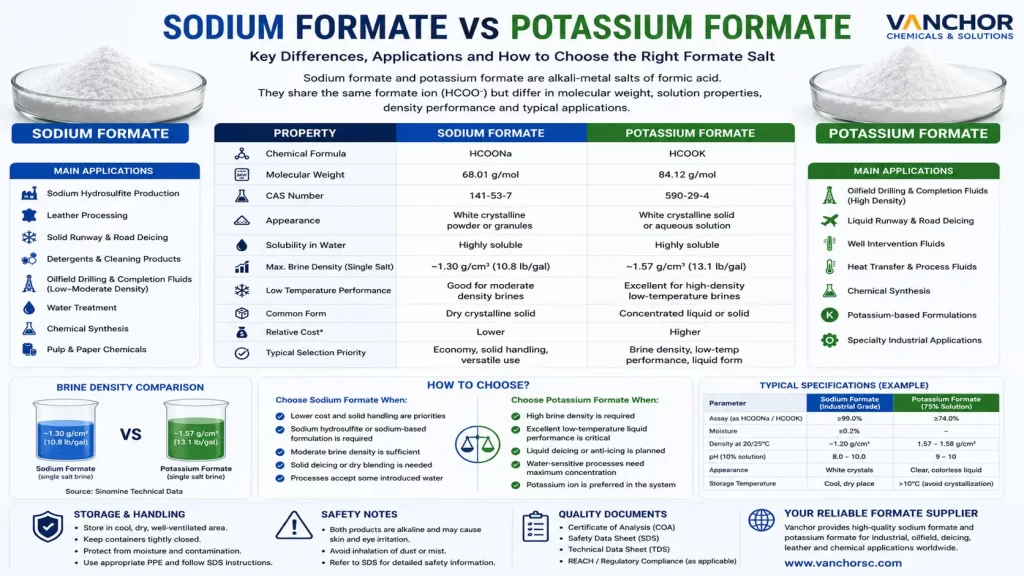
The main difference between Sodium Formate vs Potassium Formate is the alkali-metal ion attached to the formate group. Sodium formate contains sodium, while potassium formate contains potassium.
This difference affects molecular weight, solubility, maximum brine density, crystallization behavior, product form, application performance and cost.
As a practical guide:
- Choose sodium formate for sodium hydrosulfite production, leather processing, solid deicing, detergents and lower-density oilfield brines.
- Choose potassium formate for higher-density drilling and completion fluids, liquid runway deicers and processes requiring strong low-temperature solution performance.
Neither product is universally better. The right choice depends on whether the process requires a solid industrial salt, a high-density clear brine, a sodium or potassium source, or dependable performance at low temperatures.
What Are Sodium Formate and Potassium Formate?
Sodium formate and potassium formate are alkali-metal salts of formic acid. Both contain the formate ion, HCOO⁻, but have different cations.
| Property | Sodium Formate | Potassium Formate |
|---|---|---|
| Chemical formula | HCOONa | HCOOK |
| CAS number | 141-53-7 | 590-29-4 |
| Molecular weight | Approximately 68.01 g/mol | Approximately 84.12 g/mol |
| Cation | Sodium, Na⁺ | Potassium, K⁺ |
| Appearance | White crystalline powder or granules | White crystalline solid or aqueous solution |
| Water solubility | Highly soluble | Highly soluble |
| Solution character | Alkaline formate brine | Alkaline formate brine |
| Main commercial forms | Solid powder or granules | Solid or concentrated liquid |
| Major applications | Chemical production, leather, deicing, detergents and oilfield fluids | Oilfield brines, liquid deicing and specialty industrial fluids |
PubChem identifies sodium formate as the sodium salt of formic acid and potassium formate as the corresponding potassium salt. Their chemical identities remain different even though both provide the same formate anion.
Sodium Formate vs Potassium Formate: Quick Comparison
| Selection Factor | Sodium Formate | Potassium Formate |
|---|---|---|
| Molecular weight | Lower | Higher |
| Formate content per mole | One formate ion | One formate ion |
| Formate content by product weight | Higher in pure solid | Lower in pure solid |
| Maximum practical single-salt brine density | About 1.30 g/cm³ | About 1.57 g/cm³ |
| Common commercial form | Dry crystalline solid | Concentrated liquid or solid |
| Low-temperature liquid performance | Suitable for moderate-density brines | Better suited to concentrated low-temperature brines |
| Solid runway deicing | Common application | Less common than liquid potassium systems |
| Liquid runway deicing | Possible in formulations | Major application |
| Sodium hydrosulfite production | Major application | Not normally selected |
| Leather processing | Common | Less common |
| Oilfield fluids | Lower-density drilling and completion fluids | Higher-density drilling and completion fluids |
| Typical purchasing priority | Economy and solid handling | Brine density and low-temperature performance |
Sinomine’s technical information shows practical single-salt brine densities of approximately 1.30 g/cm³ for sodium formate and 1.57 g/cm³ for potassium formate. This difference is one of the main reasons potassium formate is preferred for higher-density oilfield fluids.
What Is Sodium Formate?
Sodium formate is normally supplied as a white crystalline powder or granular solid. A representative commercial specification lists at least 99% sodium formate, no more than 0.2% water and a maximum iron content of 10 ppm. Actual specifications vary by manufacturer and grade.
Its main industrial applications include:
- Sodium hydrosulfite or sodium dithionite production
- Pulp and paper bleaching-chemical production
- Leather tanning
- Solid runway and pavement deicing
- Drilling and completion fluids
- Enzyme stabilization in detergents
- Chemical synthesis
- Selected construction formulations
Perstorp identifies sodium formate for sodium hydrosulfite production, leather tanning and deicing. Its S Grade technical sheet also lists detergents and drilling and completion fluids.
Why Is Sodium Formate Used to Produce Sodium Hydrosulfite?
Sodium formate acts as a raw material in the production of sodium hydrosulfite, also called sodium dithionite. Sodium hydrosulfite is widely used as a reducing and bleaching agent in pulp, paper and textile processing.
Because the final product is sodium-based, sodium formate provides the appropriate alkali-metal component for this manufacturing route. Potassium formate is not a direct equivalent for this application.
Why Is Sodium Formate Used in Leather Processing?
In leather production, sodium formate may be used during tanning and pH-control stages. It helps formulators introduce formate in a dry, accurately dosed form.
Its solid format supports:
- Convenient dry storage
- Controlled batch dosing
- Easy transportation
- Integration into prepared tannery chemical blends
- Reduced handling of liquid formic acid
The exact dosage depends on the tanning process, hide type, bath composition and required pH profile.
What Is Potassium Formate?
Potassium formate can be supplied as a solid, but concentrated aqueous solution is especially important commercially.
A current technical data sheet for Potassium Formate 75% specifies:
- At least 74% potassium formate
- Density of 1.57–1.58 g/cm³ at 25°C
- pH of 9–10
- CAS number 590-29-4
The same technical sheet recommends storing the solution above 10°C to reduce crystallization risk. These values apply to that specific commercial grade and should not be treated as universal specifications for every potassium formate product.
Typical potassium formate applications include:
- Drilling fluids
- Completion and workover fluids
- Well-intervention fluids
- Liquid runway deicing
- Road and industrial deicing formulations
- Heat-transfer and specialty process fluids
- Potassium-containing chemical formulations
Which Is Better for Oilfield Drilling Fluids?
Potassium formate is usually preferred when a higher-density solids-free brine is required.
Formate salts dissolve in water to create clear, alkaline brines for drilling, completion, workover and intervention operations. In single-salt systems, potassium formate can reach substantially higher density than sodium formate:
- Sodium formate brine: approximately 1.30 g/cm³, or 10.8 lb/gal
- Potassium formate brine: approximately 1.57 g/cm³, or 13.1 lb/gal
Both can be useful, but they serve different density ranges.
Choose Sodium Formate Brine When:
- A relatively low fluid density is sufficient.
- Cost control is a major consideration.
- A sodium-based formulation is acceptable.
- The fluid will be blended with potassium formate.
- A dry material is preferred for on-site preparation.
Choose Potassium Formate Brine When:
- Higher brine density is required.
- Low-temperature fluid performance is important.
- A concentrated ready-to-use liquid is preferred.
- The completion program requires a monovalent, halide-free clear brine.
- Sodium ion exposure must be limited by the fluid design.
Actual oilfield selection must also consider reservoir mineralogy, clay sensitivity, completion hardware, polymer compatibility, crystallization temperature, water activity and operating temperature.
Which Is Better for Deicing?
Both sodium formate and potassium formate are used in deicing products, but they are commonly supplied in different physical forms.
Sodium Formate for Solid Deicing
Sodium formate is widely used in solid runway, taxiway and parking-apron deicers. The granulated or powdered product can be spread using suitable solid-deicer equipment.
A commercial Perstorp sodium formate deicer is described specifically as a solid product for airport operating surfaces.
Sodium formate may be preferred when:
- A solid product is required.
- Existing equipment is designed for granules.
- Storage of large liquid volumes is impractical.
- Transport and handling costs favor dry material.
- Moderate winter temperatures are expected.
Potassium Formate for Liquid Deicing
Potassium formate is commonly formulated as a concentrated liquid runway deicer. Liquid products can provide rapid surface coverage and support anti-icing before snow or ice bonds strongly to the pavement.
Perstorp supplies both sodium- and potassium-formate deicers and certifies relevant solid and liquid runway products to SAE AMS 1431 and AMS 1435 standards.
Potassium formate may be preferred when:
- Liquid application equipment is available.
- Rapid wetting and coverage are required.
- Very low-temperature performance is important.
- Anti-icing application is planned before precipitation.
- Automated spraying is preferred.
Airport buyers should evaluate the complete formulated deicer rather than purchasing an untreated raw salt based only on its chemical name.
Which Product Has Better Low-Temperature Performance?
Concentrated potassium formate solutions generally provide better low-temperature liquid performance than sodium formate solutions.
This advantage results from their ability to remain in solution at high concentrations and to produce higher-density brines. However, crystallization temperature depends on:
- Potassium formate concentration
- Sodium or cesium formate blending
- Other dissolved salts
- Additive package
- pH
- Pressure
- Storage history
A 75% commercial potassium formate product may require storage above 10°C, while a formulated 50% runway deicer can be designed for much colder field use. Product concentration and formulation must therefore be considered together.
Can Sodium Formate Replace Potassium Formate?
Substitution is possible in some formulations, but it should not be performed on a one-to-one weight basis without recalculation and testing.
The molecular weights are different:
- Sodium formate: approximately 68.01 g/mol
- Potassium formate: approximately 84.12 g/mol
This means 68.01 kg of pure sodium formate and 84.12 kg of pure potassium formate each provide approximately one kilomole of formate ions.
To replace one product with the other, formulators should evaluate:
- Required formate-ion concentration
- Sodium or potassium concentration
- Final solution density
- Crystallization temperature
- pH
- Water content
- Material compatibility
- Application-specific regulations
Replacing potassium formate with sodium formate may reduce attainable brine density. Replacing sodium formate with potassium formate may increase raw-material cost or introduce more potassium than the process requires.
Are Formate Brines Less Corrosive Than Chloride Brines?
Sodium and potassium formate are chloride-free and halide-free salts. This makes them useful in applications seeking to avoid the high chloride loading associated with traditional chloride deicers or selected oilfield brines.
However, “chloride-free” does not mean non-corrosive under every condition. Corrosion performance depends on:
- Brine concentration
- pH and buffer system
- Temperature
- Dissolved oxygen
- Carbon dioxide or hydrogen sulfide exposure
- Metallurgy
- Contact time
- Contaminants
- Corrosion inhibitor package
Material compatibility tests should be performed for tanks, pumps, seals, pipelines, airport infrastructure and downhole equipment.
Price and Total Operating Cost
Sodium formate is often considered when procurement cost and dry-solid handling are the main priorities. Potassium formate is generally chosen when its higher brine density or liquid low-temperature performance creates operational value.
The correct cost comparison should include:
- Price per tonne
- Product concentration
- Required dosage
- Freight cost
- Water transported with liquid grades
- Tank or warehouse capacity
- Heating requirements
- Crystallization risk
- Application equipment
- Fluid recovery and reuse
- Production downtime risk
For oilfield applications, a higher-priced potassium formate brine may still provide the better total value if it delivers the required density without suspended weighting solids.
Quality Factors Buyers Should Check
| Parameter | Why It Matters |
|---|---|
| Formate assay | Confirms active material |
| Sodium or potassium content | Verifies grade identity |
| Water content | Important for solids and concentrated solutions |
| Density | Critical for liquid potassium formate |
| pH | Influences stability and process compatibility |
| Chloride content | Important for corrosion-sensitive uses |
| Iron content | Relevant to color and sensitive formulations |
| Insoluble matter | Affects solution clarity and filtration |
| Particle size | Influences dry flow and dissolution |
| Crystallization temperature | Essential for winter and oilfield use |
| COA, SDS and TDS | Confirm batch quality and handling requirements |
For runway deicing, buyers should also confirm the applicable SAE specification. Oilfield buyers should request complete brine-property and compatibility data rather than relying only on purity.
Storage and Handling
Sodium Formate
Sodium formate is hygroscopic and can absorb moisture from the air. It should be stored:
- In sealed moisture-resistant bags
- In a cool, dry warehouse
- Away from wet floors and walls
- Preferably below approximately 30°C to limit caking
- With opened bags resealed immediately
Perstorp specifically advises protecting sodium formate from moisture absorption.
Potassium Formate Solution
Concentrated potassium formate should be stored:
- In compatible sealed tanks or containers
- Away from direct sunlight
- At the temperature specified by the supplier
- With crystallization risk monitored
- With suitable secondary containment
- Using compatible pumps, valves, seals and pipelines
A representative 75% product should be stored above 10°C to reduce crystallization risk.
Sodium and Potassium Formate Supply from Vanchor
Vanchor supplies sodium formate and potassium formate for leather processing, deicing, chemical production and oilfield drilling applications. Both products are included in Vanchor’s current formate and oilfield chemical portfolio.
Supply support can include:
- Solid sodium formate
- Potassium formate solutions
- Industrial and application-specific specifications
- Batch-specific Certificates of Analysis
- SDS and Technical Data Sheets
- Samples for customer testing
- Moisture-resistant export packaging
- Drums, IBCs and bulk liquid arrangements
- Customized labeling
- International logistics coordination
When requesting a quotation, provide the required product, concentration, application, annual quantity, packaging, destination and minimum operating temperature.
Frequently Asked Questions
What is the main difference between sodium formate and potassium formate?
Sodium formate contains sodium ions, while potassium formate contains potassium ions. This changes molecular weight, solution density and practical applications.
Which formate produces the higher-density brine?
Potassium formate. A practical single-salt potassium formate brine can reach approximately 1.57 g/cm³, compared with around 1.30 g/cm³ for sodium formate.
Which product is better for drilling fluids?
Potassium formate is preferred for higher-density fluids. Sodium formate can be suitable for lower-density systems or blended brines.
Which product is used to make sodium hydrosulfite?
Sodium formate is used in sodium hydrosulfite or sodium dithionite production.
Which formate is better for runway deicing?
Sodium formate is commonly used in solid deicers, while potassium formate is widely used in liquid deicing and anti-icing formulations.
Is potassium formate suitable for very cold conditions?
Properly formulated potassium formate solutions can provide strong low-temperature performance. The exact operating limit depends on concentration and formulation.
Can sodium formate directly replace potassium formate?
Not without recalculation. Their molecular weights, cations, solution densities and crystallization behavior differ.
Are both formates chloride-free?
Yes. Neither sodium formate nor potassium formate contains chloride as part of its chemical formula.
Which formate is normally cheaper?
Sodium formate is often selected for cost-sensitive industrial applications, but actual prices depend on purity, concentration, packaging, region and market conditions.
What documents should a supplier provide?
Buyers should request a batch-specific COA, SDS, Technical Data Sheet, packing information and application-specific compliance documents.
Choose the Formate Salt Based on Process Requirements
The comparison of Sodium Formate vs Potassium Formate shows that the correct choice depends mainly on product form, brine density, low-temperature performance and end use.
Sodium formate is a practical solid for chemical manufacturing, leather processing, detergents, deicing and lower-density fluids. Potassium formate is the stronger choice for concentrated liquid deicers and higher-density oilfield drilling and completion brines.
Contact Vanchor for sodium formate and potassium formate specifications, samples, packaging options, technical documents and export quotations.


Contact Us
In This Article
Related Posts
Custom Packaging Solutions from an Anhydrous Sodium Acetate Supplier in China
2026-09-23
Application Trends in Anhydrous Sodium Acetate for Special Chemical Manufacturing
2026-09-23
Anhydrous Sodium Acetate for Leather Tanning: Improve Dyeing Uniformity
2026-09-22
Formic Acid 85% for Textile Dyeing: Industrial Applications, Technical Benefits and Future Trends
2026-09-22


