



Formic Acid 85% for Animal Feed Preservation: Moisture and Storage Stability Guide
By Vanchorsc
2026-09-21Related Posts
Custom Packaging Solutions from an Anhydrous Sodium Acetate Supplier in China
2026-09-23
Application Trends in Anhydrous Sodium Acetate for Special Chemical Manufacturing
2026-09-23
Anhydrous Sodium Acetate for Leather Tanning: Improve Dyeing Uniformity
2026-09-22
Formic Acid 85% for Textile Dyeing: Industrial Applications, Technical Benefits and Future Trends
2026-09-22
Formic Acid 85% for Animal Feed Preservation requires more than selecting an acid concentration. Storage performance depends on feed composition, water activity, microbial contamination, treatment uniformity and warehouse conditions.
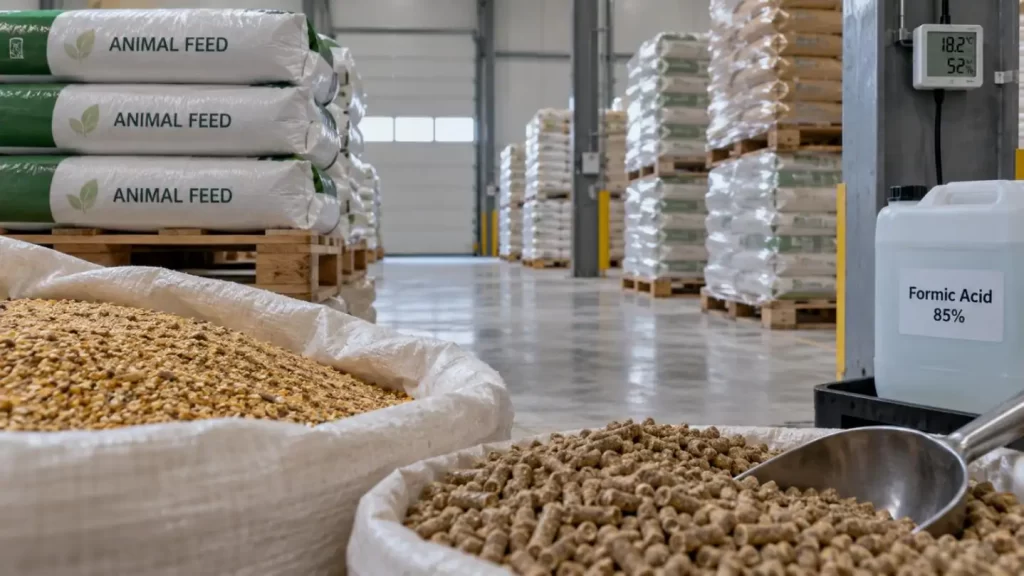
For grain ingredients, mash and pellets, the practical question is whether acid treatment addresses the actual deterioration mechanism. Liquid feed and silage require separate validation.
Why Feed Spoils Despite Passing Moisture Checks
A batch can pass its average moisture specification while developing mold near a silo wall. Condensation, leaking roofs or uneven liquid application can create wet pockets that composite samples overlook.
It is also the case that two formulations with the same moisture content can result in products with different bind-water effects. Caking can also be caused by a number of physical factors, but heating may be caused by microbial spoilage or exposure to oxygen.
While the acid level is still below detection limits:
• Sample the representative material and the suspected wet areas.
• Review the temperature logs for the cooling, packaging, and transportation of the sample.
• Determine if bacterial, mold, yeast, or nonmicrobial spoilage (including physical factors) is the predominant cause of spoilage.
How Water Activity and pH Affect Acid Performance
For Formic Acid 85% for Animal Feed Preservation, moisture content, water activity and acidity answer different questions.
| Parameter | What It Reveals | Important Limitation |
| Moisture content, % | Water-related mass content under the stated method | Does not independently predict microbial stability |
| Water activity, aw | Water availability, expressed from 0 to 1 | Requires controlled measurement temperature |
| Feed extract pH | Acidity under a defined extraction procedure | Does not describe every particle's local environment |
| Buffering capacity | Resistance to acidification | Changes with protein and mineral composition |
| Temperature and storage time | Conditions governing deterioration | Must reflect actual transport and storage |
At equilibrium and the same temperature, equilibrium relative humidity is approximately 100 × aw. Ambient warehouse humidity cannot be substituted directly for product aw.
Formic acid supports acidification and microbial inhibition; its effectiveness depends partly on local pH and available acid. Higher buffering capacity can increase the acid required for a given pH response.
Acidification does not establish that water activity has fallen sufficiently. Low aw also does not prove pathogens are absent. Evidence of bacterial inhibition cannot automatically establish mold or yeast control, and acid treatment does not demonstrate removal of existing mycotoxins. EFSA's formic acid assessment provides background on its feed applications.
Comparing Acid Formulations and Moisture Controls
Evaluate Formic Acid 85% for Animal Feed Preservation against the identified risk, using comparable feed batches and storage conditions.
| Comparison | Decision Criteria | Trade-Off |
| Free formic acid vs buffered acid | Active acid equivalent, microbial results, materials compatibility | Reduced corrosiveness depends on the buffered formulation |
| Formic acid vs propionic-containing blends | Bacterial, mold and yeast targets | Blends require evidence of improved performance |
| Acid treatment vs drying and cooling | Initial moisture, condensation, energy and equipment | Acid cannot correct water ingress or inadequate cooling |
| Direct vs diluted spraying | Metering accuracy, coverage and added water | Dilution may improve distribution but create wet pockets |
| Before vs after pelleting | Heat exposure, acid retention and recontamination | Each position requires distribution and performance trials |
| Standard vs barrier packaging | Permeability, seals and packing temperature | Barrier packaging cannot correct excessively warm or wet feed |
Compare both commercial dosage and active acid equivalent; equal product weights are not necessarily equivalent treatments.
Matching 85% Formic Acid to the Feed Line
The "85%" describes the supplied solution, not its inclusion rate in feed. At a confirmed 85% mass fraction:
Pure formic acid input = commercial product input × 0.85.
This calculates input acid before processing. Include the dilution water and any liquid additions to the water balance.
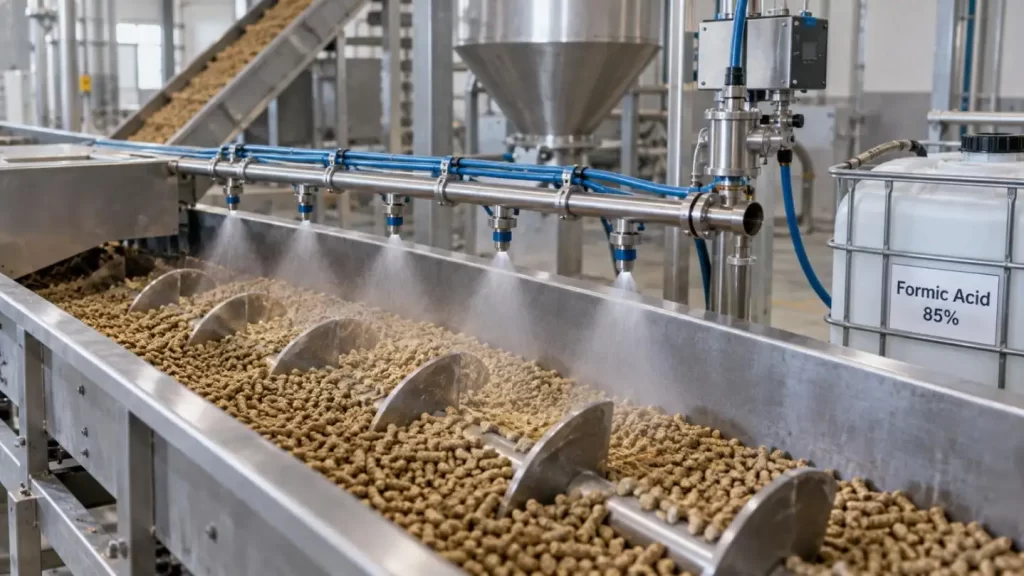
Link the delivery of link pump to feed throughput. Determine the minimum controllable flow and collect samples of acid from the mixer discharge. Validate the dosage based on the formulation (buffering capacity), initial level of contamination, the target microorganisms and the proposed condition of use.
Vanchor offers a clear, colorless, water-miscible 85% solution, CAS 64-18-6, with COA and SDS available. Packaging includes 25, 35 and 250 kg drums and 1,200 kg IBCs, enabling selection around consumption and unloading arrangements. Vanchor product specifications
Preventing Corrosion and Uneven Application
Confirm pump heads, seals, pipes and nozzles against the actual concentration and operating temperature. Neither "stainless steel" nor "plastic" alone establishes compatibility.
Commissioning and maintenance should cover:
• Flow calibration, spray coverage and feed-flow interlocks.
• Nozzle blockage, dripping, seal damage and leaks.
• Ventilation, containment and protection specified by the SDS.
• Cooler performance, condensation points and warehouse hygiene.
Correct total consumption does not prove uniform treatment.
Validating Storage Stability and Feed-Use Eligibility
To test the preservation of animal feed with Formic Acid 85%, run untreated controls as a parallel, choose representative batches, use actual packaging and storage as defined. Check aw, temperature, relevant microbial counts, quality indicators at specified time points and set acceptance criteria. Visual absence of mold is not acceptable.
ISO 18787 defines aw and describes some of the adaptations of equipment that can be used for samples of volatile content. Check acid compatibility with the supplier of the equipment. For the moisture test, check the scope of ISO 6496, drying loss including other volatile matters.
Verify microbial recovery to ensure residual acid does not affect the results. Check the market authorization of the destination country, the animal groups, the approved use, and the labeling. Verify the validity and scope of any GMP+ and/or FAMI-QS certificates.
Purchasing on Verified Treatment Cost
Compare delivered chemical, application, maintenance, testing, and rejected-feed costs per accepted ton.
For Formic Acid 85% for Animal Feed Preservation, please share aw, formulation, storage and acceptance criteria with Vanchor and we will discuss details of specifications, documentation and sampling before bulk purchase.
FAQs
Q1. What is the purpose of Formic Acid 85% for Animal Feed Preservation?
Formic Acid 85% for Animal Feed Preservation assists feed quality management by reducing microbial feed problems and increasing storage stability when appropriately used.
Q2. Does Vanchor offer 85 % formic acid suitable for Animal Feed?
Vanchor offers Formic Acid 85% solution with a Certificate of Analysis (COA) and a Safety Data Sheet (SDS). Potential customers need to evaluate feed use, regulations, and the conditions of use themselves before considering a bulk purchase.
Q3. What parameters of Formic Acid 85% do you supply?
Vanchor supplies Formic Acid 85% as a clear, colorless, water-miscible solvent along with quality documentation and packaging options.
Q4. What packaging options does Vanchor provide for Formic Acid 85%?
Vanchor provides packaging options of 25 kg, 35 kg, and 250 kg drums and 1,200 kg IBC containers for different consumption and logistics needs.
Q5. What assurances has Vanchor given regarding the availability of Formic Acid 85%?
Vanchor offers assurances of supply of formic acid through its manufacturing resources and a production base of 50,000 m² with an annual capacity. Vanchor offers logistics and services near major ports.


Contact Us
In This Article
Related Posts
Custom Packaging Solutions from an Anhydrous Sodium Acetate Supplier in China
2026-09-23
Application Trends in Anhydrous Sodium Acetate for Special Chemical Manufacturing
2026-09-23
Anhydrous Sodium Acetate for Leather Tanning: Improve Dyeing Uniformity
2026-09-22
Formic Acid 85% for Textile Dyeing: Industrial Applications, Technical Benefits and Future Trends
2026-09-22


