



Formic Acid Exporter with Manufacturing Capability: Why Factory-Backed Supply Matters
By vanchor
2026-08-13Related Posts
Custom Packaging Solutions from an Anhydrous Sodium Acetate Supplier in China
2026-09-23
Application Trends in Anhydrous Sodium Acetate for Special Chemical Manufacturing
2026-09-23
Anhydrous Sodium Acetate for Leather Tanning: Improve Dyeing Uniformity
2026-09-22
Formic Acid 85% for Textile Dyeing: Industrial Applications, Technical Benefits and Future Trends
2026-09-22
When deciding on an exporter of Formic Acid for consistent industrial purchases, considereing FOB price and concentration of HCOOH is not sufficient. Formic acid is an industrial chemical that is corrosive in nature. Concentration level, impurity, batch tracing, packaging, and logistics have a role to play in the performance of the procurement.
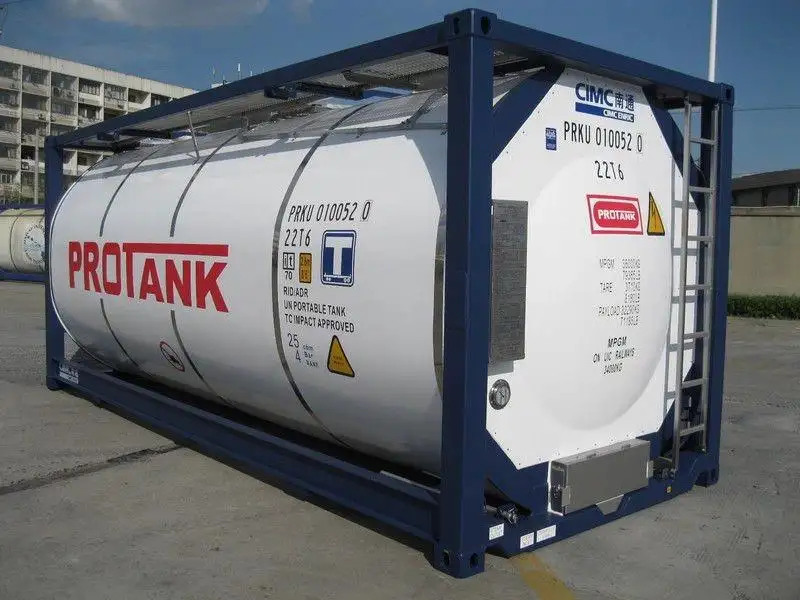
It is important for the buyer to find out if the Formic Acid exporter produces the acid on their own or casts a procurement order on upstream factories. A production-based supply chain would help in bringing the process control and exporting of the batches in close proximity.
Vanchor provides manufacturing, chemical export, and logistics services integrated as a single international business. We aim to bridge the gap between production and export as we manage processes as one rather than distinct operations.
What Does a Manufacturing-Backed Formic Acid Exporter Control?
A manufacturing-backed Formic Acid Exporter combines two different capabilities.
Manufacturing control includes:
• Raw-material management;
• Reaction and process control;
• Concentration adjustment;
• Impurity monitoring;
• Laboratory analysis;
• Batch release;
• Filling and packaging.
Export control includes:
• SDS and COA preparation;
• Dangerous-goods handling;
• Packaging verification;
• Customs documentation;
• Port warehousing;
• Container and shipping coordination.
The resulting supply chain is more integrated:
Production → QC Testing → Batch Release → Filling → Export Documentation → Port Handling → Shipment
Vanchor's supply structure is supported by approximately 30 years of manufacturing experience and a 50,000 m² industrial base, combining R&D, production, testing, storage, and logistics resources.
Manufacturing-Backed Exporter vs Trading Exporter
Neither sourcing model is automatically superior. A trader may provide local inventory or access to multiple producers, while a manufacturing-backed exporter provides closer visibility into production.
| Procurement Factor | Manufacturing-Backed Exporter | Trading Exporter |
| Production visibility | Direct/integrated | Upstream-dependent |
| Batch investigation | Closer to production records | Requires supplier coordination |
| Specification adjustment | Direct technical communication | Relayed to manufacturer |
| Production planning | Based on factory capacity | Based on external availability |
| Traceability chain | Relatively short | Additional sourcing layer |
| Source flexibility | Limited by production network | Can switch producers |
| Local stock | Depends on warehouse strategy | May offer regional inventory |
For long-term procurement, buyers therefore need to evaluate the complete supply model rather than assuming that either "factory" or "trader" alone determines reliability.
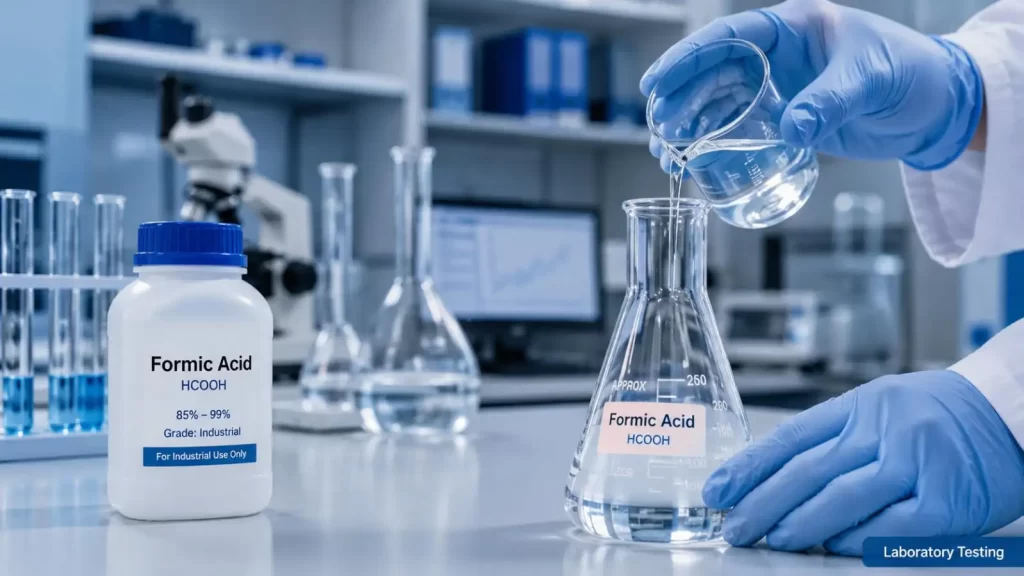
Why Production Control Matters for Formic Acid
Concentration Is Only the Starting Specification
Industrial formic acid is normally purchased by concentration, but the nominal grade does not describe every process-relevant characteristic.
A technically qualified Formic Acid Exporter should provide specifications covering parameters such as:
• HCOOH assay;
• Water content;
• Appearance;
• Relevant impurity limits;
• Batch identification;
• Applicable analytical methods.
Vanchor supplies Formic Acid 85%, 90%, 94%, and 99%, allowing concentration to be selected according to process conditions rather than simply choosing the strongest grade.
Batch Consistency Affects Downstream Processing
Changes in active acid concentration or impurities can influence:
• Acid dosing rates;
• pH adjustment;
• Reaction stoichiometry;
• Textile and leather processing;
• Rubber coagulation;
• Chemical intermediate production;
• Formulation repeatability.
For recurring orders, buyers should compare COAs from multiple production batches rather than reviewing only a single sample certificate.
Traceability Should Extend Beyond the COA
A COA is more useful when it can be connected to the physical shipment.
A practical traceability sequence is:
Production Batch → Laboratory Sample → Test Result → COA → Filling Lot → Shipment
Vanchor integrates laboratory quality control with production and export preparation so that technical documentation remains connected to the corresponding production batch.
Selecting 85%, 90%, 94%, or 99% Formic Acid
The highest concentration is not automatically the most economical or technically appropriate choice.
| Grade | Water Level | Typical Procurement Consideration |
| 85% | Higher | General industrial use, leather, textile, rubber, feed and processing |
| 90% | Moderate | Higher active-acid demand with some process-water tolerance |
| 94% | Lower | Chemical processing and higher-strength industrial applications |
| 99% | Very low | Chemical synthesis and processes requiring minimal introduced water |
A Formic Acid Exporter should help buyers evaluate concentration against:
• Required HCOOH dosage;
• Permitted process water;
• Storage temperature;
• Unloading and dosing system;
• Packaging volume;
• Annual consumption;
• Freight cost per unit of active acid.
For example, higher-concentration formic acid transports less water per tonne of active HCOOH, but storage, handling, and process requirements must also be evaluated.
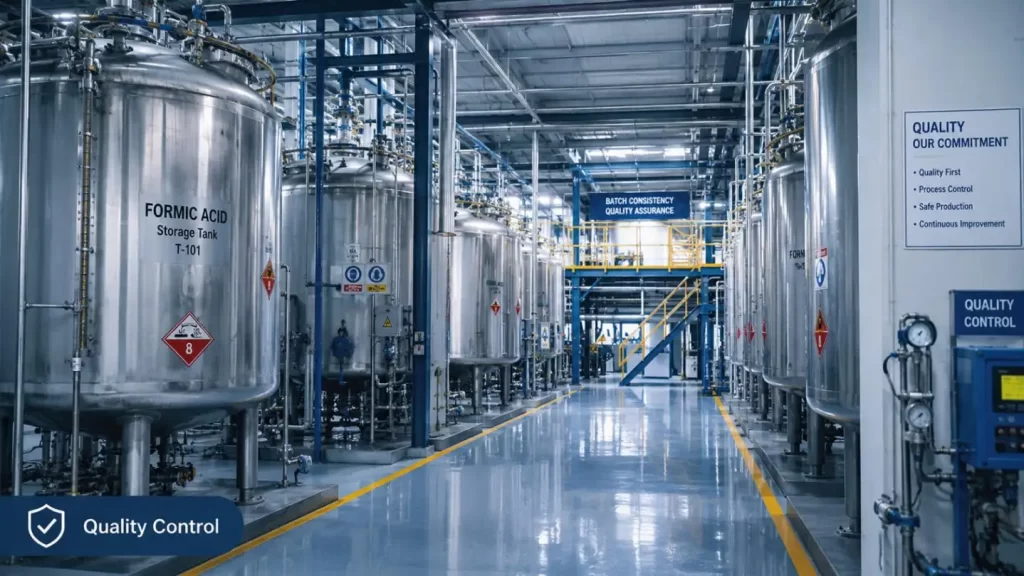
Eight Checks That Should Be Conducted Before Sanctioning a Formic Acid Exporter
1. Verification of the Manufacturing Relationship
Is the exporter the owner of, an integrated part of, or merely a purchaser from, the manufacturing plant?
2. Analysis of Actual Specifications
Detail descriptions of the sales do not suffice. Technical specs and historical certificates of analysis (COAs) needs to be added.
3. Analysis of Laboratory Capability
Check and see if those parameters get tested and recorded on a routine basis.
4. Assessment of Batch Traceability
Records have to be maintained for production, analysis, filling, and shipment.
5. Evaluation of Quality Systems
Vanchor has established and made available quality management systems of ISO 9001, ISO 14001 and ISO 45001.
6. Confirmation of Export Documentation
Depending on the market and the shipment, purchasers may require the following:
• SDS
• COA
• Specification sheet
• Commercial invoice
• Packing list
• Dangerous-goods documents
• Customs or origin documentation
7. Assessment of Packaging in Relation to the Plant
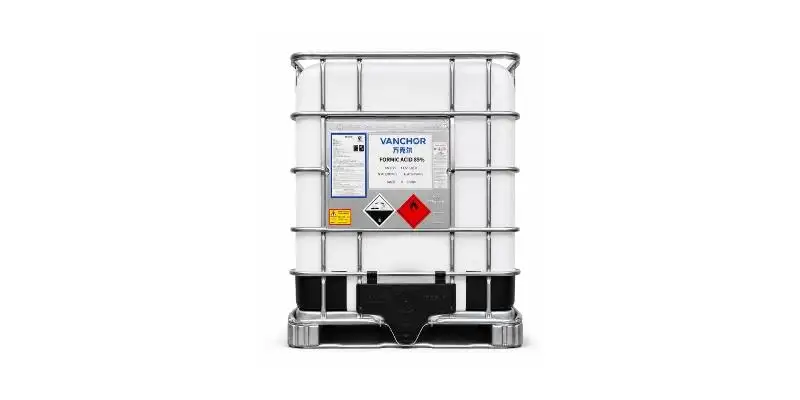
Packaging should be of appropriate size for storage, unload capacity, and should be considerate of the local transport, dosing rate, shipment volume and rules of local transport.
8. Analysis of Logistics Capability
A reliable Formic Acid Exporter should be able to integrate production of dangerous goods with transportation of containers, customs clearance, and port storage as well as scheduling of vessel.
Manufacturing Capability Does Not Ensure Export Reliability
A technically capable factory can still run into export problems if documentation, packaging, customs, or freight coordination is weak.
For this reason, Vanchor provides production resources together with supply-chain resources. This includes the infrastructure of strategic warehousing around the Tianjin and Qingdao ports and private logistics resources to connect factory outputs to desired shipping and port operations.
Our trade agreement also includes a China Customs AEO Advanced Certification and an AAA Corporate Credit Rating, and has a National Green Factory and Sci-Tech SME. These certifications support our effort to prioritize manufacturing and sustainability.
Our employees learn how to negotiate the obstacles and challenges presented by the diverse delivery systems and services when we cater to our customers in over 60 countries.
We need to coordinate the shifting considerations regarding delivery destinations, documentation, packaging, and service fulfillment.
Choosing a Formic Acid Exporter for Long-Term Supply
A complete production-to-delivery system encompasses concentration control, batch consistency, traceability, laboratory capability, documentation, packaging, hazardous-goods handling, and production logistics, among other factors. These need to be assessed together in a single package in order to provide the best service to our clients.
Vanchor offers 85%, 90%, 94% and 99% pure formic acid through its manufacturing-centric supply chain to cater to your industrial and bulk procurement needs.
For your new sourcing project, if you can provide us with your required concentration, specification, application, estimated monthly volume, preferred packaging, and the destination port, we can evaluate the best grade offer and structure more competitive production and export supplies to meet your needs.
FAQs
Q1. Which industries does Vanchor supply formic acid to?
Vanchor's supply of formic acid can be utilized in leather processing, textile processing, rubber production, chemical synthesis, animal feed, agriculture, water treatment, and other industrial chemical processes.
Q2. What formic acid concentrations does Vanchor offer?
Vanchor offers Formic Acid 85%, 90%, 94%, and 99%. This allows industrial clients to select formic acid concentration based on the requirements of their process, as well as tolerance to water and dosing as well as end-case requirements.
Q3. What steps has Vanchor taken to control batch consistency of formic acid?
Vanchor, being a manufacturing-backed supplier of formic acid, has integrated production, lab testing, approval for batch release, filling and preparation for export, thereby retaining traceability between the manufactured batch and the export documentation.
Q4. Will Vanchor issue a COA and SDS with formic acid shipments?
Yes. Vanchor is able to issue all standard documentation required for technical and export purposes, COA, SDS, product specifications, commercial and packing documents and shipping documentation as per requirements of the order and the destination.
Q5. How do clients decide on 85 %, 90%, 94% and 99% formic acid?
This usually depends on the process requirement, the permitted process water, the application, storage and the transport economics. Vanchor can advise based on the above parameters.


Contact Us
In This Article
Related Posts
Custom Packaging Solutions from an Anhydrous Sodium Acetate Supplier in China
2026-09-23
Application Trends in Anhydrous Sodium Acetate for Special Chemical Manufacturing
2026-09-23
Anhydrous Sodium Acetate for Leather Tanning: Improve Dyeing Uniformity
2026-09-22
Formic Acid 85% for Textile Dyeing: Industrial Applications, Technical Benefits and Future Trends
2026-09-22


