



Formic Acid for Silage: Benefits, Application, Safety, and Purchasing Guide
By vanchor
2026-07-21Related Posts
Custom Packaging Solutions from an Anhydrous Sodium Acetate Supplier in China
2026-09-23
Application Trends in Anhydrous Sodium Acetate for Special Chemical Manufacturing
2026-09-23
Anhydrous Sodium Acetate for Leather Tanning: Improve Dyeing Uniformity
2026-09-22
Formic Acid 85% for Textile Dyeing: Industrial Applications, Technical Benefits and Future Trends
2026-09-22
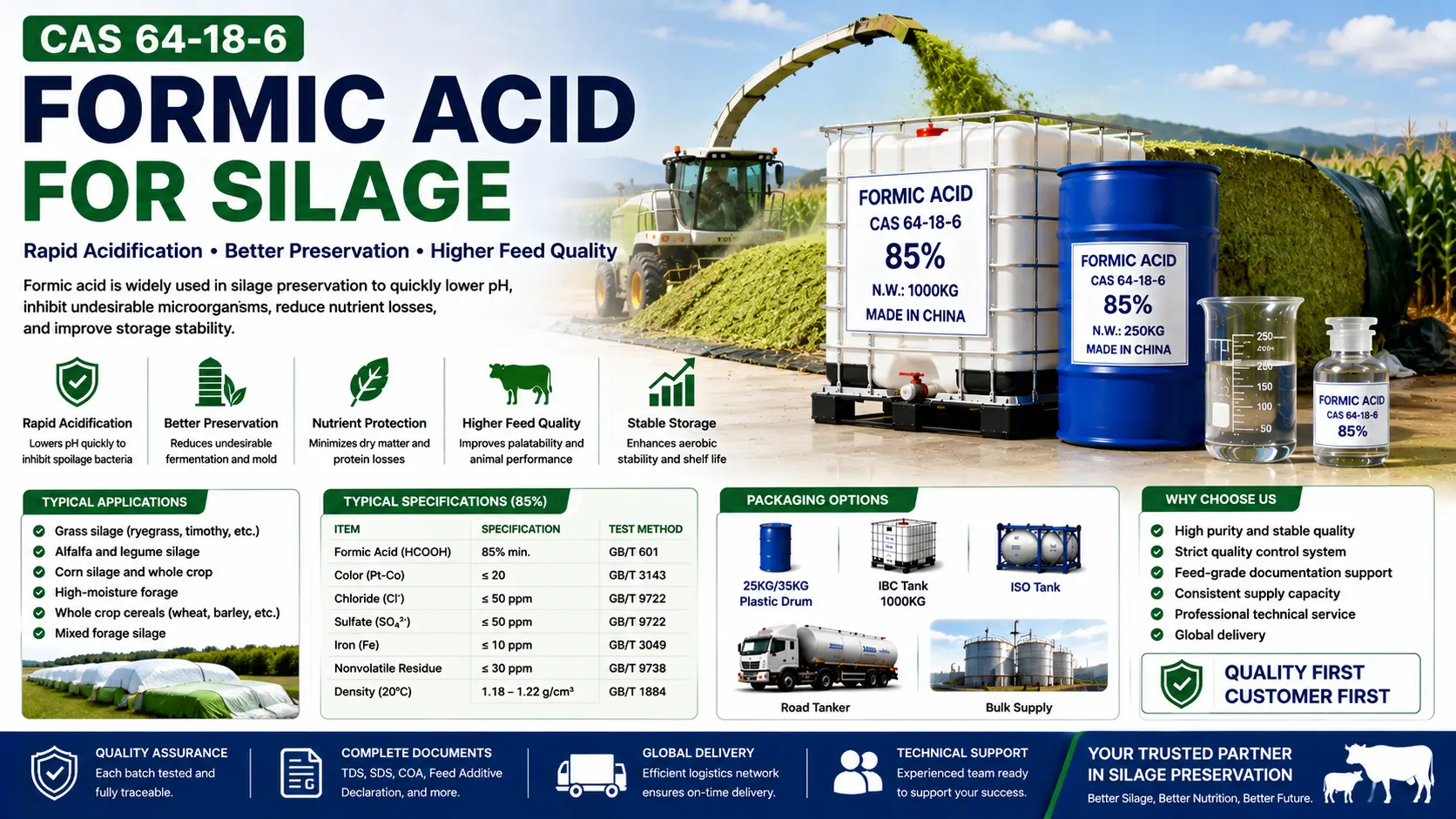
Formic Acid for Silage is extensively applied to forage preservation systems to quickly acidify forage, cut down on unwanted fermentation, prevent nutrient losses in the silage, and increase the storage stability of the silage. It can be used on grass, alfalfa, clover, corn, whole-crop cereals and other silage crops where increased control over the early stages of ensiling is required.
The quality of silages is not solely dependent on the preservative used. The final product is affected by the amount of forage moisture, sugar content, buffering capacity, chop length, compaction, exclusion of oxygen, uniformity of application, storage temperature, and the sealing of the silos.
When buying formic acid for farms, feed mills, silage contractors, dairy farms, livestock farmers and agricultural distributors, it's important to consider concentrations, feed-use documentation, dosing equipment, packaging, purity control, storage precautions and supplier reliability.
What Is Formic Acid?
Formic acid is the simplest carboxylic acid. Its chemical formula is HCOOH, and its CAS number is 64-18-6. It is normally supplied as a clear, colorless liquid that mixes readily with water.
Typical product information includes:
- Chemical name: Formic Acid
- CAS number: 64-18-6
- Molecular formula: HCOOH
- Molecular weight: approximately 46.03
- Appearance: Clear, colorless liquid
- Solubility: Miscible with water
- Common commercial concentrations: 75%, 80%, 85%, 90%, 94%, 98%, and 99%
For silage applications, buyers should confirm that the product is approved, labeled, documented, and supplied for feed or forage preservation in the destination market.
Industrial-grade formic acid should not automatically be considered suitable for animal-feed use.
What Is Silage?
Silage is fermented forage preserved under anaerobic conditions. Fresh forage is chopped, compacted, and sealed to exclude oxygen.
During successful ensiling, naturally occurring or added lactic acid bacteria convert plant sugars into organic acids. This lowers the pH and helps preserve the forage.
A well-managed silage process aims to:
- Exclude oxygen quickly
- Reduce pH efficiently
- Limit undesirable microorganisms
- Preserve dry matter
- Retain nutrients
- Reduce protein breakdown
- Maintain palatability
- Support stable storage
Poorly managed silage may experience heating, mold growth, excessive protein degradation, butyric fermentation, dry-matter loss, or reduced feed value.
Why Formic Acid Is Used in Silage
Formic acid can rapidly lower forage pH after application. This may help control the early fermentation stage and reduce the activity of undesirable microorganisms.
Potential benefits include:
- Faster initial acidification
- Reduced undesirable fermentation
- Lower risk of excessive protein breakdown
- Better dry-matter preservation
- Reduced nutrient losses
- Improved storage stability
- More predictable silage quality
- Support for difficult-to-ensile crops
The results depend on forage conditions, dosage accuracy, application uniformity, silo management, and the complete preservation program.
Formic acid does not replace proper harvesting, compaction, sealing, or feed-management practices.
How Formic Acid Supports Silage Preservation
Fresh forage contains plant enzymes, naturally occurring microorganisms, moisture, and fermentable sugars.
After the crop is placed in the silo, several processes begin:
- Plant respiration consumes oxygen and sugars
- Aerobic microorganisms remain active until oxygen is depleted
- Fermentation organisms begin to multiply
- Acids accumulate
- The forage pH gradually decreases
Applying formic acid can accelerate the reduction in pH. This may shorten the period during which undesirable organisms remain active.
A faster pH reduction may help reduce:
- Plant respiration losses
- Clostridial activity
- Excessive protein breakdown
- Ammonia formation
- Butyric fermentation
- Heating
- Dry-matter losses
The actual effect varies according to crop chemistry and storage conditions.
Suitable Forage Types
Formic acid may be used in selected silage systems involving:
- Grass
- Alfalfa
- Clover
- Corn forage
- Whole-crop wheat
- Whole-crop barley
- Sorghum
- Legume mixtures
- High-protein forage
- Wet forage crops
Different crops respond differently because they vary in:
- Dry-matter content
- Sugar concentration
- Buffering capacity
- Protein level
- Natural microbial population
- Chop characteristics
Legumes such as alfalfa often have high buffering capacity, which means more acid may be required to lower the pH than for sugar-rich grass or corn.
Formic Acid for Grass Silage
Grass silage may benefit from rapid acidification when the crop has high moisture, limited sugar, or challenging harvesting conditions.
Potential benefits include:
- Reduced unwanted fermentation
- Better protein preservation
- Lower ammonia production
- Improved dry-matter retention
- More stable storage
- More consistent feed quality
The crop should still be harvested at an appropriate maturity and wilted when practical.
Excessively wet forage may create runoff and increase the amount of acid required.
Formic Acid for Alfalfa Silage
Alfalfa can be difficult to ensile because it often has:
- High buffering capacity
- Relatively low sugar content
- High protein content
- Variable moisture
Formic acid may support faster pH reduction and help control undesirable fermentation.
However, application must be combined with:
- Suitable wilting
- Correct chop length
- Rapid filling
- Strong compaction
- Immediate sealing
- Accurate dosing
The final preservation program should be developed according to forage analysis and local technical guidance.
Formic Acid for Corn Silage
Corn generally contains more fermentable carbohydrate than many grasses or legumes and often ensiles readily under good management.
Formic acid may still be considered when:
- The crop is harvested unusually wet
- Storage conditions are difficult
- Rapid preservation is required
- The microbial load is high
- A specific preservation program is used
Because corn silage usually ferments differently from grass or alfalfa, the same acid dosage should not be assumed suitable for every crop.
High-Moisture Forage
High-moisture forage may be more vulnerable to undesirable fermentation and nutrient loss.
Potential risks include:
- Clostridial fermentation
- Butyric acid formation
- High ammonia levels
- Effluent production
- Reduced palatability
- Lower dry-matter recovery
Formic acid may help manage some of these risks by reducing pH rapidly.
However, harvesting extremely wet forage should still be avoided where possible because preservatives cannot fully compensate for poor moisture control.
Dry-Matter Content
Dry-matter content is one of the most important factors in silage preservation.
Very wet forage may require:
- Higher preservative input
- Better effluent management
- Faster filling
- Strong compaction
- More careful sealing
Very dry forage may be difficult to compact and may retain excessive oxygen.
Before application, producers should measure or estimate forage dry matter and follow a dosage program appropriate for the crop and moisture level.
Buffering Capacity
Buffering capacity describes how strongly the forage resists a change in pH.
High-buffering crops require more acid to produce the same pH reduction.
Factors affecting buffering capacity include:
- Protein content
- Mineral content
- Crop species
- Growth stage
- Fertilization
- Soil contamination
- Harvest conditions
Alfalfa and other legumes commonly have higher buffering capacity than corn.
Sugar Content
Fermentable sugars support lactic acid production during natural fermentation.
Low sugar content may result from:
- Immature forage
- Heavy rain
- Poor sunlight
- Delayed harvesting
- Excessive respiration
- Plant species
- Prolonged wilting
Formic acid may reduce dependence on fermentation by rapidly lowering pH, but the entire preservation strategy should still consider sugar availability.
Application Rate
There is no universal formic acid application rate suitable for every forage or storage system.
The correct rate depends on:
- Formic acid concentration
- Crop type
- Forage dry matter
- Buffering capacity
- Sugar content
- Storage period
- Application equipment
- Product authorization
- Local regulations
- Supplier instructions
Producers should follow the approved product label and obtain qualified technical guidance.
Guessing the dosage can lead to ineffective treatment, excessive acidity, feed rejection, corrosion, or unnecessary cost.
Importance of Uniform Application
Uniform distribution is essential.
Poor application may leave some forage untreated while applying excessive acid to other areas.
Uneven treatment may result in:
- Variable fermentation
- Local heating
- Mold development
- Nutrient loss
- Inconsistent palatability
- Unstable feed quality
Uniform application requires:
- Calibrated metering pumps
- Correct nozzle placement
- Stable pressure
- Suitable forage flow
- Accurate harvesting speed
- Regular flow checks
- Clean application lines
- Proper operator training
Application Equipment
Formic acid may be applied through:
- Forage-harvester applicators
- Metering pumps
- Spray bars
- Liquid manifolds
- Chopper-mounted systems
- Conveyor dosing systems
- Automated flow-controlled equipment
The dosing system should match the harvesting rate.
All tanks, hoses, pumps, seals, valves, and nozzles should be compatible with the acid concentration.
Equipment Calibration
Application equipment should be calibrated before harvest and checked regularly during use.
Calibration may involve:
- Measuring the actual forage flow rate
- Confirming the target application rate
- Checking pump output
- Inspecting nozzle spray patterns
- Verifying pressure
- Measuring liquid consumption
- Adjusting for changes in harvesting speed
Poor calibration may result in underapplication, excessive cost, inconsistent preservation, or safety risks.
Harvesting and Chop Length
Correct chop length helps improve compaction and fermentation.
Forage that is too long may:
- Trap more air
- Compact poorly
- Slow oxygen removal
- Increase heating risk
Forage that is too finely chopped may:
- Increase effluent
- Reduce effective fiber
- Create handling problems
The appropriate chop length depends on the crop, moisture, storage structure, and feeding program.
Rapid Silo Filling
The silo should be filled as quickly as practical.
Slow filling can expose forage to oxygen for extended periods, leading to:
- Sugar loss
- Heating
- Aerobic microbial growth
- Reduced dry-matter recovery
- Delayed preservation
Formic acid may help reduce some early fermentation losses, but rapid filling remains essential.
Compaction
Strong and uniform compaction helps remove oxygen from the forage mass.
Poor compaction can create air pockets and increase the risk of:
- Heating
- Mold growth
- Yeast activity
- Dry-matter loss
- Aerobic spoilage
Compaction effectiveness depends on:
- Forage moisture
- Chop length
- Layer thickness
- Tractor weight
- Packing time
- Filling rate
Silo Sealing
The silo should be sealed immediately after filling.
A complete sealing system may include:
- Suitable plastic film
- Oxygen-barrier film
- Sidewall protection
- Weighted covers
- Secure edges
- Regular inspection
- Prompt repair of holes
Formic acid cannot protect silage effectively if oxygen repeatedly enters through damaged covers or poor seals.
Fermentation Quality Indicators
Silage may be evaluated through:
- Final pH
- Dry-matter recovery
- Lactic acid
- Acetic acid
- Butyric acid
- Ammonia nitrogen
- Crude protein
- Sugar content
- Mold and yeast counts
- Temperature
- Smell and appearance
Formic acid-treated silage may show a different fermentation profile from untreated or inoculant-treated silage.
The results should be interpreted according to crop type, dry matter, and preservation method.
Protein Preservation
One potential benefit of rapid acidification is reduced protein degradation.
Slow pH reduction may allow plant enzymes and microorganisms to break down proteins into smaller nitrogen compounds.
Excessive protein breakdown may lead to:
- Higher ammonia levels
- Reduced true protein
- Poor nitrogen efficiency
- Reduced feed quality
- Strong or unpleasant odors
Rapid acidification may help limit this process under suitable conditions.
Dry-Matter Preservation
Dry-matter losses may occur through:
- Plant respiration
- Fermentation gases
- Effluent
- Heating
- Mold growth
- Aerobic spoilage
By reducing undesirable biological activity, formic acid may support improved dry-matter recovery.
However, the largest losses may still result from poor sealing, excessive moisture, slow filling, or poor feed-out management.
Aerobic Stability
Aerobic stability describes how well silage resists heating and spoilage after exposure to air.
Formic acid is mainly used to control preservation during ensiling. Its effect on feed-out stability depends on the complete fermentation profile and storage conditions.
Silage with residual sugars may be vulnerable to yeast activity after opening.
Good feed-out management should include:
- Maintaining a smooth silo face
- Removing sufficient silage daily
- Limiting loose material
- Avoiding excessive air exposure
- Keeping the feed area clean
Formic Acid vs. Silage Inoculants
Formic acid and bacterial inoculants work differently.
Formic Acid
Formic acid directly lowers pH and suppresses selected microorganisms.
Potential advantages include:
- Rapid acidification
- Reduced undesirable fermentation
- Strong preservation support for difficult crops
Silage Inoculants
Inoculants introduce selected bacteria that convert plant sugars into fermentation acids.
Potential advantages include:
- Controlled fermentation
- Improved lactic acid production
- Potential support for aerobic stability, depending on the strain
The better choice depends on forage type, moisture, sugar content, storage conditions, and production goals.
Some programs may use acid-based blends or combined preservation strategies, but compatibility and authorization must be confirmed.
Buffered Formic Acid Products
Buffered products may contain formic acid combined with formate salts or other ingredients.
Potential advantages may include:
- Reduced volatility
- Lower corrosiveness
- Easier handling
- Improved operator comfort
- Better equipment compatibility
However, buyers should compare:
- Actual active-acid content
- Formic acid equivalent
- Application rate
- Cost per treated ton
- Regulatory status
- Preservation performance
A buffered product should not be compared with concentrated formic acid only by price per kilogram.
Important Quality Specifications
A professional supplier should provide a clear technical specification.
Important indicators may include:
- Formic acid concentration
- Density
- Color
- Chloride
- Sulfate
- Iron
- Nonvolatile residue
- Water content
- Appearance
- Heavy-metal limits
- Feed-use documentation
Concentration Control
Stable concentration is essential for predictable dosing.
Variation may cause:
- Underapplication
- Excessive application
- Inconsistent pH reduction
- Higher cost
- Variable preservation
- Greater safety risk
The supplier should provide the actual batch concentration on the certificate of analysis.
Appearance and Color
The product should normally be clear and free from visible contamination unless it is intentionally blended or colored.
Cloudiness, solids, or unusual color may indicate:
- Contamination
- Storage problems
- Metal impurities
- Packaging incompatibility
- Product degradation
Incoming shipments should be inspected before unloading or use.
Packaging Options
Formic acid for silage may be supplied in:
- Small plastic drums
- 25 kg or 35 kg drums
- 250 kg HDPE drums
- IBC tanks
- ISO tanks
- Road tankers
- Bulk delivery systems
The correct packaging depends on:
- Annual forage volume
- Storage capacity
- Dosing equipment
- Delivery access
- Local regulations
- Worker-safety procedures
Storage Requirements
Formic acid should be stored in a cool, ventilated, secure area in compatible containers.
It should be protected from:
- Heat
- Direct sunlight
- Alkalis
- Strong oxidizing agents
- Incompatible metals
- Contamination
- Damaged packaging
- Unauthorized access
Storage areas should include:
- Secondary containment
- Clear labels
- Spill-control equipment
- Emergency showers
- Eyewash stations
- Ventilation
- Regular inspections
- Restricted access
Worker Safety
Concentrated formic acid is corrosive and can damage skin and eyes. Vapors may also irritate the respiratory system.
Operators should follow the current safety data sheet.
Suitable protective equipment may include:
- Chemical-resistant gloves
- Splash goggles
- Face shield
- Protective clothing
- Chemical-resistant footwear
- Respiratory protection where required
Closed-transfer and automated dosing systems can reduce worker exposure.
Corrosion and Equipment Compatibility
Formic acid may corrode unsuitable metals and equipment components.
Compatibility should be confirmed for:
- Storage tanks
- Pumps
- Hoses
- Valves
- Seals
- Gaskets
- Nozzles
- Flow meters
- Harvesting equipment
Regular maintenance and washing may help reduce corrosion and residue buildup.
Feed-Use Compliance
The legal status of formic acid for silage varies by market.
Buyers should verify:
- Feed-additive authorization
- Functional category
- Approved forage uses
- Permitted concentration
- Labeling requirements
- Worker-safety instructions
- Documentation requirements
- Traceability obligations
The product should be purchased and used according to local feed regulations and the approved label.
Supplier Documentation
A qualified supplier should provide:
- Technical data sheet
- Safety data sheet
- Batch-specific certificate of analysis
- Feed-use declaration where applicable
- Product label
- Authorization or registration details
- Traceability information
- Commercial invoice
- Packing list
- Transport documents
All documents should show consistent product identity, concentration, batch number, net weight, and packaging.
How to Evaluate a Supplier
Confirm Silage-Use Suitability
The supplier should confirm that the product is intended and documented for silage or feed preservation in the destination market.
Review the Specification
The technical specification should provide measurable quality limits.
Request Batch-Specific COAs
Each shipment should have a certificate corresponding to the actual batch.
Test a Representative Sample
Testing may include:
- Concentration
- Density
- Color
- Chloride
- Sulfate
- Iron
- Residue
- Equipment compatibility
- Silage trial performance
Review Traceability
Each shipment should be traceable through production, testing, storage, packaging, and delivery.
Confirm Supply Capacity
Seasonal demand can increase rapidly during harvest.
Buyers should ask about:
- Monthly supply capacity
- Seasonal inventory
- Standard lead time
- Emergency delivery
- Bulk tanker availability
- Repeat-order support
How to Request a Quotation
A complete inquiry should include:
- Required concentration
- Intended crop
- Feed-use documentation
- Estimated annual quantity
- Packaging
- Delivery schedule
- Destination
- Incoterm
- Required certificates
- Bulk unloading requirements
For example:
“Please quote formic acid 85% for silage preservation, packed in IBC tanks, including TDS, SDS, feed-use declaration, and batch-specific COA.”
Total Procurement Cost
The total cost includes more than the price of the acid.
Silage producers should consider:
- Active acid concentration
- Application rate
- Cost per treated ton
- Packaging
- Freight
- Storage tanks
- Dosing equipment
- Worker protection
- Corrosion control
- Maintenance
- Dry-matter preservation
- Feed losses
- Delivery reliability
A higher-quality product may provide better value if it improves dosing accuracy, reduces equipment problems, and supports more consistent preservation.
Common Purchasing Risks
Potential risks include:
- Incorrect concentration
- Industrial-grade material supplied for feed use
- Missing feed documentation
- Inconsistent batches
- Incompatible packaging
- Leaking containers
- Poor equipment compatibility
- Incorrect dosing
- Weak traceability
- Late seasonal delivery
These risks can be reduced through supplier qualification, sample testing, clear purchase specifications, and batch-specific documentation.
Questions to Ask Before Ordering
Buyers should confirm:
- Is the product documented for silage preservation?
- Which formic acid concentrations are available?
- What is the guaranteed concentration?
- What are the impurity limits?
- Can recent batch COAs be provided?
- Is a representative sample available?
- What application equipment is recommended?
- What packaging options are offered?
- Can bulk tanker delivery be arranged?
- What is the seasonal supply capacity?
- What is the normal lead time?
- Which feed-use documents are included?
- How is batch traceability managed?
- How are quality claims handled?
Conclusion
Formic Acid for Silage can be used to help with the quick fermentation, lower the amount of undesirable fermentation, help to preserve protein, minimize dry-matter losses, and help to keep the forage more stable during storage.
It will only work when the type of forage, its dry-matter content, sugar content, buffering capacity, dosage, uniformity of application, compaction, oxygen exclusion, sealing and feed-out management are all in place.
Silage producers should validate the feed-use status of the product, check the full technical specification, obtain a certificate of analysis for a specific batch, and ensure that dosing, storage, equipment, safety and documentation requirements are adhered to before purchase.
A reliable supplier will ensure a stable concentration, low concentrations of impurities, secure packaging, full feed use documentation, consistent seasonal capacity, quick technical support, and predictable delivery.


Contact Us
In This Article
Related Posts
Custom Packaging Solutions from an Anhydrous Sodium Acetate Supplier in China
2026-09-23
Application Trends in Anhydrous Sodium Acetate for Special Chemical Manufacturing
2026-09-23
Anhydrous Sodium Acetate for Leather Tanning: Improve Dyeing Uniformity
2026-09-22
Formic Acid 85% for Textile Dyeing: Industrial Applications, Technical Benefits and Future Trends
2026-09-22


