



Polyacrylamide Grade Selection: How to Choose the Right PAM
By vanchor
2026-07-11Related Posts
Custom Packaging Solutions from an Anhydrous Sodium Acetate Supplier in China
2026-09-23
Application Trends in Anhydrous Sodium Acetate for Special Chemical Manufacturing
2026-09-23
Anhydrous Sodium Acetate for Leather Tanning: Improve Dyeing Uniformity
2026-09-22
Formic Acid 85% for Textile Dyeing: Industrial Applications, Technical Benefits and Future Trends
2026-09-22
Effective Polyacrylamide Grade Selection starts with the wastewater, sludge or slurry—not with a generic product specification.
Polyacrylamide, commonly abbreviated as PAM, is available in anionic, cationic and nonionic grades with different molecular weights, charge densities and physical forms. These characteristics affect particle attraction, polymer bridging, floc strength, settling rate, filtration and sludge dewatering.
As a practical starting point:
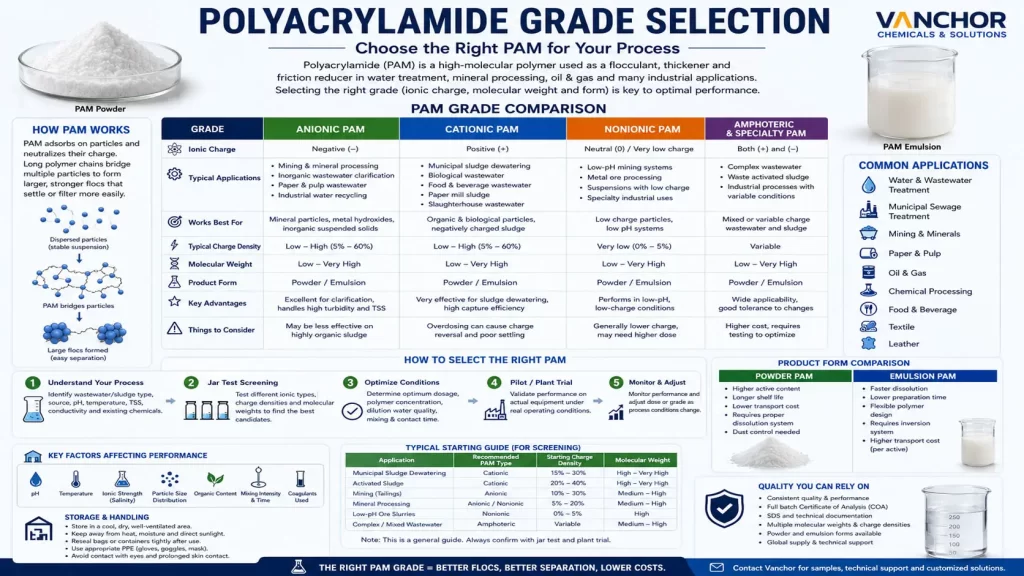
- Choose cationic polyacrylamide for biological sludge and many municipal or organic wastewater dewatering applications.
- Choose anionic polyacrylamide for mineral suspensions, inorganic wastewater clarification, mining and process-water recycling.
- Choose nonionic polyacrylamide for low-pH systems or suspensions where ionic interactions are limited.
- Confirm every selection through laboratory screening and a plant trial.
Kemira confirms that industrial polyacrylamides are supplied as cationic, anionic or nonionic products across a broad range of charge densities and molecular weights. They are available in dry powder and emulsion forms, and proper dissolution equipment is required to achieve consistent performance.
What Is Polyacrylamide?
Polyacrylamide is a water-soluble polymer produced from acrylamide-based monomers. In water treatment and industrial processing, it is mainly used to gather small suspended particles into larger flocs that can be removed by sedimentation, flotation, filtration or mechanical dewatering.
Its principal functions include:
- Flocculation
- Solid-liquid separation
- Sludge conditioning
- Rheology modification
- Friction reduction
- Process-water recovery
- Retention and drainage control
Commercial PAM products can have anionic, cationic or nonionic chemistry and may be supplied as dry powders, inverse emulsions or liquid solutions. Polymer architecture can also be linear, branched, cross-linked or otherwise modified for particular processes.
Polyacrylamide Grades at a Glance
| Grade | Electrical Character | Common Starting Applications | Main Selection Consideration |
|---|---|---|---|
| Anionic PAM | Negative charge | Mining, mineral processing, inorganic wastewater, clarification and water recycling | Particle mineralogy, divalent ions and required floc size |
| Cationic PAM | Positive charge | Municipal sludge, biological sludge, food-processing sludge and organic wastewater | Organic content and required cationic charge density |
| Nonionic PAM | Very low or neutral charge | Low-pH mining systems and selected mineral suspensions | pH, salinity and limited particle charge |
| Amphoteric PAM | Contains positive and negative groups | Complex wastewater and variable sludge | Balance of anionic and cationic components |
| Specialized PAM | Application-specific architecture | Oilfield, paper, mining and high-shear systems | Temperature, salinity, shear and process equipment |
This table provides a screening direction rather than a final product recommendation. Kemira notes that cationic PAM is commonly used for biological sludge dewatering, anionic PAM for water clarification and recycling, and nonionic PAM in mining—particularly where low-pH conditions are involved.
How Does Polyacrylamide Work?
PAM promotes solid-liquid separation primarily by connecting dispersed particles into larger aggregates.
Two factors are especially important:
Charge Interaction
A charged polymer can interact with oppositely charged particle surfaces and reduce the stability of the suspension.
The correct polymer charge depends on:
- Surface charge of the suspended solids
- Organic and inorganic composition
- pH
- Conductivity
- Dissolved salts
- Coagulants already used
- Process-water chemistry
Polymer Bridging
Long polymer chains can adsorb onto more than one particle, creating bridges that form larger flocs. High-molecular-weight polymers are often selected when stronger bridging and faster settling are needed.
However, the highest molecular weight is not always optimal. Very large polymers may produce excessive solution viscosity, dissolve more slowly or lose performance under high shear. Solenis describes specialized high-molecular-weight flocculants as producing larger, more robust mineral aggregates, illustrating how polymer architecture affects floc formation and consolidation.
When to Choose Anionic Polyacrylamide
Anionic polyacrylamide carries negatively charged functional groups and is frequently selected for suspensions containing positively charged sites, metal hydroxides or mineral particles.
Common applications include:
- Mining and mineral processing
- Coal washing
- Sand and aggregate washing
- Metallurgical wastewater
- Raw-water clarification
- Industrial wastewater sedimentation
- Process-water recycling
- Pulp and paper wastewater
- Construction and tunneling wastewater
- Lower-density oilfield and industrial fluids
Kemira identifies anionic PAM as a major option for water clarification and process-water recycling and supplies anionic grades across charge densities from nearly nonionic to strongly anionic.
Select Anionic Charge Density According to:
- Mineral composition
- Particle surface charge
- Calcium, magnesium and metal-ion content
- Coagulant type and dosage
- pH
- Desired settling rate
- Required underflow density
- Filtrate clarity
A low- or medium-anionic product may work well in one mineral slurry, while a higher-charge grade may perform better after metal-salt coagulation. Laboratory comparison is necessary because wastewater described simply as “mining water” can vary greatly between sites.
When to Choose Cationic Polyacrylamide
Cationic polyacrylamide carries positively charged groups and is widely used for sludge containing negatively charged organic matter.
Typical applications include:
- Municipal sewage sludge
- Activated sludge
- Biological wastewater sludge
- Food and beverage wastewater
- Slaughterhouse wastewater
- Dairy-processing wastewater
- Paper-mill sludge
- Textile wastewater
- Fermentation and pharmaceutical sludge
- Belt press, centrifuge and screw-press dewatering
Kemira states that cationic PAM is commonly used for sludge from biological treatment and that a higher proportion of biological sludge will typically require a higher cationic charge density.
Low Cationic Charge
A low-cationic PAM may be considered when:
- The sludge contains a relatively high mineral fraction.
- Organic content is limited.
- Charge demand is low.
- Excessive charge neutralization could reduce floc size.
Medium Cationic Charge
Medium-charge products are common starting candidates for:
- Mixed municipal sludge
- Industrial biological sludge
- Food-processing wastewater
- Paper sludge
- General mechanical dewatering
High Cationic Charge
Higher-charge PAM may be screened when:
- The biological or organic fraction is high.
- Sludge particles carry strong negative charge.
- Existing low-charge products produce weak flocs.
- High capture efficiency is required.
Charge density should not be increased automatically. A polymer that is too highly charged may produce small or fragile flocs, increase chemical consumption or reduce filtrate quality in a specific system.
When to Choose Nonionic Polyacrylamide
Nonionic polyacrylamide has very low ionic charge and relies mainly on hydrogen bonding and polymer bridging.
It may be suitable for:
- Low-pH mineral processing
- Acidic wastewater
- Selected metal-ore slurries
- Coal and mineral separation
- Suspensions with limited electrical charge
- Processes where high ionic charge interferes with other chemicals
Kemira identifies nonionic PAM as an option in mining applications, especially under low-pH conditions, and notes that high-molecular-weight nonionic polymers can form large, fast-settling and compacting flocs.
Nonionic PAM should not be selected simply because the wastewater pH is low. A jar test should compare nonionic products with low-anionic and low-cationic alternatives.
Molecular Weight vs Charge Density
Molecular weight and charge density describe different PAM characteristics.
| Parameter | Primary Effect |
|---|---|
| Molecular weight | Polymer-chain length and bridging capability |
| Charge density | Strength and frequency of ionic interaction |
| Polymer architecture | Floc structure, shear resistance and drainage behavior |
| Product concentration | Active polymer delivered per kilogram |
| Particle size | Powder dissolution and handling |
| Residual monomer | Regulatory and application suitability |
Higher Molecular Weight May Provide:
- Larger flocs
- Faster settling
- Better bridging
- Improved solids capture
It may also require:
- Longer dissolution time
- More careful agitation
- Lower mechanical shear
- Better make-down equipment
Higher Charge Density May Provide:
- Faster particle interaction
- Greater neutralization of negatively charged sludge
- Better capture of fine organic solids
It does not necessarily produce stronger flocs. The optimum product needs an effective balance of charge attraction and chain length.
Powder vs Emulsion Polyacrylamide
PAM is commonly supplied as dry powder or inverse emulsion.
| Factor | Powder PAM | Emulsion PAM |
|---|---|---|
| Active content | Generally higher | Contains carrier phase and water |
| Storage volume | Lower per unit of active polymer | Usually higher |
| Dissolution time | Longer | Faster make-up |
| Equipment | Powder wetting and aging system | Inversion and dilution system |
| Handling | Dust and fish-eye control required | Pumping and emulsion handling required |
| Typical advantage | Transport and active-content efficiency | Rapid preparation and flexible polymer design |
Kemira notes that emulsion products usually have faster make-up times and provide additional flexibility in molecular architecture, while dry and emulsion products both require appropriate preparation systems.
The product form should be selected according to plant consumption, operator experience, available equipment, storage conditions and required response time.
How to Conduct a PAM Selection Test
A reliable Polyacrylamide Grade Selection program should evaluate multiple products under the same conditions.
Step 1: Characterize the Process
Record:
- Wastewater or sludge source
- Total suspended solids
- Sludge concentration
- pH and temperature
- Conductivity
- Organic content
- Existing coagulants
- Separation equipment
- Current polymer and dose
- Required filtrate or overflow quality
Step 2: Screen Ionic Types
Select several candidates:
- Low-, medium- and high-anionic PAM
- Low-, medium- and high-cationic PAM
- Nonionic PAM where appropriate
- Powder and emulsion alternatives if equipment permits
Step 3: Prepare Polymer Correctly
Use clean dilution water and follow the supplier’s preparation instructions. Polymer powder should be introduced gradually to prevent agglomerates, and the solution should receive sufficient hydration time without severe mechanical shear.
Step 4: Compare Performance
Evaluate:
- Floc formation speed
- Floc size and strength
- Settling rate
- Supernatant clarity
- Solids capture
- Filtration rate
- Cake dryness
- Polymer consumption
- Behavior under plant-level shear
Step 5: Run a Plant Trial
Jar testing narrows the product range, but full-scale equipment can produce different results because of mixing energy, feed variability, pipe shear and mechanical pressure.
The best grade is generally the one that consistently meets treatment targets at the lowest practical total operating cost—not necessarily the product with the lowest price per kilogram.
Common PAM Selection Mistakes
Selecting Only by Ionic Type
Two anionic PAM products may perform differently because their charge density, molecular weight and architecture are not the same.
Using the Highest Molecular Weight
A very high-molecular-weight PAM may dissolve poorly or form flocs that break in pumps and centrifuges.
Ignoring Existing Coagulants
Ferric salts, aluminium salts, polyamines and polyDADMAC can change particle charge and therefore alter the ideal PAM grade.
Comparing Products at Equal Product Weight
Powders and emulsions can contain different active-polymer concentrations. Compare them on an active basis and by treatment result.
Skipping Water-Quality Testing
Hardness, salinity, pH and dissolved iron can affect polymer preparation and performance.
Assuming One Grade Will Always Work
Seasonal changes, production changes and sludge age can alter polymer demand. Periodic retesting supports more stable operation.
Drinking-Water and Regulated Applications
Polyacrylamide intended for drinking-water treatment must meet the applicable product certification, residual acrylamide and maximum-use requirements of the destination market.
In the United States, EPA’s treatment-technique requirement specifies an equivalent combination of no more than 0.05% residual acrylamide monomer when dosed at 1 mg/L. NSF listings identify individually certified products and their approved maximum-use levels; only products bearing the applicable certification mark are certified.
Industrial wastewater PAM should therefore not automatically be used for potable-water applications, even when its ionic type and molecular weight appear suitable.
Quality Factors Buyers Should Specify
When requesting a quotation, provide more than “anionic PAM” or “cationic PAM.”
Important parameters include:
- Ionic type
- Charge density or ionic degree
- Molecular-weight range
- Product form
- Active content
- Residual acrylamide limit
- Dissolution time
- Insoluble matter
- Particle-size range
- Solution viscosity
- Application
- Required certifications
- Packaging
- Annual consumption
- Destination market
A representative wastewater or sludge sample can significantly improve product screening accuracy.
Polyacrylamide Supply from Vanchor
Vanchor includes polyacrylamide within its water-treatment and oilfield chemical portfolio and supports industrial and municipal water-treatment applications.
Supply support can include:
- Anionic polyacrylamide
- Cationic polyacrylamide
- Nonionic polyacrylamide
- Powder and selected emulsion grades
- Different molecular weights and charge densities
- Samples for laboratory evaluation
- Batch-specific Certificates of Analysis
- SDS and Technical Data Sheets
- Moisture-resistant export packaging
- Customized labeling
- International shipping coordination
To support grade selection, provide wastewater characteristics, current treatment chemicals, separation equipment, required treatment results and expected consumption.
Frequently Asked Questions
Which PAM is best for wastewater treatment?
There is no universal best grade. Anionic PAM is often used for inorganic solids and clarification, while cationic PAM is common for biological sludge dewatering.
Which PAM is used for municipal sludge?
Cationic polyacrylamide is generally the first grade screened for municipal and activated sludge.
Which PAM is used in mining?
Anionic and nonionic PAM are widely screened for mineral processing, depending on ore type, pH and water chemistry.
Does higher molecular weight always mean better performance?
No. High molecular weight can improve bridging, but it may also increase dissolution difficulty and shear sensitivity.
What does PAM charge density mean?
Charge density describes the proportion of charged functional groups along the polymer chain and influences interaction with suspended particles.
Can anionic PAM dewater sludge?
It may work for certain mineral-rich or positively charged sludges, but cationic PAM is more typical for biological sludge.
Is powder PAM better than emulsion PAM?
Powder offers high active content and shipping efficiency. Emulsion generally provides faster preparation. The better option depends on the dosing system and process.
How is the correct PAM dose determined?
Use laboratory testing followed by a plant trial. Dose depends on solids concentration, particle characteristics, chemistry and separation equipment.
Can industrial PAM be used in drinking water?
Only when the specific product complies with applicable drinking-water standards, certification and residual-monomer requirements.
What information should be sent to a PAM supplier?
Provide the application, pH, solids content, wastewater source, existing chemicals, equipment, current dosage, required performance and destination market.
Select PAM Through Testing, Not Assumption
Successful Polyacrylamide Grade Selection requires balancing ionic type, molecular weight, charge density, polymer form and process conditions.
Cationic PAM is generally the starting choice for biological sludge dewatering. Anionic PAM is widely used for mineral suspensions and clarification, while nonionic PAM can perform well in low-pH or low-charge systems.
Laboratory screening and full-scale verification remain the most reliable way to identify a grade that delivers stable settling, clear water, strong solids capture and efficient polymer consumption.


Contact Us
In This Article
Related Posts
Custom Packaging Solutions from an Anhydrous Sodium Acetate Supplier in China
2026-09-23
Application Trends in Anhydrous Sodium Acetate for Special Chemical Manufacturing
2026-09-23
Anhydrous Sodium Acetate for Leather Tanning: Improve Dyeing Uniformity
2026-09-22
Formic Acid 85% for Textile Dyeing: Industrial Applications, Technical Benefits and Future Trends
2026-09-22


