



Glacial Acetic Acid for Pharmaceutical Manufacturing: Purity and Documentation
By vanchor
2026-07-27Related Posts
Custom Packaging Solutions from an Anhydrous Sodium Acetate Supplier in China
2026-09-23

Application Trends in Anhydrous Sodium Acetate for Special Chemical Manufacturing
2026-09-23
Anhydrous Sodium Acetate for Leather Tanning: Improve Dyeing Uniformity
2026-09-22
Formic Acid 85% for Textile Dyeing: Industrial Applications, Technical Benefits and Future Trends
2026-09-22
Glacial acetic acid for pharmaceutical manufacturing is not just a bulk chemical sourcing question; it is a purity, documentation, and supplier-qualification question. If you are evaluating it for pharma use, the real issue is whether the material can meet your internal specification, support GMP-controlled handling, and arrive with the right batch evidence.
The broader supplier context is covered in the parent guide How a Verified Glacial Acetic Acid Exporter Supports Precision Formulation Work (inferred), but this article stays narrower and focuses on what pharma buyers actually need to verify.
What Pharma Use Changes
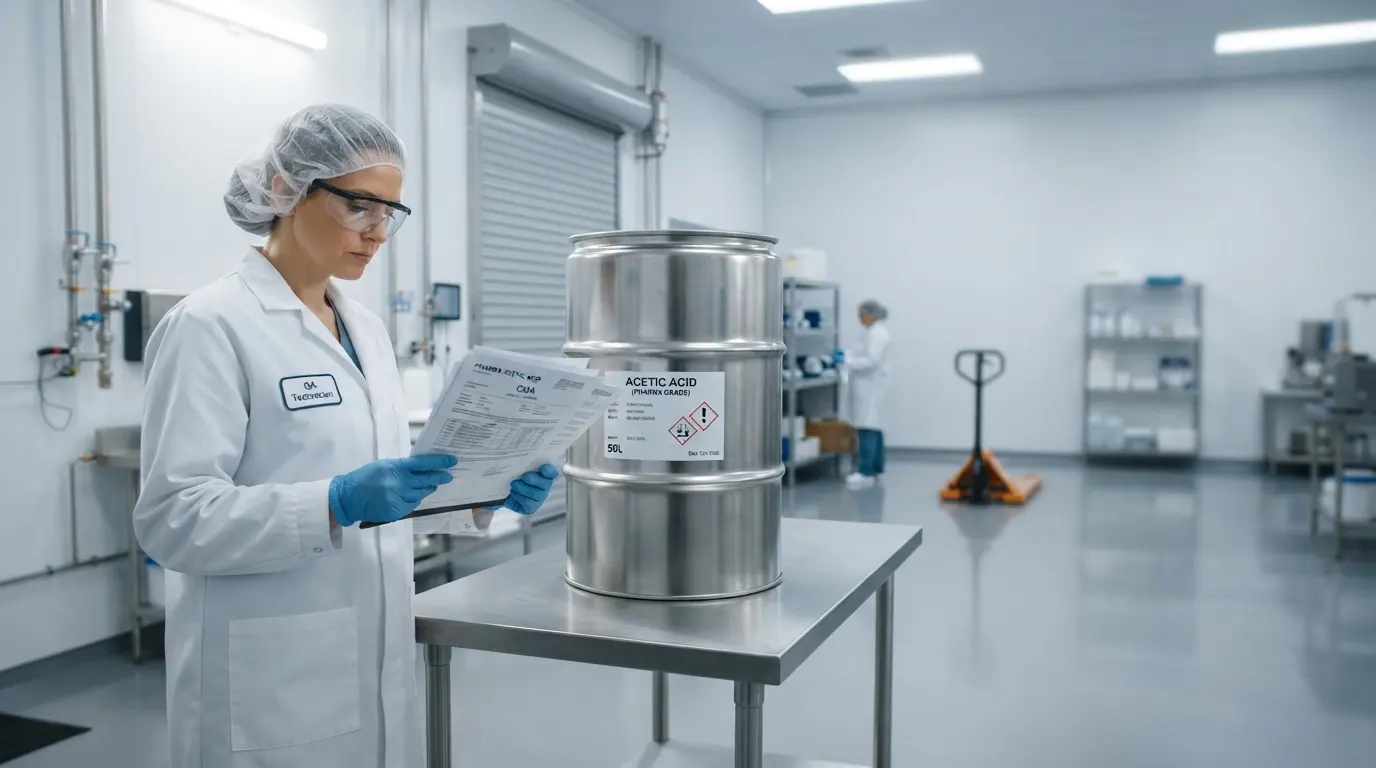
In pharmaceutical manufacturing, the question is not simply whether glacial acetic acid is “high purity.” The more important question is whether its assay, moisture level, impurity profile, and documentation line up with the way your process is controlled and released. ICH Q7 frames API-related manufacturing around documented specifications, quality control, traceability, and release decisions rather than generic product descriptions.semrush
That means the same material can be acceptable for one process and unsuitable for another. A formulation or synthesis step may tolerate one impurity profile, while another step may need tighter moisture control or more complete batch documentation. The buyer’s job is to match the supplier’s evidence to the process’s quality needs.semrush
Purity Signals That Matter
For pharma use, purity should be evaluated as a set of linked attributes, not a single marketing number. The main signals are assay, water content, impurity profile, and whether the product is described against a pharmacopeial grade such as USP, BP, Ph. Eur., or JP when that is relevant to your market and specification.eastman+1
A high assay alone is not enough if moisture or impurities are not controlled. Vanchor’s exporter guide also treats purity consistency as a controlled variable and notes that batch variability can affect downstream reproducibility, which is the right general lens for pharma sourcing as well.reddit
Assay, moisture, and impurities
Assay tells you how much acetic acid is present, but it does not tell the whole story. Water content matters because it can change reaction behavior, stability, and consistency across batches. Impurity profile matters because small trace components can affect sensitive manufacturing steps even when the headline assay looks acceptable.ich+1
For a pharma buyer, the practical question is: does the supplier show the full picture, or only a concentration claim? If the answer is only a concentration claim, the material is not yet qualified for a pharmaceutical workflow.
Documentation Buyers Should Expect
The core documents are the Certificate of Analysis, the Safety Data Sheet, and the supplier’s specification sheet or equivalent quality document. ICH Q7 explicitly emphasizes documented specifications, records for raw materials, and certificates of analysis as part of controlled API-related manufacturing.fda+1
A COA should let you identify the lot or batch, see the relevant test results, and check whether the material matches your internal acceptance criteria. A good SDS supports safe handling and storage, but it does not prove that the material is suitable for your exact pharmaceutical process.fda+1
What a COA should show
A usable COA should show the batch identity, the measured assay, any relevant impurity or moisture results, and the test methods or specification references used. It should also let your quality team compare supplier data against your own limits rather than guessing from a product name.ema.europa+1
Vanchor’s exporter article specifically highlights batch-specific COA, SDS availability, export documentation, and traceability as part of a reliable supply model, which aligns well with how a pharma buyer should think about document readiness.reddit
What SDS and traceability do not prove
An SDS tells you about hazards, handling, and emergency response; it does not prove pharmacopeial compliance or process suitability. Traceability helps you follow the batch through the supply chain, but it does not replace analytical evidence or internal approval.fda+1
That distinction matters because pharma sourcing often fails when teams treat “documented” as the same thing as “qualified.” For this child topic, documentation is only useful when it supports a real specification decision.
Supplier Qualification for Pharma Buyers
Supplier qualification is where the technical and commercial sides meet. You are not only checking whether the seller can supply glacial acetic acid; you are checking whether the supplier can supply it consistently, document it clearly, and support release decisions when your quality team asks questions.ich+1
A practical approval review should include three checks: spec alignment, document completeness, and lot-to-lot consistency. If the supplier cannot show how the batch documents map to your requirements, the material is still a candidate, not an approved input. Vanchor’s broader supplier framing around traceability and process alignment fits this buyer-first logic.reddit
Practical approval checklist
Confirm the exact grade language and the intended pharmaceutical use.
Review the COA against your internal specification, not just against a brochure claim.
Check whether water content and impurity data are provided in a way your QA team can evaluate.
Verify SDS availability and batch traceability.
Ask how re-test or expiry dating is handled if it applies to your buying process.
This is the point where many buyers should pause and ask for additional clarification rather than moving straight to purchase.
Where This Fits in the Cluster
This page is the pharma-manufacturing child topic inside the broader glacial acetic acid cluster. If you need a wider supplier and export context, the parent pillar is the right place to start, while the manufacturer page is the closest sibling for source-control context.reddit
For adjacent topics, the food-vs-industrial-grade page can help with grade confusion, but it should stay secondary here because the main search intent is pharmaceutical suitability, not a general grade comparison.topicalauthority
What to Request Next
Before approving glacial acetic acid for pharmaceutical manufacturing, request the COA, SDS, and a clear specification sheet, then compare those documents to your own acceptance criteria. If the supplier can also explain traceability, batch consistency, and packaging integrity in a way your QA team understands, that is a stronger signal than a generic “high purity” claim.fda+2
If you are evaluating a supplier path next, the most useful next step is the broader exporter guide linked above, followed by the manufacturer page for source-control context.


Contact Us
In This Article
Related Posts
Custom Packaging Solutions from an Anhydrous Sodium Acetate Supplier in China
2026-09-23
Application Trends in Anhydrous Sodium Acetate for Special Chemical Manufacturing
2026-09-23
Anhydrous Sodium Acetate for Leather Tanning: Improve Dyeing Uniformity
2026-09-22
Formic Acid 85% for Textile Dyeing: Industrial Applications, Technical Benefits and Future Trends
2026-09-22


