



Chemical Import Landed Cost Calculation: Estimate the Full Delivered Cost
By vanchor
2026-08-02Related Posts
Custom Packaging Solutions from an Anhydrous Sodium Acetate Supplier in China
2026-09-23
Application Trends in Anhydrous Sodium Acetate for Special Chemical Manufacturing
2026-09-23

Anhydrous Sodium Acetate for Leather Tanning: Improve Dyeing Uniformity
2026-09-22

Formic Acid 85% for Textile Dyeing: Industrial Applications, Technical Benefits and Future Trends
2026-09-22
If you are importing chemicals, the factory quote is only the starting point. The real number is the landed cost: product cost plus freight, insurance, duties, taxes, and the local fees needed to get the shipment to your door.
This guide shows how to calculate chemical import landed cost in a practical way, so you can compare supplier quotes on a true delivered basis. For the broader sourcing process, see Chemical Procurement From China: A Practical Buyer’s Guide (inferred).
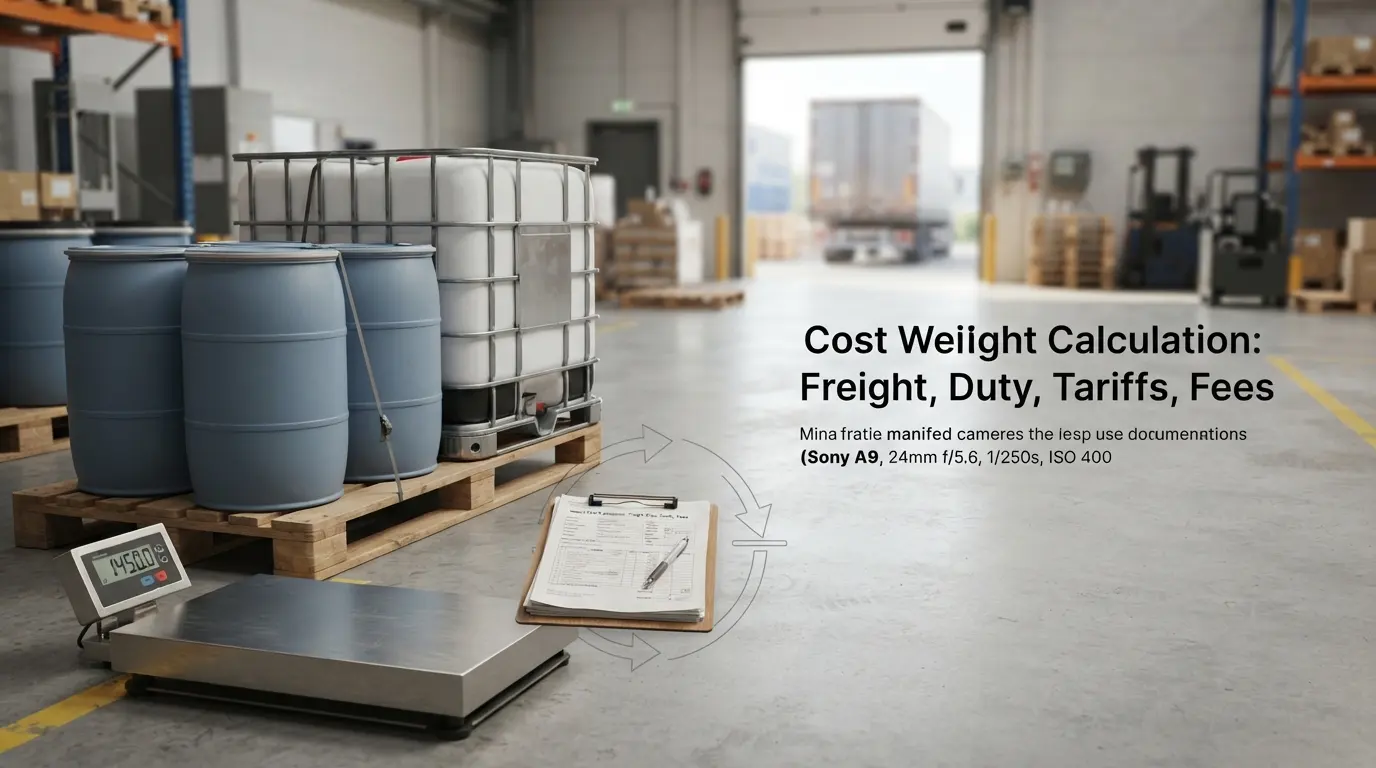
What counts in chemical landed cost?
Landed cost is not just the invoice value from the supplier. For chemical imports, the calculation usually includes the product price, international freight, cargo insurance, customs duty, import taxes, brokerage, port or terminal handling, and inland delivery to the final destination.trade+2
The exact mix depends on the Incoterm, the destination country, and how the chemical is shipped. That is why two quotes with the same factory price can produce very different delivered costs.trade+1
| Cost item | What it covers | Why it matters |
|---|---|---|
| Product cost | Supplier’s chemical price | Starting point of the calculation |
| Freight | Ocean, air, or multimodal transport | Often a major cost swing |
| Insurance | Cargo cover during transit | Needed in many planning models |
| Customs duty | Import tariff based on classification | Can materially change final cost |
| Import taxes | VAT, GST, or similar destination taxes | Varies by market |
| Brokerage / clearance | Customs filing and release fees | Often overlooked |
| Port / terminal charges | Local handling at entry point | Common hidden charge |
| Inland delivery | Movement from port to warehouse | Needed for true delivered cost |
Which costs are already included under the Incoterm?
Incoterms control where the seller’s responsibility ends and the buyer’s cost begins. For example, CIF already includes freight and insurance to the named port, while FOB usually leaves the buyer responsible for those transport costs.trade+1
That means you should never add freight twice just because it appears in both the supplier quote and your spreadsheet. If you are unsure how a quote is structured, compare it against the dedicated Incoterms for Chemical Imports page before you finalize the landed-cost model.topicalos
How to calculate landed cost step by step
A simple way to calculate chemical import landed cost is to start with the supplier price, then add every buyer-paid cost until the goods reach the final destination. The most useful output is the per-unit landed cost, because that is what you compare against other suppliers or local alternatives.pitaratools+1
Start with the chemical purchase price.
Add international freight.
Add cargo insurance if it is not already included.
Add customs duty based on the correct HS code.
Add import taxes such as VAT or GST, if applicable.
Add brokerage, clearance, port handling, and inland delivery.
Divide the total by the number of units to get landed cost per unit.
| Formula step | Example input | Result |
|---|---|---|
| Product cost | Supplier quote | Base value |
| Freight | Carrier quote | Add transport cost |
| Insurance | Cargo policy premium | Add risk cover |
| Duty | HS-based tariff | Add import duty |
| Taxes | Destination tax | Add tax amount |
| Fees | Broker, handling, delivery | Add local charges |
| Per-unit landed cost | Total ÷ quantity | True unit cost |
Simple landed-cost formula for chemical imports
A practical formula is:
Landed cost = product cost + freight + insurance + duty + taxes + fees
If you want the unit figure, use:
Per-unit landed cost = total landed cost ÷ quantity
This is the number procurement teams usually need, because it lets them compare different suppliers, shipping routes, and Incoterms on the same basis.
Chemical-specific cost drivers that change the total
Chemicals often cost more to land than ordinary cargo because the shipment can trigger special handling, packaging, or documentation requirements. Hazardous-goods status is a major example: if a chemical is regulated as dangerous goods, freight and handling can rise because carriers and terminals need extra controls.uncoverseo
Packaging also matters. A chemical shipped in drums, IBCs, or other protected packaging may weigh more, take more space, or require safer handling than a simple general-cargo pallet. In practice, packaging choice can affect both transport cost and local handling charges, so it should be part of the landed-cost model rather than treated as an afterthought.dwfgroup+1
| Chemical factor | Cost impact | Why it matters |
|---|---|---|
| Dangerous goods status | Higher freight or handling | Carrier restrictions and extra controls |
| Packaging type | Higher freight or handling | Weight, volume, and protection requirements |
| Documentation quality | Lower or higher clearance cost | Errors can cause delays and fees |
| Product form | Can change shipping method | Liquid, powder, or corrosive goods may ship differently |
Why documents matter in landed-cost planning
Shipment documents do more than satisfy customs paperwork. For chemical imports, the invoice, packing list, Safety Data Sheet, Certificate of Analysis, and any dangerous-goods documents help determine whether the shipment clears smoothly and whether the carrier can accept it.uncoverseo
When these documents do not match the cargo, delays can appear as storage charges, rework, or customs clearance friction. That is why landed-cost planning should include document consistency, not just freight and duty math.uncoverseo
For a fuller checklist of shipping documents, see the chemical export documentation checklist.uncoverseo
Example calculation for a chemical shipment
Here is a simple example to show how the calculation works. The numbers below are illustrative, not a quote.
| Item | Amount |
|---|---|
| Chemical purchase price | 10,000 |
| Freight | 1,200 |
| Insurance | 80 |
| Customs duty | 700 |
| Import taxes | 1,100 |
| Brokerage and handling | 220 |
| Inland delivery | 300 |
| Total landed cost | 13,600 |
If the shipment contains 1,000 kg, the per-unit landed cost is:
13,600 ÷ 1,000 = 13.60 per kg
That is the number you should use when comparing suppliers, because it reflects the real delivered cost rather than the factory price alone.
Common mistakes when estimating landed cost
The most common mistake is double-counting freight or insurance when the supplier quote already includes them under the Incoterm. Another common error is using the wrong HS code, which can produce the wrong duty rate and distort the entire estimate.trade+1
Importers also miss small but real charges such as brokerage, port handling, and inland delivery. For chemical cargo, another frequent mistake is ignoring the cost impact of hazard classification or document errors, even though those issues can change the shipping quote or create extra clearance charges.uncoverseo
Double-counting transport costs.
Ignoring taxes at destination.
Using the wrong duty classification.
Leaving out local clearance fees.
Forgetting chemical handling or documentation costs.
When to use a calculator versus a spreadsheet
A calculator is best when you want a fast estimate or need to compare several supplier quotes quickly. A spreadsheet is better when you import the same chemical often, want to model different Incoterms, or need to capture more detailed fee assumptions across multiple shipments.trademo+2
If your shipment is simple, a calculator-style workflow is usually enough. If the cargo is hazardous, multi-leg, or highly variable by destination, a spreadsheet gives you more control over assumptions and unit costs.
Next step for buyers
If you already know your landed cost, the next question is whether the supplier and sourcing route make sense at that number. That is where broader procurement decisions start to matter, especially when comparing factory quotes, shipping terms, and document readiness.
Use the calculation here as the cost baseline, then return to the broader sourcing guide for the next procurement step: Chemical Procurement From China: A Practical Buyer’s Guide (inferred).dwfgroup


Contact Us
In This Article
Related Posts
Custom Packaging Solutions from an Anhydrous Sodium Acetate Supplier in China
2026-09-23
Application Trends in Anhydrous Sodium Acetate for Special Chemical Manufacturing
2026-09-23
Anhydrous Sodium Acetate for Leather Tanning: Improve Dyeing Uniformity
2026-09-22
Formic Acid 85% for Textile Dyeing: Industrial Applications, Technical Benefits and Future Trends
2026-09-22


