



Glacial Acetic Acid Dilution Calculation: Concentration and Safety Steps
By vanchor
2026-07-28Related Posts
Custom Packaging Solutions from an Anhydrous Sodium Acetate Supplier in China
2026-09-23
Application Trends in Anhydrous Sodium Acetate for Special Chemical Manufacturing
2026-09-23
Anhydrous Sodium Acetate for Leather Tanning: Improve Dyeing Uniformity
2026-09-22
Formic Acid 85% for Textile Dyeing: Industrial Applications, Technical Benefits and Future Trends
2026-09-22
Glacial acetic acid dilution is a calculation problem first and a safety task second: you need the right starting concentration, the right target concentration, and a safe way to mix them. If you also want broader supplier context around verified sourcing and formulation support, see the parent pillar on How a Verified Glacial Acetic Acid Exporter Supports Precision Formulation Work (inferred).
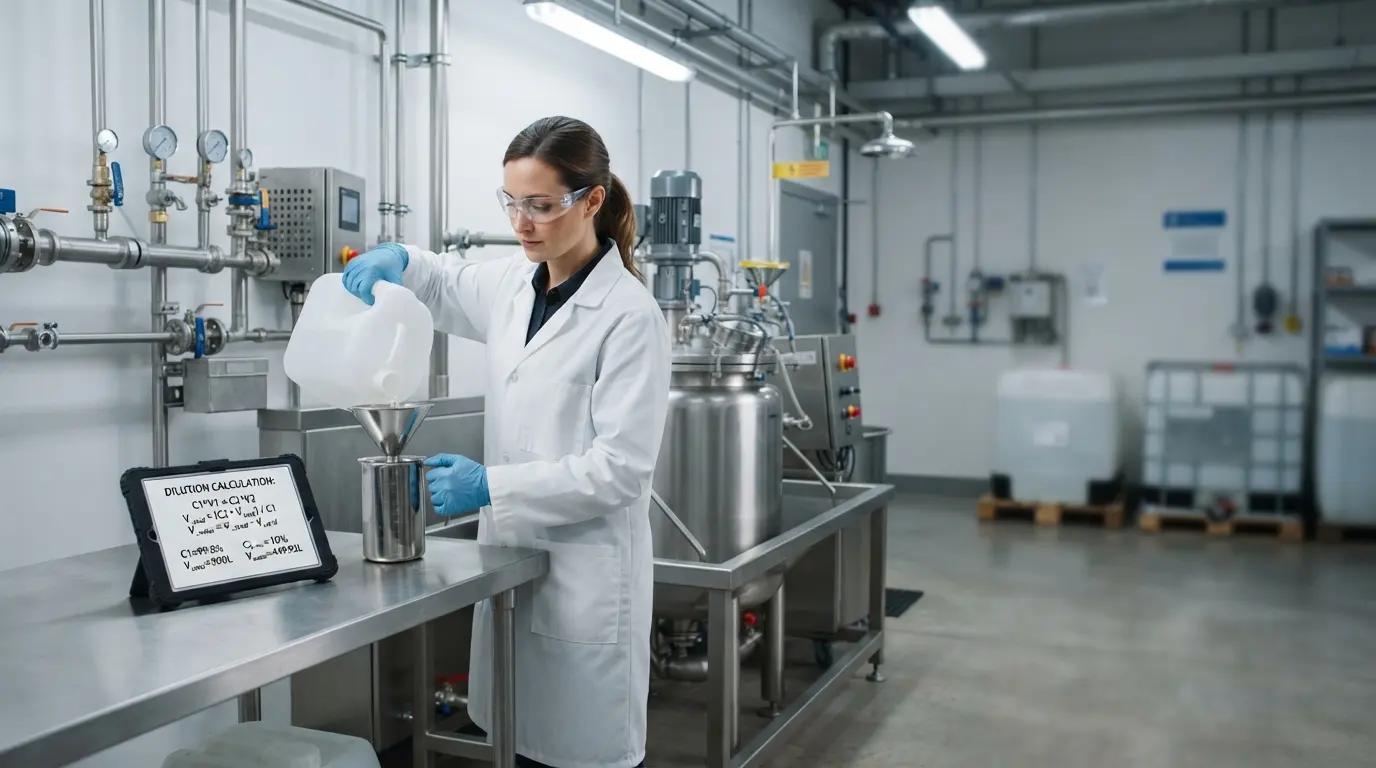
What You Need Before You Calculate
Before you start, confirm three inputs: the stock concentration, the target concentration, and the final volume you want to make. In lab-style work, that might be a molarity target; in industrial work, it may be a percentage-based solution, but the logic is the same.
Check the label, the COA, and the SDS before mixing. The COA helps confirm the starting assay, while the SDS tells you the handling risks and protective steps. Vanchor’s site also presents glacial acetic acid with documentation support such as COA and SDS context, which is useful for pre-mix verification.cameochemicals.noaa+3
How to Calculate the Dilution
The basic dilution idea is simple: the amount of solute you start with must match the amount you want in the final solution. In formula form, that is usually written as , where is the stock concentration, is the stock volume you need, is the target concentration, and is the final volume.
For a quick example, if you are making 1 liter of a weaker acetic acid solution from a stronger stock, solve for by rearranging the formula: . That gives you the exact amount of glacial acetic acid to measure before adding the diluent.
If your calculation is percentage-based instead of molarity-based, use the same logic with consistent units. The key is not the label on the unit; it is making sure stock and target are expressed in the same system before you solve. General dilution calculators from lab suppliers follow this same workflow.sigmaaldrich+2
Worked Example
Suppose you want 1,000 mL of a 5% solution from a 99.8% stock. Using the dilution formula, the stock amount is , which is about 50.1 mL.
That means you would measure about 50.1 mL of glacial acetic acid and then add diluent until the final volume reaches 1,000 mL. This is why the final volume matters more than simply “adding water” by feel: the target strength depends on the total finished volume, not just the amount of liquid you add.
How to Mix It Safely
The safest mixing order is to add acid to water, not water to acid. That reduces splash risk and helps the heat from mixing dissipate more safely. Safety data references for glacial acetic acid consistently treat it as a hazardous corrosive substance that needs ventilation, compatible containers, and proper PPE.sigmaaldrich+2
Use gloves, eye protection, and a well-ventilated work area before starting. If the material has sat in a cold area, check whether it has thickened or crystallized, because handling behavior can change near room temperature. That is one reason the SDS matters before you begin and not after a mistake has already happened.cameochemicals.noaa+1
Common Safety Mistakes
Adding water into concentrated acid.
Guessing the stock concentration instead of checking the label or COA.
Measuring by eye instead of using a proper calculation.
Skipping ventilation or eye protection.
Treating acetic acid like a low-risk household liquid.
What Changes When You Work by Volume or by Mass
Some users prefer volume-based dilution because it is faster; others prefer mass-based preparation because it can be more precise when density matters. If you need to convert between mL and grams, density becomes part of the calculation.
That matters because glacial acetic acid is not just “water with acid in it”; its physical properties affect how you measure and prepare the final solution. If your process is sensitive, mass-based preparation is often easier to control than estimating by volume alone.
| Method | Best for | Main benefit | Main limitation |
|---|---|---|---|
| Volume-based | Routine preparation | Fast and simple | Less precise if temperature or density varies |
| Mass-based | More controlled preparation | Better repeatability | Needs a balance and careful unit conversion |
How to Verify the Final Solution
After mixing, confirm that the final volume matches the target and that the batch was prepared from the correct starting concentration. If your process depends on repeatability, document the calculated values, the actual measured volumes, and the source batch details.
That is where COA-based verification and batch consistency matter. If your stock concentration varies from batch to batch, your final solution will vary too, even if your math is correct. For industrial users, that is the practical link between supplier quality and formulation accuracy.topicalauthority+1
When to Use a Different Grade or Supplier
If the final use depends on documentation, purity expectations, or a particular application, confirm the grade before dilution rather than after. Vanchor’s grade comparison page is the right next stop for that decision: glacial acetic acid food vs industrial grade.
If you are working from a broader supply or formulation perspective, the manufacturer page is also relevant: Glacial Acetic Acid Manufacturer. Those pages help with source selection, while this page stays focused on the dilution calculation itself.
Quick Reference
Use the same unit system for stock and target concentration.
Solve the dilution with .
Add acid to water, not water to acid.
Check the label, COA, and SDS before mixing.
Verify the final volume after dilution.
Use the supplier pages only for sourcing context, not as a substitute for the calculation.
For related practical uses, you can also review acetic acid solution manufacturer and acetic acid solution for cleaning applications.


Contact Us
In This Article
Related Posts
Custom Packaging Solutions from an Anhydrous Sodium Acetate Supplier in China
2026-09-23
Application Trends in Anhydrous Sodium Acetate for Special Chemical Manufacturing
2026-09-23
Anhydrous Sodium Acetate for Leather Tanning: Improve Dyeing Uniformity
2026-09-22
Formic Acid 85% for Textile Dyeing: Industrial Applications, Technical Benefits and Future Trends
2026-09-22


