



Sodium Acetate for Wastewater Treatment: Dosage and Selection Guide
By vanchor
2026-07-11Related Posts
Custom Packaging Solutions from an Anhydrous Sodium Acetate Supplier in China
2026-09-23

Application Trends in Anhydrous Sodium Acetate for Special Chemical Manufacturing
2026-09-23

Anhydrous Sodium Acetate for Leather Tanning: Improve Dyeing Uniformity
2026-09-22
Formic Acid 85% for Textile Dyeing: Industrial Applications, Technical Benefits and Future Trends
2026-09-22
Sodium acetate for wastewater treatment is commonly used as an external carbon source to support biological denitrification. It provides readily biodegradable organic carbon that denitrifying microorganisms can use to convert nitrate and nitrite into nitrogen gas.
This application is particularly valuable when wastewater contains enough nitrogen for biological removal but does not contain sufficient readily available carbon. The condition often occurs in post-anoxic treatment stages, tertiary denitrification filters, industrial wastewater systems, and treatment plants with low influent carbon-to-nitrogen ratios.
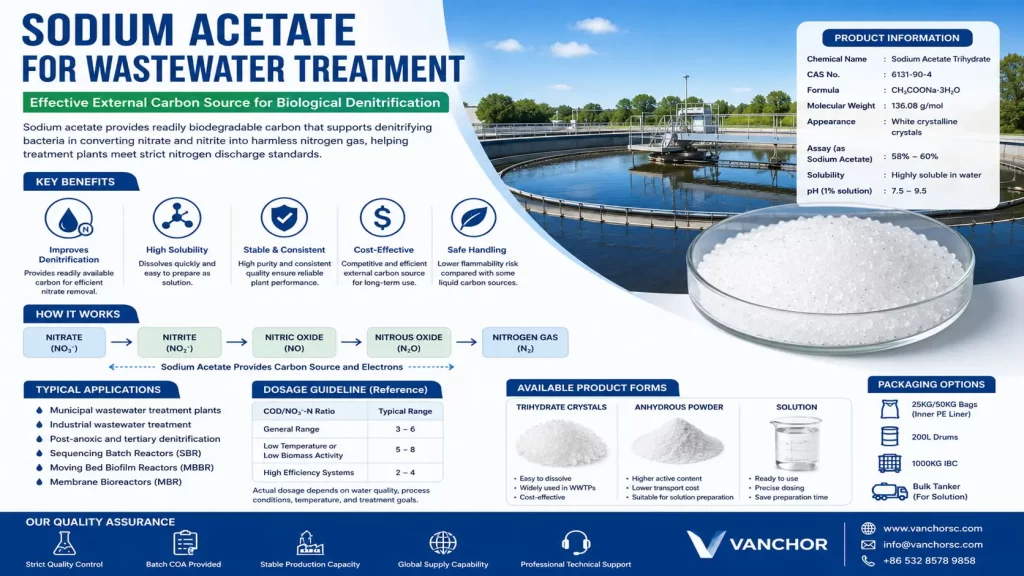
However, successful use of sodium acetate depends on more than adding a fixed quantity to the treatment system. Operators need to consider sodium acetate form, active content, nitrate loading, COD demand, dosing location, process temperature, dissolved oxygen, mixing, residual COD, and effluent nitrogen targets.
This guide explains how sodium acetate works in wastewater treatment and how treatment plants can select and dose it effectively.
Why Is an External Carbon Source Needed?
Biological nitrogen removal generally includes two main stages:
- Nitrification, in which ammonia is converted into nitrate under aerobic conditions
- Denitrification, in which nitrate is reduced to nitrogen gas under anoxic conditions
Denitrifying bacteria require an electron donor, usually an organic carbon source, to complete the denitrification process.
In many treatment plants, much of the biodegradable organic matter has already been consumed during primary treatment and aeration. As a result, wastewater entering a post-anoxic zone or tertiary denitrification filter may contain insufficient carbon to support complete nitrate removal.
The US Environmental Protection Agency notes that supplemental carbon is often required when organic matter has already been oxidized, particularly in post-anoxic zones and denitrifying filters. Common external carbon sources include methanol, ethanol, acetate, acetic acid, glycerol, molasses, and proprietary carbon formulations.
How Sodium Acetate Supports Denitrification
Sodium acetate dissolves in water and provides acetate ions that can be metabolized by heterotrophic microorganisms.
During denitrification, bacteria use the acetate as a source of energy and reducing power while converting oxidized nitrogen compounds into nitrogen gas.
A simplified process can be represented as:
Nitrate → Nitrite → Nitric oxide → Nitrous oxide → Nitrogen gas
Sodium acetate is often considered a readily biodegradable carbon source because acetate can be used by many heterotrophic organisms already present in activated-sludge systems. A scientific review of external carbon sources reports that sodium acetate can provide effective denitrification performance and is frequently selected where rapid biological availability is important.
Benefits of Sodium Acetate for Wastewater Treatment
Rapid Biological Availability
Acetate can be used by general heterotrophic denitrifying bacteria without requiring the same degree of specialized microbial adaptation associated with some other carbon sources.
This can support:
- Faster process response
- Stable nitrate removal
- Shorter acclimation periods
- Effective post-denitrification
- Operation under variable nitrate loading
Actual performance still depends on biomass condition, temperature, hydraulic retention time, dissolved oxygen, pH, and process configuration.
Consistent Carbon Content
Commercial sodium acetate can provide a more predictable carbon concentration than many waste-derived carbon sources.
Consistency is important because variation in carbon strength can lead to:
- Incomplete nitrate removal
- Excess residual COD
- Changes in sludge production
- Unstable dosing control
- Effluent-quality variation
- Pumping or handling problems
The EPA emphasizes that consistent COD loading is especially important in tertiary treatment systems because there may be limited downstream capacity to manage carbon breakthrough.
Lower Flammability Concerns Than Some Liquid Carbon Sources
Methanol and ethanol are effective carbon sources, but they introduce flammability, explosion-prevention, storage, and staff-training requirements.
Solid sodium acetate and properly prepared aqueous sodium acetate solutions may be easier for some facilities to handle. However, plants must still follow the relevant safety data sheet, chemical-storage procedures, spill controls, and local regulations.
Flexible Product Forms
Sodium acetate for wastewater treatment may be supplied as:
- Sodium acetate trihydrate crystals
- Anhydrous sodium acetate powder
- Sodium acetate granules
- Prepared sodium acetate solution
The correct form depends on storage space, dissolution equipment, dosing system, transport cost, and required active concentration.
Sodium Acetate Trihydrate vs Anhydrous
Both forms provide acetate after dissolution, but they contain different amounts of active sodium acetate.
| Property | Sodium Acetate Trihydrate | Anhydrous Sodium Acetate |
|---|---|---|
| Formula | CH₃COONa·3H₂O | CH₃COONa |
| CAS number | 6131-90-4 | 127-09-3 |
| Molecular weight | Approximately 136.08 g/mol | Approximately 82.03 g/mol |
| Crystal water | Three water molecules | None |
| Active content by weight | Lower | Higher |
| Typical appearance | White or colorless crystals | White powder or granules |
| Transport efficiency | Lower active content per ton | Higher active content per ton |
PubChem identifies sodium acetate trihydrate as the hydrated form of sodium acetate and links it to anhydrous sodium acetate under CAS 127-09-3.
Anhydrous sodium acetate generally provides more active acetate per kilogram. Sodium acetate trihydrate may offer easier sourcing, favorable pricing, or convenient dissolution characteristics.
Treatment plants should compare the products based on:
- Active sodium acetate content
- COD contribution
- Delivered price
- Storage volume
- Dissolution cost
- Packaging
- Freight
- Dosage requirement
Comparing only the price per metric ton can produce a misleading result.
Sodium Acetate Dosage for Denitrification
There is no universal sodium acetate dosage for all wastewater-treatment systems.
The required quantity depends on:
- Influent nitrate concentration
- Target effluent nitrate concentration
- Nitrite concentration
- Existing biodegradable COD
- Sodium acetate purity
- Product form
- Biomass yield
- Solids-retention time
- Temperature
- Dissolved oxygen
- Process configuration
- Required safety margin
External carbon dosage is normally evaluated using the COD-to-nitrogen ratio. The EPA explains that the required COD-to-nitrate-nitrogen ratio is affected by carbon-source type, biomass characteristics, electron-donor capacity, solids-retention time, and sludge yield.
Theoretical Starting Point
The theoretical oxygen demand of pure anhydrous sodium acetate is approximately:
0.78 kg COD per kg of anhydrous sodium acetate
For pure sodium acetate trihydrate, the theoretical value is approximately:
0.47 kg COD per kg of sodium acetate trihydrate
These values can be used as an initial conversion reference. However, the actual operating dosage will normally be higher than the minimum theoretical requirement because part of the carbon is used for biomass growth and other biological reactions.
A practical calculation can begin with:
Required carbon-source COD = Nitrate-N to be removed × Target COD:NO₃-N ratio
The required product quantity can then be calculated from:
Product dose = Required COD ÷ Product COD equivalent
The final setting should be verified through bench testing, pilot trials, process modeling, or controlled full-scale operation.
Example Dosage Calculation
Assume a plant needs to remove:
- Nitrate-N: 10 mg/L
- Flow rate: 5,000 m³/day
- Selected operating COD:NO₃-N ratio: 4.0
- Sodium acetate trihydrate COD equivalent: 0.47 kg COD/kg product
First calculate the nitrate load:
10 mg/L × 5,000 m³/day = 50 kg nitrate-N/day
Then calculate the required COD:
50 kg N/day × 4.0 kg COD/kg N = 200 kg COD/day
Then calculate the theoretical sodium acetate trihydrate requirement:
200 ÷ 0.47 = approximately 426 kg/day
This example is for explanation only. The selected COD:N ratio must be based on actual plant data, residual carbon, biomass behavior, temperature, and effluent requirements.
Operators should not apply the example dose directly to a treatment plant without process verification.
Where Should Sodium Acetate Be Dosed?
Common dosing points include:
- Pre-anoxic tanks
- Post-anoxic tanks
- Sequencing batch reactors
- Denitrification filters
- Moving-bed biofilm reactors
- Membrane bioreactor anoxic zones
- Tertiary biological filters
The dosing point should provide:
- Good mixing
- Low dissolved oxygen
- Sufficient anoxic contact time
- Contact with active denitrifying biomass
- Minimal carbon loss to aerobic zones
- Reliable online monitoring
Adding sodium acetate too early may allow aerobic organisms to consume the carbon before it reaches the denitrification stage.
Adding it too late may provide insufficient reaction time.
Key Operating Parameters
Dissolved Oxygen
Denitrification requires anoxic conditions. Excess dissolved oxygen consumes part of the added carbon and can reduce carbon-use efficiency.
Facilities should control oxygen carryover from upstream aeration systems and monitor dissolved oxygen at the sodium acetate dosing point.
Nitrate and Nitrite
Online nitrate or NOx monitoring can help adjust sodium acetate dosage according to changing nitrogen loads.
A fixed-dose system may overfeed during low-load periods and underfeed during peak loading.
Residual COD
Excess sodium acetate may appear as elevated COD in the final effluent.
This is particularly important in tertiary denitrification systems where there may be no later biological stage to remove residual carbon.
Oxidation-Reduction Potential
Oxidation-reduction potential can be used with nitrate, dissolved oxygen, flow, and laboratory data to evaluate anoxic conditions and identify denitrification endpoints.
Temperature
Biological reaction rates generally decrease at lower temperatures. Seasonal operating conditions should therefore be included in dosing and treatment-capacity evaluations.
Quality Requirements for Wastewater Applications
A sodium acetate supplier should provide a clear specification and batch certificate of analysis.
Important parameters may include:
| Parameter | Why It Matters |
|---|---|
| Assay | Determines active dosage |
| Product form | Affects dissolution and handling |
| Insoluble matter | May block pumps or dosing equipment |
| Chloride | Can contribute to effluent salinity |
| Sulfate | May affect selected industrial systems |
| Iron | May affect color or downstream processes |
| pH | Supports solution preparation and process control |
| Batch consistency | Helps maintain stable COD dosing |
| Heavy metals | Important for sludge and discharge quality |
| Packaging integrity | Protects material from moisture and contamination |
A low-purity or highly variable product can make dosage control less predictable.
Preparing a Sodium Acetate Solution
Solid sodium acetate is normally dissolved in water before metering into the treatment process.
A typical preparation system may include:
- Dry-product storage
- Bag unloading
- Dissolution tank
- Mixer
- Day tank
- Metering pump
- Flow meter
- Level control
- Secondary containment
During solution preparation:
- Add clean water to the mixing tank
- Start agitation
- Add sodium acetate gradually
- Continue mixing until fully dissolved
- Confirm solution concentration
- Transfer the solution to the dosing tank
- Calibrate the metering pump
Plants should avoid excessive solution concentrations that may cause crystallization under low-temperature storage conditions.
The final concentration should match pump capacity, tank size, ambient temperature, and expected daily consumption.
Avoiding Overdosing and Underdosing
Signs of Underdosing
- Elevated effluent nitrate
- Incomplete denitrification
- Low denitrification rate
- Nitrate breakthrough during peak flow
- Insufficient COD:NOx-N ratio
Signs of Overdosing
- Elevated effluent COD
- Increased sludge production
- Additional oxygen demand downstream
- Unnecessary chemical cost
- Possible process imbalance
- Increased dissolved solids
Automated feed-forward and feedback control can improve dosing efficiency. Flow, nitrate loading, residual nitrate, COD, and ORP can be incorporated into a control strategy.
Research has shown that online monitoring can improve external carbon-source control and reduce unnecessary sodium acetate addition compared with uncontrolled fixed dosing.
Storage and Handling
Sodium acetate should be stored in sealed packaging in a dry, clean, and ventilated area.
Recommended precautions include:
- Protect bags from moisture
- Keep packaging off the floor
- Avoid direct water exposure
- Reseal partially used bags
- Use first-in, first-out inventory control
- Prevent contamination
- Follow the supplier’s SDS
- Provide secondary containment for prepared solutions
Anhydrous sodium acetate can absorb moisture from the air, while sodium acetate trihydrate can be affected by unsuitable temperature and humidity conditions.
How to Select a Sodium Acetate Supplier
A reliable supplier should provide:
- Clear product identity
- Correct CAS number
- Defined active content
- Technical data sheet
- Safety data sheet
- Batch certificate of analysis
- Stable production capacity
- Suitable export packaging
- Sample availability
- Consistent delivery
- Quality-claim procedures
- Technical support
Buyers should also confirm whether the supplier is offering trihydrate, anhydrous material, or a prepared solution.
The quotation, product label, SDS, TDS, COA, and shipping documents should all identify the same product form.
Frequently Asked Questions
Why Is Sodium Acetate Added to Wastewater?
It is added as a readily biodegradable external carbon source to support biological nitrate and nitrite removal.
Is Sodium Acetate Suitable for Every Treatment Plant?
No. Its suitability depends on process design, nitrogen loading, residual COD, dosing equipment, operating cost, storage capacity, and discharge requirements.
Can Sodium Acetate Reduce Total Nitrogen?
It can support the denitrification stage of total nitrogen removal by providing carbon for the conversion of nitrate and nitrite into nitrogen gas.
Is Trihydrate or Anhydrous Sodium Acetate Better?
Anhydrous material offers higher active content per kilogram. Trihydrate may provide favorable handling, availability, or procurement economics. The selection should be based on active COD contribution and total delivered cost.
Can Sodium Acetate Be Overdosed?
Yes. Excess dosing can increase residual COD, sludge production, oxygen demand, dissolved solids, and operating costs.
Should Dosage Be Based Only on Flow?
No. Effective control should also consider nitrate loading, residual COD, temperature, dissolved oxygen, process response, and effluent targets.
Conclusion
Sodium acetate for wastewater treatment provides a controllable and readily available carbon source for biological denitrification.
It can support reliable nitrate removal in post-anoxic tanks, tertiary filters, sequencing batch reactors, and other biological nitrogen-removal systems. Its effectiveness depends on selecting the correct product form, calculating dosage from active COD content, maintaining anoxic conditions, and preventing both underfeeding and carbon breakthrough.
Vanchor supplies sodium acetate trihydrate and related chemical solutions for industrial wastewater-treatment applications. Buyers can request product specifications, certificates of analysis, packaging information, samples, and bulk quotations based on their process and destination requirements.


Contact Us
In This Article
Related Posts
Custom Packaging Solutions from an Anhydrous Sodium Acetate Supplier in China
2026-09-23
Application Trends in Anhydrous Sodium Acetate for Special Chemical Manufacturing
2026-09-23
Anhydrous Sodium Acetate for Leather Tanning: Improve Dyeing Uniformity
2026-09-22
Formic Acid 85% for Textile Dyeing: Industrial Applications, Technical Benefits and Future Trends
2026-09-22


