



Sodium Acetate Trihydrate vs Anhydrous: Key Differences and Selection Guide
By vanchor
2026-07-11Related Posts
Custom Packaging Solutions from an Anhydrous Sodium Acetate Supplier in China
2026-09-23

Application Trends in Anhydrous Sodium Acetate for Special Chemical Manufacturing
2026-09-23

Anhydrous Sodium Acetate for Leather Tanning: Improve Dyeing Uniformity
2026-09-22

Formic Acid 85% for Textile Dyeing: Industrial Applications, Technical Benefits and Future Trends
2026-09-22
When comparing sodium acetate trihydrate vs anhydrous, the most important difference is the amount of water contained in the crystal structure. Although both materials provide sodium acetate in industrial processes, their molecular weight, active content, physical behavior, storage requirements, transportation efficiency, and preferred applications are not identical.
Choosing the correct form is important for manufacturers using sodium acetate in wastewater treatment, textile processing, buffer preparation, food production, thermal energy storage, chemical synthesis, and other industrial applications.
This guide compares sodium acetate trihydrate and anhydrous sodium acetate to help procurement teams and process engineers select the appropriate grade.
What Is Sodium Acetate?
Sodium acetate is the sodium salt of acetic acid. It is commonly supplied as either an anhydrous material or a hydrated crystalline material.
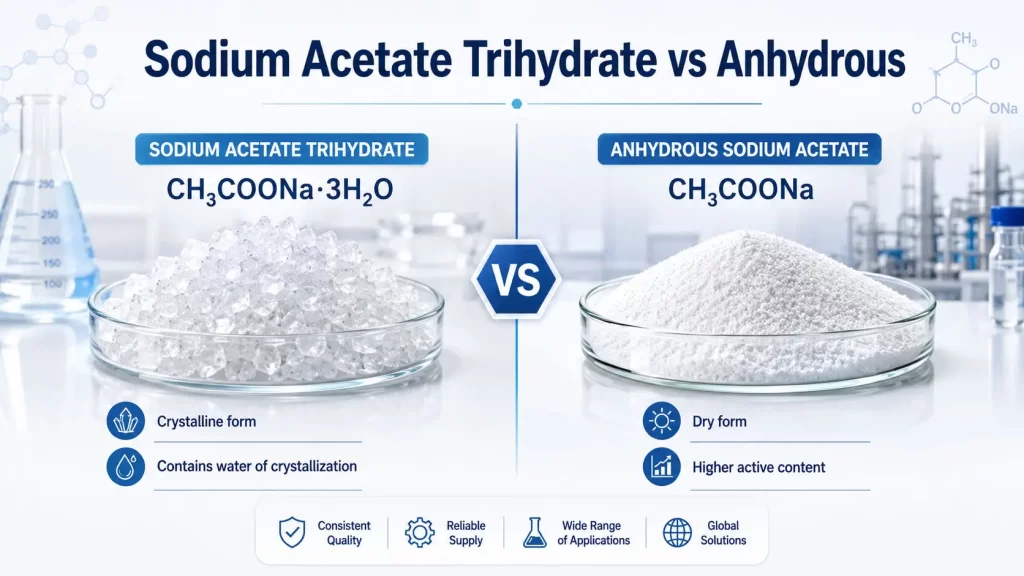
Anhydrous sodium acetate contains no water of crystallization and has the formula CH₃COONa. Its CAS number is 127-09-3, and its molecular weight is approximately 82.03 g/mol.
Sodium acetate trihydrate contains three water molecules for every sodium acetate unit. Its formula is CH₃COONa·3H₂O, its CAS number is 6131-90-4, and its molecular weight is approximately 136.08 g/mol.
Once dissolved in water, both forms provide sodium and acetate ions. However, the water contained in the trihydrate affects how much active sodium acetate is delivered per kilogram of product.
Sodium Acetate Trihydrate vs Anhydrous at a Glance
| Property | Sodium Acetate Trihydrate | Anhydrous Sodium Acetate |
|---|---|---|
| Chemical formula | CH₃COONa·3H₂O | CH₃COONa |
| CAS number | 6131-90-4 | 127-09-3 |
| Molecular weight | 136.08 g/mol | 82.03 g/mol |
| Water of crystallization | Three molecules | None |
| Approximate sodium acetate content by molecular weight | 60.3% | Close to 100%, depending on purity |
| Physical form | Colorless or white crystals | White crystalline powder or granules |
| Active material per kilogram | Lower | Higher |
| Moisture sensitivity | Can exchange crystal water under unsuitable conditions | Can absorb moisture from the environment |
| Thermal storage suitability | Commonly preferred | Generally not selected for hydrated phase-change systems |
| Transportation efficiency | Lower active content per shipment | Higher active content per shipment |
The exact commercial specification depends on the grade, manufacturing process, purity requirement, particle size, and intended application.
The Main Difference: Water of Crystallization
The three water molecules in sodium acetate trihydrate represent approximately 39.7% of its theoretical molecular weight. This means one kilogram of pure sodium acetate trihydrate does not deliver the same amount of sodium acetate as one kilogram of anhydrous material.
This distinction is especially important when calculating:
- Process dosage
- Buffer concentration
- Acetate ion demand
- Carbon-source addition
- Transportation cost
- Storage capacity
- Cost per unit of active ingredient
A process formulation written for anhydrous sodium acetate should not automatically use the same mass of sodium acetate trihydrate.
For example, approximately 1.66 kilograms of pure sodium acetate trihydrate would theoretically provide the same amount of sodium acetate as one kilogram of pure anhydrous sodium acetate. Actual commercial calculations should also consider the assay stated on the certificate of analysis.
Which Form Has Higher Active Content?
Anhydrous sodium acetate has a higher active sodium acetate content per kilogram because it does not contain crystal water.
This can make anhydrous sodium acetate attractive when:
- Shipping weight needs to be reduced
- Warehouse space is limited
- A concentrated formulation is required
- Additional water is undesirable
- Precise dry blending is important
- The process uses a high sodium acetate dosage
Sodium acetate trihydrate may still be the more practical choice when its crystalline form, handling characteristics, local availability, production cost, or thermal properties match the application.
Procurement decisions should therefore compare the cost per kilogram of active sodium acetate, rather than only the quoted cost per metric ton of product.
Solubility and Solution Performance
Both sodium acetate trihydrate and anhydrous sodium acetate are suitable for preparing aqueous sodium acetate solutions. Once properly dissolved, their functional acetate chemistry is generally comparable at an equivalent active concentration.
The operational difference is mainly found in the amount of product required to reach the target concentration.
When replacing one form with the other, manufacturers should recalculate the formulation based on:
- Product assay
- Molecular form
- Required acetate concentration
- Final solution volume
- Water already present in the formulation
Plants should also verify dissolution temperature, mixing time, water quality, and compatibility with other ingredients through laboratory or pilot testing.
Sodium Acetate for Wastewater Treatment
Sodium acetate can be used as an external carbon source in biological wastewater treatment processes. It may support microorganisms involved in processes such as denitrification when the incoming wastewater does not provide sufficient readily available carbon.
Both forms can be used when they meet the required technical specification. However, dosage must be calculated according to active sodium acetate content.
Anhydrous sodium acetate delivers more active material per kilogram, which may reduce transportation and storage volume. Sodium acetate trihydrate may offer convenient handling or a more favorable local purchase price.
Wastewater operators should evaluate:
- Required carbon dosage
- Product purity
- Insoluble matter
- Chloride and sulfate content
- Storage conditions
- Dissolution equipment
- Cost per unit of active material
- Consistency between production batches
Final dosing should be based on the actual wastewater composition, treatment targets, microbial performance, and plant operating data.
Sodium Acetate in Textile Processing
In textile dyeing and finishing, sodium acetate may be used to support pH control and buffering. It can help maintain suitable process conditions in selected dyeing operations and may also be used in formulations containing acetic acid.
Either sodium acetate trihydrate or anhydrous sodium acetate may be suitable, provided the formulation is adjusted for active content.
Anhydrous sodium acetate is often convenient for dry formulations because it contributes less water by weight. Trihydrate may be selected when crystalline handling, availability, or solution preparation requirements make it more suitable.
Textile manufacturers should confirm:
- Required pH range
- Dye and fiber compatibility
- Product purity
- Iron and heavy-metal limits
- Dissolution behavior
- Influence on shade consistency
- Batch-to-batch stability
A production trial is recommended before changing the sodium acetate grade or supplier.
Why Sodium Acetate Trihydrate Is Used in Heat Packs
One of the best-known applications of sodium acetate trihydrate is in reusable heat packs and thermal energy storage systems.
Sodium acetate trihydrate undergoes a phase transition near 58°C. It can form a supersaturated liquid that releases stored heat during controlled crystallization. NIST reports phase-change data around 331.5–331.7 K, equivalent to approximately 58.4–58.6°C.
This thermal behavior makes the trihydrate form particularly relevant for:
- Reusable hand warmers
- Bottle warmers
- Portable heating packs
- Low-temperature thermal storage
- Phase-change material research
Anhydrous sodium acetate does not provide the same hydrated phase-change system and is therefore not a direct substitute in these applications.
For commercial thermal-storage products, manufacturers must control purity, nucleation, phase separation, cycling stability, packaging integrity, and heat-release performance.
Food and Regulated Applications
Sodium acetate can be used in certain food, pharmaceutical, laboratory, and other regulated applications. However, chemical form alone does not determine whether a product is suitable.
A material labeled “sodium acetate trihydrate” or “anhydrous sodium acetate” may be supplied in industrial, food, reagent, pharmaceutical, or other grades.
Buyers should verify:
- Applicable regulatory standard
- Assay and impurity limits
- Heavy-metal requirements
- Microbiological requirements where applicable
- Manufacturing controls
- Allergen or GMO statements where required
- Certificate of analysis
- Traceability documentation
- Intended-use declaration
Industrial-grade sodium acetate should not automatically be treated as food-grade or pharmaceutical-grade material.
Storage and Packaging Differences
Both products should be stored in tightly sealed packaging in a dry, ventilated area away from incompatible materials.
Anhydrous sodium acetate can absorb moisture from humid air. Moisture uptake may change its flowability, weight, active concentration, and suitability for dry blending.
Sodium acetate trihydrate already contains crystal water, but unsuitable temperature and humidity conditions can still affect its crystalline structure, appearance, and handling properties.
Recommended procurement checks include:
- Moisture-resistant inner liners
- Secure bag or drum sealing
- Pallet protection
- Batch identification
- Storage temperature recommendations
- Shelf-life information
- Handling instructions
- Packaging compatibility with transport conditions
Common packaging options may include lined bags, larger industrial sacks, drums, or customized bulk packaging, depending on the grade and destination.
How to Choose Between Sodium Acetate Trihydrate and Anhydrous
Choose sodium acetate trihydrate when:
- The application specifically requires hydrated sodium acetate
- Thermal energy storage or heat-pack performance is needed
- The existing formulation is designed for the trihydrate
- The crystalline form is easier for the process to handle
- Local supply economics favor the hydrated grade
Choose anhydrous sodium acetate when:
- Maximum active content per kilogram is important
- Transportation and storage efficiency are priorities
- The formulation must minimize added water
- The material will be used in a concentrated dry blend
- Dosage precision is based on an anhydrous specification
Neither form is universally better. The correct choice depends on process requirements, active concentration, handling conditions, applicable regulations, and total delivered cost.
Questions to Ask a Sodium Acetate Supplier
Before placing a bulk order, request the following information:
- Exact chemical form
- CAS number
- Product assay
- Moisture or water content
- pH specification
- Insoluble matter
- Chloride and sulfate limits
- Heavy-metal limits
- Particle size
- Packaging options
- Batch certificate of analysis
- Safety data sheet
- Production lead time
- Sample availability
Buyers should make sure that quotations, technical data sheets, safety data sheets, labels, and certificates of analysis all describe the same chemical form.
Frequently Asked Questions
Is Sodium Acetate Trihydrate the Same as Anhydrous Sodium Acetate?
No. They provide the same sodium acetate chemistry after dissolution, but sodium acetate trihydrate contains three molecules of crystal water, while anhydrous sodium acetate contains no water of crystallization.
Can Sodium Acetate Trihydrate Replace Anhydrous Sodium Acetate?
It may replace it in some aqueous applications, but the dosage must be recalculated according to active content. It is not automatically interchangeable in dry blends, regulated products, or thermal-storage applications.
Which Form Is More Concentrated?
Anhydrous sodium acetate is more concentrated by weight because it does not contain crystal water.
Which Form Is Better for Heat Packs?
Sodium acetate trihydrate is the appropriate form for conventional reusable heat packs because of its hydrated phase-change and crystallization behavior.
Which Form Is More Economical?
The answer depends on purchase price, assay, freight, storage, handling, and process dosage. Compare the delivered cost per kilogram of active sodium acetate rather than only the price per ton.
Conclusion
The comparison of sodium acetate trihydrate vs anhydrous is primarily a comparison of water content, active concentration, physical behavior, and application suitability.
Sodium acetate trihydrate is widely selected for hydrated formulations and thermal energy storage, while anhydrous sodium acetate offers higher active content and greater transportation efficiency. In aqueous industrial applications, both forms may perform effectively when dosage is calculated correctly.
Vanchor supplies sodium acetate solutions for industrial and commercial requirements. Buyers can request specifications, packaging information, certificates of analysis, and product samples to determine which sodium acetate grade is suitable for their process.


Contact Us
In This Article
Related Posts
Custom Packaging Solutions from an Anhydrous Sodium Acetate Supplier in China
2026-09-23
Application Trends in Anhydrous Sodium Acetate for Special Chemical Manufacturing
2026-09-23
Anhydrous Sodium Acetate for Leather Tanning: Improve Dyeing Uniformity
2026-09-22
Formic Acid 85% for Textile Dyeing: Industrial Applications, Technical Benefits and Future Trends
2026-09-22


