



Sodium Formate Factory China: Production, Quality Control, and Sourcing Factors
By vanchor
2026-07-17Related Posts
Custom Packaging Solutions from an Anhydrous Sodium Acetate Supplier in China
2026-09-23

Application Trends in Anhydrous Sodium Acetate for Special Chemical Manufacturing
2026-09-23
Anhydrous Sodium Acetate for Leather Tanning: Improve Dyeing Uniformity
2026-09-22
Formic Acid 85% for Textile Dyeing: Industrial Applications, Technical Benefits and Future Trends
2026-09-22
China is an important production and export base for industrial chemicals, including sodium formate. Buyers searching for a Sodium Formate Factory China may find significant differences in product grade, impurity control, packaging, technical documentation, and export capability.
Sodium formate is used in leather processing, textile production, chemical manufacturing, deicing formulations, oilfield systems, and selected construction chemicals. Because these applications have different technical requirements, factory selection should involve more than comparing purity and price.
A suitable Sodium Formate Factory China should demonstrate stable production control, batch traceability, application-specific specifications, and reliable delivery planning.
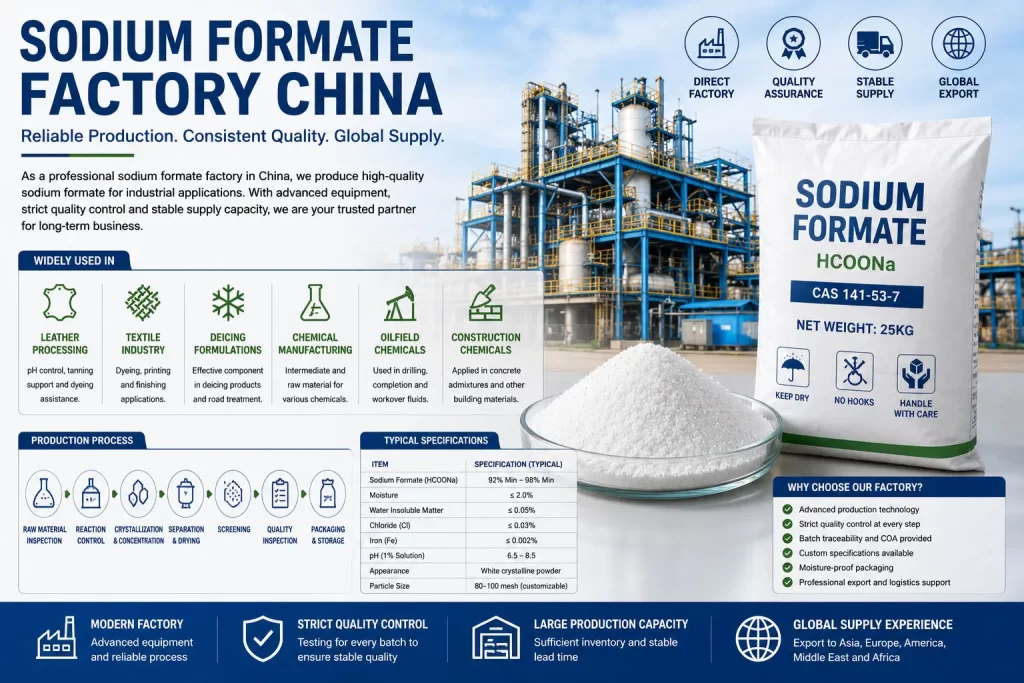
What Is Sodium Formate?
Sodium formate is the sodium salt of formic acid. It is commonly supplied as a white crystalline powder.
| Property | Basic Information |
|---|---|
| Chemical name | Sodium formate |
| Chemical formula | HCOONa |
| CAS number | 141-53-7 |
| Molecular weight | Approximately 68.01 g/mol |
| Appearance | White crystalline powder |
| Common grades | Industrial grades with different assay levels |
Sodium formate absorbs moisture from the surrounding environment. For this reason, moisture control during production, packaging, storage, and transportation is important.
How Is Sodium Formate Produced?
Industrial production routes may vary by manufacturer and available raw materials. A factory may produce sodium formate through reactions involving formic acid and sodium-based compounds or as part of an integrated chemical production process.
Regardless of the production route, the main manufacturing stages generally include:
- Raw-Material Preparation: Sodium-containing and formate-related raw materials are inspected before use.
- Reaction Control: Temperature, concentration, pH, and reaction time are controlled to support stable conversion.
- Concentration and Crystallization: The solution is concentrated to form sodium formate crystals.
- Separation and Drying: Crystals are separated and dried to control moisture.
- Screening: The dried material is screened to obtain a suitable particle-size distribution.
- Quality Inspection: Samples are tested for assay, moisture, insoluble matter, chloride, iron, and other specified properties.
- Packaging: The product is packed in moisture-resistant bags and prepared for storage or export.
A Sodium Formate Factory China should be able to explain how these stages are controlled rather than relying only on a finished-product specification.
Which Quality Indicators Matter?
Sodium formate grades may range from lower-purity industrial material to higher-purity products for more sensitive applications.
| Quality Indicator | Why It Matters |
|---|---|
| Sodium formate assay | Indicates the main chemical content |
| Moisture | Affects caking, storage, and dosing |
| Water-insoluble matter | Influences dissolution and process cleanliness |
| Chloride | Important for corrosion-sensitive applications |
| Iron | May affect color-sensitive processes |
| Particle size | Influences powder flow and dissolution speed |
| pH | Helps evaluate downstream compatibility |
| Appearance | May reveal contamination or storage problems |
Buyers should distinguish between typical values and guaranteed specification limits. Typical data describe expected performance, while guaranteed limits define what the factory commits to supplying.
Common Applications
Leather Processing
Sodium formate may be used in leather-processing systems where pH adjustment, dyeing control, or process stabilization is required.
For these applications, buyers may focus on:
- Low iron content
- Controlled insoluble matter
- Good dissolution
- Stable batch-to-batch quality
- Compatibility with other tanning chemicals
Textile Manufacturing
In textile processing, sodium formate may be used as a process chemical in dyeing and finishing operations.
Color-sensitive applications may require stricter control of iron, insoluble residue, and contamination.
Deicing Formulations
Sodium formate can be incorporated into certain solid or liquid deicing formulations.
Relevant considerations include:
- Fast dissolution
- Controlled particle size
- Low moisture
- Seasonal production capacity
- Corrosion-inhibitor compatibility
- Moisture-resistant packaging
The finished deicing formulation normally requires additional additives and performance testing. Raw sodium formate alone should not be treated as a complete pavement deicer.
Chemical Manufacturing
Sodium formate may function as an intermediate, process salt, reducing component, or raw material in downstream chemical production.
In this application, the required specification depends on the reaction process and sensitivity to impurities.
Oilfield and Industrial Fluids
Formate salts can be used in selected drilling, completion, and industrial fluid systems. Buyers should confirm whether sodium formate is suitable for the required density, corrosion profile, temperature, and fluid composition.
What Should Buyers Check at a Factory?
A factory audit or supplier qualification process should cover several areas.
Raw-Material Control
The factory should inspect incoming raw materials and maintain approved-supplier records. Changes in raw-material source can affect impurity levels and final consistency.
Production Monitoring
Important process variables may include:
- Reaction temperature
- Concentration
- pH
- Crystallization conditions
- Drying temperature
- Final moisture
- Screening performance
Laboratory Capability
A Sodium Formate Factory China should have suitable testing procedures for the agreed specification.
Buyers may ask which methods are used to test:
- Assay
- Moisture
- Chloride
- Iron
- Water-insoluble matter
- Particle size
- pH
Batch Traceability
Each production batch should have a unique identification number linked to raw materials, process records, test results, and packaging information.
Nonconforming Product Control
The factory should have procedures for isolating, investigating, reprocessing, or rejecting material that does not meet specification.
Packaging Options
Sodium formate must be protected from moisture during storage and transportation.
Common packaging formats include:
- 25 kg bags
- Multi-layer paper bags with inner liners
- Woven bags with polyethylene liners
- 500 kg or 1,000 kg bulk bags
- Palletized export packaging
- Customized labels and markings
The appropriate packaging depends on unloading equipment, warehouse conditions, shipment distance, and local regulations.
Buyers should also confirm:
- Net weight tolerance
- Pallet dimensions
- Container-loading quantity
- Moisture protection
- Bag strength
- Label information
Factory Versus Trading Company
Working directly with a factory may provide closer access to production data, samples, and specification adjustments. However, a trading company may offer broader product consolidation, export coordination, and logistics support.
| Factor | Factory | Trading Company |
|---|---|---|
| Production control | Direct | Indirect |
| Product range | Usually narrower | Often broader |
| Custom specifications | Potentially easier | Depends on factory relationship |
| Export coordination | Varies by factory | Often experienced |
| Technical communication | Closer to production | May involve an additional layer |
| Consolidated sourcing | Limited | More flexible |
The appropriate choice depends on order volume, technical complexity, product range, and supply-chain requirements.
Documents to Request
Before placing an order with a Sodium Formate Factory China, buyers should request:
- Product specification
- Batch-specific Certificate of Analysis
- Technical Data Sheet
- Safety Data Sheet
- Packaging information
- Quality-management certificates
- Export documentation examples
- Product sample
- Traceability information
- Regulatory statements where applicable
Document names, product grade, manufacturer identity, and batch information should be consistent.
How to Compare Quotations
A useful quotation comparison should include more than price per metric ton.
| Comparison Item | Purchasing Question |
|---|---|
| Grade | Are the purity and impurity limits equivalent? |
| Packaging | Are the bag type and pallet method the same? |
| Incoterm | Does the price include freight or insurance? |
| Quantity | Is the quotation based on the same order size? |
| Lead time | When can production and shipment begin? |
| Documentation | Are COA, SDS, and export documents included? |
| Payment terms | What financial conditions apply? |
| Sample testing | Has the offered grade been approved? |
A lower price may not represent a lower total cost if the material produces caking, inconsistent dissolution, delayed delivery, or additional inspection requirements.
Vanchor’s Supply Approach
Vanchor supplies sodium formate for industrial applications and coordinates product specifications, quality documentation, packaging, and international delivery according to customer requirements.
Before commercial orders, buyers should review the offered grade and test a representative sample under actual production conditions. This is particularly important when changing suppliers or using sodium formate in a sensitive process.
Conclusion
Selecting a Sodium Formate Factory China requires a structured review of production control, quality indicators, laboratory capability, batch traceability, packaging, and export reliability.
Assay remains important, but moisture, chloride, iron, insoluble matter, particle size, and batch stability may have an equal influence on downstream performance.
The most reliable sourcing process combines factory qualification, document review, representative sample testing, and clear purchasing specifications. This approach helps reduce quality variation and supports more predictable industrial production.


Contact Us
In This Article
Related Posts
Custom Packaging Solutions from an Anhydrous Sodium Acetate Supplier in China
2026-09-23
Application Trends in Anhydrous Sodium Acetate for Special Chemical Manufacturing
2026-09-23
Anhydrous Sodium Acetate for Leather Tanning: Improve Dyeing Uniformity
2026-09-22
Formic Acid 85% for Textile Dyeing: Industrial Applications, Technical Benefits and Future Trends
2026-09-22


