



Formic Acid Storage: Tank Materials, Temperature, and Safety Guide
By vanchor
2026-07-07Related Posts
Custom Packaging Solutions from an Anhydrous Sodium Acetate Supplier in China
2026-09-23
Application Trends in Anhydrous Sodium Acetate for Special Chemical Manufacturing
2026-09-23
Anhydrous Sodium Acetate for Leather Tanning: Improve Dyeing Uniformity
2026-09-22
Formic Acid 85% for Textile Dyeing: Industrial Applications, Technical Benefits and Future Trends
2026-09-22
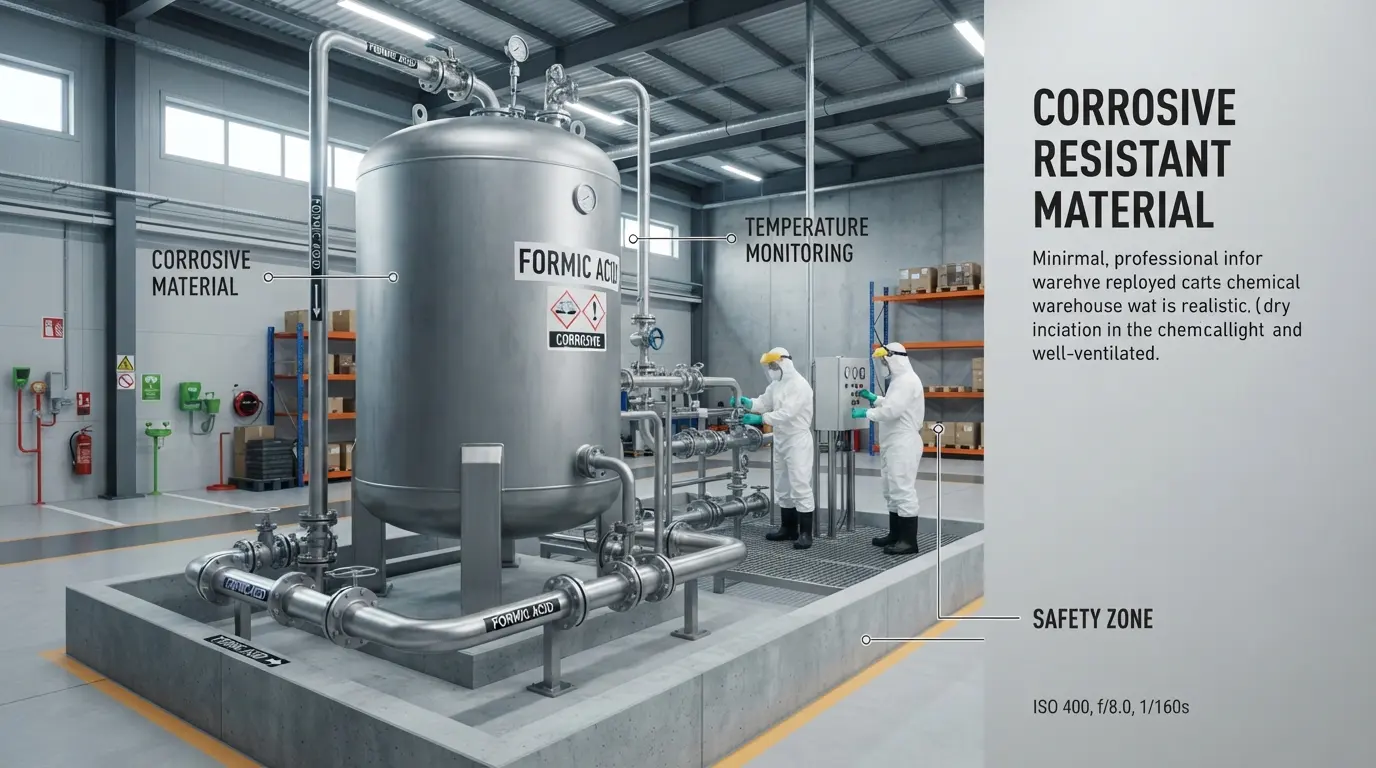
Formic acid storage comes down to one practical question: how do you keep the chemical safely contained without damaging the tank, fittings, or surrounding system? The answer depends on material compatibility, temperature behavior, and basic safety controls such as venting and secondary containment.
For a broader overview of the chemical itself, see our Formic Acid CAS 64-18-6: Properties, Applications, Grades, and Purchasing Guide (inferred).
What Makes Formic Acid Storage Different
Formic acid is not something you treat like an ordinary liquid in bulk storage. Its compatibility profile means the tank body is only part of the picture; seals, piping, vents, and transfer equipment also matter. The storage setup should be evaluated as a system, not just as a container.
Concentration also matters. A storage solution that looks acceptable for one grade or concentration may not be ideal for another, so buyers should verify the exact product specification and review the SDS before making a storage decision.
Choosing the Right Tank Material
The tank material is the central storage decision because it affects corrosion resistance, service life, and maintenance risk. In practice, the most relevant comparison is usually between plastic options such as HDPE, metal options such as stainless steel, and lined steel systems.
A simple rule helps: do not assume that one material is universally best. The right choice depends on concentration, operating temperature, transfer method, and whether the full system — including seals and fittings — is chemically compatible.
| Material | Practical role in storage | What to check |
|---|---|---|
| HDPE | Common plastic storage candidate | Compatibility with the exact concentration, structural strength, temperature limits |
| Stainless steel | Common metal comparison point | Grade, corrosion behavior, and compatibility with the acid service |
| Lined steel | Alternative system option | Lining type, integrity, and maintenance requirements |
The tank body is not the only point of failure. Gaskets, pipe runs, valves, and pump seals can create a leak path even when the main tank material looks acceptable. That is why formic acid storage should be reviewed as a full materials package, not a single-product choice.
Tank body versus seals and fittings
If a tank is compatible but the seals are not, the storage setup still fails. The same is true for piping and pumps, which can be more exposed during transfer and maintenance.
A practical review should ask:
Are the gaskets and seals rated for formic acid service?
Are the pipe and fitting materials compatible with the same concentration?
Will the transfer equipment be exposed to splashes, residue, or vapor?
Temperature Considerations for Storage
Temperature affects more than comfort or convenience; it affects whether the chemical remains easy to handle and whether the storage system stays stable in real conditions. Cold weather can change how the liquid behaves in tanks, lines, and transfer equipment, which is why temperature planning belongs in the storage decision.
For many users, the main concern is not a precise number from a generic guide but the operational effect of cold storage. If the chemical gets too cold, handling can become more difficult, and the risk of crystallization or restricted flow can increase depending on the product and conditions.
What happens in cold weather
Cold conditions can create practical issues such as slower transfer, more difficult pumping, and possible phase-related handling problems. That is especially important for outdoor tanks, uninsulated piping, and facilities with seasonal temperature swings.
The safest approach is to check the exact product documentation, then design storage around the lowest expected ambient conditions rather than average conditions. If the system must operate in winter, temperature protection may matter as much as tank material choice.
Safety Systems That Should Be in Place
A formic acid storage setup should include more than a compatible tank. Secondary containment helps limit the impact of a leak, while venting helps the system manage pressure and vapor-related issues more safely.
The goal is not only to protect the product but also to protect people, equipment, and the surrounding area. Good storage planning should also make spill response straightforward rather than improvised.
A practical safety checklist includes:
Secondary containment sized and positioned for the storage area.
Venting that matches the storage setup and operating conditions.
Transfer methods that reduce splash, residue, and exposure.
Clear access for inspection, cleaning, and emergency response.
Documented SDS review before storage is approved.
Common storage mistakes
The most common mistakes are usually simple but costly:
Choosing a tank material without checking the full system compatibility.
Ignoring seals, gaskets, and fittings.
Overlooking cold-weather handling conditions.
Skipping secondary containment.
Assuming one concentration behaves the same as another.
These mistakes matter because formic acid storage failures often start at the weakest component, not at the main tank wall.
What Buyers Should Verify Before Choosing a Storage Setup
Before approving a storage solution, buyers should confirm the exact concentration, review the SDS, and verify that the tank, seals, piping, and transfer equipment all match the intended service. If the storage decision is part of a broader sourcing or procurement process, documentation matters as much as the hardware.
Vanchor’s product page for formic acid notes COA and SDS availability, which is useful context when evaluating storage and handling documentation. For procurement follow-up, the related bulk formic acid supplier page and formic acid manufacturer page can be useful next steps, depending on whether the reader is comparing supply options or validating documentation.
Related Formic Acid Topics
If the storage decision is part of a broader formic acid project, two related pages are especially relevant. The main pillar covers the chemical in broader context, while the descaling page is the closest operational sibling for industrial use cases.
For readers who need a safe, practical setup, the key is simple: choose a compatible tank system, verify seals and fittings, plan for temperature conditions, and confirm the safety documentation before storage begins.


Contact Us
In This Article
Related Posts
Custom Packaging Solutions from an Anhydrous Sodium Acetate Supplier in China
2026-09-23
Application Trends in Anhydrous Sodium Acetate for Special Chemical Manufacturing
2026-09-23
Anhydrous Sodium Acetate for Leather Tanning: Improve Dyeing Uniformity
2026-09-22
Formic Acid 85% for Textile Dyeing: Industrial Applications, Technical Benefits and Future Trends
2026-09-22


