



Formic Acid for Industrial Descaling: Concentration, Compatibility, and Control
By vanchor
2026-07-24Related Posts
Custom Packaging Solutions from an Anhydrous Sodium Acetate Supplier in China
2026-09-23
Application Trends in Anhydrous Sodium Acetate for Special Chemical Manufacturing
2026-09-23
Anhydrous Sodium Acetate for Leather Tanning: Improve Dyeing Uniformity
2026-09-22
Formic Acid 85% for Textile Dyeing: Industrial Applications, Technical Benefits and Future Trends
2026-09-22
Formic acid can be used for industrial descaling, but the real question is not just whether it works — it is whether the concentration, temperature, and metallurgy in your system make it a safe choice. In practice, it is a process-control problem as much as a chemistry problem.patents.
For broader product context, grades, and purchasing details, see the parent guide on Formic Acid CAS 64-18-6: Properties, Applications, Grades, and Purchasing Guide (inferred).
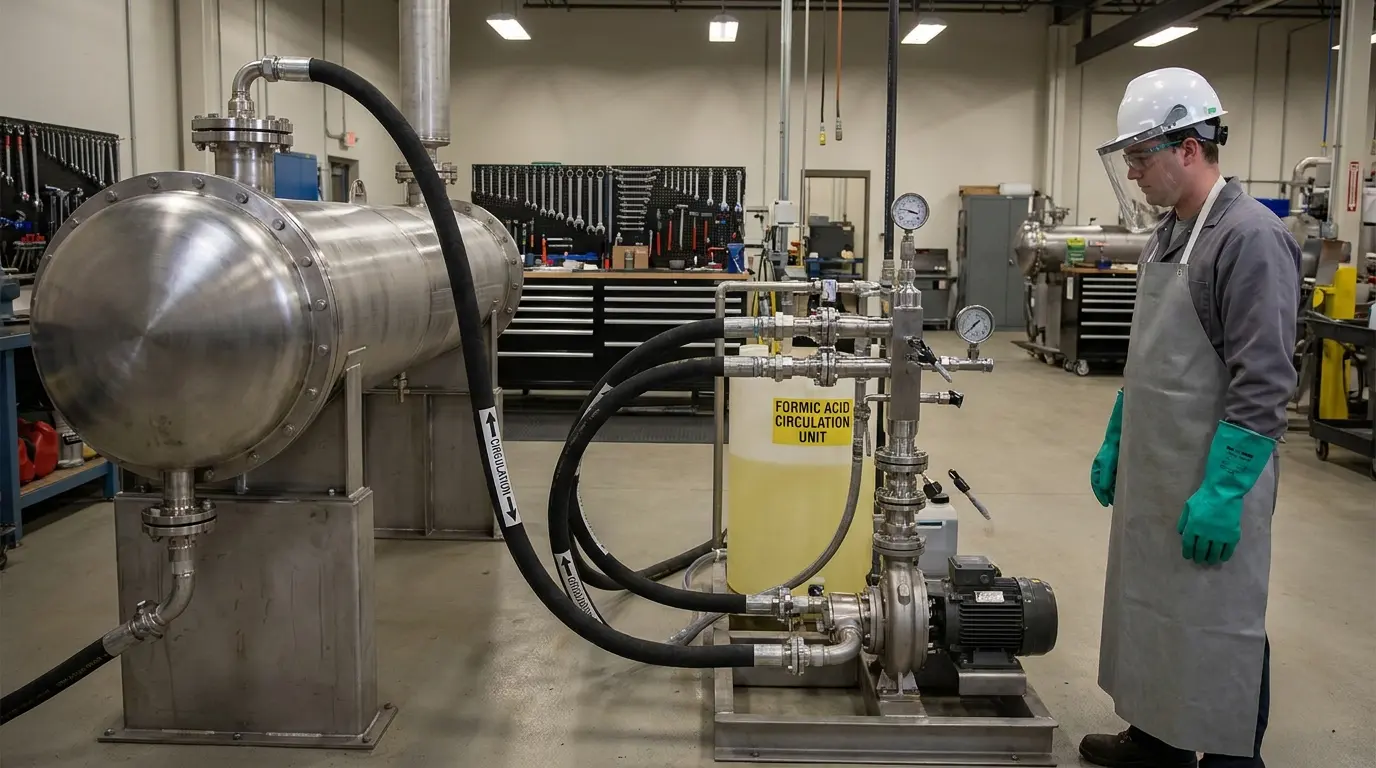
When Formic Acid Is Used for Industrial Descaling
Formic acid is most relevant when the target is industrial scale removal rather than broad-purpose cleaning. The live technical results point to its use against iron oxide scale and related deposits on steel surfaces, especially where the cleaning solution is being formulated as a controlled acid wash rather than an aggressive pickling blend.patents.google
That makes it useful in systems where scale has built up inside equipment and the operator needs a chemical that can dissolve deposits without automatically moving to a stronger mineral acid. The trade-off is that the same chemistry that helps strip scale can also attack metal if the system, concentration, or exposure time is wrong.doaj+1
What scale types it handles best
Formic acid is most defensible when the scale is mineralized and oxide-heavy, especially iron oxide scale. It is less about “all-purpose dirt removal” and more about a targeted chemical response to a deposit problem.patents.google
For the reader, the practical question is simple: if the buildup is a hard scale layer rather than surface soil, formic acid may be a viable candidate; if the problem is general fouling, another cleaner may be a better fit. That distinction matters because the article’s intent is to help choose the right treatment, not to sell acid as a universal cleaner.patents.google+1
Concentration, Dilution, and Operating Conditions
Concentration is the first variable to control because it affects both cleaning speed and corrosion risk. The research shows that formic acid becomes more aggressive to stainless steel as conditions intensify, so there is no safe “one-size-fits-all” strength for every system.doaj+1
In practice, descaling solutions are usually designed as diluted, controlled-use formulations rather than a “use it straight and hope for the best” approach. The exact usable window depends on the metal, the deposit, temperature, and whether the formulation includes corrosion protection.patents.google+1
Temperature matters just as much. Higher temperature can improve cleaning performance, but it can also accelerate corrosion, which is why the compatibility question cannot be separated from the process conditions.doaj+1
Why concentration changes both cleaning and corrosion
A stronger solution is not automatically a better one. As concentration rises, formic acid can become more effective at attacking scale, but it also raises the risk of metal attack on exposed surfaces.doaj
That is why a descaling program needs two checks at the same time: will it remove the deposit, and will it leave the base metal in acceptable condition? The live evidence on stainless steel corrosion makes that trade-off especially important.doaj+1
Material Compatibility and Corrosion Risk
Compatibility is the section that most readers need before they commit to a cleaning plan. Formic acid is not simply “good” or “bad” for metal; its effect depends on alloy type, concentration, temperature, and time in contact.chemicalresistance+1
Stainless steel is often the first concern because it is common in industrial equipment and can still suffer corrosion under acidic conditions. The technical sources show that corrosion behavior changes with concentration and temperature, and that 316L in particular is not immune to attack in aqueous formic acid at elevated severity.doaj+1
Carbon steel generally deserves even more caution in mixed-metal systems, because an acid descaling cycle that is acceptable for one component may be too aggressive for another. If the system includes different metals, the cleaning plan should be built around the most vulnerable surface, not the most tolerant one.chemicalresistance+1
Stainless steel versus carbon steel
| Material | Practical compatibility view | Main concern | What to check first |
|---|---|---|---|
| Stainless steel 304 | May tolerate some conditions, but not automatically safe | Corrosion can increase as conditions intensify | Concentration, temperature, and exposure time chemicalresistance+1 |
| Stainless steel 316L | Often treated as a higher-resistance option, but still condition-sensitive | Corrosion risk rises under harsher acid conditions | Actual process severity, not just alloy name doaj |
| Carbon steel | Higher caution level in acid cleaning systems | Faster attack and mixed-metal risk | Whether the system can be isolated or protected alleima |
That table is the decision point many competitors skip. The useful answer is not a blanket “yes” or “no,” but a controlled compatibility check before any cleaning cycle begins.doaj+2
How to Control the Descaling Process
A good formic-acid descaling program is built around control, not guesswork. The main controls are concentration, temperature, contact time, agitation or circulation, and whether the formulation includes an inhibitor.patents.google+1
Circulation cleaning is often more controllable than static soaking because it helps move fresh solution across the deposit and reduces uneven exposure. Soaking can still be useful for smaller or isolated components, but it makes time control and corrosion monitoring more important.patents.google
A practical sequence is usually: confirm metallurgy, choose a conservative starting concentration, define a short exposure window, monitor the result, and stop as soon as the scale is removed. If the surface needs additional protection afterward, follow the cleaning step with the appropriate rinse or post-treatment required by the system.patents.google+1
Circulation or soaking?
Use circulation when the equipment geometry allows it, because it tends to give more even chemical contact and better process control. Use soaking only when the part geometry or operational setup makes circulation impractical.patents.google
The difference matters because contact time is not a minor detail; it is one of the main variables that separates effective descaling from unnecessary corrosion exposure.doaj+1
When Formic Acid Is Not the Right Choice
Formic acid is not the safest answer for every descaling job. If the metallurgy is uncertain, if the system includes sensitive stainless grades, or if the cleaning conditions require high temperature and long exposure, the risk can outweigh the benefit.doaj+2
It is also a poor fit when the plant needs a chemistry with a very wide compatibility margin and no room for testing. In those cases, the best next step is usually to compare alternative cleaning approaches rather than force formic acid into a marginal application.chemicalresistance+1
Practical takeaway for buyers and plant teams
If you are evaluating formic acid for industrial descaling, the decision should start with three questions: what scale are you removing, what metal is being cleaned, and how tightly can you control the process? Those three answers usually determine whether the acid is a sensible tool or a corrosion risk.doaj+2
For broader product specifications, grade options, and purchasing context, return to the parent guide on Formic Acid CAS 64-18-6: Properties, Applications, Grades, and Purchasing Guide (inferred). If storage and handling are the next concern, the related Formic Acid Storage page is the more relevant follow-up.anobee


Contact Us
In This Article
Related Posts
Custom Packaging Solutions from an Anhydrous Sodium Acetate Supplier in China
2026-09-23
Application Trends in Anhydrous Sodium Acetate for Special Chemical Manufacturing
2026-09-23
Anhydrous Sodium Acetate for Leather Tanning: Improve Dyeing Uniformity
2026-09-22
Formic Acid 85% for Textile Dyeing: Industrial Applications, Technical Benefits and Future Trends
2026-09-22


