


Isobutanol 99.3% vs N-Butanol 99.5%: Key Differences for Industrial Buyers
By Vanchorsc
2026-10-22Related Posts
How to Choose a Reliable 2-Ethylhexanol (2-EH) Supplier in China: Quality, Packaging and Shipping
2026-10-22
Natural vs Synthetic Sodium Sulfate Anhydrous: Which Is Better for Industrial Applications?
2026-10-22
Isobutanol 99.3% Price and Supply in 2026: A Guide for Chemical Importers
2026-10-22
Sodium Sulfate Anhydrous 99% for Detergent Manufacturing: Benefits, Specifications and Bulk Supply
2026-10-22
A coating manufacturer replacing n-butanol with isobutanol may find that the new formulation meets its initial viscosity target but develops poor leveling during drying. The problem is not necessarily solvent purity. Different evaporation rates and resin–solvent interactions can change how the wet film behaves as solvent leaves.
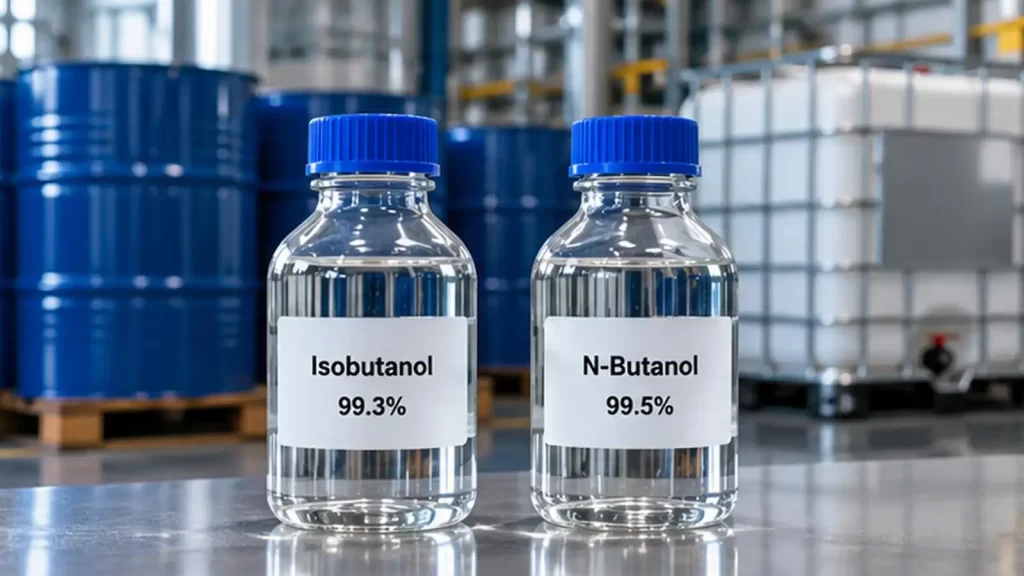
Buyers considering Isobutanol 99.3% and N-Butanol 99.5% usually regard the molecular structure of a solvent to be of greater importance than purity. Impurities and process compatibility tend to be of greater concern for solvent producers and synthesis chemists. In chemical synthesis, choosing the wrong isomer can yield an entirely different derivative.
1. Impact of Molecular Structure on Solvent Performance
What effect does the presence of branching iso groups have when compared to straight chain groups on the molecular packing and solvent performance? As far as molecular weight is concerned, both N-Butanol and Isobutanol are the same and both contain a primary hydroxyl group. However, as Isobutanol contains an iso group, it is expected that solvent performance will be different compared to N-Butanol.
| Property | Isobutanol 99.3% | N-Butanol 99.5% |
| CAS number | 78-83-1 | 71-36-3 |
| Molecular structure | Branched | Linear |
| Comparison-grade purity | ≥99.3% | ≥99.5% |
| Boiling point | Approx. 108°C | Approx. 117–118°C |
| Vapor pressure at 25°C | Approx. 10.5 mmHg | Approx. 7.0 mmHg |
| Water solubility | Limited | Limited |
| Acetate derivative | Isobutyl acetate | n-Butyl acetate |
Physical-property values are approximate reference data from the U.S. EPA, not Vanchor batch measurements.
At 25°C, isobutanol has about 50% higher equilibrium vapor pressure than n-butanol. This difference, by itself, doesn't mean a coating containing isobutanol would dry 50% faster. Drying is brought about by change in the composition of the coating solution and solvent, diffusion through the wet film, air movement, and temperature.
n-Butanol has lower volatility than isobutanol. This allows a longer period for leveling of the film. Isobutanol may be better when rapid solvent release is required and the resin remains soluble during the process.
2. Can Isobutanol Replace N-Butanol in Coatings and Inks?
There are some cases where a direct substitution is technically possible, but equivalent viscosity doesn't always mean equivalent coating performance.
As solvent evaporates during drying, the polymer concentration increases. If the remaining solvent blend can't dissolve the resin, it may lead to localized precipitation or surface defects, and film leveling may not occur.
With n-butanol-based systems, slower solvent removal may assist film leveling and wet-edge retention. Retention of too much solvent, however, may increase drying time and lead to residual solvent if the curing cycle is not adequate.
For isobutanol-based formulations, greater volatility does shorten the solvent release time. However, at high airflow and elevated substrate temperatures, premature buildup of viscosity may lead to orange peel and other defects in surface appearance, and flow.
In regard to boiling points, neither solvent exhibits better solvent performance. Solvency is determined by the complete formulation which may include, esters, ketones, hydrocarbons, and other alcohols.
A substitution test assesses the following:
•Resin Compatibility: Determine if resin shows (pre)cipitation, clarity, and viscosity over (operating) temperature and airflow.
•Evaporation: Compare mass loss curves and evaluate airflow and temperature.
•Film: Evaluate gloss, and surface defects; determine drying time and solvent level.
•Storage Stability: Evaluate for phase separation, sediment and viscosity over time of resin.
Water contamination in solvent systems is a problem. Both alcohols have limited solubility in water and changes in the mixture may alter the phase behavior.
3. Why Are the Two Alcohols Not Interchangeable in Ester Production?
In chemical synthesis, the identity of the derivative is determined by the alcohol's molecular structure.
E.g. Esterification with acetic acid produces:
•N-Butanol + acetic acid → n-Butyl acetate
•Isobutanol + acetic acid → Isobutyl acetate
These esters have different boiling points and solvent properties. Using the wrong isomer of alcohol, even with complete conversion, can't be compensated for.
The esterification reaction produces water, and if the removal of water or some other control of the water is not done, then the esterification reaction equilibrium limits conversion. Moisture in the reaction system increases the water content of the system and can affect the separation.
Branching affects the reaction, catalyst, and purification rates and behaviour, however, those effects can't be generalized with alcohol purity alone.
For ester producers, the important checks are alcohol identity, water content, conversion, the final ester composition, and the performance of the distillation. Gas chromatography should be done to identify and evaluate the ester of interest.
4. Is 99.5% Purity Always Better Than 99.3%?
Not necessarily. A minimum assay specifies the concentration of the target compound, but it does not identify the remaining constituents.
If both specifications are expressed on a mass basis, the nominal maximum non-target fractions are 0.7% for isobutanol 99.3% and 0.5% for n-butanol 99.5%. These fractions should not automatically be interpreted as moisture.
Depending on the production route and purification process, impurities may include other alcohol isomers, carbonyl compounds, water, or trace acidic substances.
Their effects differ considerably. Water can interfere with moisture-sensitive reactions; other alcohols may produce unintended derivatives; aldehydes and acidic impurities may affect product odor, color, or stability.
A COA should provide more information than the total assay.
| Required Checks | Recommended Methods | What They Represent |
| Alcohol Identity and Purity | GC | Target Compounds; Organic Impurities |
| Moisture Content | Karl Fischer Titration | Water Introduced During Process |
| Acidity | Titration | Acidic Contaminants |
| Appearance and Color | Visual Inspection, Color Measurement | Vis. Contam., Discoloration |
In GC analysis, area normalization does not automatically correlate with weight percent purity. Buyers should validate analytical methods and calibration, reporting basis, and acceptability limits.
5. What Should Industrial Buyers Verify Prior To Ordering From Vanchor?
Vanchor has provided specification for n-butanol. As per that specification, Vanchor provides an industrial grade n-butanol with ≥99.5% purity. Packaging options given on Vanchor webpage are 170 kg Iron Drums and Bulk ISO Tanks.
As part of our quality control, we test samples of both inbound and outbound materials. In process samples are tested for concentration, moisture and impurities. Finished samples are tested prior to shipment. Sample of shipments are retained for at least 3 months for traceability.
The procedures describe quality control procedures. Procedures do not ensure manufacturing numerical precision for the alcohol. Results and tolerances of measurements for each batch should be validated by accompanying documents.
Procurement verifies the following prior to authorizing the first industrial purchase order:
•Approved Specification: The minimum assay, maximum moisture, and maximum impurity limits and the tests methods need to be confirmed.
•Batch Acceptance: A representative Certificate of Analysis (COA) needs to be obtained, and additional testing performed, if necessary.
•Process Qualification: The solvent needs to be qualified and accepted upon completion of the production process.
•Packaging and Logistics: The suitability of the container needs to be confirmed, and delivery controls need to be verified, as well as the applicable Safety Data Sheet (SDS).
Flammability of both alcohols requires that specified design, construction and operational requirements and safety be met.
Change of either solvent may cause increased drying losses and/or greater demand for solvent and/or purification, and/or increased number of batches rejected.
For further information on the industrial requirements of n-butanol or availability of 99.3% isobutanol, contact Vanchor, and provide your target impurity limits, annual requirements, and delivery terms. We can review product documentation and supply options.
FAQs
Q1: What is the main difference between Isobutanol 99.3% and N-Butanol 99.5%?
Isobutanol has a branched molecular structure and a boiling point of approximately 108°C. N-butanol is linear and boils at approximately 117–118°C. Their evaporation behavior and chemical derivatives differ.
Q2: Does Vanchor supply both Isobutanol 99.3% and N-Butanol 99.5%?
Both grades require direct availability confirmation. Buyers should contact Vanchor for current supply status, product specifications, and quotation details.
Q3: Is N-Butanol 99.5% always better than Isobutanol 99.3%?
No. Higher purity does not guarantee better performance. Solvent selection depends on resin compatibility, evaporation requirements, moisture limits, and reaction chemistry.
Q4: Can Isobutanol replace N-Butanol in industrial coatings?
Only after formulation testing. Differences in volatility and solvency can affect viscosity, film leveling, drying time, and surface defects.
Q5: Can both alcohols be used for acetate ester production?
Yes, but they produce different esters. N-butanol forms n-butyl acetate, while isobutanol forms isobutyl acetate. They cannot be substituted when the ester identity is fixed.


Contact Us
In This Article
Related Posts
How to Choose a Reliable 2-Ethylhexanol (2-EH) Supplier in China: Quality, Packaging and Shipping
2026-10-22
Natural vs Synthetic Sodium Sulfate Anhydrous: Which Is Better for Industrial Applications?
2026-10-22
Isobutanol 99.3% Price and Supply in 2026: A Guide for Chemical Importers
2026-10-22
Sodium Sulfate Anhydrous 99% for Detergent Manufacturing: Benefits, Specifications and Bulk Supply
2026-10-22


