



Polyacrylamide Charge Density: How It Affects Flocculation and Sludge Dewatering
By Tonmoy
2026-09-10Related Posts
Custom Packaging Solutions from an Anhydrous Sodium Acetate Supplier in China
2026-09-23

Application Trends in Anhydrous Sodium Acetate for Special Chemical Manufacturing
2026-09-23
Anhydrous Sodium Acetate for Leather Tanning: Improve Dyeing Uniformity
2026-09-22

Formic Acid 85% for Textile Dyeing: Industrial Applications, Technical Benefits and Future Trends
2026-09-22
Selecting polyacrylamide charge density is not a matter of choosing the highest available value. Charge density affects how the polymer interacts with suspended solids, but the suitable range depends on the PAM ionic family, molecular weight, sludge composition, water chemistry, dosage, preparation, mixing, shear, and dewatering equipment.
For this reason, charge density should be treated as one variable in a controlled selection process. A candidate that performs well in a laboratory test may behave differently in a centrifuge, belt press, screw press, or other full-scale system. The most reliable approach is to compare suitable grades using representative sludge and process-relevant performance criteria.
What PAM Charge Density Means in a Selection Decision
Polyacrylamide charge density describes the level or proportion of ionic groups associated with the polymer chain. These ionic groups influence the electrostatic interaction between the polymer and charged particles or sludge solids.
In practical terms, charge density can affect:
- How strongly the polymer interacts with particle surfaces
- The balance between charge neutralization and polymer bridging
- Floc formation and structure
- Floc response to mixing and shear
- Filtrate clarity, drainage, and dewatering behavior
Charge density is not the same as molecular weight. It is also not the same as:
- Polymer dosage
- Active polymer content
- Product-as-supplied concentration
- Physical density of a powder or liquid product
- The overall performance of a PAM grade
When comparing products, technical and procurement teams should confirm how the supplier defines and reports charge density. Different products should not be compared solely because their labels use terms such as “low,” “medium,” or “high charge.” The reporting basis, ionic family, product form, molecular-weight specification, and test conditions also matter.
For broader background on the chemical family, see polyacrylamide.
How Charge Density Changes Flocculation Behavior
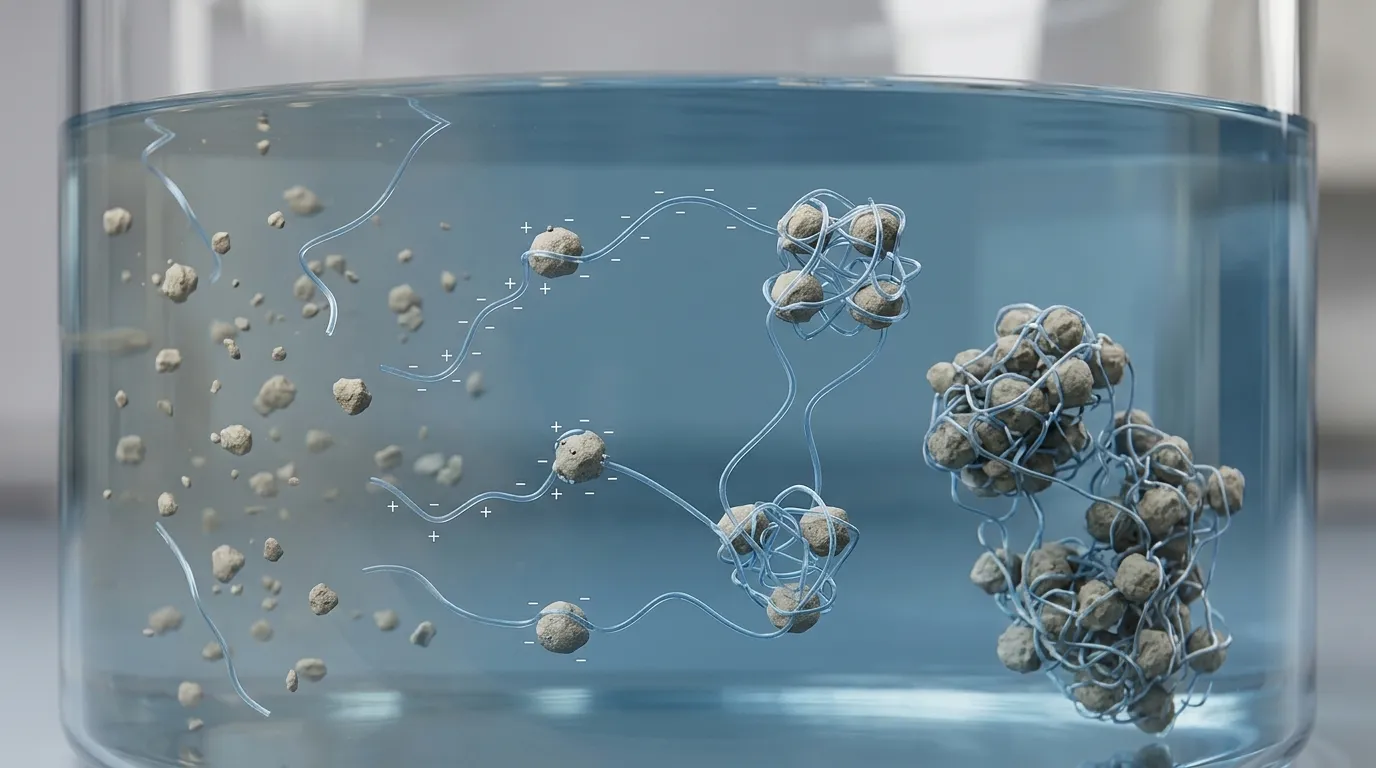
PAM flocculation involves interactions between polymer chains and suspended particles. Charge density can influence the attraction between the polymer and particle surfaces, including the extent to which electrostatic effects contribute to charge neutralization.
However, charge density is not the only mechanism involved. Polymer-chain length and bridging behavior also influence how particles are incorporated into a floc. This is why a charge-density value should not be evaluated separately from molecular weight, dosage, and mixing conditions.
A useful way to interpret the relationship is:
| Selection variable | What it describes | What it may influence | What it cannot establish alone |
|---|---|---|---|
| Charge density | Ionic character of the PAM chain | Interaction with charged solids and charge-neutralization behavior | The best grade for every sludge |
| Molecular weight | Polymer-chain size and length | Bridging, floc structure, and response to shear | The correct charge density |
| Dosage | Amount of polymer applied | Coverage of available particle surfaces and overall treatment response | Whether the grade is chemically suitable |
| Mixing and shear | Physical treatment conditions | Contact, floc growth, and floc survival | The intrinsic specification of the product |
The effect of charge density can change when pH, dissolved salts, conductivity, organic content, solids concentration, or coagulant sequence changes. A polymer that forms a large floc under one set of conditions may produce a weaker or less drainable floc under another.
Higher charge density is therefore not automatically better. Excessive or unsuitable ionic interaction can produce a result that appears acceptable during initial floc formation but does not deliver the desired clarification or dewatering performance after further mixing or mechanical processing.
Research on PAM flocculation has also examined charge density and molecular weight together rather than treating either property as an independent universal predictor. See the study on PAM charge density, molecular weight, flocculation, and sedimentation behavior.
Select the Ionic Family Before Refining Charge Density
Charge-density selection normally begins after identifying the PAM ionic family most relevant to the treatment system. Comparing charge-density values across chemically different families without preserving that context can lead to poor specifications.
Cationic PAM is commonly evaluated for biological or organic sludge dewatering, while anionic PAM is commonly evaluated for mineral or inorganic suspensions and clarification. These are practical starting points, not universal rules. Actual performance depends on the surface chemistry of the solids, upstream treatment, coagulant sequence, water chemistry, and equipment.
| Initial evaluation context | PAM family commonly screened | Why the starting point may differ | What still needs testing |
|---|---|---|---|
| Biological or organic sludge dewatering | Cationic PAM | Organic and biological solids may respond differently to cationic interaction | Charge density, molecular weight, dosage, drainage, cake release, and filtrate quality |
| Mineral or inorganic clarification | Anionic PAM is commonly evaluated | Mineral particles and inorganic suspensions may have different surface-charge behavior | Ionic family, charge density, molecular weight, settling, and supernatant clarity |
| Mixed or variable industrial solids | More than one family may need screening | Feed composition and pretreatment can vary substantially | Actual sludge or suspension, process sequence, and representative test conditions |
The comparison should remain within the same chemical context. A cationic product with one charge-density value is not automatically equivalent to an anionic product with a similar label or percentage. The product form and the supplier’s reporting method must also be preserved.
For a broader family-level comparison, see anionic vs cationic polyacrylamide wastewater. That comparison should support, not replace, charge-density testing within the selected ionic family.
Charge Density and Molecular Weight Are Different Variables
Charge density describes ionic interaction. Molecular weight describes polymer-chain size and is associated with the chain’s ability to contribute to bridging and floc structure. Both properties can affect flocculation and dewatering, but they do not provide the same information.
For example, two candidate grades may differ in both charge density and molecular weight. Their performance cannot be explained by charge density alone because:
- A longer polymer chain may promote different bridging behavior.
- A higher charge level may alter interaction with the particle surface.
- A dosage change may change the apparent performance of either grade.
- Mixing and shear may favor one floc structure over another.
- The same grade may behave differently with different sludge compositions.
A procurement or QA specification should therefore request more than a charge-density label where relevant. Useful information includes:
- PAM ionic family
- Product form, such as powder or liquid formulation
- Charge-density basis and reporting method
- Molecular-weight basis and reporting method
- Active-content or product-as-supplied basis
- Applicable technical data sheet
- Test conditions used to support any performance statement
Do not treat a high-charge, lower-molecular-weight product and a lower-charge, higher-molecular-weight product as interchangeable alternatives. They represent different combinations of polymer properties and must be evaluated under controlled conditions.
Process Variables That Can Shift the Suitable Charge Density
The suitable charge density depends on the treatment environment as much as on the polymer specification. Before concluding that a grade is unsuitable, confirm that the main process variables were controlled or recorded.
Important variables include:
- Sludge or suspension composition: Organic content, mineral content, solids concentration, and particle-size distribution can change polymer response.
- Surface charge and charge demand: The amount and type of charge available on the solids affect how the polymer interacts with them.
- pH: Changes in pH can alter particle-surface behavior and the interaction between the polymer and the solids.
- Dissolved salts and conductivity: Water chemistry can affect polymer conformation and particle interactions.
- Coagulant sequence: A coagulant added before PAM can change the condition of the particle surface and therefore the subsequent polymer response.
- Dosage: Dosage should be controlled during comparison. A charge-density result cannot be separated from the amount of product applied.
- Preparation quality: Incomplete or inconsistent make-down can make a suitable grade appear ineffective.
- Mixing intensity: Insufficient contact may prevent the polymer from interacting with the solids, while excessive mixing can damage developing flocs.
- Mechanical shear: Flocs must survive the shear conditions imposed by the relevant dewatering equipment.
Preparation is particularly important when comparing grades. The comparison should not change the product form, preparation quality, dosage basis, and mixing conditions at the same time. Detailed preparation guidance belongs in a dedicated polyacrylamide dissolution procedure rather than in a charge-density selection article.
Laboratory results may not transfer directly to full-scale operation because plant equipment exposes the floc to different hydraulic and mechanical conditions. A grade that produces a visually large floc in a beaker may not provide the same drainage or cake-release behavior after mechanical dewatering.
A Test-Based Method for Comparing Charge-Density Options
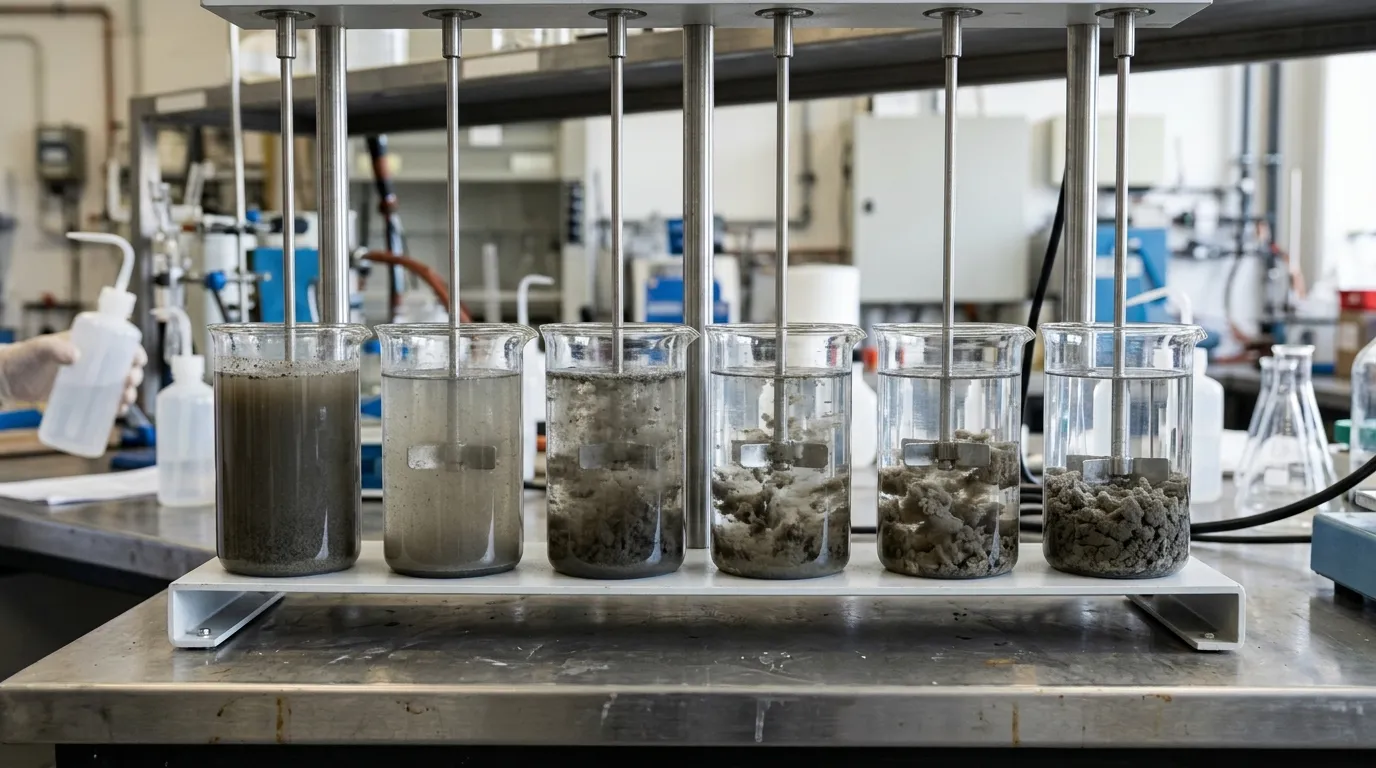
A practical comparison should begin with the treatment objective and then control the variables that can obscure the result.
- Define the performance objective.
Decide whether the primary objective is clarification, sludge thickening, filtrate quality, drainage, cake release, cake solids, or another measurable process outcome.
- Characterize the actual material.
Use representative sludge or suspension and record relevant information about solids, upstream treatment, pH, water chemistry, and variability.
- Select the likely PAM family.
Screen the appropriate ionic family before refining charge density. If the chemistry is uncertain, more than one family may need to be evaluated.
- Identify comparable candidate grades.
Record the exact product identity, form, ionic family, charge-density basis, and molecular-weight basis. Do not compare products using only a supplier’s “low,” “medium,” or “high” label.
- Control the test variables.
Keep preparation quality, dosage basis, mixing sequence, contact conditions, and other relevant variables consistent while comparing candidates.
- Compare more than one charge-density option where available.
The objective is to identify the best-performing range under the defined conditions, not to assume that the highest charge density will produce the best result.
- Measure the process-relevant outcomes.
Record floc formation, settling or clarification, drainage, filtrate quality, cake release, and other outcomes relevant to the equipment.
- Check scale relevance.
Where laboratory results are not sufficient, verify the preferred candidate under representative shear or through pilot or full-scale evaluation.
- Document the result.
Record the product form, grade, test material, preparation method, dosage basis, test conditions, and measured outcome so that the result can be reproduced or compared later.
This is a selection framework, not a universal jar-test recipe. Dosage, dilution, mixing speed, mixing time, and temperature should not be transferred between plants without evidence that the conditions are comparable. A dedicated polyacrylamide jar test procedure can provide more detailed testing guidance where available.
A useful test record should include:
- Exact PAM product and form
- Ionic family
- Charge-density reporting basis
- Molecular-weight reporting basis
- Dosage basis and units
- Sludge source and sampling information
- Preparation method
- Mixing and shear conditions
- Coagulant sequence, if applicable
- Clarification and dewatering results
- Any observed sensitivity to process variation
Which Results Should Determine the Final Choice?
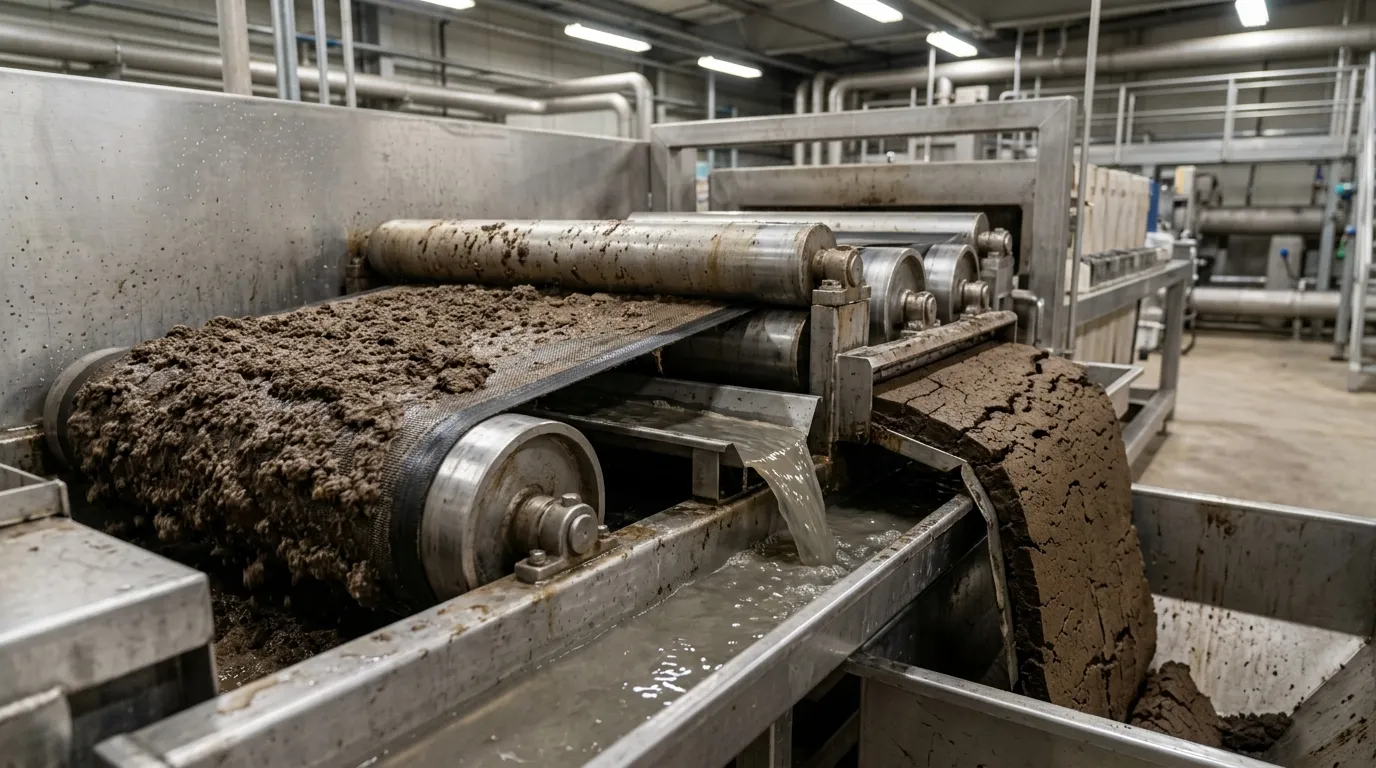
The best charge-density option is the one that supports the actual treatment objective under relevant conditions. Settling speed or visual floc size alone may not be enough, particularly when the polymer is intended for mechanical sludge dewatering.
| Process objective | Useful observations | Limitation |
|---|---|---|
| Clarification | Supernatant or filtrate clarity, settling behavior, and floc stability | A fast-settling floc may not provide the required downstream filtration performance |
| Sludge thickening | Water release, thickening behavior, and solids capture | Results may change after further mixing or transfer |
| Mechanical dewatering | Drainage, cake release, filtrate quality, cake-solids result where measured, and floc resistance to shear | Equipment conditions can differ substantially from laboratory conditions |
| Operations and QA | Repeatability, preparation consistency, sensitivity to feed variation, and documented test conditions | A single test does not establish long-term plant performance |
| Procurement | Clearly identified grade, form, specification basis, and evidence applicable to the intended process | A catalog label does not replace application testing |
For sludge dewatering, the evaluation should extend beyond initial floc formation. A candidate may form a visible floc but still produce poor drainage, unstable filtrate quality, difficult cake release, or weak performance after mechanical shear.
The preferred charge density should therefore be selected using the weighting that matters to the plant. For one operation, filtrate clarity may be decisive. For another, drainage, cake release, or solids capture may carry more importance. There is no single performance metric that determines the best grade for every dewatering system.
For broader application context, see polyacrylamide for sludge dewatering.
Why Generic Charge-Density Tables Need Caution
Generic charge-density tables can be useful for generating initial candidates, but they should not be treated as universal specifications. The available evidence does not support a single charge-density range that applies to every sludge or suspension.
Values may not be directly comparable when they differ in:
- Ionic family
- Product form
- Charge-density test method
- Reporting basis
- Molecular-weight basis
- Active-content basis
- Sludge composition
- pH, salinity, or solids concentration
- Mixing and shear conditions
- Clarification or dewatering equipment
A practical request to a supplier or technical partner should identify:
- The exact product and grade
- The ionic family
- The physical form
- How charge density is defined and measured
- How molecular weight is defined and measured
- Whether values are minimum, maximum, or typical
- The dosage basis used in any test
- The material and process conditions used in performance testing
- The applicable technical documents
Terms such as “low charge,” “medium charge,” and “high charge” are not sufficient on their own for QA approval or process selection. They can help organize a screening program, but the final decision should be based on results obtained with representative material and controlled conditions.
Practical Selection Takeaway
For polyacrylamide charge density selection, use this sequence:
- Define whether the main objective is clarification, thickening, or sludge dewatering.
- Identify the likely PAM ionic family before comparing charge-density options.
- Evaluate charge density together with molecular weight, dosage, preparation, water chemistry, and shear.
- Test candidate grades using representative sludge or suspension.
- Judge results using process-relevant criteria rather than visual floc size alone.
- Record the exact grade, form, reporting basis, and test conditions.
- Treat generic charge-density tables as starting points, not performance guarantees.
Charge density is an important PAM selection variable, but it is not a stand-alone answer. The most defensible grade choice is the one supported by a controlled comparison that reflects the actual solids, treatment sequence, and dewatering equipment.


Contact Us
In This Article
Related Posts
Custom Packaging Solutions from an Anhydrous Sodium Acetate Supplier in China
2026-09-23
Application Trends in Anhydrous Sodium Acetate for Special Chemical Manufacturing
2026-09-23
Anhydrous Sodium Acetate for Leather Tanning: Improve Dyeing Uniformity
2026-09-22
Formic Acid 85% for Textile Dyeing: Industrial Applications, Technical Benefits and Future Trends
2026-09-22


