



Potassium Formate Brine Density Chart: Concentration and Temperature Effects
By Tonmoy
2026-09-08Related Posts
Custom Packaging Solutions from an Anhydrous Sodium Acetate Supplier in China
2026-09-23

Application Trends in Anhydrous Sodium Acetate for Special Chemical Manufacturing
2026-09-23

Anhydrous Sodium Acetate for Leather Tanning: Improve Dyeing Uniformity
2026-09-22

Formic Acid 85% for Textile Dyeing: Industrial Applications, Technical Benefits and Future Trends
2026-09-22
A reported saturated potassium formate brine density is approximately 1.57 specific gravity (SG), or about 13.1 lb/gal. The same source-reported value is approximately 1,570 kg/m³ or 1.57 g/cm³ when converted for reference.
However, this is not a complete concentration-temperature chart. A density value is only technically useful when its potassium formate concentration, temperature, unit basis, measurement method, and reference condition are identified. The reported 1.57 SG and 13.1 lb/gal values should therefore be treated as qualified reference data, not as a universal specification for every potassium formate brine.
For broader chemical background, see potassium formate.
Potassium Formate Brine Density: The Documented Reference Point
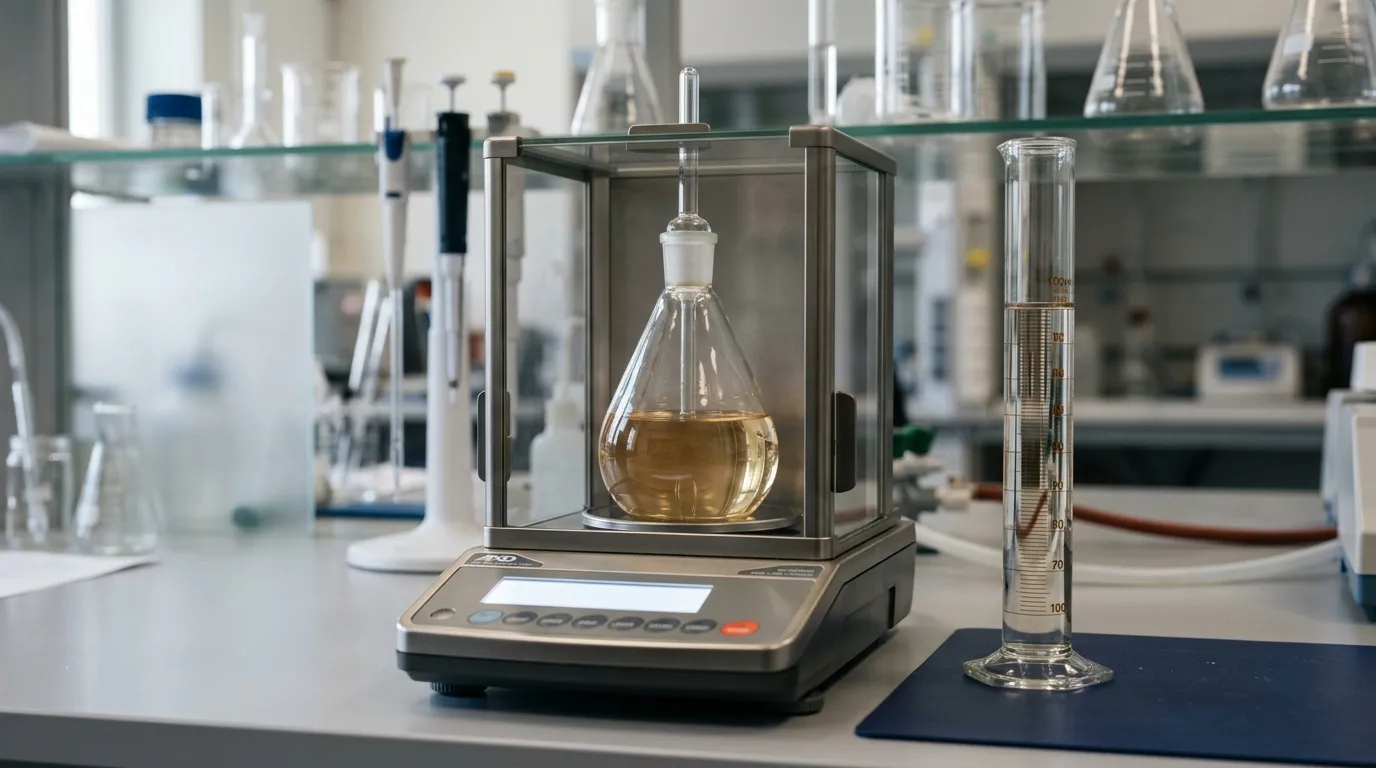
The most useful directly reported reference point is the density of saturated potassium formate brine.
| Property | Reported reference | Condition or limitation |
|---|---|---|
| Specific gravity | Approximately 1.57 SG | Reported for potassium formate fluid; reference temperature not stated |
| Density | Approximately 13.1 lb/gal | Reported at saturation; measurement method not stated |
| Approximate converted density | 1,570 kg/m³ | Illustrative unit conversion from the reported value |
| Approximate converted density | 1.57 g/cm³ | Illustrative unit conversion from the reported value |
| Concentration | Saturated brine | Exact concentration basis was not stated in the retrieved source |
The reported 1.57 SG and 13.1 lb/gal values are consistent as a broad saturated-brine reference. The product-information source reporting these figures does not, however, provide enough detail to establish a full density table for different concentrations and temperatures. In particular, the retrieved information does not identify:
- The reference temperature
- The exact potassium formate concentration
- Whether concentration is expressed as mass percent or another basis
- The density test method
- Whether the value is typical, maximum, or batch-specific
- The applicable product grade or supplied form
The source-reported figures should therefore be cited with their condition—saturated potassium formate brine—rather than presented as the density of all potassium formate solutions. The value is attributed to the product information available from Oil & Gas Online, not to a verified Vanchor product specification.
How Potassium Formate Concentration Changes Brine Density
A potassium formate brine density chart should show density against a defined concentration scale. In practice, the concentration basis is as important as the density number itself.
For example, a chart may use:
- Mass percent potassium formate
- Mass fraction of the supplied solution
- Active potassium formate content
- Concentration calculated from a particular product grade
- Saturation or near-saturation condition
These descriptions are not interchangeable. A value expressed as mass percent potassium formate should not be treated as a volume percent value. Likewise, the assay of a solid raw material is not the same as the concentration of potassium formate in a supplied brine solution.
As concentration increases, the amount of dissolved potassium formate in a given quantity of solution changes. That affects the solution’s mass per unit volume, which is the basis of density. A technically usable chart should therefore identify the concentration for every row or plotted point.
A complete table would normally require columns such as:
| Required chart field | Why it matters |
|---|---|
| Potassium formate concentration | Defines the solution composition |
| Temperature | Defines the measurement or calculation condition |
| Density | Provides the mass-per-volume result |
| Specific gravity | Provides the dimensionless comparison value |
| Unit basis | Allows comparison between laboratory and field data |
| Method or source | Indicates whether the value is measured or calculated |
| Status | Identifies typical, maximum, minimum, or calculated data |
The retrieved evidence supports the saturated endpoint but does not verify the intermediate concentration values needed to populate such a table. Intermediate values should not be estimated from the endpoint without a validated dataset.
For detailed preparation topics, readers should use a dedicated potassium formate brine mixing guide. Density interpretation and mixing procedure are related, but they are not the same technical task.
Why Temperature Must Appear Beside Every Density Value
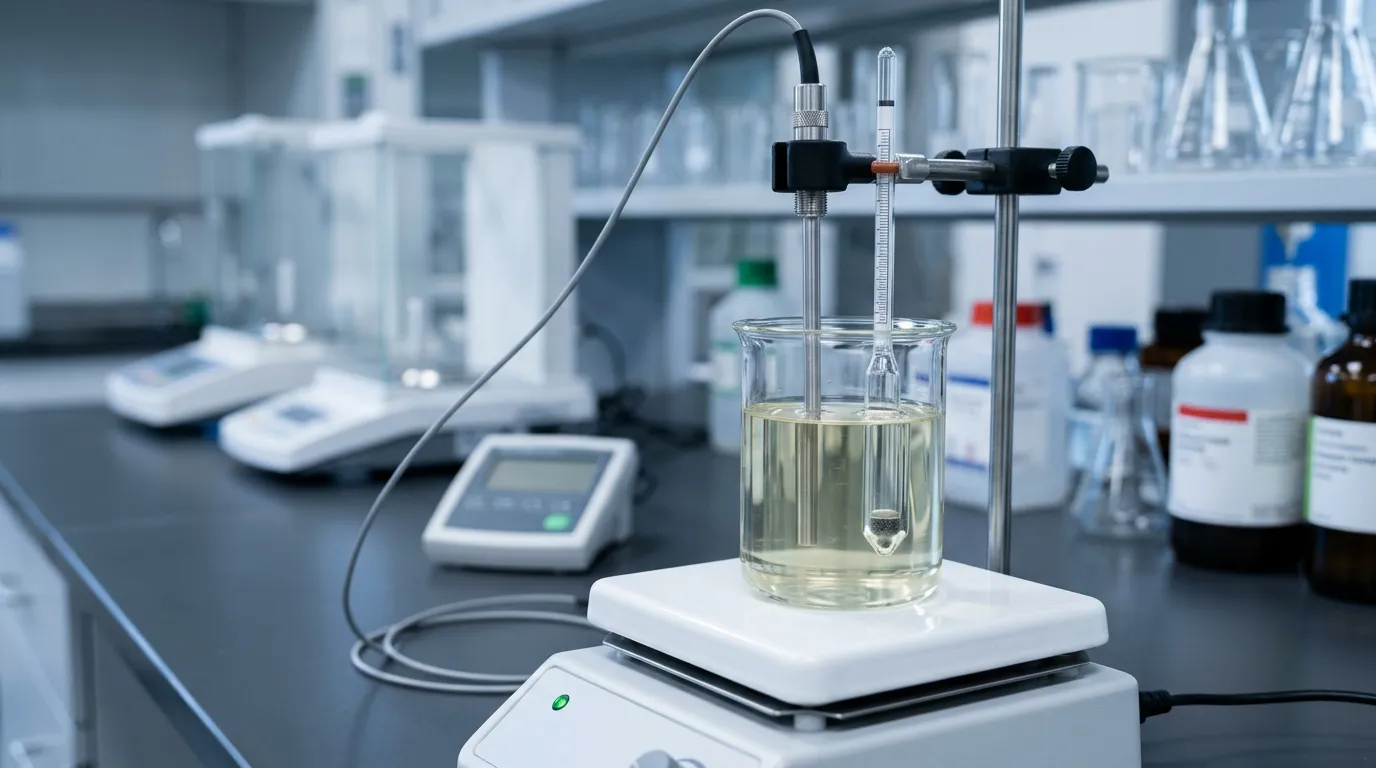
Temperature must be attached to every potassium formate brine density value used in formulation, laboratory control, or field operations.
Density is temperature-dependent. If the same brine is measured at two different temperatures, the reported density may differ even when the chemical composition has not changed. This creates a practical risk when a laboratory result, supplier document, and field measurement are compared without checking their temperature conditions.
Before using a density value, confirm:
- The potassium formate concentration or composition.
- The temperature at which density was measured or calculated.
- Whether the value is an actual measurement or a model output.
- The density unit and specific-gravity reference basis.
- Whether the value has been converted to a standard reference condition.
A formate technical manual identified in the research scope describes measured pressure-volume-temperature data and a model for relating density at different temperatures to an equivalent density at standard conditions. That type of reference is more useful than a temperature-free number because it explains how the reported value should be normalized.
The available evidence does not provide a verified temperature coefficient or a complete temperature-indexed table for potassium formate brine. Do not therefore apply a fixed correction factor or assume that a density reported at one temperature remains valid at another.
For QA purposes, a density record without temperature should be treated as incomplete technical information. The temperature may be especially important when a specification limit is narrow or when laboratory and operating conditions differ substantially.
Reading the Chart in SG, lb/gal, kg/m³, and g/cm³
Potassium formate brine may be reported using different units depending on the application and location.
| Unit | Meaning or use | Important qualification |
|---|---|---|
| SG | Specific gravity relative to a reference liquid | The reference basis and temperature should be stated |
| lb/gal | Common oilfield density unit | Confirm whether US gallons are intended |
| kg/m³ | SI mass-per-volume unit | Useful for international technical specifications |
| g/cm³ | Laboratory and technical density unit | Numerically close to SG only under a defined reference basis |
Using the reported saturated value as an illustration:
- 13.1 lb/gal converts to approximately 1,570 kg/m³
- 13.1 lb/gal converts to approximately 1.57 g/cm³
- 1.57 SG is commonly expressed as approximately 1,570 kg/m³ when the reference basis is treated as water at approximately 1,000 kg/m³
These are unit conversions, not new measurements. They do not resolve the missing temperature, concentration, product grade, or test-method information.
A technical document should retain the original source unit and place any converted value beside it. For example:
Saturated potassium formate brine: approximately 13.1 lb/gal, equivalent to approximately 1,570 kg/m³ by unit conversion; reference temperature and test method must be confirmed.
Avoid reporting unnecessary decimal places. A converted value of 1,569.7 kg/m³ may appear more precise than the original source supports.
Specific gravity also should not be treated as an absolute density unless its reference basis is understood. In procurement and QA documents, ask whether SG refers to a specified temperature and reference liquid before comparing it with a density stated in kg/m³.
What QA and Procurement Teams Should Verify Before Using a Density Chart

Before using a potassium formate brine density chart for formulation, laboratory release, field control, or purchasing, verify the following information:
- Chemical identity: Confirm that the data apply to potassium formate rather than sodium formate, cesium formate, or a formate blend.
- Product form: Distinguish solid potassium formate from a supplied brine solution.
- Grade: Confirm the exact grade or commercial product to which the data apply.
- Concentration basis: Check whether the value is mass percent, active content, supplied-product concentration, or another basis.
- Temperature: Record the measurement or calculation temperature.
- Unit: Confirm whether the value is stated in SG, lb/gal, kg/m³, or g/cm³.
- Reference condition: Determine whether density is reported at the measurement temperature or converted to a standard condition.
- Data type: Identify whether the value is measured, calculated, typical, minimum, maximum, or batch-specific.
- Method: Request the applicable density or PVT test method where the value is decision-critical.
- Document control: Check the TDS, COA, or technical document revision and date.
- Cross-document consistency: Compare the density chart with the applicable product documentation and laboratory result.
A certificate or COA should not automatically be treated as universal product approval. Similarly, a density value alone does not establish compatibility, regulatory suitability, or performance in a particular drilling or completion system.
For sourcing decisions, the RFQ should request the exact density basis rather than simply asking for “potassium formate brine density.” A clear request should specify the desired concentration, temperature, units, grade, and whether the result must be measured or converted to a reference condition.
How Density Fits Into Formate-Brine Selection
Density is an important design variable in clear-brine systems, but it is not the only one. Clear-brine fluids may also be selected or formulated against requirements such as temperature-related crystallization behavior, pressure-related conditions, clarity, compatibility, and other application constraints.
A reported potassium formate density should not be applied automatically to a blended formate system. TETRA’s formate-brine information separately reports sodium/potassium formate blends in a range of approximately 11.0 to 13.1 lb/gal and potassium/cesium formate blends from approximately 13.1 to 19.2 lb/gal. Those figures are attributed blend ranges, not single-salt potassium formate data.
The distinction matters because:
- A blend has a different chemical composition from pure potassium formate brine.
- The concentration basis may differ.
- The density range may reflect a blended formulation rather than saturation of one salt.
- The temperature and measurement conditions still need to be confirmed.
- A higher density does not by itself establish better application performance.
Readers working specifically with high-density systems can review high density potassium formate brine. Completion-fluid applications should be evaluated separately through the relevant potassium formate completion fluid information rather than inferred from a density number alone.
Practical Takeaway: Use the Chart With Its Conditions Attached
The most defensible reference point currently available is approximately 1.57 SG or 13.1 lb/gal for saturated potassium formate brine. The value is useful as a qualified endpoint, but it is not a substitute for a complete concentration-temperature dataset.
Before using any potassium formate brine density value, confirm:
- Potassium formate concentration
- Product grade and solution form
- Measurement or calculation temperature
- Density unit and SG reference basis
- Test method or calculation source
- Whether the value is typical, maximum, minimum, or batch-specific
If a supplier or laboratory provides only a temperature-free density number, request the missing conditions before using it for formulation, QA release, field control, or procurement comparison. A chart becomes technically reliable only when its composition, temperature, units, and evidence status are visible beside the value.


Contact Us
In This Article
Related Posts
Custom Packaging Solutions from an Anhydrous Sodium Acetate Supplier in China
2026-09-23
Application Trends in Anhydrous Sodium Acetate for Special Chemical Manufacturing
2026-09-23
Anhydrous Sodium Acetate for Leather Tanning: Improve Dyeing Uniformity
2026-09-22
Formic Acid 85% for Textile Dyeing: Industrial Applications, Technical Benefits and Future Trends
2026-09-22


