



Potassium Formate Brine Mixing Guide: Dilution, Density Targets, and Quality Checks
By Tonmoy
2026-09-09Related Posts
Custom Packaging Solutions from an Anhydrous Sodium Acetate Supplier in China
2026-09-23

Application Trends in Anhydrous Sodium Acetate for Special Chemical Manufacturing
2026-09-23
Anhydrous Sodium Acetate for Leather Tanning: Improve Dyeing Uniformity
2026-09-22

Formic Acid 85% for Textile Dyeing: Industrial Applications, Technical Benefits and Future Trends
2026-09-22
A reliable potassium formate brine mixing guide must begin with the correct starting basis—not with a nominal salt percentage. Before mixing, confirm whether the material is solid potassium formate or an aqueous potassium formate solution, identify its assay or concentration, define the required final density or concentration, and record the temperature at which the target will be measured.
The mix should then be checked against an appropriate density/concentration relationship and released only after the required quality checks are complete. Density is important, but it does not independently confirm concentration, cleanliness, chemical identity, or application suitability.
Confirm the starting material before calculating the mix
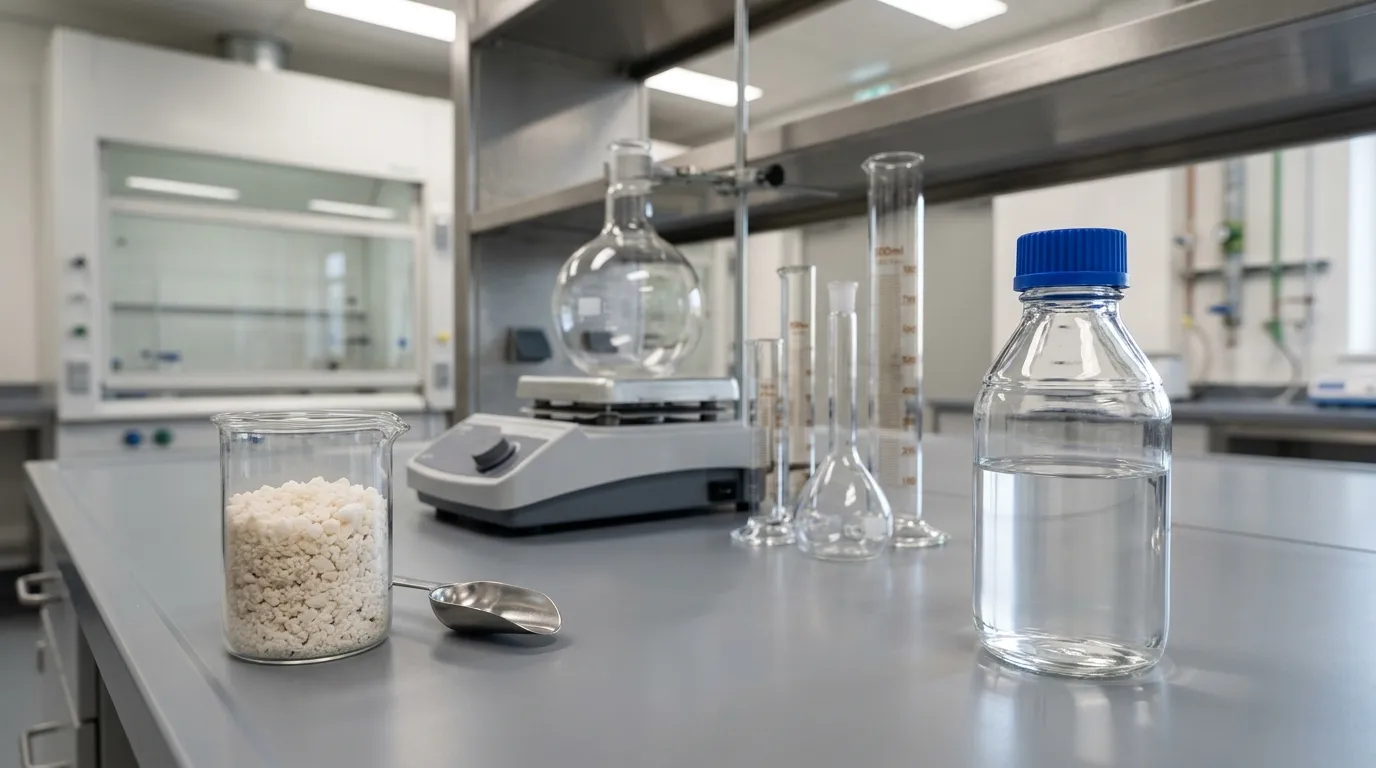
Potassium formate brine is an aqueous solution of potassium formate. Formate brines are generally prepared by dissolving a formate salt in water, but the calculation basis changes depending on whether the starting material is a solid or a supplied liquid solution.
For broader chemical context, see potassium formate.
Solid potassium formate
When starting with solid potassium formate, the mixing plan depends on:
- The exact product form and grade
- Assay or active-content basis
- Moisture or impurity information, where applicable
- Required final batch mass or volume
- Target density or concentration
- Reference temperature for the target
- Approved water or dilution-medium requirements
- Any application-specific crystallization or compatibility requirement
The mass of solid added cannot be selected reliably from a generic percentage unless the product assay, final-batch basis, and target specification are known.
Supplied potassium formate solution
A supplied liquid solution requires a different calculation. Confirm:
- Starting concentration or active content
- Density of the supplied solution
- Temperature associated with the stated density
- Quantity available
- Required final concentration or density
- Final batch mass or volume
- Whether the operation is dilution or blending
A liquid product’s concentration, density, and product-as-supplied quantity are different values. They should not be substituted for one another.
Vanchor describes potassium formate brine as being prepared either by dissolving solid potassium formate in water or by preparing a controlled aqueous solution. The exact grade, concentration, and product specification still need to be confirmed for the material being used. A potassium formate brine supplier can be asked to provide the relevant product and batch documentation.
Define the target density, concentration, and temperature basis
The first calculation decision is to identify what the target actually represents. A brine specification may refer to density, specific gravity, mass concentration, active content, or another application-defined parameter. These terms are related, but they are not interchangeable.
Before preparing a batch, document:
| Input | Why it matters |
|---|---|
| Starting form | Determines whether the operation is solid dissolution or liquid dilution |
| Assay or active content | Establishes how much potassium formate is present in the supplied material |
| Starting density | Needed when working from a supplied liquid solution |
| Target density or concentration | Defines the required final condition |
| Reference temperature | Density and crystallization behavior are temperature-dependent |
| Final batch basis | Establishes whether quantities are calculated by mass or volume |
| Approved dilution medium | Water quality can affect the final brine and its suitability |
| Application requirement | May include crystallization, TCT/PCT, compatibility, or contamination limits |
A useful density target should therefore include more than a number. It should identify the unit, temperature, measurement method, chemical form, and applicable product or application specification.
Technical formate references identify dedicated mixing tables and density/PVT data for formate brines. The Formate Technical Manual is described as containing these resources, but a table should be used only after confirming that its chemical form, grade, units, temperature, and test basis match the material being prepared.
Do not use an industry-average density table when the product specification is unknown. Do not copy a table for one grade or supplier and present it as a universal potassium formate specification.
Plan solid dissolution or liquid-brine dilution separately
The preparation sequence should be controlled, but the numerical recipe must come from the applicable product and fluid specification. Without verified product-specific data, it is safer to define the calculation and control points than to publish a universal solid-to-water ratio.
A practical planning sequence is:
- Confirm the starting form and documentation.
Identify whether the batch begins with solid potassium formate or a supplied aqueous solution. Check the product name, grade if applicable, assay or concentration, batch identity, and available technical documentation.
- Define the final target.
Record the required density or concentration, reference temperature, final batch mass or volume, and any application-specific crystallization or compatibility requirement.
- Select the correct density/concentration relationship.
Use a table, TDS, approved fluid program, or other controlled technical source that applies to the exact chemical form and measurement basis.
- Prepare the equipment and dilution medium.
Confirm that the tank, transfer lines, and other equipment are clean and suitable for the intended operation. Check the quality of the water or other approved dilution medium before use.
- Mix or dilute under the applicable procedure.
Use the controlled addition, agitation, temperature, and transfer conditions specified for the product or application. Avoid presenting a generic mixing speed, addition rate, temperature, or hold time as universally valid.
- Sample and verify before release.
Take a representative sample using the responsible site’s sampling procedure. Record the result against the applicable specification rather than approving the batch from appearance alone.
Vanchor’s available oilfield-chemical guidance refers to equipment cleaning, water-quality checks, controlled agitation, and gradual addition or transfer as mixing considerations. These points should be treated as site-stated guidance, not as a complete universal operating procedure. Broader application context is available through potassium formate oilfield chemical.
Diluting a supplied brine
When lowering the concentration or density of an existing potassium formate solution, first establish the starting concentration and the required final basis. The calculation must distinguish:
- Mass of supplied solution
- Active potassium formate content
- Added water or dilution medium
- Final batch mass
- Final batch volume
- Temperature at measurement
- Density or concentration of the final brine
A concentration calculation based on mass percent is not automatically interchangeable with one based on volume percent. Likewise, a density reading cannot be treated as a direct assay result unless an approved product-specific relationship supports that interpretation.
If the starting concentration, assay basis, or target temperature is unavailable, pause the calculation and obtain the missing data. Guessing the dilution quantity can produce a brine that appears uniform but does not meet the intended specification.
Use density as a controlled measurement, not as the only acceptance criterion
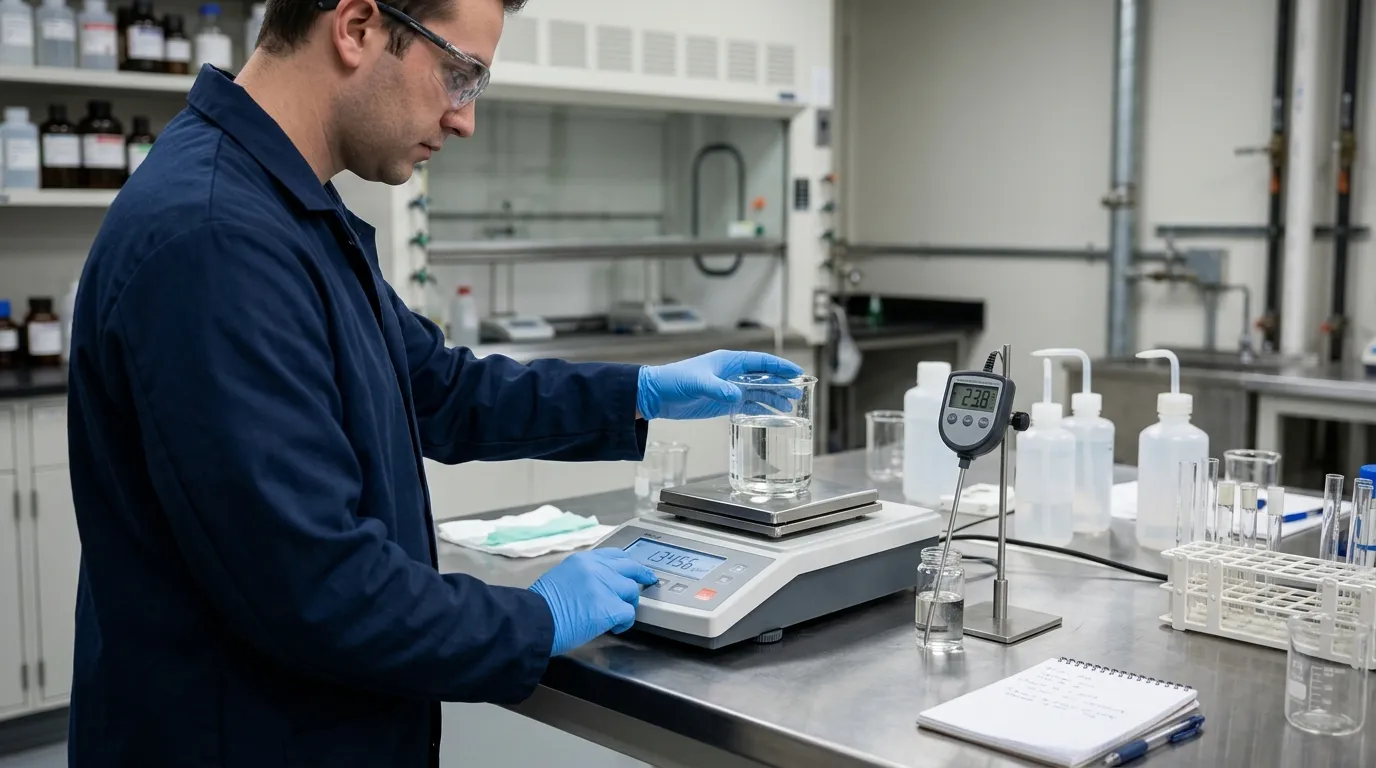
Density or specific gravity is often a central control variable for potassium formate brine. It can help confirm whether a prepared batch is near its intended physical-property target, but the result is meaningful only when the measurement conditions are recorded.
A density result should include:
- Measured value
- Unit
- Sample temperature
- Measurement method
- Instrument or equipment identification
- Sample or batch identity
- Applicable reference table or specification
- Any correction or conversion applied
Temperature is particularly important. A density value measured at one temperature should not be compared directly with a target reported at another temperature unless an approved correction or interpretation method is available.
Density also does not independently prove:
- Chemical identity
- Assay or active content
- Absence of contamination
- Absence of undissolved material
- Compatibility with the intended system
- Compliance with an application-specific requirement
For high-density applications, the target should remain tied to the relevant application program and product data. A high-density potassium formate brine may require additional review of crystallization behavior, temperature limits, and compatibility rather than density verification alone. See high density potassium formate brine for related application context.
A useful minimum density record is:
| Record | Required detail |
|---|---|
| Result | Density or specific-gravity value |
| Unit | For example, the unit used by the approved fluid program |
| Temperature | Sample temperature at measurement |
| Method | Approved test or measurement procedure |
| Instrument | Equipment used and relevant identification |
| Sample identity | Batch, tank, or transfer-line reference |
| Comparison basis | Product specification, approved table, or fluid program |
Do not use a reported saturation value from another supplier or service provider as a Vanchor product specification. Any numerical property must remain tied to the exact source, product form, conditions, and measurement basis.
Add crystallization-temperature and application checks before release
Density targeting and crystallization-temperature control address different requirements.
A brine may meet a density target while still requiring review against the temperature conditions of the intended application. The Formate Technical Manual identifies crystallization-temperature data separately from mixing and density/PVT information. Technical service literature also discusses formate-fluid blending in relation to density and TCT/PCT objectives.
For that reason, the formulation review should ask:
| Check | What it answers | Evidence needed |
|---|---|---|
| Density or specific gravity | Is the brine at the required physical-property target? | Temperature-specific table or specification |
| Concentration or assay | Is the chemical content within the required range? | Approved product or laboratory method |
| Crystallization or TCT/PCT behavior | Does the brine meet the relevant temperature requirement? | Application-specific technical data |
| Compatibility | Can the brine enter the intended system? | Approved compatibility or fluid-program guidance |
| Contamination | Has the batch remained within the required cleanliness standard? | Sampling and inspection procedure |
The terms TCT, PCT, and crystallization temperature should not be treated as interchangeable without confirming the test method and application context. A value from one method or fluid system should not automatically be applied to another.
For deeper property discussion, see potassium formate crystallization temperature. The linked topic should supplement, not replace, the product-specific or application-specific data used for release.
Release the batch with a documented quality-check sequence
A potassium formate brine should be released according to the responsible organization’s written specification or fluid program. The following sequence provides a practical framework; acceptance limits and test methods must come from the applicable product or application documentation.
- Confirm identity and batch documentation
Record the exact chemical name, supplied form, grade if applicable, batch or lot number, and source documentation. Confirm that the material being mixed matches the material used in the calculation.
- Inspect appearance
Record visible clarity, undissolved solids, precipitate, foreign material, or abnormal color where these observations are relevant to the specification. Do not invent a universal visual acceptance limit. Appearance is a screening check, not a substitute for assay or density testing.
- Measure density or specific gravity
Measure the representative sample using the approved procedure. Record the value, unit, temperature, method, instrument, and sample identity. Compare the result only with a compatible reference.
- Verify concentration or assay when required
Density should not automatically be reported as assay. If concentration or active content is decision-critical, verify it using the approved product or laboratory method.
- Check pH or other application variables when specified
Include pH, impurity, compatibility, or other application checks only when they are required by the relevant specification or fluid program. The absence of a documented limit is not permission to create one.
- Review crystallization or TCT/PCT requirements
Confirm that the selected density and concentration remain appropriate for the temperature and application conditions. This review is especially important where low-temperature behavior affects handling or service performance.
- Document the disposition
Release, adjust, quarantine, or investigate the batch according to the responsible organization’s procedure. A batch should not be approved solely because it looks uniform or because its density is close to an assumed target.
A certificate of analysis can provide batch-specific results when supplied and applicable, but it does not by itself establish universal product approval or suitability for every application. Similarly, an SDS provides hazard and handling information but does not establish assay, application performance, or regulatory suitability.
Request the documents needed to approve a supplied brine or raw material

Procurement and QA teams should define the documentation required before ordering or receiving potassium formate. The exact list depends on the application and internal quality system, but the following information is commonly decision-critical:
- Exact chemical name and supplied form
- Product grade or application designation, if applicable
- Assay or active-content basis
- Concentration of supplied liquid solution
- Density of supplied liquid and reference temperature
- Technical Data Sheet with units and test methods
- Safety Data Sheet for hazard and handling information
- Batch-specific Certificate of Analysis
- Density/concentration table or approved mixing data
- Crystallization, TCT, or PCT data where relevant
- Batch or lot traceability
- Packaging and identification details required by the receiving procedure
Each document answers a different question:
| Document or record | What it can help establish |
|---|---|
| TDS | Product properties, test methods, units, and stated specification |
| SDS | Hazards, handling, storage, and emergency information |
| COA | Reported results for a specific batch |
| Density/concentration table | Relationship between composition, density, and stated temperature basis |
| Application data | Suitability under defined process or fluid conditions |
| Batch records | Traceability between the purchased material and the tested sample |
Do not assume that a catalog listing proves in-house manufacture, current availability, certification, or application approval. Those claims require separate, current evidence.
Practical decision rule
The correct potassium formate brine mix is not defined by a nominal salt percentage alone. It is defined by:
- The exact starting form
- The verified assay or concentration basis
- The target density or concentration
- The reference temperature and measurement method
- The applicable density/concentration relationship
- The required crystallization, compatibility, and application checks
- A documented QC release decision
When any of these inputs is missing, the appropriate next step is to obtain the product and application data rather than substitute an industry average. For technical or sourcing discussions, specify the starting form, target density basis, intended application, required temperature range, batch quantity, and documentation needed.


Contact Us
In This Article
Related Posts
Custom Packaging Solutions from an Anhydrous Sodium Acetate Supplier in China
2026-09-23
Application Trends in Anhydrous Sodium Acetate for Special Chemical Manufacturing
2026-09-23
Anhydrous Sodium Acetate for Leather Tanning: Improve Dyeing Uniformity
2026-09-22
Formic Acid 85% for Textile Dyeing: Industrial Applications, Technical Benefits and Future Trends
2026-09-22


