



Sodium Formate vs Sodium Acetate Deicer: Performance, Corrosion, and Selection
By Tonmoy
2026-09-08Related Posts
Custom Packaging Solutions from an Anhydrous Sodium Acetate Supplier in China
2026-09-23

Application Trends in Anhydrous Sodium Acetate for Special Chemical Manufacturing
2026-09-23

Anhydrous Sodium Acetate for Leather Tanning: Improve Dyeing Uniformity
2026-09-22

Formic Acid 85% for Textile Dyeing: Industrial Applications, Technical Benefits and Future Trends
2026-09-22
For most industrial and airport deicing decisions, neither sodium formate nor sodium acetate is a universal winner. The better choice depends on the exact product form, operating temperature, spreading conditions, exposed materials, environmental requirements, and quality documentation.
A commercial comparison describes sodium acetate as more strongly exothermic during dissolution, while sodium formate is associated with lower reported BOD and angular or irregular granules in some products. These are not universal properties of every grade. The comparison applies to the specific products and test basis reported by the source, not automatically to all sodium acetate or sodium formate. See the cited commercial comparison of sodium acetate and sodium formate deicers.
A defensible selection should therefore compare like with like:
- Solid sodium formate against solid sodium acetate
- Anhydrous sodium acetate against a clearly identified sodium formate form
- Pure chemicals against pure chemicals, not against acetate/formate blends
- Matching temperature, application, concentration, and test conditions
- Product-specific corrosion, environmental, and approval evidence
Compare like with like before evaluating either deicer
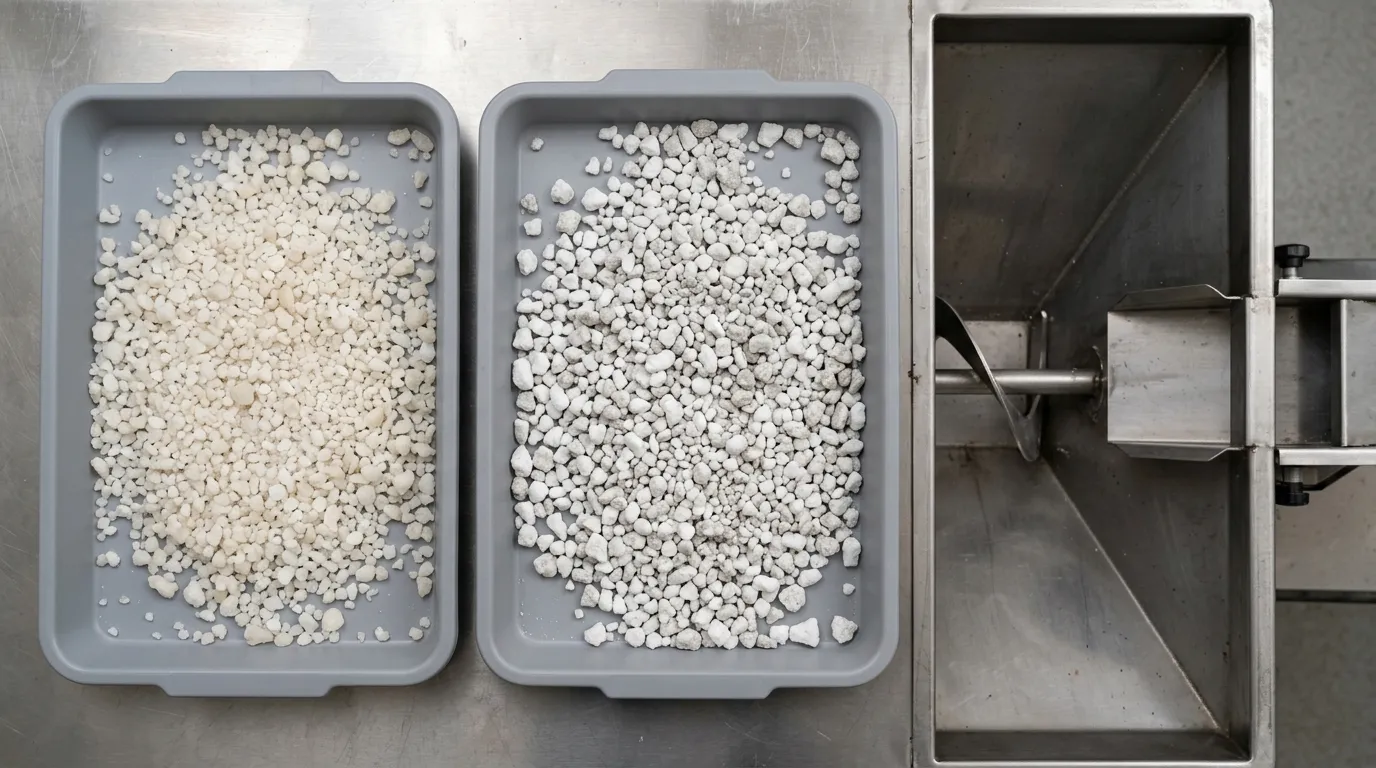
“Sodium acetate” can refer to anhydrous sodium acetate or a hydrated form. Those products should not be treated as interchangeable in a technical comparison. The same principle applies when comparing a dry chemical with a solution, brine, or formulated blend.
A procurement team should identify the following before comparing supplier offers:
- Chemical identity and CAS number
- Solid, solution, or blend status
- Anhydrous or hydrated form
- Assay and moisture basis
- Particle-size distribution
- Bulk density and spreading characteristics
- Product-specific temperature data
- Corrosion and concrete-compatibility test results
- BOD or COD test method and reporting basis
A sodium acetate/formate blend also requires separate treatment. A transportation study evaluated a 1:1 molar sodium acetate/formate blend, but results from that blend cannot be transferred directly to pure sodium formate or pure sodium acetate.
For general product context, buyers can review sodium formate and sodium acetate, but the product form and technical documents still need to be confirmed for the material being purchased.
Performance: activation, melting behavior, and spreading
Initial activation and heat release
A commercial comparison describes sodium acetate as highly exothermic and sodium formate as mildly exothermic. In practical terms, this suggests that a particular sodium acetate product may release more heat during dissolution and may activate quickly when it contacts moisture.
That observation should not be converted into a universal claim that sodium acetate always melts ice faster or performs better at every temperature. Actual deicing performance depends on factors such as:
- Surface temperature
- Ice or snow condition
- Moisture availability
- Product concentration
- Application rate
- Contact time
- Traffic or mechanical action
- Particle-size distribution
- Drainage and dilution after application
A product advertised as “exothermic” may still perform poorly if it is not distributed effectively or if the site conditions differ from the test conditions. Conversely, a product with less initial heat release may provide suitable performance when its dissolution, spreading, and concentration behavior match the application.
Particle shape and spreading behavior
The physical form of the solid can affect how a deicer is stored, metered, spread, and retained on a surface. One commercial comparison describes sodium acetate as spherical and sodium formate as angular or crystalline. A separate product description characterizes its solid sodium formate granules as irregular-shaped particles intended to resist displacement.
These statements are product-specific. They should not be treated as defining the physical form of every grade. However, particle behavior can matter in exposed areas such as runways, ramps, bridges, and open industrial yards where wind, vehicle movement, and surface slope affect retention.
For an operational comparison, request:
- Particle-size distribution
- Percentage of fines
- Bulk density
- Flowability data
- Spreading-equipment compatibility
- Caking or moisture-sensitivity information
- Performance under representative wind, traffic, and surface conditions
Storage can also affect field performance. Moisture pickup, caking, and changes in flowability may alter how consistently a solid deicer is delivered. A relevant follow-up resource is sodium formate storage and caking.
Runway and airside use
Both acetate- and formate-based products are associated with airport deicing applications, but chemical identity alone does not establish approval for a particular airport or airside use.
Airport buyers should verify:
- Exact product name and formulation
- Current airside or authority requirements
- Application equipment compatibility
- Effects on metals, concrete, coatings, and drainage systems
- Temperature test method
- Environmental requirements at the airport
- Current product documentation and approval status
A supplier’s statement that a product is suitable for runway use is not equivalent to approval by every airport authority or jurisdiction.
Performance comparison at a glance
| Criterion | Sodium formate | Sodium acetate | What the buyer must verify |
|---|---|---|---|
| Initial heat release | A commercial comparison describes the reported product as mildly exothermic | The same comparison describes the reported product as highly exothermic | Test method, product form, concentration, and surface temperature |
| Particle behavior | One commercial product is described as using irregular granules intended to resist displacement | One commercial comparison describes the reported product as spherical | Particle-size distribution, bulk density, spreader calibration, and site conditions |
| Low-temperature performance | Product-specific claims exist, but cannot be generalized to all grades | Product-specific performance also requires testing and documentation | Exact temperature basis, concentration, exposure time, and test method |
| Runway suitability | Used in some commercial runway-deicer offerings | Used in some commercial runway-deicer offerings and blends | Current authority requirements and exact product approval |
| Environmental metrics | Some commercial comparisons report lower BOD for the compared product | Some commercial comparisons report higher BOD for the compared product | Test method, product identity, units, and receiving-environment requirements |
| Universal winner | Not established | Not established | Complete like-for-like field or laboratory evidence |
Corrosion and material compatibility: what can and cannot be concluded

Neither “chloride-free” identity nor a chemical name is enough to prove that a deicer is non-corrosive. Corrosion risk depends on the exact material, concentration, exposure time, temperature, wetting and drying cycles, contaminants, and protective coating condition.
The available evidence does not establish a direct, like-for-like corrosion ranking between pure solid sodium formate and pure solid sodium acetate. It is therefore not supportable to state that one chemical is universally safer for aircraft, vehicles, steel structures, aluminum components, galvanized surfaces, concrete, or other infrastructure.
Before approving a deicer, QA and engineering teams should request test data covering the materials actually exposed at the site:
- Carbon steel and stainless steel
- Aluminum or other aircraft-related metals, where applicable
- Galvanized surfaces
- Painted or coated components
- Concrete and reinforced concrete
- Drainage components and storage equipment
- Elastomers or other sensitive construction materials
The test request should identify:
- Chemical form and grade
- Product concentration
- Test temperature
- Exposure duration
- Wet/dry cycling
- Material grade
- Test method
- Rating system
- Control material
- Whether the result is typical, minimum, or maximum
Concrete compatibility also requires caution. A test on one concrete formulation or one formate-based product cannot automatically establish compatibility for every sodium formate or sodium acetate product. Where concrete durability or alkali-silica reaction is a concern, request evidence for the actual product and the relevant concrete system.
Environmental indicators: interpreting BOD and COD
Biochemical oxygen demand (BOD) and chemical oxygen demand (COD) can help characterize the potential oxygen demand associated with deicer runoff. They are useful comparison metrics, but neither one is a complete environmental approval or aquatic-impact assessment.
One commercial comparison reports BOD values of 0.58 g O₂/g for sodium acetate and 0.23 g O₂/g for sodium formate. Those values should remain tied to the products and test basis reported by that source. The source does not establish that every sodium formate grade has lower BOD than every sodium acetate grade.
A transportation research record also describes laboratory evaluation of a 1:1 molar sodium acetate/formate blend using BOD, COD, trout bioassays, and phytotoxicity testing. The record reports temperature-dependent degradation and notes the possibility of dissolved-oxygen reduction in runoff at higher temperatures. Because this evidence concerns a blend, it should not be presented as a direct test of either pure chemical.
For an environmental review, consider:
- BOD and COD method
- Product form and composition
- Application quantity
- Drainage volume
- Receiving-water sensitivity
- Runoff temperature
- Site discharge requirements
- Local environmental permits or authority requirements
A lower reported BOD may be a useful selection factor, but it does not by itself establish regulatory compliance, aquatic safety, or overall environmental superiority.
Select the better deicer by operating condition
The practical decision is not simply “sodium formate versus sodium acetate.” It is which documented product fits the site.
Sodium acetate may be worth evaluating when:
- Rapid activation or initial heat release is a priority
- The product has suitable performance data for the operating temperature
- The spreading system is compatible with the product’s particle characteristics
- Material-compatibility evidence is acceptable
- The product’s environmental and approval documents meet site requirements
These considerations are based partly on an attributed commercial comparison and must be confirmed for the proposed grade.
Sodium formate may be worth evaluating when:
- A formate-based solid deicer fits the airport or industrial application
- The specific granule design supports retention and spreading requirements
- Reported BOD is important to the site’s runoff assessment
- The product’s temperature performance is documented for the intended conditions
- Corrosion and concrete testing is available for the actual product
A formate product’s physical and environmental claims must remain product-specific. Chemical identity alone does not establish performance.
Use neither product without further validation when:
- The supplier cannot identify the exact anhydrous or hydrated form
- A commercial blend is being compared with a pure chemical
- Temperature claims lack a test method
- Corrosion data does not identify the tested material and concentration
- Environmental figures do not identify the reporting basis
- Required airport, site, or jurisdictional documentation is missing
- The product cannot be matched to the intended spreading equipment
Procurement and QA checklist

Use the following sequence when comparing offers:
- Define the operating conditions. Record the surface, temperature range, application method, drainage setting, exposed materials, and whether the application is runway, roadway, bridge, industrial yard, or another site type.
- Specify the exact chemical form. State whether the requirement is solid sodium formate, solid anhydrous sodium acetate, a hydrated form, a solution, or a formulated blend.
- Request technical documents. Obtain the current TDS, SDS, batch COA, assay basis, moisture specification, particle-size data, and bulk-density information where relevant.
- Compare test methods, not just numbers. For temperature, BOD, COD, corrosion, and concrete performance, confirm the method, units, concentration, temperature, exposure time, and material tested.
- Validate application fit. Confirm compatibility with spreaders, storage systems, drainage controls, site materials, and applicable airport or authority requirements.
- Approve the documented product. The approval should apply to the identified grade, form, and supplier specification—not to the chemical name in the abstract.
For procurement teams evaluating a specific formate requirement, sodium formate for de-icing can serve as a relevant follow-up destination, subject to confirmation of the exact product information and application scope.
Final selection principle
Sodium formate and sodium acetate can both be viable deicer candidates, but the evidence does not support naming one as universally superior. Sodium acetate may have an advantage in a particular application where rapid exothermic activation is demonstrated. Sodium formate may be preferable where a specific product provides suitable spreading behavior, documented temperature performance, and a lower reported BOD under a comparable test basis.
The most defensible choice is the product whose exact form, grade, performance data, material-compatibility results, environmental documentation, and site approval requirements align with the intended application.


Contact Us
In This Article
Related Posts
Custom Packaging Solutions from an Anhydrous Sodium Acetate Supplier in China
2026-09-23
Application Trends in Anhydrous Sodium Acetate for Special Chemical Manufacturing
2026-09-23
Anhydrous Sodium Acetate for Leather Tanning: Improve Dyeing Uniformity
2026-09-22
Formic Acid 85% for Textile Dyeing: Industrial Applications, Technical Benefits and Future Trends
2026-09-22


