



Soda Ash for Glass Manufacturing: Grade, Purity, and Batch Requirements
By vanchor
2026-07-04Related Posts
Custom Packaging Solutions from an Anhydrous Sodium Acetate Supplier in China
2026-09-23
Application Trends in Anhydrous Sodium Acetate for Special Chemical Manufacturing
2026-09-23
Anhydrous Sodium Acetate for Leather Tanning: Improve Dyeing Uniformity
2026-09-22
Formic Acid 85% for Textile Dyeing: Industrial Applications, Technical Benefits and Future Trends
2026-09-22
Glass furnaces demand soda ash with a purity level typically at or above 99% Na₂CO₃, combined with tight control over sulfate, iron, and moisture content. Getting these specifications wrong doesn't just risk a rejected shipment — it can show up months later as bubbles, discoloration, or inconsistent melt behavior in the finished glass. This guide breaks down what "glass grade" actually means in practical terms, and what to check before you commit to a supplier.
Soda ash (sodium carbonate, Na₂CO₃, CAS 497-19-8) works in a glass furnace as a flux — it lowers the melting point of silica sand, which reduces the energy needed to reach a workable melt. The grade almost always used in this application is Dense soda ash, which handles better in high-volume batching systems than the lighter, fluffier form. If you're still deciding between grades for your specific process, the detailed comparison in Soda Ash Light vs Dense: How to Choose the Right Grade (inferred) covers that decision across multiple industries. This article assumes Dense grade has already been selected and focuses on the purity and batch-level details that matter once you're sourcing.
Why Glass Furnaces Require Dense-Grade Soda Ash
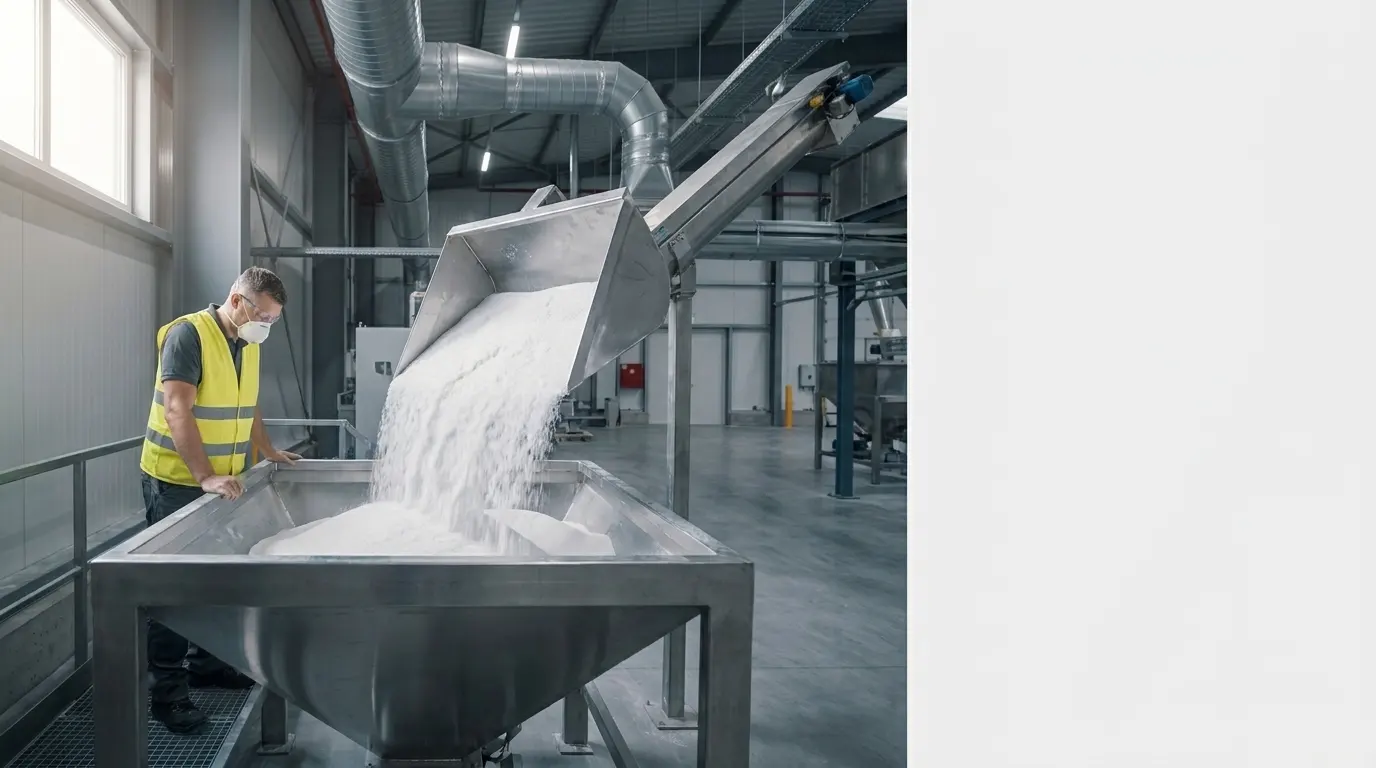
Dense soda ash has a higher bulk density than Light soda ash, which means it generates less dust and mixes more evenly with silica sand and other batch materials during feeding. In a continuous furnace operation, that consistency matters more than it sounds — uneven feeding creates hot spots and inconsistent melt chemistry across a production run.
Light soda ash, by contrast, is more prone to segregation and airborne loss during handling, which is part of why it's rarely specified for glass batches at scale. For the full technical breakdown of bulk density ranges, particle size, and where each grade fits best, see Soda Ash Light vs Dense: How to Choose the Right Grade (inferred).
Minimum Purity Requirements for Glass-Grade Soda Ash
Purity is the first number most buyers check, and for good reason — it's the most direct indicator of how much genuinely useful flux you're getting per ton, and how much of everything else (moisture, insolubles, trace salts) you're paying to ship and handle.
Industrial glass-grade soda ash generally needs to sit at 99% Na₂CO₃ or higher. Vanchor's sodium carbonate is supplied at ≥99% purity in both Dense and Light grades, which meets the baseline expectation for glass furnace feed. Purity below that threshold doesn't necessarily make the material unusable, but it does mean more of the batch is inert filler, which can shift your calculated silica-to-alkali ratio if you're not adjusting dosing to compensate.
Impurity Tolerances That Affect Glass Quality
Purity percentage tells you how much Na₂CO₃ is present, but it doesn't tell you what the remaining fraction is made of — and that's often the more important question for a furnace operator. A handful of specific impurities are worth checking on any specification sheet:
Sodium sulfate — Elevated sulfate content is a known contributor to fining bubbles, tiny gas inclusions that get trapped in the melt and remain visible in the finished glass. This is one of the more common quality complaints traced back to soda ash contamination.
Iron content — Even trace iron can introduce a faint green or yellow tint, which is a serious problem for clear container glass or optical applications, though less critical for colored glass.
Chloride content — Chloride is generally a secondary concern compared to sulfate and iron, but excessive levels can still affect melt behavior and are worth confirming on a specification sheet.
Moisture content (loss on ignition) — Moisture doesn't affect the finished glass directly, but it does affect how accurately you're measuring the batch, which is covered in more detail below.
None of these limits are standardized the same way across every supplier or every glass type — a fiberglass producer and a flat-glass producer may have different tolerances depending on their process and end-use requirements. This is why requesting supplier-specific documentation, rather than assuming a generic industry number applies, is the more reliable approach.
How Batch Weight and Moisture Affect Furnace Accuracy
This is the part of the specification that gets the least attention, even though it directly affects production consistency. Glass batch recipes are calculated by weight, based on a fixed ratio of silica sand to soda ash to other minor ingredients. That ratio assumes the soda ash you're weighing is actually soda ash — not soda ash plus absorbed moisture.
If a shipment has picked up moisture during storage or transit, the same scoop or metered dose delivers less actual Na₂CO�3 than the recipe assumes, even though the scale reads the same weight. Over a large batch, that shortfall can measurably shift the silica-to-alkali ratio, which in turn affects melting temperature and viscosity. This is one reason moisture-resistant packaging matters as much as the chemical specification itself.
Bulk density plays a related role. Dense soda ash's higher density means a given volume delivers more material by weight than the same volume of Light soda ash — which is exactly why volumetric feeding systems calibrated for one grade can misdose if switched to the other without recalibration. Particle size consistency matters too, since a wide size distribution can cause settling or uneven flow through automated feed systems.
Documentation to Request Before Ordering Glass-Grade Soda Ash
Specification numbers on a product page are only useful if they're backed by batch-specific proof. Before finalizing an order, it's worth asking a supplier for:
Certificate of Analysis (COA) — This should show the actual purity and impurity results for the specific batch you're purchasing, not a generic product average.
Technical Data Sheet (TDS) — Confirms the standard specification range the supplier commits to across production runs.
Safety Data Sheet (SDS) — Standard for handling and storage guidance, particularly relevant given the moisture sensitivity discussed above.
Vanchor provides COA, SDS, and TDS documentation for its sodium carbonate, along with packaging in 40kg or 50kg bags and 1000kg FIBC jumbo bags designed to limit moisture exposure during transit. If you're comparing multiple suppliers rather than a single source, Soda Ash Manufacturer in China covers what to look for when evaluating manufacturers more broadly, including production scale and export experience.
Applications Beyond a Single Glass Type
Dense soda ash purity and impurity expectations are broadly similar across most glass categories, though the tolerance for visible defects varies by product.
Container glass and float glass generally tolerate the standard 99%+ purity range without special adjustment.
Fiberglass production tends to be more sensitive to trace iron, given its effect on fiber consistency and appearance.
Specialty and optical glass applications typically require the tightest impurity control of the group.
Soda ash used in glass manufacturing is chemically the same material.


Contact Us
In This Article
Related Posts
Custom Packaging Solutions from an Anhydrous Sodium Acetate Supplier in China
2026-09-23
Application Trends in Anhydrous Sodium Acetate for Special Chemical Manufacturing
2026-09-23
Anhydrous Sodium Acetate for Leather Tanning: Improve Dyeing Uniformity
2026-09-22
Formic Acid 85% for Textile Dyeing: Industrial Applications, Technical Benefits and Future Trends
2026-09-22


