



Soda Ash Storage and Caking: Moisture Control, Silo Handling, and Packaging
By Tonmoy
2026-08-26Related Posts
Custom Packaging Solutions from an Anhydrous Sodium Acetate Supplier in China
2026-09-23

Application Trends in Anhydrous Sodium Acetate for Special Chemical Manufacturing
2026-09-23
Anhydrous Sodium Acetate for Leather Tanning: Improve Dyeing Uniformity
2026-09-22

Formic Acid 85% for Textile Dyeing: Industrial Applications, Technical Benefits and Future Trends
2026-09-22
Soda ash caking is primarily a moisture-control problem. When solid sodium carbonate is exposed to atmospheric moisture, particles can form lumps and lose their free-flowing behavior. The right response depends on where the problem occurs: inside bags or bulk bags, at a silo outlet, in a feeder, or throughout the stored material.
Effective control therefore combines:
- Dry, protected storage
- Intact and suitable packaging
- First-in, first-out inventory management
- Silo and discharge equipment appropriate for the actual soda ash grade
- A clear distinction between caking, bridging, segregation, and feeder problems
Soda ash is sodium carbonate. The guidance below applies to solid soda ash and should not be transferred automatically to sodium carbonate solutions, sodium bicarbonate, hydrates, or caustic soda.
Why soda ash cakes during storage
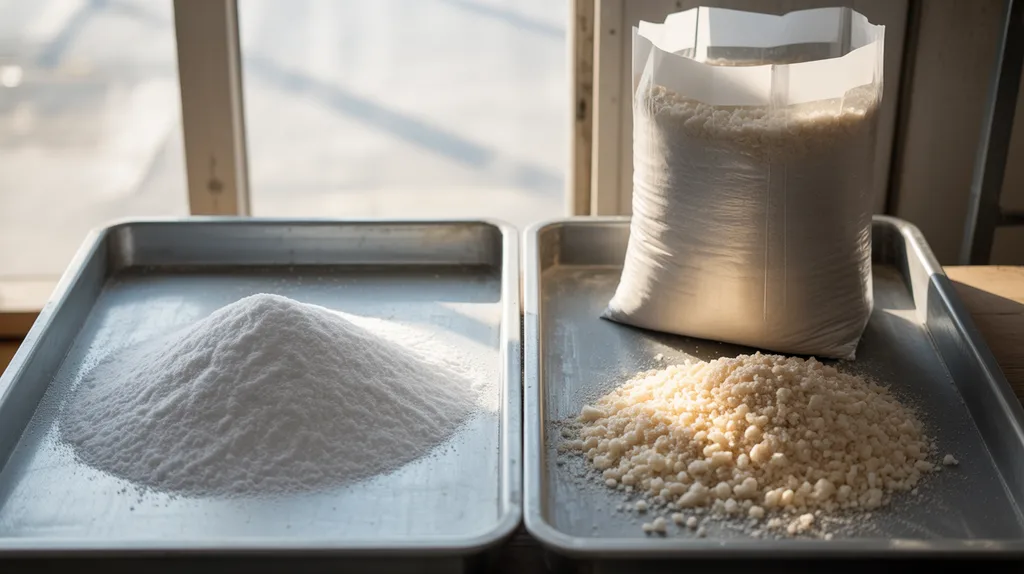
Soda ash can cake when it absorbs moisture from the surrounding air. The result may be soft clumping, hardened lumps, or a larger mass that no longer discharges consistently from a bag, hopper, or silo.
Moisture exposure can occur through:
- Opened or poorly closed packaging
- Torn bags, damaged FIBCs, or compromised liners
- Humid storage areas
- Water entering during transport or warehouse handling
- Condensation or other site-specific moisture sources
Caking is not the same as every type of flow failure. Use the location and appearance of the problem to guide the first inspection:
| Observed problem | Possible category | First checks |
|---|---|---|
| Lumps inside a bag or FIBC | Moisture-related caking or compaction | Packaging condition, closure, wetting, storage duration |
| Material arches above a silo outlet | Bridging or hang-up | Outlet geometry, product condition, recent handling changes |
| Variable flow with different particle fractions | Segregation | Filling method, vibration, particle-size distribution |
| Feeder runs but receives little material | Discharge or feeder problem | Outlet, feeder, blockage, controls, and material condition |
These categories can overlap. For example, moisture-related caking may create a bridge at a silo outlet, but adding vibration without identifying the cause can create a separate segregation problem.
For more detail on how physical properties can affect handling, see dense soda ash particle size. The actual particle-size and bulk-flow data for the supplied grade should still be confirmed from current product documentation.
Moisture-control practices for bagged soda ash
Bagged soda ash should be protected from excessive humidity and direct contact with water. Storage controls should cover the entire handling chain, from receipt and inspection through warehouse storage and use.
Keep packaging dry and intact
Before placing soda ash into inventory, inspect bags and bulk bags for:
- Tears, punctures, or abrasion
- Damaged closures
- Signs of wetting or staining
- Compromised liners
- Deformation that could indicate rough handling or compression
Do not assume that an undamaged outer bag guarantees that the product remained dry. If a shipment has been exposed to rain, condensation, flooding, or visibly wet conditions, quarantine and QA review may be appropriate under the site’s procedures.
Opened packaging should be closed or otherwise protected from ambient moisture. The specific closure method should follow the packaging design and the supplier’s handling documentation rather than a universal rule.
Control the storage area
A suitable storage area should protect soda ash from:
- Rain and spray
- Roof or pipe leaks
- Wet floors
- Condensation
- Excessive humidity
- Cross-contamination from other materials
Storage practices should also prevent bags from being damaged by forklifts, pallets, sharp edges, or unsuitable stacking conditions. The exact warehouse arrangement depends on the packaging format, handling equipment, and site risk assessment.
Use inventory rotation
First-in, first-out inventory management helps limit unnecessary storage duration and is included in published soda ash storage guidance. FIFO does not create a universal shelf-life period, but it reduces the time during which packaging may be exposed to warehouse conditions.
A shelf-life decision should consider:
- The exact soda ash grade and form
- Packaging integrity
- Liner and closure design
- Storage conditions
- Time in inventory
- Any supplier-specific storage statement
- QA inspection or batch documentation
If a project requires a defined storage period, request product-specific documentation rather than applying a generic number to every soda ash product.
Bulk silo handling: design factors that affect flow
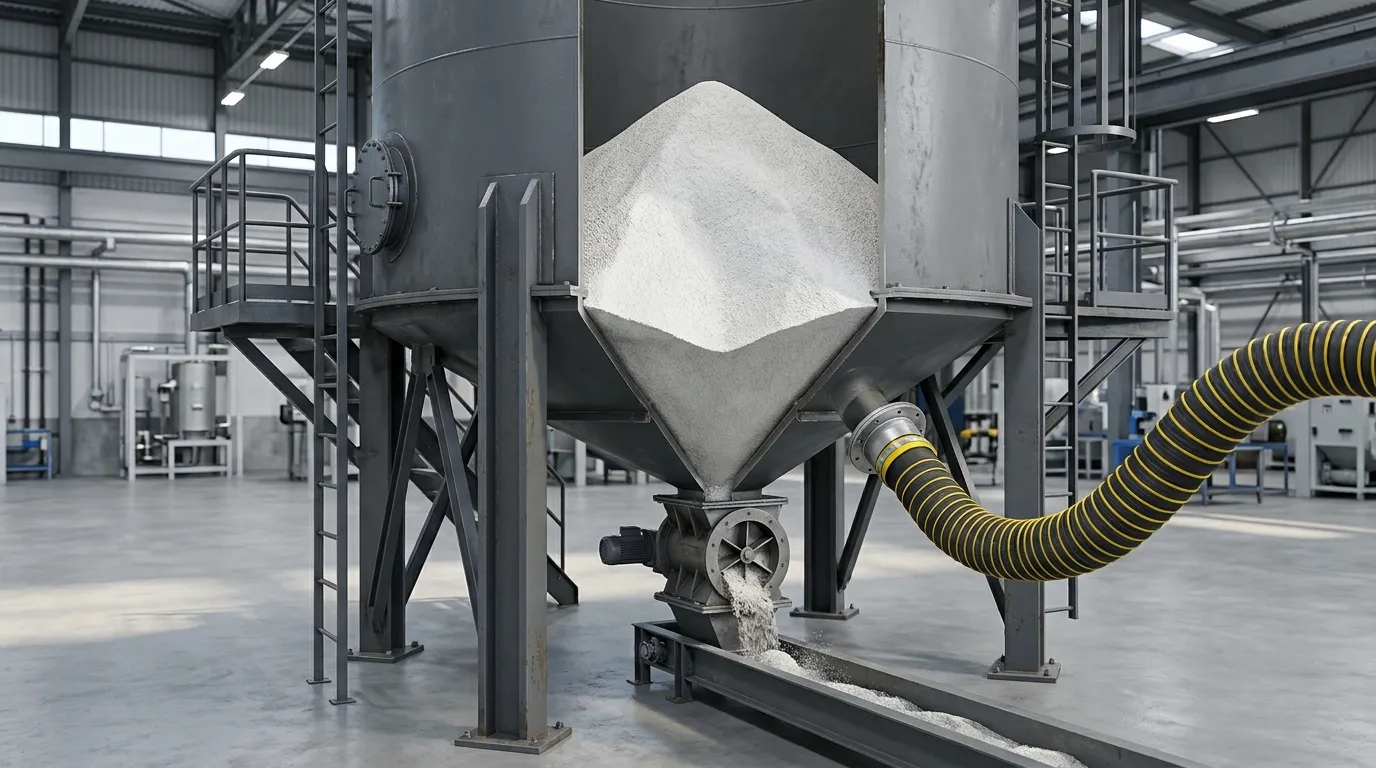
Bulk soda ash systems may include a silo, feeder, dust collection, controls, and, where required by the process, solution-preparation equipment. The correct arrangement depends on the actual material and the plant’s throughput and discharge requirements.
Before finalizing or modifying a silo system, confirm:
- Soda ash grade and physical form
- Particle-size distribution
- Bulk-density data
- Expected filling and discharge rate
- Silo capacity and outlet arrangement
- Dust-collection requirements
- Feeder type and control method
- Packaging or unloading method
- Whether vibration or other flow-assistance equipment is proposed
Detailed information on the broader chemical-storage topic is available through soda ash storage handling, provided the page is used as a related handling resource rather than a substitute for product-specific engineering review.
Treat silo geometry as source-specific
One published soda ash storage guide recommends epoxy-lined steel bins and gives a cone angle of 45–55 degrees from horizontal for its bulk-storage guidance. These values should be treated as that supplier’s recommendation, not as a universal design standard for every soda ash grade, silo size, or discharge system.
The appropriate design should be reviewed using current product data and the responsible equipment or process engineer’s calculations. A cone angle that works for one material form may not provide the same flow behavior for another form, particle-size distribution, or storage condition.
Do not use vibration automatically
Vibration may appear to offer a simple solution to poor flow, but published storage guidance cautions that it can promote segregation and particle-size classification. This matters when different particle fractions move or settle unevenly during filling, storage, or discharge.
Before adding or increasing vibration, establish whether the actual problem is:
- Moisture-related caking
- Bridging at the outlet
- Segregation
- Inadequate outlet geometry
- Feeder malfunction
- A change in product grade or particle-size distribution
The solution should address the diagnosed problem rather than treating all flow interruptions as a vibration requirement. Published soda ash storage guidance provides the attributed cone-angle and vibration cautions; these recommendations should not be presented as universal engineering rules.
Packaging and discharge choices for bulk bags and FIBCs
Packaging should be evaluated together with the storage and discharge system. A bulk bag that protects the product during transport may still require a suitable frame, liner, closure, and discharge arrangement for the receiving plant.
When reviewing bulk bags or FIBCs, confirm:
- Bag construction and rated handling method
- Liner type and moisture-barrier requirements
- Filling and closure arrangement
- Lifting and unloading points
- Discharge spout design
- Compatibility with the receiving frame and feeder
- Protection during warehouse storage
- Whether the packaging can remain closed between partial uses
- Required supplier documents and inspection records
Bulk-bag discharge equipment may include a dedicated support frame and bag-activation equipment. These are equipment options, not mandatory components for every soda ash installation. The selected system should reflect the bag design, product characteristics, and required discharge rate.
For broader logistics and packaging context, see chemical packaging and logistics. Vanchor-specific bag, liner, bulk-density, and storage specifications should not be inferred from a general logistics page.
Troubleshooting caking, bridging, and segregation
When soda ash stops flowing as expected, use a controlled diagnostic sequence rather than immediately applying mechanical force or changing equipment settings.
- Identify where the problem occurs.
Determine whether the issue is inside a bag, at a bulk-bag outlet, above a silo outlet, inside a hopper, at the feeder, or further along the process line.
- Inspect for moisture exposure.
Check for damaged packaging, open closures, wet floors, roof or pipe leaks, condensation, and unusual humidity exposure.
- Classify the material behavior.
Decide whether the product is hardened into lumps, forming an arch, separating into different fractions, or failing to reach the feeder for another reason.
- Review recent changes.
Compare the affected material with previous deliveries or batches. Check for changes in grade, particle size, packaging, storage duration, filling method, unloading practice, or vibration.
- Review product documentation.
Confirm the exact product form and compare the site’s handling assumptions with the current TDS, SDS, packaging information, and available batch documentation.
- Escalate safely.
Any intervention involving a silo, hopper, elevated equipment, dust exposure, or confined space should follow the site’s engineering and safety procedures. Do not enter a silo or attempt manual blockage removal without the required controls.
The following actions should not be assumed to solve every flow problem:
- Adding vibration without checking segregation risk
- Increasing discharge force without checking packaging or outlet conditions
- Applying water or another material to break up soda ash
- Transferring guidance from caustic soda to soda ash
- Treating a general storage recommendation as a product-specific operating procedure
Safety and documentation checks before changing storage practice
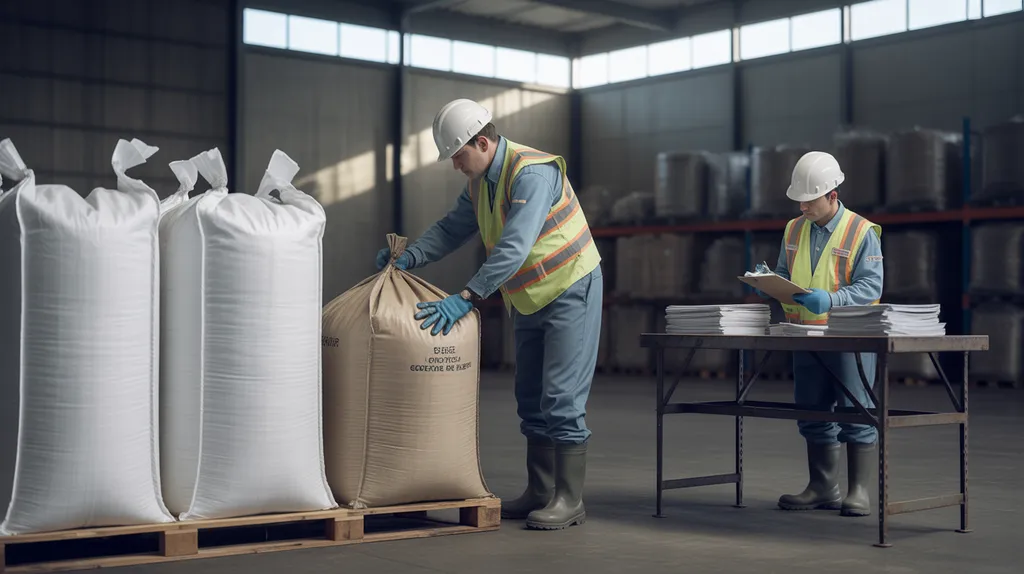
Soda ash dust can irritate the eyes, skin, and mucous membranes. Dust control, appropriate PPE, spill response, and equipment-access procedures should follow the current SDS and the site’s safety program.
Before changing storage or handling practices, QA, operations, and procurement teams should confirm:
- Exact chemical identity and product form
- Applicable SDS and TDS
- Grade and particle-size information, where relevant
- Packaging and liner specification
- Storage and handling statement
- Batch or lot documentation where required
- Site requirements for dust, confined spaces, and equipment isolation
An SDS is a safety document; it does not by itself establish food, feed, pharmaceutical, or drinking-water suitability. Similarly, a COA describes a particular batch and does not establish universal approval for every application.
If the required storage duration is longer than normal inventory practice, ask for a product-specific storage or shelf-life statement. Do not substitute a generic shelf-life number for evidence covering the actual grade, packaging, and storage conditions.
The main operational decision is straightforward: keep soda ash dry, protect packaging from damage and humidity, rotate inventory, and diagnose the type of flow failure before changing silo equipment or operating practices. For broader context on sodium carbonate applications, see sodium carbonate industrial uses. When a storage issue remains unresolved, the next step is to compare the actual product form and packaging with the supplier’s current technical documents and the plant’s engineering requirements.


Contact Us
In This Article
Related Posts
Custom Packaging Solutions from an Anhydrous Sodium Acetate Supplier in China
2026-09-23
Application Trends in Anhydrous Sodium Acetate for Special Chemical Manufacturing
2026-09-23
Anhydrous Sodium Acetate for Leather Tanning: Improve Dyeing Uniformity
2026-09-22
Formic Acid 85% for Textile Dyeing: Industrial Applications, Technical Benefits and Future Trends
2026-09-22


