



Dense Soda Ash Particle Size: Flow, Dust, and Glass-Batch Segregation
By Tonmoy
2026-08-25Related Posts
Custom Packaging Solutions from an Anhydrous Sodium Acetate Supplier in China
2026-09-23

Application Trends in Anhydrous Sodium Acetate for Special Chemical Manufacturing
2026-09-23
Anhydrous Sodium Acetate for Leather Tanning: Improve Dyeing Uniformity
2026-09-22

Formic Acid 85% for Textile Dyeing: Industrial Applications, Technical Benefits and Future Trends
2026-09-22
Dense soda ash particle size should be evaluated as a particle-size distribution, not as one average number. Dense soda ash is generally a coarser, more granular form of sodium carbonate than soda ash light, but the word “dense” does not by itself define the material’s sieve profile, fines content, bulk density, or handling behavior.
For glass-batch users, the practical questions are:
- How much material is in the main coarse fraction?
- What percentage is fine enough to increase dust or carryover?
- Is there an oversize fraction that may affect feeding?
- How were sieve results measured and reported?
- Does the distribution fit the other raw materials and the plant’s handling system?
Dense soda ash can offer different flow and dust characteristics from finer soda ash, but it should not automatically be treated as dust-free, free-flowing, or capable of preventing glass-batch segregation. Those outcomes depend on the complete distribution, moisture, compaction, equipment, transfer conditions, and batch composition.
What “dense soda ash particle size” actually means
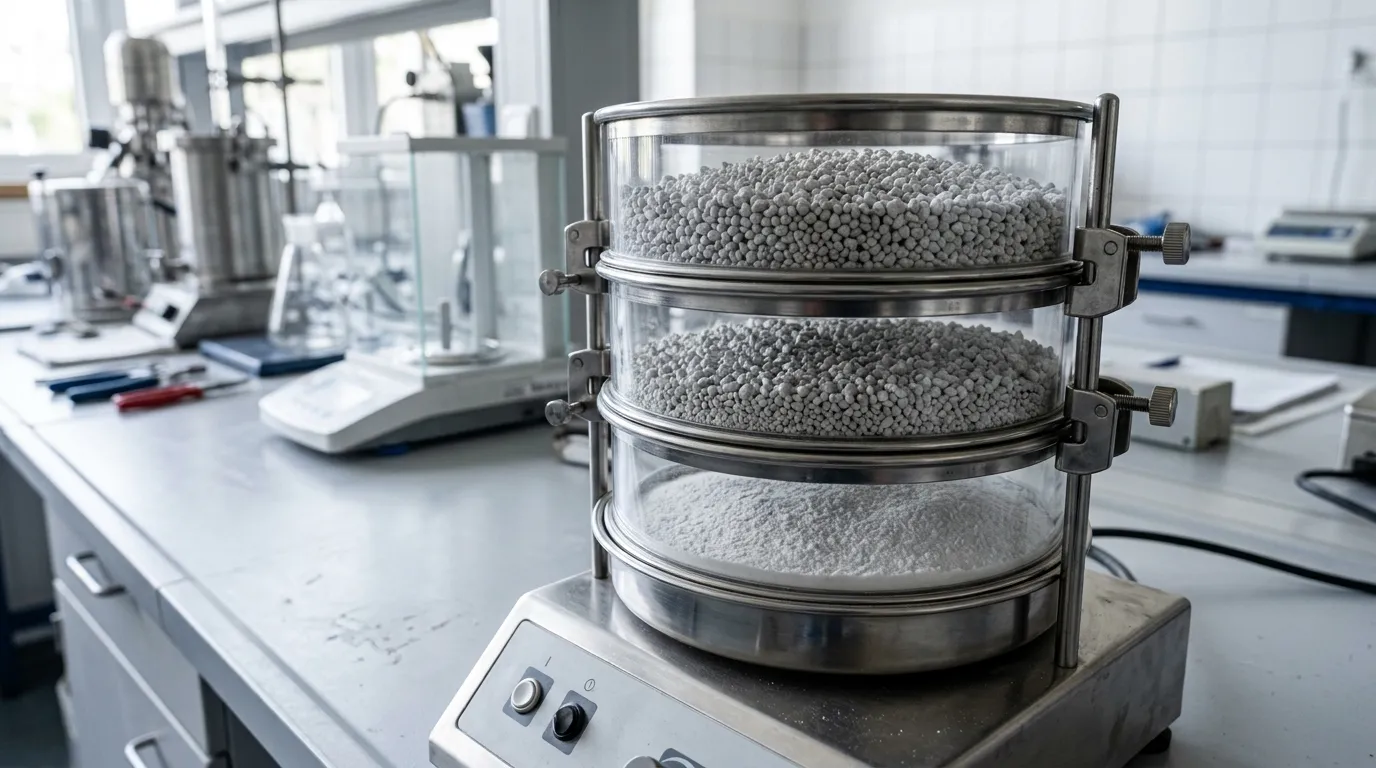
Dense and light soda ash are both forms of sodium carbonate, commonly identified as CAS 497-19-8. Their chemical identity is the same, but their physical form, bulk density, and particle characteristics differ. Dense soda ash is generally described as coarser or more granular than soda ash light.
A full dense soda ash particle-size specification may use:
- U.S. Standard mesh values
- Micrometre or micrometre-based screen sizes
- Percentage retained on a sieve
- Percentage passing through a sieve
- Minimum or maximum limits
- Typical values
- Fines and oversize fractions
This means that “particle size” may refer to one part of a distribution rather than a single diameter. Two dense soda ash products can both be described as granular while having different proportions of fines, main-size particles, and oversize material.
Some supplier specifications report several sieve fractions across different mesh or micrometre thresholds rather than one nominal size. These examples demonstrate how particle-size data may be presented, but they are not universal standards for every dense soda ash grade. See this dense soda ash specification example for the type of multi-fraction information that may appear in supplier documentation.
| Specification field | What it may indicate | What it does not prove |
|---|---|---|
| Sieve fraction | The amount retained or passing at a stated screen size | Overall flow performance |
| Fines fraction | Potential dust, carryover, and handling relevance | A guaranteed dust level |
| Oversize fraction | Potential feeding or distribution concerns | Guaranteed batch segregation |
| Bulk density | Mass per unit of bulk volume under a stated method | Particle-size distribution |
| Moisture | A condition that may affect bulk behavior | Product approval or application suitability |
| Test method | How the value was measured | That the result applies to another grade or supplier |
A single value such as “coarse,” “granular,” or one mesh result is therefore not enough for technical approval. Buyers should request the complete distribution and confirm how the reported values were generated.
For a broader comparison of physical form, use the dedicated guide to soda ash light vs dense. This article focuses more narrowly on how dense soda ash particle-size data should be interpreted for handling and glass-batch decisions.
Particle size, particle-size distribution, and bulk density are different
Particle size and bulk density are related, but they are not interchangeable.
Particle-size distribution describes how much of the solid falls within different size ranges. It can show whether a material is concentrated in a relatively narrow coarse fraction or contains a wider mixture of coarse, intermediate, and fine particles.
Bulk density describes the mass of material occupying a given bulk volume under a stated measurement condition. It is influenced not only by the particles themselves, but also by how they pack, settle, compact, and retain moisture.
This distinction matters in plant operations. A dense soda ash product may have a higher bulk density than a light form, yet that does not establish that it will flow better through every hopper or feeder. Similarly, a coarser material may generate less airborne dust than a finer material during some handling steps, but a product with a significant fines fraction can still create dust during discharge or transfer.
Bulk-density results should therefore be reviewed with:
- The measurement basis and method
- Moisture information
- The relevant sieve distribution
- Whether the value is loose, tapped, or otherwise conditioned
- The equipment and feeding method used at the plant
Without these details, comparing bulk-density numbers from different documents can be misleading.
How particle-size distribution affects flow and dust
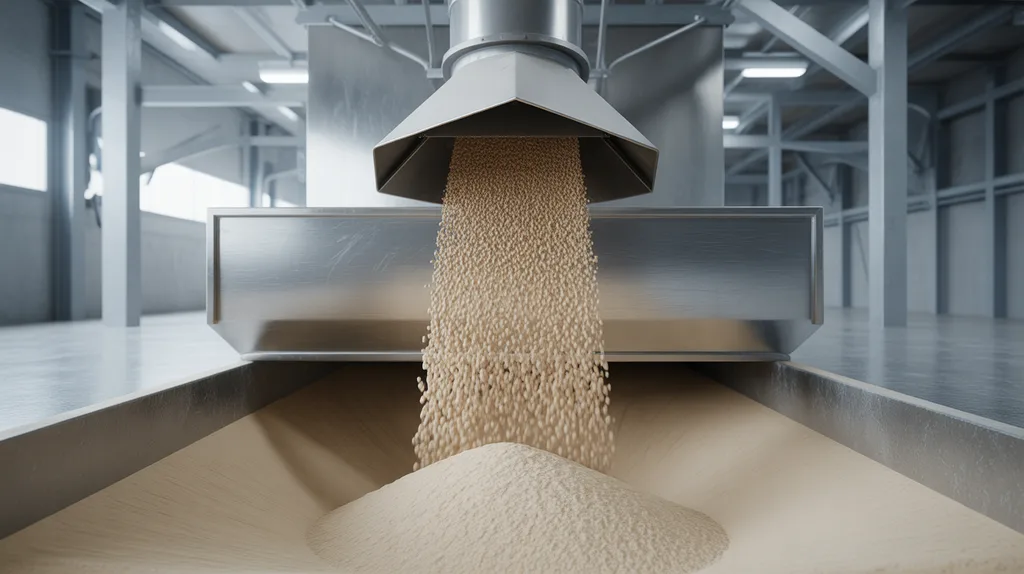
Dense soda ash particle-size distribution can influence how the material behaves during unloading, conveying, transfer, storage discharge, and feeding. The effect is not determined by the coarsest fraction alone. Fines, distribution width, moisture, compaction, and equipment geometry all matter.
A coarse granular fraction is commonly associated with different handling behavior from a fine powder. Fewer very fine particles may reduce the amount of dust released during some transfers. However, “dense” does not mean dust-free. Dust can still be generated when bags or bulk material are emptied, when particles fall through a significant height, or when material is conveyed or agitated.
The fines fraction deserves particular attention because it may affect:
- Visible dust during transfer
- Dust collection load
- Material carryover
- Feeder consistency
- Local accumulation around transfer points
- The proportion of material that behaves differently from the main coarse fraction
A broad distribution can also matter. If a product contains both a substantial coarse fraction and a fine fraction, the two fractions may respond differently to vibration, air movement, impact, and conveying. That does not prove a specific plant problem, but it identifies a reason to review the complete distribution rather than relying on the product name.
| Particle or bulk property | Possible operational relevance | What should be verified |
|---|---|---|
| Higher fines fraction | Greater potential for dust or carryover during handling | Fines limit, test method, and plant dust observations |
| Broad size distribution | Different fractions may pack or move differently | Lot-to-lot distribution and feeder response |
| Higher bulk density | Different volumetric feeding behavior | Measurement basis and feeder calibration |
| Moisture or compaction | Changed discharge and flow behavior | Storage history, moisture data, and test conditions |
| Oversize fraction | Potential obstruction or feeding concern in some systems | Maximum size, screen limits, and equipment compatibility |
Flowability is also equipment-dependent. Hopper design, outlet geometry, vibration, conveying method, transfer height, and the condition of the material can all affect observed behavior. A supplier specification can describe the material, but it cannot by itself guarantee how that material will move through a particular plant.
Storage can further change handling behavior if material cakes or compacts. For related storage considerations, see soda ash storage and caking. That topic should be considered separately from the initial particle-size specification: a compliant sieve distribution does not guarantee that material will retain the same handling behavior after unfavorable storage conditions.
Glass-batch segregation: where particle size becomes a process risk
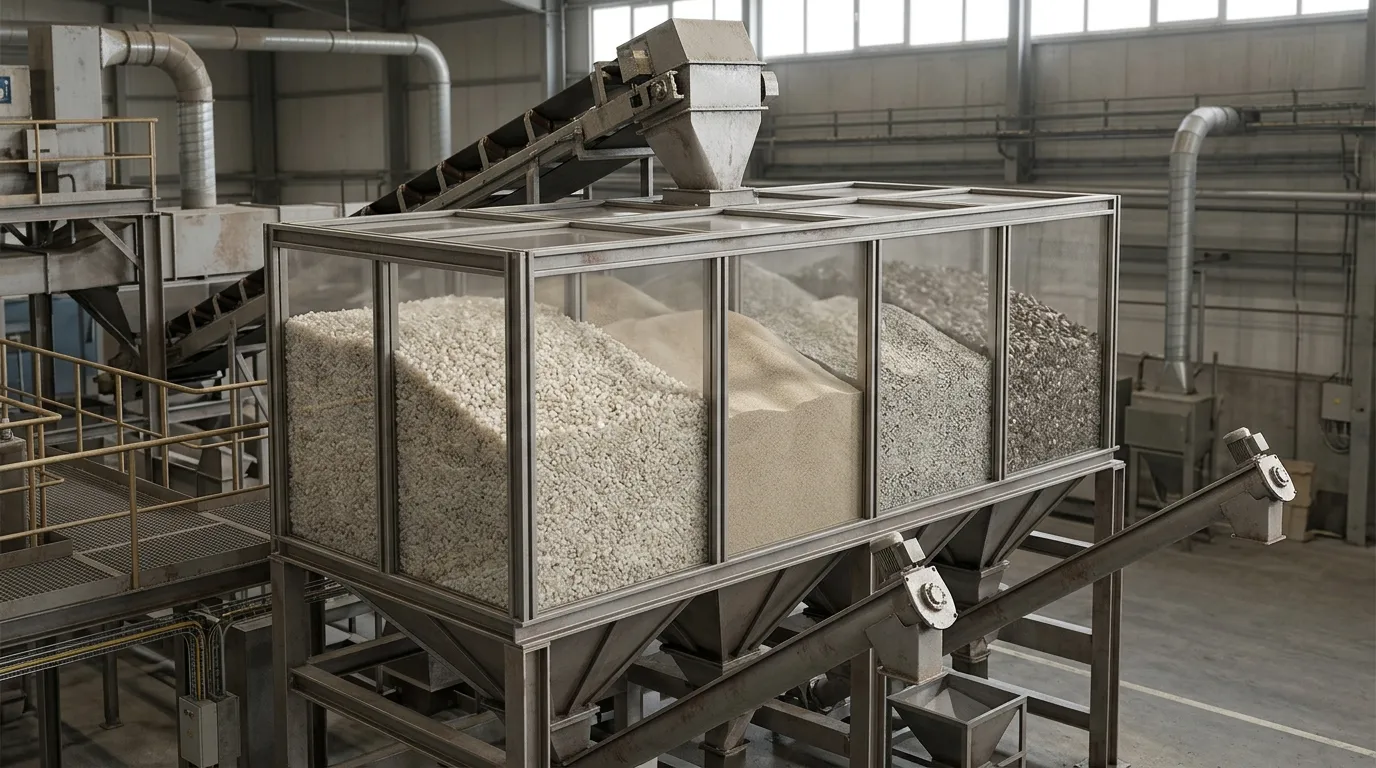
Glass-batch users should consider dense soda ash particle size in relation to the other solids in the batch. Soda ash does not move through a batch-handling system in isolation. The relevant system may include other raw materials with different particle sizes, densities, moisture levels, shapes, and surface properties.
Size-based segregation can become a process risk when different fractions respond differently during:
- Blending
- Transfer between vessels
- Conveyor movement
- Hopper discharge
- Pneumatic or mechanical conveying
- Truck or silo unloading
- Vibration and settling
- Storage before charging
The important point is not that dense soda ash automatically causes segregation. It is that particle-size distribution can be one variable in a broader segregation assessment.
A coarse dense soda ash product may fit a glass-batch handling objective, particularly where the buyer is trying to avoid an excessively fine material. However, the available evidence does not establish that every dense soda ash grade prevents segregation or guarantees a more homogeneous glass batch.
Vanchor’s glass-related site material describes dense particle size as being closer to silica sand and as potentially supporting more homogeneous glass raw materials. That statement should be treated as a Vanchor site-stated position, not as independent test evidence or a universal performance guarantee. The broader application context is covered in soda ash glass manufacturing.
A practical glass-batch review should ask:
- Is the soda ash distribution compatible with the size distribution of the other major batch solids?
- Could a fine fraction move differently from the principal coarse fraction?
- Are there transfer points where vibration or air movement could separate fractions?
- Does moisture or compaction change the discharge behavior?
- Are the supplier’s sieve results consistent across representative lots?
- Is batch uniformity being verified through the plant’s existing quality-control method?
Particle-size matching alone does not establish uniformity. A buyer may need to compare material data with the actual batch system and validate the selected grade under representative plant conditions. The required validation method will depend on the equipment, formulation, and quality objectives.
Which dense soda ash particle-size data should appear on a TDS or COA?
When particle size is important to handling or glass-batch control, a TDS or COA should provide more than a general description such as “dense,” “granular,” or “coarse.”
The buyer should request or confirm the following information:
- Exact chemical identity and product form
- Exact dense grade or product designation
- Assay basis, kept separate from physical properties
- Sieve distribution across relevant mesh or micrometre sizes
- Whether each value is retained or passing
- Whether each limit is minimum, maximum, or typical
- Fines fraction
- Oversize fraction
- Bulk-density value and measurement basis
- Moisture value and test method
- Sieve or particle-size test method
- Lot or batch identification
- Date or version of the applicable specification
- Whether the values apply to the exact grade being purchased
A TDS normally describes the product specification or typical characteristics. A COA relates to a particular lot or batch. Neither document should automatically be treated as proof that the material will suit every glass-batch system.
The following checklist can help identify incomplete documentation:
- Is the particle-size result a distribution or only one nominal value?
- Are the units clear?
- Are retained and passing values clearly distinguished?
- Are fines and oversize limits stated?
- Is the test method identified?
- Is bulk density reported under a defined condition?
- Is moisture included where it matters to handling?
- Can the result be connected to a specific lot?
- Are the stated limits for dense soda ash rather than soda ash light?
- Do the documents use the same definitions and units as the buyer’s internal specification?
Supplier specifications can differ in both format and limits. One supplier may report several retained sieve fractions, while another may emphasize a limited number of screen values or a bulk-density range. These differences do not necessarily indicate that one material is suitable and another is unsuitable; they mean the data must be compared on an equivalent basis.
A documented chemical sample approval process can be useful when a buyer needs to connect specification review with lot documentation and application evaluation. The approval criteria still need to be defined for the buyer’s own process.
A practical decision rule for dense soda ash approval
Dense soda ash should not be approved for a particle-size-sensitive application solely because the product is labeled “dense.” A more defensible review asks whether the exact grade is documented well enough to compare with the plant’s requirements.
Before advancing a grade, confirm that:
- The material is the required sodium carbonate dense solid form.
- The full particle-size distribution is available.
- Sieve units and retained or passing definitions are clear.
- Fines and oversize are addressed.
- Bulk density is reported with an identifiable measurement basis.
- Moisture and test-method information are available where relevant.
- The data applies to the exact grade and lot under review.
- Representative lots show acceptable consistency.
- The distribution is compatible with the plant’s feeding and glass-batch handling system.
- Any known segregation concern has a defined validation approach.
This is a practical specification and process-risk framework, not a universal acceptance standard. The appropriate limits depend on the buyer’s formulation, equipment, handling conditions, and quality requirements.
For broader context on sodium carbonate applications, see sodium carbonate industrial uses. For a dense soda ash inquiry, the most useful technical discussion should focus on the required particle-size distribution, fines and oversize limits, bulk-density basis, moisture, test method, and supporting lot documentation—not simply on whether the material is described as dense.


Contact Us
In This Article
Related Posts
Custom Packaging Solutions from an Anhydrous Sodium Acetate Supplier in China
2026-09-23
Application Trends in Anhydrous Sodium Acetate for Special Chemical Manufacturing
2026-09-23
Anhydrous Sodium Acetate for Leather Tanning: Improve Dyeing Uniformity
2026-09-22
Formic Acid 85% for Textile Dyeing: Industrial Applications, Technical Benefits and Future Trends
2026-09-22


