



Sodium Formate Brine Density: Concentration, Temperature, and Mixing Factors
By Tonmoy
2026-09-08Related Posts
Custom Packaging Solutions from an Anhydrous Sodium Acetate Supplier in China
2026-09-23

Application Trends in Anhydrous Sodium Acetate for Special Chemical Manufacturing
2026-09-23

Anhydrous Sodium Acetate for Leather Tanning: Improve Dyeing Uniformity
2026-09-22

Formic Acid 85% for Textile Dyeing: Industrial Applications, Technical Benefits and Future Trends
2026-09-22
Sodium formate brine density depends mainly on dissolved sodium formate concentration and temperature. For oilfield completion-fluid applications, published sources report sodium formate solution densities of approximately 8.4–11.0 lb/gal, while approximate saturated or near-saturated values are commonly reported around 1.30–1.32 SG or g/cm³.
These figures should not be treated as one universal specification. The reported value can change with concentration basis, temperature, saturation condition, product quality, and measurement method. When the required density exceeds the practical range of sodium formate alone, a sodium/potassium formate blend may need to be evaluated.
What sodium formate brine density means
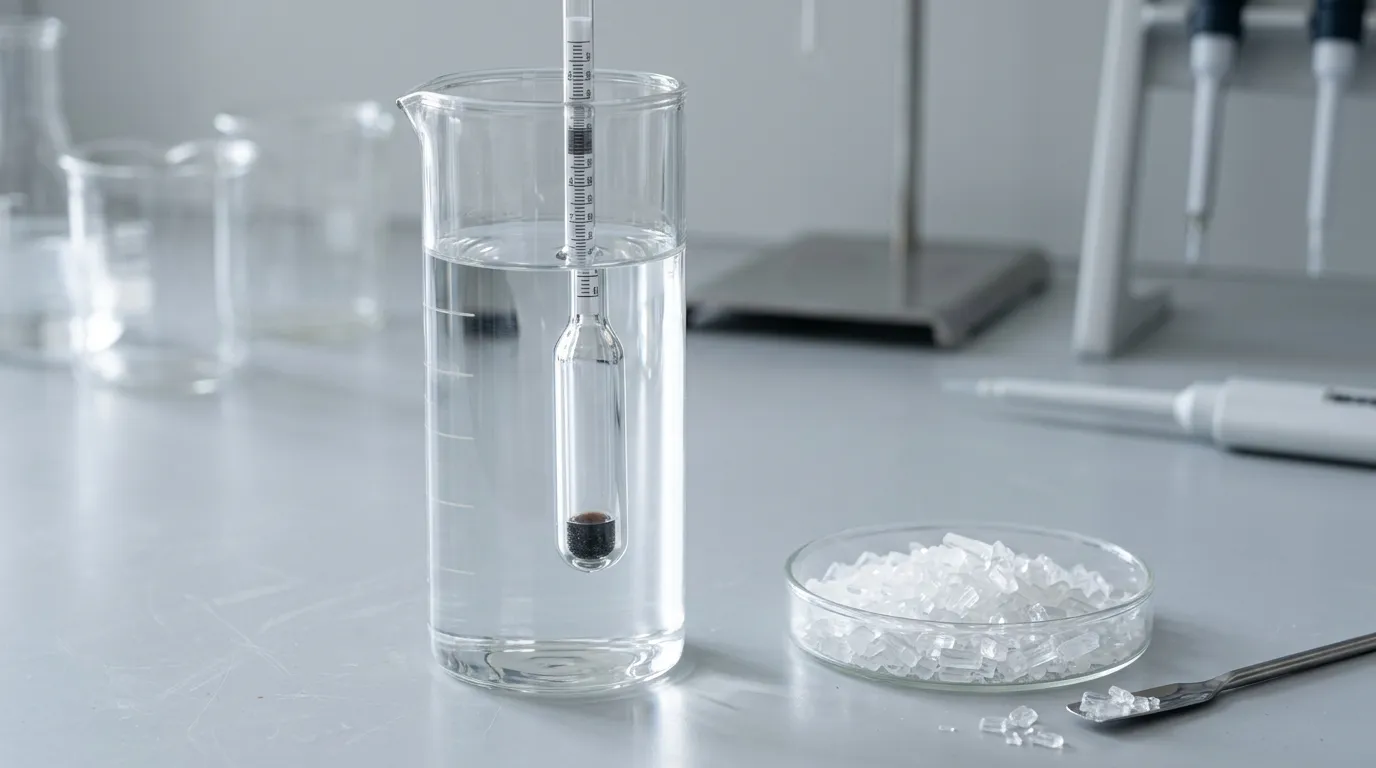
Sodium formate brine is an aqueous solution of sodium formate. Its density describes the mass of the final solution per unit of volume. It is not the same as the assay of the dry sodium formate used to prepare the brine.
Common ways to express density include:
| Expression | Meaning | Important qualification |
|---|---|---|
| SG or specific gravity | Density relative to a reference fluid | Reference and temperature should be stated |
| g/cm³ | Mass per unit volume | Measurement temperature and method matter |
| lb/gal or ppg | Oilfield mass-per-volume units | Source convention and test conditions should be identified |
A dry product specification may list assay, moisture, and impurity limits. Those values help define the quality of the supplied sodium formate, but they do not by themselves establish the density of a finished brine. The final density depends on how much product is dissolved, the water or liquid basis used, and the temperature at which the solution is measured.
For product identity and commercial product information, see sodium formate. The product page should not be treated as a substitute for a concentration–density table unless that table is provided for the exact product and conditions.
Reported sodium formate brine density range
Published technical and supplier sources do not give exactly the same number, but they place sodium formate brine in a broadly similar range.
- TETRA reports sodium formate completion-fluid applications in an approximate range of 8.4–11.0 lb/gal. Source
- The SLB Energy Glossary lists an approximate maximum clear-solution density of 1.32 g/cm³ for sodium formate. Source
- Other supplier and archived technical materials report approximately 1.30 SG or 10.8 ppg near saturation. These are source-specific values and should be treated accordingly. OSS source Archived technical source
| Source scope | Reported value | How to interpret it |
|---|---|---|
| Completion-fluid application range | Approximately 8.4–11.0 lb/gal | A source-reported application range |
| Approximate clear-solution maximum | Approximately 1.32 g/cm³ | A qualified reference value, not a universal guarantee |
| Supplier or archived technical material | Approximately 1.30 SG or 10.8 ppg | An attributed value with incomplete test conditions |
The differences may reflect different concentration definitions, temperatures, saturation conditions, rounding, or test methods. A value such as 1.30 SG should not automatically be treated as identical to every other value reported near 1.30, 1.32, or 11.0 lb/gal.
The retrieved evidence does not support publishing a universal sodium formate concentration-to-density chart. For a formulation or purchase decision, use a product-specific technical data sheet or an authoritative formate-brine table that states the concentration basis, temperature, density method, and units.
How concentration changes sodium formate brine density
Increasing the dissolved sodium formate concentration generally increases the density of the aqueous solution. This is the main reason sodium formate brine density is usually discussed together with concentration rather than as an isolated material property.
The relationship should be interpreted using the following distinctions:
| Variable | Effect on density interpretation | Information to document |
|---|---|---|
| Dissolved sodium formate concentration | Generally, a higher concentration produces a denser solution | Concentration basis and calculation method |
| Solid sodium formate assay | Determines the amount of active sodium formate entering the formulation | Assay, moisture, and impurity limits |
| Water or dilution quantity | Changes the final concentration and density | Final mass or volume basis |
| Near-saturation operation | May introduce solubility and crystallization constraints | Temperature and stability condition |
A concentration stated as mass percent is not interchangeable with a volume percentage or with the dosage of a commercial product as supplied. Similarly, a product assay such as 92%, 95%, or 98% does not directly state the concentration of the final brine.
Where solid-grade differences are relevant to formulation calculations, the sodium formate 92 vs 95 vs 98 comparison should be kept separate from the brine-density question. A grade comparison may help explain the supplied material, but it does not replace a measured or documented density curve for the finished solution.
A technical formate-brine manual identifies mixing tables and solution-property data as necessary for this type of work. The Formate Technical Manual is therefore more relevant to concentration planning than a generic solid-product specification. However, the specific concentration–density tables and their test conditions must be available before numerical values are used in a formulation.
Why temperature changes the density reading
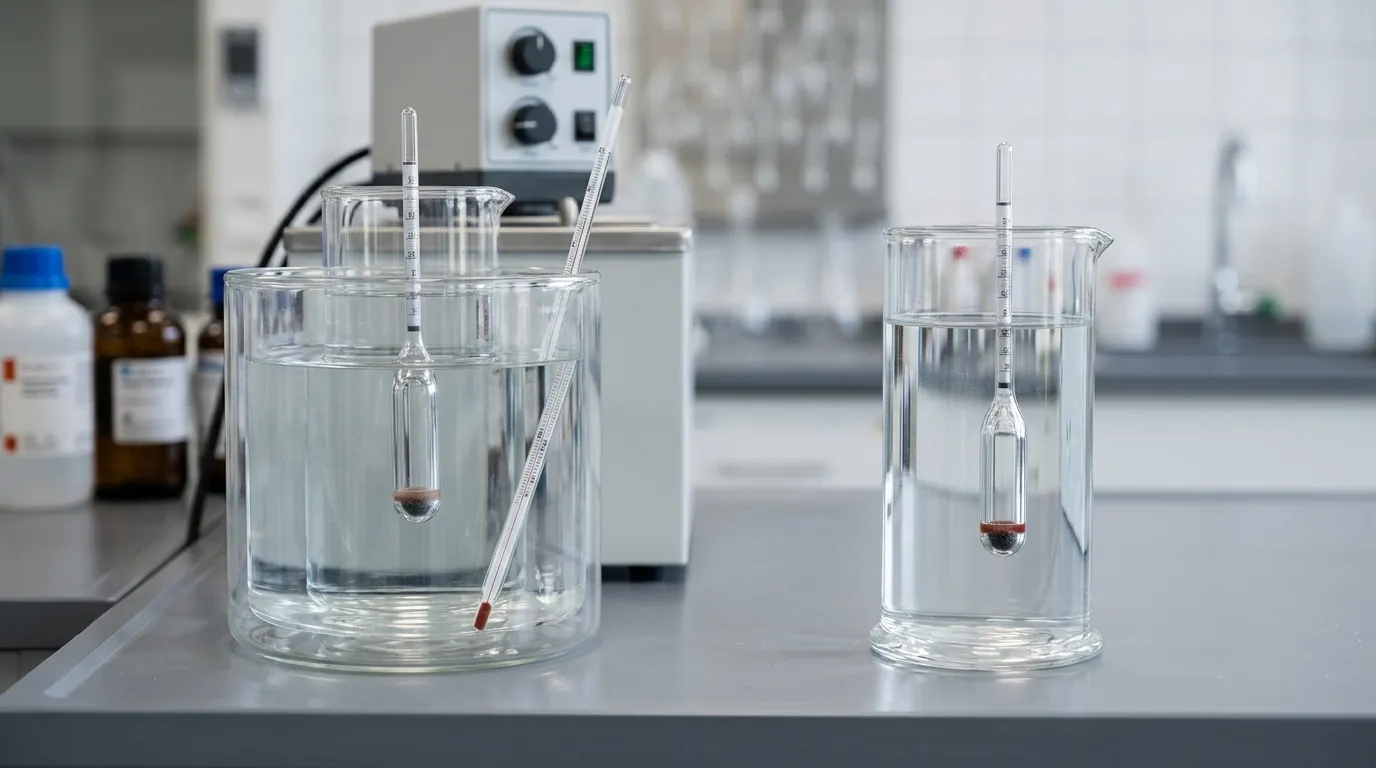
Temperature must accompany a sodium formate brine density value whenever the value is used for technical comparison.
As temperature changes, the volume of the solution changes. That changes the measured mass per unit volume even when the amount of dissolved sodium formate remains unchanged. Consequently, two density readings can differ because they were taken at different temperatures rather than because the brines have different concentrations.
Before comparing two sodium formate brine density values, confirm:
- The chemical and physical form are the same.
- The concentration basis is the same.
- The units are the same or have been properly interpreted.
- The reference or measurement temperature is stated.
- The density test method is comparable.
- The solutions are being compared under similar saturation or crystallization conditions.
The Formate Technical Manual specifically identifies temperature conversion and pressure-volume-temperature data as relevant to formate-brine properties. Without the underlying table or correction data, a fixed temperature-correction factor should not be assumed.
This is particularly important near the upper end of the sodium formate range. A value reported as a saturated-brine density may not be directly applicable to a cooler or warmer operating condition, and it should not be used as a guaranteed density at every temperature.
What mixing sodium and potassium formate changes
Sodium and potassium formate can be used in multi-salt formate-brine systems. Blending may help achieve a selected density or crystallization-temperature target when sodium formate alone does not provide the required operating window.
TETRA describes sodium and potassium formate blends in the context of density and TCT/PCT considerations. Source SLB lists an approximate clear-solution density of 1.58 g/cm³ for potassium formate, compared with approximately 1.32 g/cm³ for sodium formate. Source
These values indicate why potassium formate may be considered for a higher-density formate system. They do not establish a universal blend ratio or predict the density of every sodium/potassium formulation.
A practical selection boundary is:
| Situation | Appropriate planning direction | Evidence still required |
|---|---|---|
| Target is within the reported sodium-formate range | Evaluate sodium-formate brine | Product-specific density and temperature data |
| Target approaches saturation | Check concentration, solubility, and crystallization behavior | Concentration table and TCT/PCT data |
| Target exceeds the practical sodium-formate range | Investigate a potassium-formate blend or another system | Blend density, concentration, and crystallization data |
For a detailed chemical comparison, see sodium formate vs potassium formate. If the requirement is specifically for a higher-density formate brine, high density potassium formate brine is the more relevant adjacent product topic.
Density should not be considered alone. A blend that reaches a target density may still require evaluation for crystallization temperature, temperature range, system compatibility, and the requirements of the intended drilling, completion, or workover application.
QA and procurement checks for a usable density specification

A useful sodium formate brine-density specification should identify more than a single number. Before approving a formulation or comparing supplier data, request or confirm the following:
- Exact chemical identity and supplied form
- Whether the material is supplied as a solid or solution
- Solid assay, moisture, and relevant impurity limits
- Final brine concentration basis
- Density units
- Measurement or reference temperature
- Density test method
- Whether the value is typical, minimum, maximum, calculated, or measured
- Saturation or crystallization condition
- TCT/PCT data where temperature-related crystallization is important
- Whether the value applies to sodium formate alone or to a sodium/potassium blend
A certificate of analysis may establish a batch result for the tested material. It does not automatically establish a universal concentration–density curve or prove suitability for every application. Likewise, an SDS is not a substitute for a technical data sheet containing solution-property data.
The most useful RFQ wording specifies the complete requirement, for example:
Provide sodium formate brine density data at the required concentration basis and reference temperature, including units, test method, concentration range, and any available crystallization-temperature data.
This approach also prevents a common purchasing error: comparing the assay of one supplier’s dry sodium formate with the brine density reported for another supplier’s aqueous formulation.
Practical interpretation: choose the density basis before choosing the product
For a sodium formate brine-density decision:
- Define the required density unit and reference temperature.
- Confirm whether the target applies to sodium-formate-only brine or a multi-salt blend.
- Compare the target with a qualified source range rather than an unlabeled maximum.
- Confirm the concentration basis and distinguish it from solid-product assay.
- Check crystallization-temperature information alongside density.
- Request product-specific technical data before approving the formulation or purchase.
The published evidence supports using approximately 8.4–11.0 lb/gal as a qualified application-range reference, with approximate saturated or near-saturated values around 1.30–1.32 SG or g/cm³. Those figures are useful for initial screening, but they are not a substitute for concentration-, temperature-, and method-specific data.
For technical purchasing or formulation review, the critical question is not simply “What is the sodium formate brine density?” It is:
What is the density of this exact brine concentration, measured or referenced at which temperature, using which method, and under what crystallization condition?


Contact Us
In This Article
Related Posts
Custom Packaging Solutions from an Anhydrous Sodium Acetate Supplier in China
2026-09-23
Application Trends in Anhydrous Sodium Acetate for Special Chemical Manufacturing
2026-09-23
Anhydrous Sodium Acetate for Leather Tanning: Improve Dyeing Uniformity
2026-09-22
Formic Acid 85% for Textile Dyeing: Industrial Applications, Technical Benefits and Future Trends
2026-09-22


