



Construction Chemical Supplier China: Products, Applications, Quality Control, and Sourcing Guide
By vanchor
2026-07-20Related Posts
How to Choose a Reliable 2-Ethylhexanol (2-EH) Supplier in China: Quality, Packaging and Shipping
2026-10-22
Natural vs Synthetic Sodium Sulfate Anhydrous: Which Is Better for Industrial Applications?
2026-10-22
Isobutanol 99.3% Price and Supply in 2026: A Guide for Chemical Importers
2026-10-22
Sodium Sulfate Anhydrous 99% for Detergent Manufacturing: Benefits, Specifications and Bulk Supply
2026-10-22
For contractors, building-material distributors, ready-mix concrete manufacturers, precast factories, infrastructure enterprise, waterproofing company, flooring company, and international procurement teams, the selection of a reliable Construction Chemical Supplier China is a crucial issue.
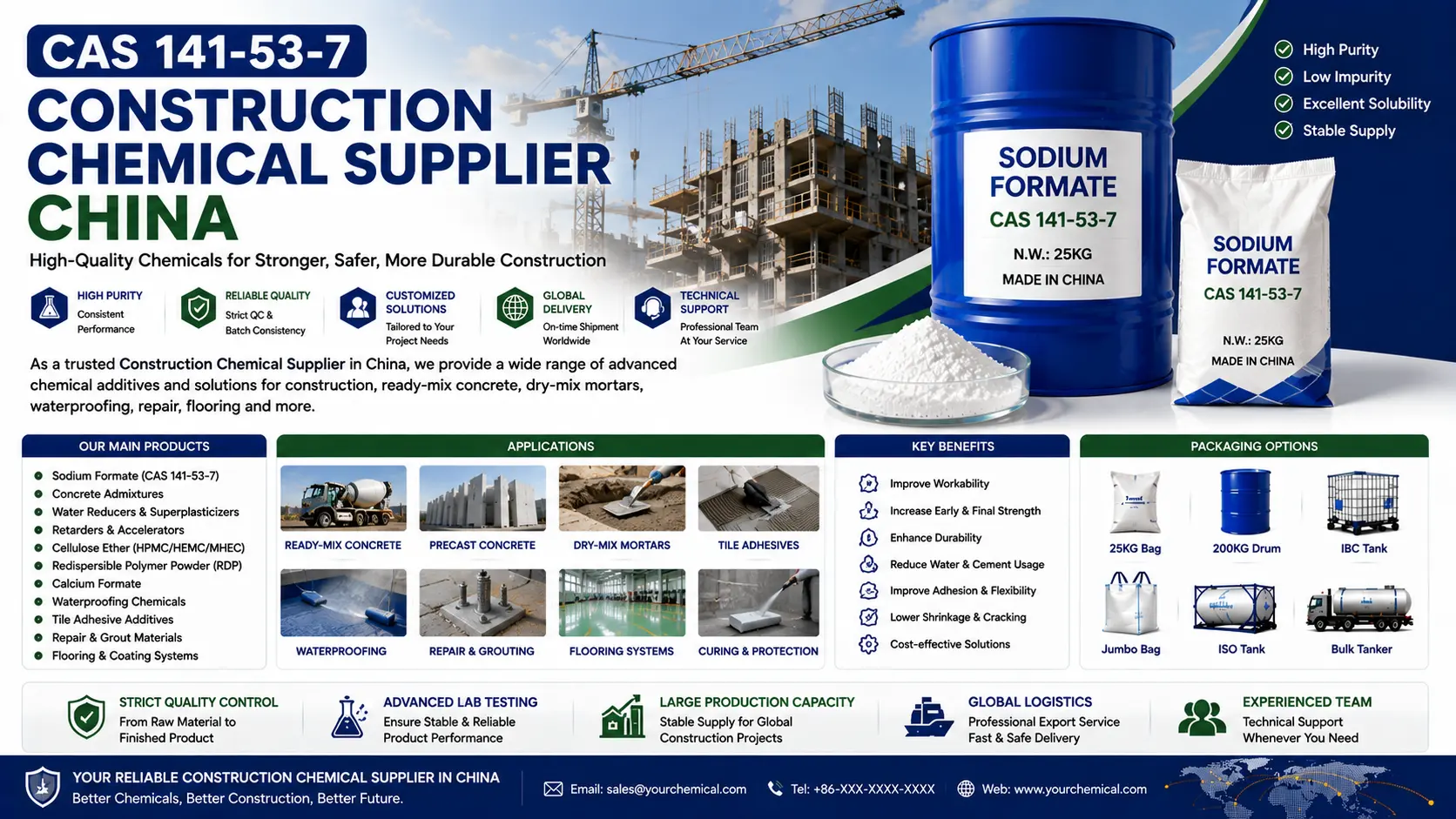
A competitive quotation isn't enough for buyers. They also want consistent product performance, batch quality, appropriate formulations, complete technical documentation, flexibility in packaging, reliable production capacity, timely technical support and international delivery.
China is now a key manufacturing and exporting center of the concrete admixture, waterproofing chemicals, dry-mix mortar additives, tile adhesives, grouts, repair materials, sealants, flooring systems, curing compounds, form-release agents and other construction chemicals.
It is important to note however that construction chemicals should not be chosen on any basis except price and product name. They are dependent on the type of cement used, quality of the aggregates, water chemistry, temperature, humidity, condition of the substrate, the way they are applied, the curing conditions, the construction program and local requirements.
This guide will explain the major categories of construction chemicals available from Chinese suppliers, how the chemicals can be used, their technical specifications, quality control requirements, packaging options, sourcing risks and ways to assess the supplier.
What Does a Construction Chemical Supplier Provide?
A construction chemical supplier provides products used to improve the performance, durability, workability, protection, appearance, and service life of concrete, mortar, masonry, flooring, roofing, and building-envelope systems.
Construction chemicals may be used in:
- Ready-mix concrete
- Precast concrete
- Bridges
- Roads
- Tunnels
- Dams
- Airports
- Railways
- Industrial plants
- Commercial buildings
- Residential projects
- Waterproofing systems
- Flooring systems
- Repair and rehabilitation
- Tile installation
- Underground structures
A professional supplier may provide standard products, customized formulations, laboratory samples, technical data, application guidance, private-label packaging, and export documentation.
Why Source Construction Chemicals from China?
China has a broad manufacturing network for polymers, cellulose ethers, redispersible polymer powders, superplasticizers, accelerators, retarders, waterproofing materials, pigments, fillers, resins, and specialty additives.
Potential sourcing advantages include:
- Broad product selection
- Competitive manufacturing costs
- Flexible minimum order quantities
- Customized formulations
- OEM and private-label services
- Multiple packaging formats
- Large production capacity
- Established export logistics
- Access to upstream raw-material manufacturers
- Technical support for different markets
Chinese construction chemical suppliers may serve customers in:
- North America
- South America
- Europe
- The Middle East
- Africa
- Southeast Asia
- Central Asia
- Australia
Supplier quality should be evaluated through specifications, testing, factory capability, documentation, and actual product performance.
Main Construction Chemical Products
Concrete Superplasticizers
Superplasticizers reduce the amount of mixing water required while maintaining or improving concrete workability.
Common types include:
- Polycarboxylate ether superplasticizers
- Naphthalene sulfonate formaldehyde condensates
- Melamine-based superplasticizers
- Lignosulfonate-based water reducers
Polycarboxylate ether, commonly abbreviated as PCE, is widely used in modern concrete.
Potential benefits include:
- High water reduction
- Improved slump
- Better slump retention
- Increased early strength
- Increased final strength
- Improved pumpability
- Reduced cement consumption
- Lower permeability
- Better surface finish
Important performance parameters include:
- Solid content
- Water-reduction rate
- Slump retention
- Air content
- Chloride content
- Alkali content
- Density
- pH
- Compatibility with cement
The correct PCE grade should be selected according to cement chemistry, mineral additions, temperature, transportation time, and concrete design.
Concrete Accelerators
Accelerators increase the rate of cement hydration and shorten setting time.
They may be used in:
- Shotcrete
- Tunnel construction
- Underground works
- Cold-weather concreting
- Emergency repairs
- Precast production
- Rapid-setting mortar
Common accelerator types include:
- Alkali-free liquid accelerators
- Alkaline accelerators
- Calcium-formate-based accelerators
- Calcium-nitrate-based products
- Calcium-chloride accelerators
- Specialty rapid-setting blends
Calcium chloride may not be suitable for reinforced or prestressed concrete because of corrosion concerns.
Accelerator selection should consider setting time, early strength, final strength, rebound, dust generation, and steel compatibility.
Calcium Formate
Calcium formate is widely used in dry-mix mortar, tile adhesive, repair mortar, cement-based products, and selected concrete applications.
Potential functions include:
- Accelerating cement hydration
- Improving early strength
- Supporting cold-weather curing
- Reducing setting time
- Improving construction efficiency
- Supporting dry-mix formulations
Important purchasing specifications include:
- Purity
- Calcium content
- Moisture
- Insoluble matter
- pH
- Particle size
- Appearance
- Packaging
Its actual dosage should be confirmed through laboratory trials because cement composition and temperature can affect performance.
Concrete Retarders
Retarders slow cement hydration and extend concrete setting time.
They may be used in:
- Hot-weather concreting
- Long-distance transportation
- Large-volume pours
- Mass concrete
- Complex pumping operations
- Decorative concrete
- Slip-form construction
Common retarder chemistries include:
- Sodium gluconate
- Citric acid
- Tartaric acid
- Lignosulfonates
- Sugar derivatives
- Hydroxycarboxylic acids
- Specialty blends
Excessive dosage may cause delayed setting, low early strength, surface dusting, or finishing problems.
Air-Entraining Agents
Air-entraining agents create small, stable air bubbles in concrete.
Potential benefits include:
- Improved freeze-thaw durability
- Better workability
- Reduced bleeding
- Reduced segregation
- Improved pumpability
- Better resistance to deicing salts
The air-void system should be controlled carefully because excessive air may reduce compressive strength.
Defoamers
Defoamers reduce unwanted air in concrete, mortar, self-leveling compounds, coatings, and adhesives.
Potential benefits include:
- Improved density
- Higher strength
- Reduced pinholes
- Better surface appearance
- More stable rheology
- Reduced foam during mixing
Common products may be based on:
- Silicone
- Mineral oil
- Polyether
- Fatty alcohol
- Hydrophobic particles
- Specialty polymer blends
The selected defoamer should not negatively affect adhesion, leveling, or long-term durability.
Shrinkage-Reducing Admixtures
Shrinkage-reducing admixtures help reduce drying shrinkage and cracking risk.
Applications may include:
- Industrial floors
- Bridge decks
- Repair mortars
- High-performance concrete
- Precast elements
- Large slabs
- Water-retaining structures
These admixtures reduce capillary tension during drying.
Their effects on setting, strength, air content, and finishing should be tested.
Expansion Agents
Expansion agents compensate for shrinkage and help improve dimensional stability.
Common types include:
- Calcium sulfoaluminate-based products
- Calcium-oxide-based agents
- Magnesium-oxide-based agents
- Ettringite-forming systems
Applications may include:
- Non-shrink grout
- Structural repair
- Equipment foundations
- Concrete floors
- Water-retaining structures
- Precast components
Dosage and curing conditions are critical for controlled expansion.
Dry-Mix Mortar Additives
Dry-mix mortar manufacturers use functional additives to control water retention, workability, adhesion, sag resistance, open time, setting, flexibility, and durability.
Common additives include:
- Cellulose ethers
- Redispersible polymer powders
- Starch ethers
- Calcium formate
- Polypropylene fibers
- Defoamers
- Water repellents
- Retarders
- Accelerators
- Thickeners
- Air-entraining agents
The complete formulation should be optimized rather than evaluating each additive separately.
Cellulose Ether
Cellulose ether is widely used in tile adhesive, wall putty, plaster, self-leveling mortar, gypsum products, and insulation systems.
Common grades include:
- Hydroxypropyl methyl cellulose
- Hydroxyethyl methyl cellulose
- Methyl hydroxyethyl cellulose
- Hydroxyethyl cellulose
Potential functions include:
- Water retention
- Thickening
- Improved workability
- Better sag resistance
- Longer open time
- Improved adhesion
- Reduced cracking
- Controlled consistency
Important specifications include:
- Viscosity
- Degree of substitution
- Gel temperature
- Moisture
- Ash
- Particle size
- Water-retention performance
- Dissolution behavior
The correct viscosity grade depends on the intended mortar system and application method.
Redispersible Polymer Powder
Redispersible polymer powder, commonly abbreviated as RDP, improves flexibility, adhesion, cohesion, and water resistance in dry-mix mortar.
Common polymer bases include:
- Vinyl acetate-ethylene
- Vinyl acetate-vinyl versatate
- Acrylic copolymers
- Styrene-acrylic copolymers
Applications include:
- Tile adhesives
- Exterior insulation systems
- Repair mortars
- Skim coats
- Waterproof mortars
- Joint fillers
- Self-leveling compounds
Important parameters include:
- Polymer type
- Glass-transition temperature
- Minimum film-forming temperature
- Ash content
- Bulk density
- Particle size
- Redispersibility
- Tensile adhesion performance
Starch Ether
Starch ether is used in small dosages to improve consistency, anti-sag performance, and application feel.
Potential benefits include:
- Better mortar body
- Reduced sag
- Improved troweling
- Controlled thickening
- Better workability
- Reduced slipping
It is commonly used together with cellulose ether.
Polypropylene Fiber
Polypropylene fiber helps control plastic shrinkage cracking and improve mortar toughness.
Applications may include:
- Repair mortar
- Plaster
- Screed
- Concrete
- Shotcrete
- Waterproof mortar
- Precast products
Important parameters include fiber length, diameter, tensile strength, dispersion, and dosage.
Tile Adhesive Chemicals
Tile adhesive formulations may include:
- Cement
- Graded sand
- Cellulose ether
- Redispersible polymer powder
- Starch ether
- Defoamer
- Accelerator or retarder
- Hydrophobic additive
- Fibers
A high-quality tile adhesive should provide:
- Strong tensile adhesion
- Good open time
- Low slip
- Easy troweling
- Water resistance
- Heat resistance
- Flexibility
- Compatibility with different tile types
The formulation should be adjusted for ceramic tile, porcelain tile, natural stone, large-format slabs, wet areas, and exterior applications.
Waterproofing Chemicals
Waterproofing products protect structures from water penetration and moisture damage.
Main categories include:
- Cementitious waterproof coatings
- Crystalline waterproofing materials
- Polyurethane coatings
- Acrylic waterproof coatings
- Polymer-modified cementitious systems
- Bituminous coatings
- Waterproofing membranes
- Water repellents
- Joint sealants
- Injection grouts
Applications include:
- Basements
- Bathrooms
- Roofs
- Balconies
- Tunnels
- Water tanks
- Swimming pools
- Foundations
- Retaining walls
- Bridges
Cementitious Waterproofing Additives
Cementitious waterproofing products may contain:
- Redispersible polymer powder
- Cellulose ether
- Hydrophobic agents
- Silica-based fillers
- Crystalline agents
- Defoamers
- Fibers
- Set-control additives
Potential benefits include:
- Strong substrate adhesion
- Easy application
- Breathability
- Compatibility with damp surfaces
- Resistance to positive and negative water pressure
- Improved crack resistance
Crystalline Waterproofing Chemicals
Crystalline waterproofing products react with moisture and cement components to form insoluble crystals within pores and microcracks.
Potential applications include:
- Concrete basements
- Water tanks
- Tunnels
- Foundations
- Sewage structures
- Underground engineering
Performance depends on concrete quality, moisture availability, crack width, curing, and application method.
Water-Repellent Agents
Water repellents reduce water absorption while allowing vapor transmission.
Common chemistries include:
- Silane
- Siloxane
- Silicone
- Stearates
- Hydrophobic powders
- Fluorinated products
Applications may include:
- Concrete
- Masonry
- Stone
- Brick
- Dry-mix mortar
- Facades
- Roof tiles
The product should be selected according to substrate porosity and exposure conditions.
Concrete Repair Chemicals
Concrete repair systems are used to restore damaged structures.
Common products include:
- Polymer-modified repair mortar
- Non-shrink grout
- Epoxy repair mortar
- Corrosion-protection coatings
- Bonding agents
- Crack-injection resins
- Surface fairing compounds
- Structural adhesives
A repair system should address the cause of damage, not only the visible defect.
Potential damage mechanisms include:
- Reinforcement corrosion
- Freeze-thaw damage
- Chemical attack
- Impact
- Abrasion
- Overloading
- Poor construction
- Water penetration
- Alkali-silica reaction
Bonding Agents
Bonding agents improve adhesion between old and new concrete or mortar.
Common types include:
- Acrylic latex
- Styrene-butadiene latex
- Epoxy bonding agents
- Polymer emulsions
- Cementitious bonding slurries
Surface preparation remains critical even when a bonding agent is used.
Non-Shrink Grout
Non-shrink grout is used under equipment bases, columns, rails, bearings, and structural elements.
Important properties include:
- Flowability
- Early strength
- Final strength
- Controlled expansion
- Low bleeding
- Dimensional stability
- Pumpability
- Bond strength
The selected grout should match gap size, loading, temperature, and placement method.
Crack-Injection Resins
Crack-injection products may include:
- Epoxy resin
- Polyurethane resin
- Acrylic gel
- Microfine cement grout
- Silicate grout
Epoxy is often used for structural crack bonding, while polyurethane is commonly used for water leakage control.
Flooring Chemicals
Industrial and commercial flooring systems may include:
- Epoxy coatings
- Polyurethane coatings
- Polyaspartic coatings
- Self-leveling cementitious systems
- Dry-shake hardeners
- Surface sealers
- Antistatic coatings
- Chemical-resistant linings
Applications include:
- Factories
- Warehouses
- Parking garages
- Hospitals
- Laboratories
- Food-processing facilities
- Shopping centers
- Data centers
Important performance requirements may include abrasion resistance, chemical resistance, slip resistance, impact resistance, cleanability, and cure time.
Concrete Curing Compounds
Curing compounds reduce moisture loss from fresh concrete.
Potential benefits include:
- Improved hydration
- Reduced plastic shrinkage
- Better surface strength
- Reduced dusting
- More uniform curing
- Lower labor requirements
Common types include:
- Water-based acrylic curing compounds
- Resin-based compounds
- Wax-based products
- Solvent-based products
- Membrane-forming compounds
Compatibility with later coatings, flooring, or adhesives should be confirmed.
Form-Release Agents
Form-release agents help separate cured concrete from molds and formwork.
They may be used with:
- Steel forms
- Aluminum forms
- Timber forms
- Plastic molds
- Precast molds
Potential benefits include:
- Cleaner concrete surfaces
- Reduced form damage
- Easier demolding
- Lower cleaning time
- Reduced surface staining
- Improved mold service life
The product should not interfere with coatings, plaster, sealants, or bonding.
Concrete Surface Hardeners
Dry-shake and liquid surface hardeners improve wear resistance and reduce dusting.
Common products include:
- Mineral-aggregate hardeners
- Metallic hardeners
- Quartz hardeners
- Lithium silicate densifiers
- Sodium silicate densifiers
- Potassium silicate densifiers
Applications include factories, logistics centers, parking facilities, workshops, and warehouses.
Sealants and Joint Materials
Sealants accommodate movement and prevent water, air, and contaminant penetration.
Common types include:
- Polyurethane sealants
- Silicone sealants
- Polysulfide sealants
- Acrylic sealants
- Hybrid polymer sealants
- Epoxy joint fillers
Applications include:
- Expansion joints
- Facade joints
- Concrete joints
- Window perimeters
- Roofing
- Flooring
- Water-retaining structures
Important properties include movement capability, adhesion, curing speed, weather resistance, chemical resistance, and service temperature.
Important Product Specifications
A professional Construction Chemical Supplier China should provide measurable technical data.
Depending on the product, important parameters may include:
- Active content
- Solid content
- Density
- pH
- Viscosity
- Moisture
- Ash content
- Particle size
- Chloride content
- Alkali content
- Setting time
- Water-reduction rate
- Slump retention
- Adhesion strength
- Compressive strength
- Flexural strength
- Water absorption
- Open time
- Sag resistance
- Shelf life
General claims such as “construction grade” or “high quality” are not enough for technical procurement.
Laboratory Testing
Construction chemicals should be tested in representative cement, mortar, or coating systems.
Common tests may include:
- Slump
- Slump retention
- Water reduction
- Setting time
- Air content
- Compressive strength
- Flexural strength
- Tensile adhesion
- Open time
- Slip resistance
- Water retention
- Water absorption
- Crack resistance
- Abrasion resistance
- Chemical resistance
- Freeze-thaw resistance
- Chloride permeability
- Drying shrinkage
- Waterproofing pressure
Testing should use local cement, sand, aggregates, water, and application conditions whenever possible.
Cement Compatibility
Cement composition can significantly affect admixture performance.
Important factors include:
- C₃A content
- Sulfate balance
- Cement fineness
- Alkali content
- Mineral additions
- Grinding aids
- Storage age
A superplasticizer that performs well with one cement may show poor slump retention or rapid setting with another.
Compatibility testing should be completed before commercial use.
Climate and Site Conditions
Construction chemical performance may change with temperature and humidity.
Hot weather may cause:
- Rapid slump loss
- Faster setting
- Surface drying
- Reduced open time
- Cracking risk
Cold weather may cause:
- Slow hydration
- Delayed strength
- Freezing damage
- Longer curing
- Poor film formation
Suppliers should recommend suitable formulations and dosage adjustments for local climate conditions.
Quality Control in Chinese Manufacturing
A reliable manufacturer should maintain quality control throughout production.
Typical procedures include:
- Raw-material qualification
- Incoming-material inspection
- Formula verification
- Automatic or controlled dosing
- Reaction monitoring
- In-process sampling
- Viscosity testing
- Solid-content testing
- pH testing
- Moisture testing
- Finished-product performance tests
- Packaging inspection
- Batch release
- Retained-sample storage
Stable batch quality helps contractors achieve predictable field results.
Batch Traceability
Each shipment should be traceable through:
- Raw-material batch numbers
- Production date
- Finished-product batch number
- Laboratory test results
- Packaging records
- Retained samples
- Warehouse records
- Loading information
- Shipping documents
Traceability supports faster investigation when product performance changes.
Sample Evaluation
Before placing a large order, buyers should request representative samples.
Sample evaluation may include:
- Appearance inspection
- Solubility or dispersibility
- Cement compatibility
- Mortar trials
- Concrete trials
- Strength testing
- Adhesion testing
- Water-retention testing
- Slump-retention testing
- Waterproofing testing
- Comparative benchmarking
Samples should represent the intended commercial grade and production process.
Customized Formulations
A capable Construction Chemical Supplier China may offer customized products based on:
- Local cement
- Sand grading
- Aggregate type
- Climate
- Application method
- Construction schedule
- Required strength
- Open-time requirements
- Waterproofing performance
- Environmental regulations
- Packaging preferences
Customization may include:
- PCE molecular-structure adjustment
- Slump-retention modification
- Setting-time control
- Cellulose-ether viscosity selection
- Polymer-powder grade selection
- Defoamer adjustment
- Hydrophobicity improvement
- Color modification
- Private-label packaging
Customized products should be validated before full-scale use.
Packaging Options
Construction chemicals may be supplied in:
- 20 kg bags
- 25 kg bags
- 500 kg bulk bags
- 1,000 kg jumbo bags
- 20 kg pails
- 25 kg pails
- 200 kg drums
- 250 kg drums
- IBC tanks
- ISO tanks
- Customized packaging
Packaging should match product form, storage conditions, transport requirements, monthly consumption, and local regulations.
Powder products should be protected from moisture.
Liquid products should be stored in chemically compatible containers.
Storage and Handling
General precautions include:
- Store powder products in a dry area.
- Keep bags sealed until use.
- Protect liquid products from freezing.
- Avoid excessive heat and direct sunlight.
- Separate incompatible materials.
- Use clean mixing equipment.
- Follow the current safety data sheet.
- Wear suitable personal protective equipment.
- Use products within the stated shelf life.
- Rotate inventory using first-in, first-out procedures.
Improper storage can cause caking, separation, viscosity changes, or reduced performance.
Export Documentation
A professional supplier should provide:
- Technical data sheet
- Safety data sheet
- Batch-specific certificate of analysis
- Product specification
- Application guidance
- Commercial invoice
- Packing list
- Certificate of origin
- Bill of lading
- Inspection reports
- Transport documents
- Dangerous-goods documents when applicable
Product names, batch numbers, quantities, concentrations, and packaging details should remain consistent across all documents.
International Logistics
Construction chemicals may be shipped by:
- Sea freight
- Rail freight
- Road transport
- Air freight for samples
- Tank container
- Bulk tanker
Important logistics factors include:
- Moisture protection
- Temperature protection
- Container loading
- Hazard classification
- Port selection
- Lead time
- Customs documentation
- Destination storage
- Local delivery
Common Incoterms may include:
- EXW
- FOB
- CFR
- CIF
- DAP
- DDP where available
The buyer and supplier should confirm responsibilities before shipment.
How to Evaluate a Construction Chemical Supplier in China
Buyers should assess:
- Product range
- Manufacturing capability
- Laboratory equipment
- Formulation experience
- Quality-control procedures
- Production capacity
- Batch consistency
- Customized-product capability
- Packaging flexibility
- Export experience
- Technical support
- Delivery reliability
- Complaint-handling process
A reliable supplier should request detailed application and raw-material information before recommending a product.
Factory Audit Checklist
A factory audit may review:
- Business licenses
- Manufacturing permits
- Production workshops
- Raw-material storage
- Automatic dosing systems
- Reaction equipment
- Powder blending lines
- Liquid filling lines
- Laboratory capability
- Quality records
- Batch traceability
- Finished-product warehouse
- Safety management
- Environmental controls
- Export records
- Retained-sample system
The buyer should also clarify whether the supplier is a manufacturer, distributor, or trading company.
Questions to Ask a Chinese Supplier
Before ordering, buyers should ask:
- Are you the manufacturer or a trading company?
- Where is the production facility?
- Which construction applications do you specialize in?
- Can samples be provided?
- Can local-cement testing be supported?
- What specifications can be guaranteed?
- Can customized formulations be developed?
- What is the normal lead time?
- What is the monthly production capacity?
- What packaging options are available?
- Can third-party inspection be arranged?
- Which export documents are included?
- Which Incoterms are available?
- Can private-label packaging be supplied?
- How are quality complaints handled?
Clear answers help reduce sourcing risk.
How to Request an Accurate Quotation
A complete inquiry should include:
- Product name
- Intended application
- Cement or binder type
- Required performance
- Climate conditions
- Target dosage
- Order quantity
- Packaging
- Destination port
- Incoterm
- Required documents
- Delivery schedule
For example:
“Please quote polycarboxylate superplasticizer, HPMC cellulose ether, redispersible polymer powder, and calcium formate for concrete and dry-mix mortar applications, including samples, TDS, SDS, COA, packaging options, and CIF delivery terms.”
Detailed information helps the supplier provide a technically suitable and accurate quotation.
Comparing Supplier Quotations
Buyers should compare more than unit price.
Important factors include:
- Product grade
- Active content
- Technical specifications
- Effective dosage
- Application performance
- Batch consistency
- Packaging
- Freight
- Payment terms
- Lead time
- Documentation
- Technical support
- Complaint handling
A low-priced chemical may result in higher total cost if it requires more dosage, causes inconsistent concrete, or creates rework.
Total Purchasing Cost
The total purchasing cost includes:
- Product price
- Packaging
- Inland transport
- Export charges
- Ocean freight
- Insurance
- Import duty
- Customs clearance
- Local delivery
- Storage
- Dosage
- Labor
- Quality variation
- Rework
- Technical support
The best supplier is the one that provides consistent performance and reliable service at the lowest total project cost.
Private Label and OEM Supply
Some Chinese suppliers provide OEM and private-label services.
Potential services include:
- Customized product names
- Buyer-designed labels
- Customized bags and drums
- Multilingual technical documents
- Formula adjustment
- Color adjustment
- Pallet configuration
- Barcode and shipping marks
Private-label projects should define responsibilities for technical claims, legal compliance, product registration, and market-specific labeling.
Sustainability and Environmental Considerations
Construction companies increasingly consider environmental performance.
Potential requirements include:
- Lower volatile organic compounds
- Formaldehyde-free formulations
- Low-chloride admixtures
- Reduced hazardous substances
- Lower cement consumption
- Improved durability
- Recyclable packaging
- Lower treatment dosage
- Reduced construction waste
- Longer building service life
Environmental improvements should be supported by measurable performance and suitable documentation.
Common Sourcing Risks
Potential risks include:
- Choosing suppliers only by price
- Ordering without sample testing
- Unclear specifications
- Poor cement compatibility
- Inconsistent batch performance
- Low active content
- Excessive moisture
- Incorrect packaging
- Incomplete export documents
- Delayed shipment
- Product damage
- Limited technical support
- Misunderstood Incoterms
- Inadequate traceability
These risks can be reduced through detailed purchase specifications, sample testing, factory audits, third-party inspection, batch-specific documentation, and clear contracts.
Conclusion
A comprehensive assessment of the range of products, manufacturing capacity, formulation knowledge, technical specifications, quality control, batch consistency, laboratory testing, packaging, export documents, technical support, and overseas delivery are required to select a reliable Construction Chemical Supplier China.
Chinese suppliers can supply concrete admixtures, polycarboxylate superplasticizer, calcium formate, cellulose ether, redispersible polymer powder, waterproofing chemicals, tile adhesive additive, repair material, floor system, sealant, curing compound and other construction chemicals for construction and projects around the world.
Buyers need to ensure that they have all the information concerning the application before buying, then they are required to ask for representative products, look at technical documents, test a product with local raw materials, check the capability of the supplier, and compare the total project costs.
A reliable supplier should be able to deliver appropriate construction chemical grades, consistent batch performance, measurable specification, flexible packing, technical support, technical guidance, export documentation and reliable global supply.


Contact Us
In This Article
Related Posts
How to Choose a Reliable 2-Ethylhexanol (2-EH) Supplier in China: Quality, Packaging and Shipping
2026-10-22
Natural vs Synthetic Sodium Sulfate Anhydrous: Which Is Better for Industrial Applications?
2026-10-22
Isobutanol 99.3% Price and Supply in 2026: A Guide for Chemical Importers
2026-10-22
Sodium Sulfate Anhydrous 99% for Detergent Manufacturing: Benefits, Specifications and Bulk Supply
2026-10-22


