



EOR Chemical Supplier: Products, Applications, Selection, and Purchasing Guide
By vanchor
2026-07-20Related Posts
How to Choose a Reliable 2-Ethylhexanol (2-EH) Supplier in China: Quality, Packaging and Shipping
2026-10-22
Natural vs Synthetic Sodium Sulfate Anhydrous: Which Is Better for Industrial Applications?
2026-10-22
Isobutanol 99.3% Price and Supply in 2026: A Guide for Chemical Importers
2026-10-22
Sodium Sulfate Anhydrous 99% for Detergent Manufacturing: Benefits, Specifications and Bulk Supply
2026-10-22
A quality EOR Chemical Supplier should offer more than just a catalog of products or a competitive price. There is also a need for improved oil recovery chemicals which are also customized to the reservoir temperature, formation salinity, hardness, permeability, viscosity of crude oil, rock mineralogy, quality of injection water and production requirements and objectives of oil and gas operators, reservoir engineering teams, oilfield service companies, water-injection facilities and chemical distributors.
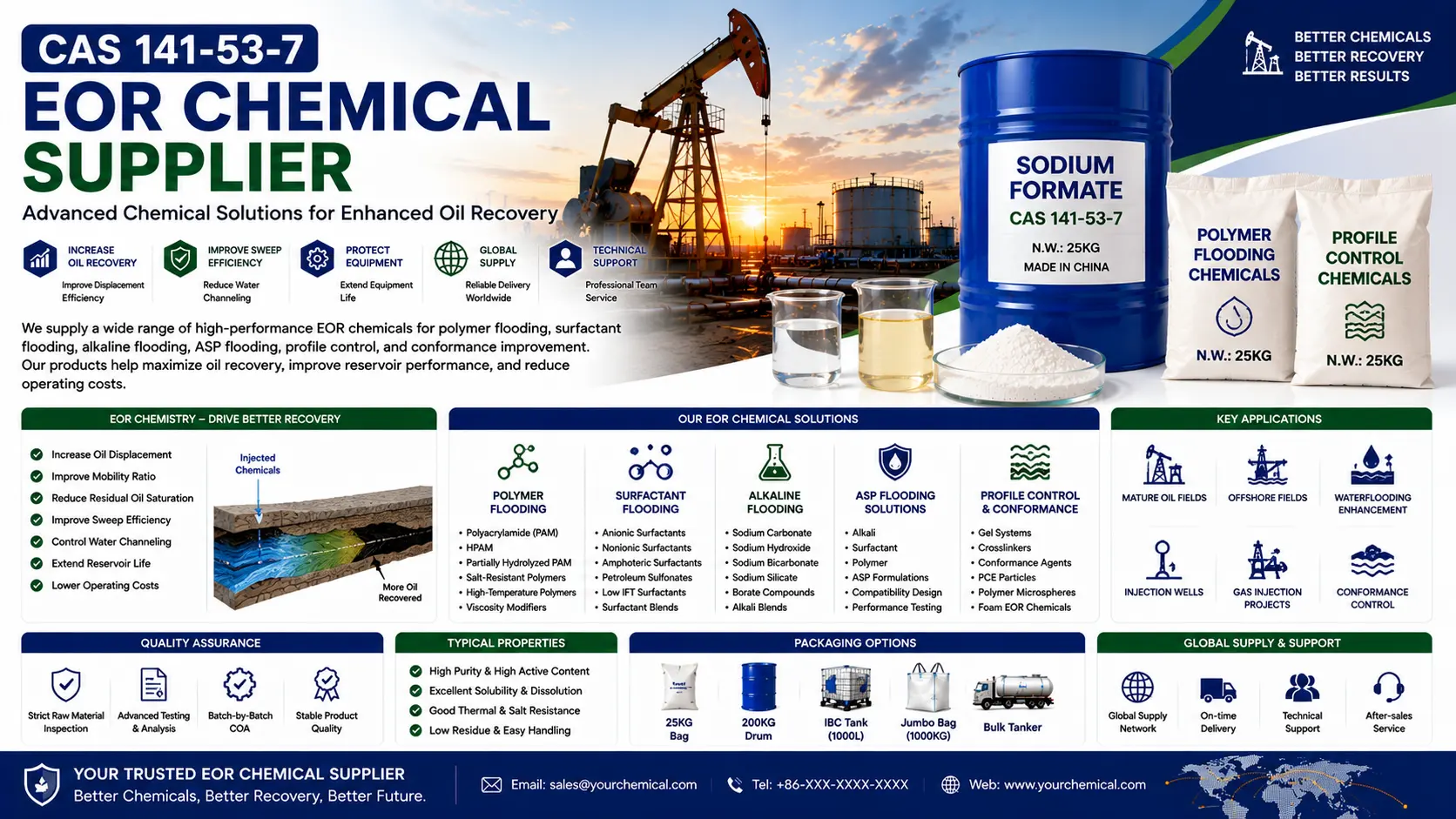
Enhanced oil recovery (EOR) is the term for techniques that boost oil recovery beyond primary recovery and waterflooding. Chemical EOR can be used to enhance the remaining oil displacement and sweep by altering the viscosity of the water, lowering I.T., reservoir heterogeneity control, wettability alteration or high permeability channel blocking.
Common EOR chemicals are polyacrylamide and hydrolyzed polyacrylamide, surfactant, alkali, crosslinker, profile-control agent, gel, biocide, oxygen scavenger, scale inhibitor and corrosion inhibitor.
Each reservoir is unique and the selection of EOR chemicals must be done by reservoir-fluid analysis, polymer and surfactant screening, core-flood testing, injectivity evaluation, compatibility studies, pilot testing, and economic analysis.
What Are EOR Chemicals?
EOR chemicals are specialized products injected into oil reservoirs to improve oil displacement, water control, mobility ratio, sweep efficiency, and reservoir contact.
Their main functions may include:
- Increasing injection-water viscosity
- Reducing water mobility
- Improving reservoir sweep
- Reducing oil-water interfacial tension
- Altering formation wettability
- Controlling water channeling
- Blocking high-permeability zones
- Diverting injected fluids
- Reducing residual oil saturation
- Improving oil recovery
- Protecting injection equipment
- Maintaining chemical stability
Chemical EOR programs may involve polymer flooding, surfactant flooding, alkaline flooding, alkaline-surfactant-polymer flooding, gel treatment, profile control, or combined formulations.
Why Enhanced Oil Recovery Is Important
After primary production and waterflooding, a significant amount of oil may remain trapped in the reservoir.
This can occur because of:
- Unfavorable water-oil mobility ratio
- Reservoir heterogeneity
- High-permeability channels
- Fractures
- Capillary trapping
- Poor vertical sweep
- Poor areal sweep
- High crude-oil viscosity
- Oil-wet reservoir surfaces
- Early water breakthrough
A properly designed chemical EOR program may help:
- Increase oil displacement
- Delay water breakthrough
- Reduce water channeling
- Improve reservoir contact
- Lower produced-water ratio
- Extend reservoir life
- Improve mature-field economics
- Recover additional oil from existing infrastructure
Main Types of EOR Chemicals
Polyacrylamide
Polyacrylamide is one of the most widely used polymers in chemical enhanced oil recovery.
Its CAS number is 9003-05-8.
Common oilfield grades include:
- Anionic polyacrylamide
- Partially hydrolyzed polyacrylamide
- HPAM
- Salt-resistant polyacrylamide
- Temperature-resistant polyacrylamide
- Hydrophobically associating polymers
- Modified copolymers
- Low-residue injection-grade polymers
Polyacrylamide increases the viscosity of injection water and reduces its mobility relative to crude oil.
Potential benefits include:
- Improved mobility ratio
- Reduced viscous fingering
- Better reservoir sweep
- Delayed water breakthrough
- Reduced channeling
- Increased oil recovery
- Lower water production
Important specifications include:
- Molecular weight
- Hydrolysis degree
- Active content
- Solution viscosity
- Filter ratio
- Insoluble matter
- Dissolution time
- Shear stability
- Thermal stability
- Salinity tolerance
- Calcium and magnesium tolerance
- Residual monomer
Hydrolyzed Polyacrylamide
Hydrolyzed polyacrylamide, commonly abbreviated as HPAM, is widely used in polymer-flooding projects.
Its carboxylate groups help the polymer expand in water and develop viscosity.
HPAM performance can be affected by:
- High salinity
- Calcium and magnesium ions
- High temperature
- Mechanical shear
- Oxygen
- Iron
- Bacteria
- Reservoir-rock adsorption
A suitable HPAM grade should retain sufficient viscosity after preparation, surface pumping, injection, and reservoir exposure.
Salt-Resistant EOR Polymers
High-salinity reservoirs may reduce conventional polymer viscosity and cause precipitation or molecular contraction.
Salt-resistant polymers may contain modified functional groups designed to improve tolerance to:
- Sodium chloride
- Calcium chloride
- Magnesium chloride
- Formation brines
- Seawater
- Produced water
Potential benefits include:
- Better viscosity retention
- Improved injectivity
- Lower polymer dosage
- Reduced precipitation risk
- More stable reservoir performance
Testing should use actual injection and formation water whenever possible.
High-Temperature EOR Polymers
High temperatures can accelerate polymer degradation and reduce solution viscosity.
High-temperature polymers may use:
- Sulfonated monomers
- Hydrophobically associating structures
- Thermally stable copolymers
- Specialized molecular architectures
The polymer should be evaluated after thermal aging under oxygen-controlled reservoir conditions.
Hydrophobically Associating Polymers
Hydrophobically associating polymers contain small amounts of hydrophobic groups that interact in solution.
Potential advantages include:
- Strong viscosity development
- Improved salt tolerance
- Better shear recovery
- Lower dosage in selected systems
- Enhanced resistance to temperature
However, these polymers may require careful dissolution and filtration control.
Surfactants
Surfactants reduce the interfacial tension between crude oil and water.
This can help mobilize oil trapped by capillary forces.
Common EOR surfactant categories include:
- Anionic surfactants
- Nonionic surfactants
- Amphoteric surfactants
- Cationic surfactants
- Petroleum sulfonates
- Alpha-olefin sulfonates
- Internal olefin sulfonates
- Alkylbenzene sulfonates
- Extended surfactants
- Surfactant blends
Potential functions include:
- Interfacial-tension reduction
- Wettability alteration
- Oil mobilization
- Emulsion control
- Improved displacement efficiency
- Reduced residual oil saturation
Surfactant performance depends on crude-oil composition, salinity, hardness, temperature, pH, adsorption, and phase behavior.
Alkali Chemicals
Alkaline flooding uses alkaline chemicals that react with acidic components in crude oil to generate surface-active species.
Common alkalis include:
- Sodium carbonate
- Sodium hydroxide
- Sodium bicarbonate
- Sodium metaborate
- Sodium silicate
Potential benefits include:
- In-situ surfactant generation
- Lower interfacial tension
- Wettability alteration
- Reduced surfactant adsorption
- Improved oil displacement
Potential challenges include:
- Scale formation
- Equipment corrosion
- Rock dissolution
- Emulsion problems
- Chemical consumption
- Compatibility with formation water
Alkali selection should consider crude-oil acid number, mineralogy, hardness, and scaling risk.
ASP Flooding Chemicals
ASP stands for alkaline-surfactant-polymer flooding.
An ASP system combines:
- Alkali for in-situ surface activity
- Surfactant for interfacial-tension reduction
- Polymer for mobility control
Potential benefits include:
- Improved microscopic displacement
- Improved macroscopic sweep
- Reduced residual oil saturation
- Better recovery than a single chemical in suitable reservoirs
ASP programs require detailed compatibility and phase-behavior testing because interactions between chemicals may affect viscosity, precipitation, adsorption, and separation.
Profile-Control Agents
Profile-control chemicals help redirect injected water away from high-permeability zones and toward unswept reservoir areas.
Common products may include:
- Polyacrylamide
- Pre-crosslinked polymer particles
- Polymer microspheres
- Gel particles
- Colloidal dispersions
- Inorganic gels
- Polymer-gel systems
Potential benefits include:
- Reduced water channeling
- Improved vertical sweep
- Better areal sweep
- Lower produced-water rate
- Improved oil recovery
- More efficient injection-water use
Polymer Gel Systems
Polymer gels are formed through the reaction of a polymer and a crosslinker.
Potential components include:
- Polyacrylamide
- HPAM
- Chromium-based crosslinkers
- Aluminum-based crosslinkers
- Phenolic resin systems
- Organic crosslinkers
- Polyethyleneimine
- Delayed gel systems
Gel strength and gelation time should be matched to treatment depth, reservoir temperature, permeability, and placement method.
Pre-Crosslinked Polymer Particles
Pre-crosslinked polymer particles can swell after contacting water and enter high-permeability channels.
Potential applications include:
- Deep profile control
- Water shutoff
- Fracture treatment
- Channel blocking
- Conformance improvement
Important specifications include:
- Initial particle size
- Swollen particle size
- Swelling ratio
- Temperature resistance
- Salinity resistance
- Strength
- Deformation capability
- Injection pressure
Polymer Microspheres
Polymer microspheres are small crosslinked particles used for deep reservoir profile control.
Potential benefits include:
- Controlled swelling
- Good deformability
- Deep migration
- Selective plugging
- Improved sweep efficiency
- Reduced water channeling
Particle size should be selected according to pore-throat distribution and reservoir permeability.
Foam EOR Chemicals
Foam can improve gas mobility control and reduce gas channeling in gas-injection projects.
Foam formulations may include:
- Foaming surfactants
- Foam stabilizers
- Nanoparticles
- Polymers
- Salinity-resistant surfactants
Potential applications include:
- CO₂ flooding
- Steam flooding
- Nitrogen injection
- Gas shutoff
- Conformance control
Foam stability should be evaluated in the presence of oil, brine, temperature, and reservoir rock.
Polymer Flooding
Polymer flooding is one of the most established chemical EOR methods.
The polymer thickens injection water and improves the mobility ratio between water and oil.
A polymer-flooding project generally includes:
- Reservoir screening
- Water analysis
- Polymer selection
- Solution preparation
- Filtration
- Injection
- Produced-fluid monitoring
- Performance evaluation
Key design parameters include:
- Target viscosity
- Polymer concentration
- Injection rate
- Slug size
- Reservoir permeability
- Adsorption
- Mechanical degradation
- Thermal degradation
- Water quality
Surfactant Flooding
Surfactant flooding focuses on reducing capillary forces that trap oil.
A successful surfactant system should provide:
- Very low interfacial tension
- Low rock adsorption
- Stable phase behavior
- Brine compatibility
- Thermal stability
- Acceptable cost
- Good separation after production
Laboratory testing should include actual crude oil, formation brine, injection water, and representative rock.
Alkaline-Surfactant-Polymer Flooding
ASP flooding combines displacement and mobility-control mechanisms.
A complete ASP study may include:
- Crude-oil acid-number measurement
- Phase-behavior testing
- Interfacial-tension measurement
- Polymer-viscosity testing
- Alkali-consumption testing
- Scale-prediction testing
- Core-flood evaluation
- Emulsion-separation testing
- Produced-water treatment assessment
The chemical package should be optimized as a complete system rather than as separate products.
Conformance Control and Water Shutoff
Water production can increase because of high-permeability channels, fractures, poor cement isolation, or reservoir heterogeneity.
Conformance-control chemicals may help:
- Block unwanted water paths
- Reduce water cut
- Redirect injection
- Improve sweep
- Extend well life
- Reduce produced-water handling
Treatment design should identify the source and location of unwanted water before chemical placement.
Water Quality Requirements
EOR chemical performance depends strongly on water quality.
Important parameters include:
- Total dissolved solids
- Calcium
- Magnesium
- Iron
- Sulfate
- Bicarbonate
- Suspended solids
- Oil content
- Bacteria
- Dissolved oxygen
- pH
- Turbidity
Poor-quality water may cause:
- Polymer degradation
- Precipitation
- Filter blockage
- Reduced viscosity
- Microbial growth
- Injection-well plugging
- Higher chemical consumption
Water treatment may include filtration, softening, oxygen removal, biocide treatment, and iron control.
Polymer Dissolution and Preparation
Polymer must be dissolved correctly to achieve stable viscosity.
A typical preparation process may include:
- Controlled powder feeding
- Initial wetting
- Low-shear mixing
- Hydration
- Maturation
- Filtration
- Transfer
- Injection
Poor preparation may cause:
- Fish eyes
- Undissolved particles
- Filter blockage
- Reduced viscosity
- Mechanical degradation
- Uneven injection concentration
The preparation system should be designed according to polymer type and project volume.
Mechanical Shear
High shear can break polymer chains and reduce viscosity.
Potential shear points include:
- Centrifugal pumps
- Control valves
- Small orifices
- Static mixers
- Chokes
- Injection equipment
- Near-wellbore restrictions
Polymer solutions should be handled with suitable pumps, piping, valves, and operating procedures.
Oxygen and Oxidative Degradation
Dissolved oxygen can accelerate polymer degradation, especially at elevated temperature.
A polymer-flooding program may use:
- Mechanical deaeration
- Nitrogen blanketing
- Oxygen scavengers
- Closed preparation tanks
- Low-oxygen makeup water
- Corrosion control
Iron and oxygen together may increase oxidative damage.
Microbial Control
Bacteria can degrade polymers, produce slime, create H₂S, and plug injection wells.
EOR water systems may require:
- Biocides
- Biodispersants
- Filtration
- Tank cleaning
- Pipeline sanitation
- Microbial monitoring
Biocide compatibility with the polymer and surfactant system should be verified.
Scale and Corrosion Control
EOR injection and production systems may experience scale and corrosion because of changing water chemistry and chemical use.
Supporting products may include:
- Scale inhibitors
- Corrosion inhibitors
- Oxygen scavengers
- H₂S scavengers
- Iron-control agents
- pH adjusters
These additives should not reduce polymer viscosity or cause surfactant precipitation.
Important Polymer Specifications
A professional EOR Chemical Supplier should provide measurable polymer data.
Important specifications may include:
- Molecular weight
- Hydrolysis degree
- Active content
- Bulk density
- Moisture
- Particle size
- Dissolution time
- Solution viscosity
- Filter ratio
- Insoluble matter
- Residual monomer
- Salinity tolerance
- Thermal stability
- Shear resistance
- Shelf life
General claims such as “high molecular weight” or “EOR grade” are not enough for technical procurement.
Important Surfactant Specifications
Depending on the product, important parameters may include:
- Active content
- Ionic type
- Appearance
- pH
- Density
- Solubility
- Cloud point
- Interfacial-tension performance
- Salinity tolerance
- Hardness tolerance
- Thermal stability
- Adsorption
- Phase behavior
- Shelf life
Actual performance should be confirmed with reservoir fluids.
Laboratory Testing
A qualified EOR Chemical Supplier should support or provide data for:
- Polymer viscosity
- Rheology
- Filter ratio
- Injectivity
- Shear stability
- Thermal aging
- Brine compatibility
- Polymer adsorption
- Interfacial tension
- Phase behavior
- Wettability alteration
- Surfactant adsorption
- Alkali consumption
- Gelation time
- Gel strength
- Core flooding
- Oil-recovery efficiency
Laboratory conditions should reproduce actual reservoir temperature, salinity, hardness, rock type, and crude-oil properties.
Core-Flood Testing
Core-flood testing helps evaluate chemical flow and displacement through reservoir rock.
It may measure:
- Differential pressure
- Injectivity
- Polymer retention
- Surfactant adsorption
- Oil recovery
- Residual resistance factor
- Permeability reduction
- Chemical breakthrough
- Pressure stability
Representative reservoir cores or carefully selected analog materials should be used.
Pilot Testing
Before full-field implementation, a pilot may evaluate:
- Chemical injectivity
- Polymer viscosity retention
- Injection pressure
- Water-cut response
- Oil-production response
- Chemical breakthrough
- Reservoir communication
- Produced-fluid separation
- Water-treatment impact
- Total operating cost
Pilot results can support chemical optimization and commercial scale-up.
Quality Control
A dependable supplier or manufacturer should maintain quality through:
- Raw-material inspection
- In-process monitoring
- Active-content testing
- Molecular-weight control
- Viscosity testing
- Dissolution testing
- Filter-ratio testing
- Finished-product inspection
- Packaging checks
- Batch release
- Retained samples
Stable batch quality is essential for long-term injection projects.
Batch Traceability
Each shipment should be traceable through:
- Raw-material lots
- Production date
- Batch number
- Laboratory results
- Packaging records
- Retained samples
- Warehouse records
- Loading information
- Shipping documents
Traceability supports performance investigation and project consistency.
Packaging Options
EOR chemicals may be supplied in:
- 25 kg bags
- 20 kg or 25 kg pails
- 200 kg drums
- 250 kg drums
- 500 kg bulk bags
- 1,000 kg jumbo bags
- IBC tanks
- ISO tanks
- Bulk tankers
- Customized export packaging
Powder polymers should be protected from moisture and excessive compression.
Liquid surfactants and additives should use chemically compatible containers.
Storage and Handling
General storage precautions include:
- Store powder polymers in a dry area.
- Keep bags tightly sealed.
- Protect liquids from freezing and excessive heat.
- Separate incompatible chemicals.
- Maintain secondary containment.
- Keep labels clearly visible.
- Follow the current safety data sheet.
- Use suitable personal protective equipment.
- Clean polymer spills immediately because wet polymer is extremely slippery.
Storage temperature and shelf life should be confirmed for each grade.
Required Documents
A professional supplier should provide:
- Technical data sheet
- Safety data sheet
- Batch-specific certificate of analysis
- Product specification
- Performance data
- Recommended preparation procedures
- Commercial invoice
- Packing list
- Certificate of origin
- Bill of lading
- Transport documents
- Inspection reports when required
All documents should show consistent product names, grades, batch numbers, quantities, and packaging details.
How to Evaluate an EOR Chemical Supplier
Buyers should assess:
- Product range
- EOR project experience
- Reservoir-screening knowledge
- Laboratory capability
- Polymer and surfactant testing
- Customized-grade capability
- Production capacity
- Batch consistency
- Technical support
- Packaging options
- Export experience
- Delivery reliability
A qualified supplier should request detailed reservoir and water information before recommending a chemical.
How to Request an Accurate Quotation
A complete inquiry should include:
- EOR method
- Reservoir temperature
- Reservoir permeability
- Formation salinity
- Calcium and magnesium concentration
- Crude-oil viscosity
- Crude-oil acid number
- Formation mineralogy
- Injection-water composition
- Target polymer viscosity
- Required chemical concentration
- Injection rate
- Pilot or commercial volume
- Packaging
- Destination
- Incoterm
- Delivery schedule
For example:
“Please recommend and quote a salt-resistant HPAM polymer for a high-salinity reservoir, together with an EOR surfactant and profile-control agent, including samples, TDS, SDS, COA, viscosity-retention data, filter-ratio results, and delivery terms.”
Detailed technical information helps the supplier provide a more suitable and accurate recommendation.
Comparing Supplier Quotations
Buyers should compare:
- Product chemistry
- Active content
- Molecular weight
- Hydrolysis degree
- Effective dosage
- Viscosity retention
- Salinity tolerance
- Temperature resistance
- Filterability
- Injectivity
- Field compatibility
- Packaging
- Freight
- Documentation
- Technical support
- Batch consistency
A lower price per kilogram may create a higher project cost if the product requires a greater dosage, loses viscosity quickly, or causes injection problems.
Total EOR Project Cost
The total cost includes more than the chemical purchase price.
Buyers should consider:
- Effective dosage
- Water treatment
- Polymer preparation
- Injection equipment
- Filtration
- Energy consumption
- Injection pressure
- Produced-water treatment
- Oil-water separation
- Waste handling
- Monitoring
- Incremental oil recovery
- Technical support
The most economical product is the one that delivers reliable injectivity, stable reservoir performance, and improved oil recovery at the lowest total project cost.
Common Purchasing Risks
Potential risks include:
- Selecting chemicals only by price
- Ignoring reservoir salinity
- Using the wrong molecular weight
- Poor polymer dissolution
- High insoluble matter
- Inadequate filterability
- Weak thermal stability
- Excessive shear degradation
- Surfactant precipitation
- High rock adsorption
- Chemical incompatibility
- Inconsistent batch quality
- Damaged packaging
- Missing documentation
- Limited technical support
These risks can be reduced through representative testing, detailed specifications, pilot trials, batch-specific documentation, and supplier qualification.
Questions to Ask Before Ordering
Buyers should confirm:
- Which EOR method is the product designed for?
- What salinity and hardness limits apply?
- What temperature resistance can be demonstrated?
- What viscosity retention is expected?
- What filter-ratio result can be guaranteed?
- How does the polymer respond to shear?
- Can reservoir-brine testing be supported?
- Can core-flood data be provided?
- Can customized molecular weight and hydrolysis grades be produced?
- Can representative samples be supplied?
- Can recent batch COAs be provided?
- What packaging options are available?
- What is the normal production lead time?
- What is the monthly supply capacity?
- Can pilot-stage technical support be provided?
Conclusion
A thorough assessment of the reservoir features, chemical mechanism, polymer viscosity and surfactant performance, thermal stability, salinity resistance, injectivity, adsorption, batch consistency, packaging, documentation, technical support and delivery reliability should be performed when choosing a reliable EOR Chemical Supplier.
The EOR chemicals have extensive applications in polymer flooding, surfactant flooding, alkaline flooding, ASP flooding, profile control, water shutoff, foam flooding, conformance improvement, and mature field development.
Buyers should include detailed reservoir, crude-oil, water-quality and injection data, and request representative samples, review complete technical documents, perform a controlled pilot project, and perform laboratory and core-flood tests prior to purchase.
A trusted supplier must deliver appropriate EOR polymer, surfactant, alkali, gel and profile-control chemicals, batch consistency, measurable performance data, secure packaging, technical support and guidance, comprehensive export documentation, and reliable global delivery.


Contact Us
In This Article
Related Posts
How to Choose a Reliable 2-Ethylhexanol (2-EH) Supplier in China: Quality, Packaging and Shipping
2026-10-22
Natural vs Synthetic Sodium Sulfate Anhydrous: Which Is Better for Industrial Applications?
2026-10-22
Isobutanol 99.3% Price and Supply in 2026: A Guide for Chemical Importers
2026-10-22
Sodium Sulfate Anhydrous 99% for Detergent Manufacturing: Benefits, Specifications and Bulk Supply
2026-10-22


