



Oilfield Scale Inhibitor Supplier: Products, Applications, Selection, and Purchasing Guide
By vanchor
2026-07-20Related Posts
How to Choose a Reliable 2-Ethylhexanol (2-EH) Supplier in China: Quality, Packaging and Shipping
2026-10-22
Natural vs Synthetic Sodium Sulfate Anhydrous: Which Is Better for Industrial Applications?
2026-10-22
Isobutanol 99.3% Price and Supply in 2026: A Guide for Chemical Importers
2026-10-22
Sodium Sulfate Anhydrous 99% for Detergent Manufacturing: Benefits, Specifications and Bulk Supply
2026-10-22
A good Oilfield Scale Inhibitor Supplier should be able to offer more than a standard list of chemicals or a competitive quotation. Scale-control products that are matched to actual water chemistry, temperature, pressure and flow, metallurgy, and treatment method are also required by oil and gas operators, drilling contractors, completion-service companies, pipeline operators, water-injection facilities, produced-water plants and chemical distributors.
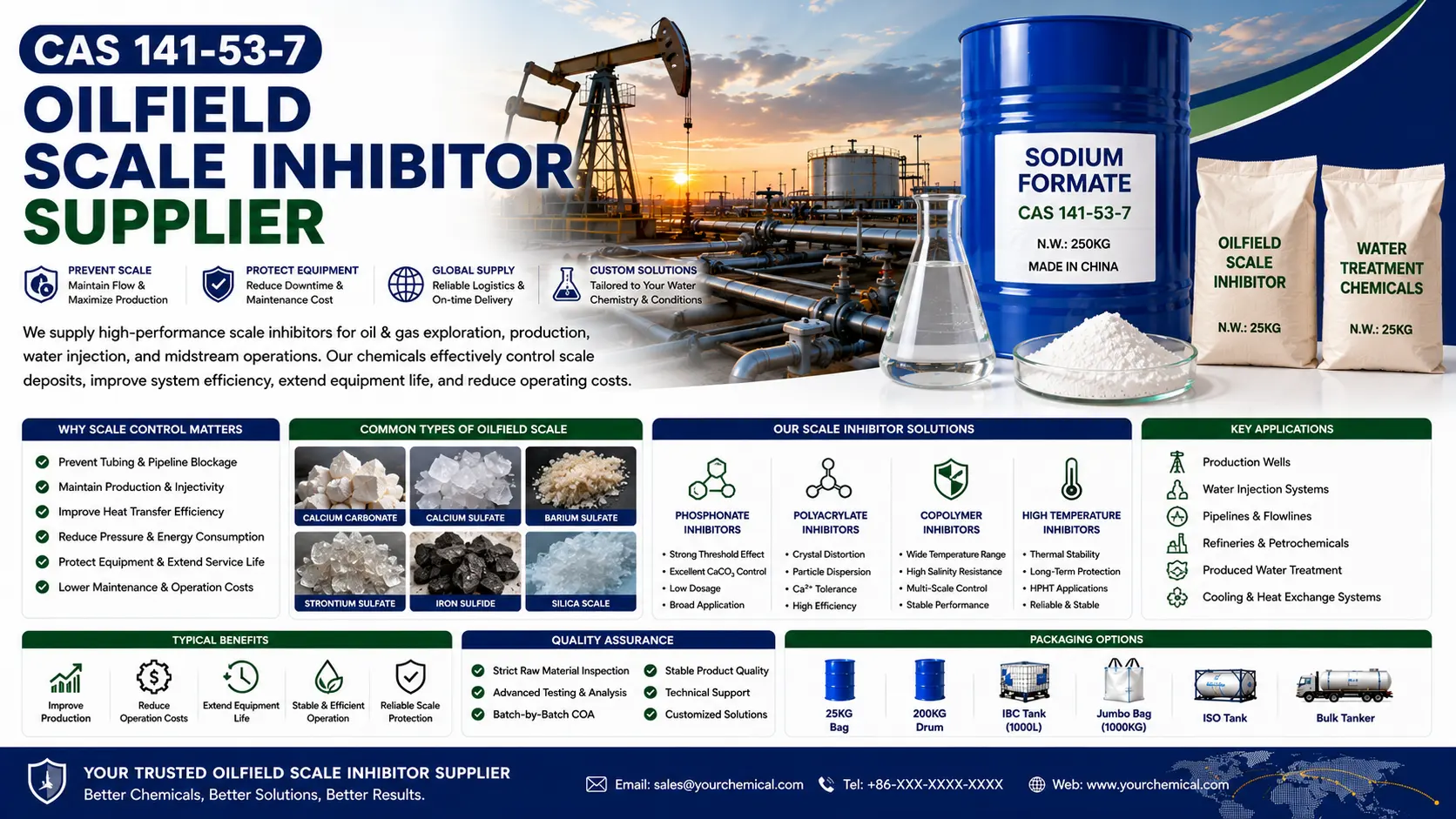
The formation of oilfield scale can occur where incompatible waters mix together or when changes in pressure, temperature, pH and dissolved-gas levels are exhibited during production. Common deposits are the following: Calcium carbonate, calcium sulfate, barium sulfate, strontium sulfate, iron sulfide and silica-related scale.
These deposits may cause blockage, damage equipment, decrease heat transfer, block perforations, increase injection pressure, affect artificial-lift systems, and decrease oil and gas production. The appropriate choice of a scale inhibitor can not only inhibit the nucleation of crystals but also alter their growth rate, disperse small particles and minimize the adhesion of crystals to the surface of the biofouling layer.
Scale risks are very different for different wells and facilities, therefore, product selection should not be based exclusively on price per kg but on water analysis, scale-prediction modelling, compatibility testing, performance in the laboratory, field trials and the total cost of treatment.
What Is an Oilfield Scale Inhibitor?
An oilfield scale inhibitor is a chemical product used to prevent or reduce the formation and deposition of inorganic mineral scale in wells, pipelines, surface equipment, water-injection systems, and produced-water facilities.
Scale inhibitors may function by:
- Delaying crystal nucleation
- Distorting crystal growth
- Preventing crystal enlargement
- Dispersing suspended mineral particles
- Reducing adhesion to metal surfaces
- Keeping scale-forming ions in solution
- Supporting stable water-handling operations
These products are commonly applied through continuous injection, batch treatment, squeeze treatment, or treatment of injection and process water.
Why Oilfield Scale Control Is Important
Scale can cause serious operational problems across upstream and midstream facilities.
Potential consequences include:
- Reduced tubing diameter
- Plugged perforations
- Restricted production
- Increased pipeline pressure
- Lower injection capacity
- Pump damage
- Valve blockage
- Heat-exchanger fouling
- Separator inefficiency
- Increased corrosion
- More frequent workovers
- Unplanned shutdowns
- Higher maintenance costs
Even a thin mineral deposit can reduce flow area and increase pressure loss.
A complete scale-management program may help:
- Maintain production
- Protect equipment
- Extend well life
- Reduce cleaning frequency
- Improve injection efficiency
- Lower workover costs
- Reduce chemical and water-treatment expenses
- Improve operational reliability
Common Types of Oilfield Scale
Calcium Carbonate Scale
Calcium carbonate is one of the most common oilfield scales.
It may form when:
- Pressure decreases
- Carbon dioxide is released
- Temperature changes
- pH increases
- Calcium and bicarbonate concentrations are high
Common locations include:
- Production tubing
- Chokes
- Valves
- Separators
- Pumps
- Heat exchangers
- Surface pipelines
Calcium carbonate is generally more soluble in acid than sulfate scales, but prevention is usually more economical than repeated removal.
Calcium Sulfate Scale
Calcium sulfate may occur as:
- Gypsum
- Hemihydrate
- Anhydrite
It can form when calcium-rich water contacts sulfate-rich water or when temperature and concentration conditions change.
Potential locations include:
- Injection wells
- Production wells
- Pipelines
- Surface-water systems
- Heat-transfer equipment
Calcium sulfate can be difficult to remove once a hard deposit forms.
Barium Sulfate Scale
Barium sulfate is one of the most difficult oilfield scales to remove.
It often forms when barium-rich formation water mixes with sulfate-rich injection water.
Potential problems include:
- Perforation plugging
- Formation damage
- Tubing restriction
- Pipeline blockage
- Equipment fouling
- Reduced injectivity
Barium sulfate has extremely low solubility, so prevention through chemical treatment and water management is essential.
Strontium Sulfate Scale
Strontium sulfate may form under conditions similar to barium sulfate.
It can occur together with:
- Barium sulfate
- Calcium sulfate
- Mixed sulfate deposits
A scale inhibitor should be evaluated against the complete ionic composition of the water rather than a single scale type.
Iron Sulfide Deposits
Iron sulfide can form when dissolved iron reacts with hydrogen sulfide.
Potential sources of iron include:
- Corrosion
- Formation minerals
- Acid treatments
- Contaminated water
- Equipment wear
Iron sulfide may cause:
- Black deposits
- Filter blockage
- Under-deposit corrosion
- Formation plugging
- Reduced water quality
- Increased chemical consumption
A complete treatment program may require scale inhibitors, corrosion inhibitors, H₂S scavengers, iron-control agents, and dispersants.
Silica and Silicate Scale
Silica-related deposits may occur in:
- Produced-water systems
- Geothermal operations
- High-temperature facilities
- Water-reuse systems
- Evaporation processes
Silica deposits can be difficult to dissolve and may require specialized dispersants or process-control strategies.
Main Types of Oilfield Scale Inhibitors
Phosphonate Scale Inhibitors
Phosphonates are widely used in oilfield scale-control applications.
Common types may include:
- Aminotris(methylene phosphonic acid)
- Hydroxyethylidene diphosphonic acid
- Diethylenetriamine pentamethylene phosphonic acid
- Phosphonocarboxylic acid derivatives
- Modified phosphonate blends
Potential benefits include:
- Strong threshold inhibition
- Good performance at low dosage
- Broad calcium-scale control
- Good thermal stability in selected grades
- Compatibility with many water systems
Potential limitations may include:
- Calcium-phosphonate precipitation
- Environmental restrictions
- Reduced performance under certain high-iron conditions
- Compatibility problems with cationic chemicals
The correct phosphonate grade should be selected according to water chemistry and operating temperature.
Polyacrylate Scale Inhibitors
Polyacrylates are polymeric scale inhibitors used for crystal modification and dispersion.
Potential functions include:
- Calcium carbonate inhibition
- Calcium sulfate control
- Particle dispersion
- Deposit reduction
- High-solids stabilization
Important product characteristics include:
- Molecular weight
- Active content
- Thermal stability
- Salt tolerance
- Calcium tolerance
- Shear stability
Low-molecular-weight polyacrylates are often preferred for scale inhibition and dispersion.
Copolymer Scale Inhibitors
Copolymer products may combine acrylic acid with other functional monomers.
Potential benefits include:
- Improved calcium tolerance
- Better high-temperature stability
- Enhanced sulfate-scale control
- Improved iron tolerance
- Reduced deposit adhesion
- Broader operating range
These products may be designed for:
- High-salinity brines
- High-temperature wells
- Produced-water systems
- Water-injection facilities
- Difficult mixed-scale conditions
Phosphate Ester Scale Inhibitors
Phosphate ester products may provide scale inhibition and surface activity.
They may be used in:
- Production systems
- Pipeline operations
- Water treatment
- Mixed oil-water environments
Compatibility with brine, crude oil, demulsifiers, and other production chemicals should be verified.
Sulfonated Polymer Inhibitors
Sulfonated polymers may provide improved performance in high-temperature and high-salinity conditions.
Potential benefits include:
- Thermal stability
- Calcium tolerance
- Sulfate-scale control
- Dispersancy
- Brine compatibility
These products may be suitable for challenging offshore and high-pressure, high-temperature applications.
Environmentally Adapted Scale Inhibitors
Some operations require products with improved environmental profiles.
These may include:
- Low-phosphorus formulations
- Phosphorus-free polymers
- Biodegradable products
- Reduced-toxicity formulations
- Products designed for offshore discharge requirements
Environmental performance should be evaluated together with scale-control effectiveness, not as a separate consideration.
Scale Inhibitors for Production Wells
Production wells may experience scale in:
- Tubing
- Perforations
- Downhole pumps
- Safety valves
- Flowlines
- Wellheads
- Chokes
Potential treatment methods include:
- Continuous injection
- Capillary-string injection
- Annular injection
- Batch treatment
- Squeeze treatment
The treatment method depends on:
- Scale location
- Water cut
- Production rate
- Completion design
- Well accessibility
- Chemical-return behavior
- Required treatment lifetime
Continuous Chemical Injection
Continuous injection delivers scale inhibitor at a controlled rate into the production or water system.
Potential advantages include:
- Stable inhibitor concentration
- Easy dosage adjustment
- Rapid response to changing conditions
- Suitable for accessible surface systems
- Continuous protection
Important considerations include:
- Injection-point location
- Pump reliability
- Chemical mixing
- Line blockage
- Inhibitor residual
- Product compatibility
- Chemical storage
The injection point should allow the inhibitor to contact the water before significant scale precipitation begins.
Scale-Inhibitor Squeeze Treatment
A squeeze treatment places scale inhibitor into the near-wellbore formation.
The inhibitor adsorbs or precipitates within the formation and is gradually released during production.
Potential benefits include:
- Long-term downhole protection
- Reduced need for continuous injection
- Protection of perforations and near-wellbore areas
- Suitability for subsea and remote wells
A squeeze program may include:
- Preflush
- Main inhibitor treatment
- Overflush
- Shut-in period
- Return to production
- Residual monitoring
Important design factors include:
- Rock mineralogy
- Formation permeability
- Brine chemistry
- Inhibitor adsorption
- Precipitation behavior
- Temperature
- Treatment volume
- Return profile
Poor squeeze design may lead to short treatment life or formation damage.
Water-Injection Systems
Water-injection systems are vulnerable to scale when injection water mixes with formation water.
Common risks include:
- Barium sulfate
- Strontium sulfate
- Calcium sulfate
- Iron deposits
- Suspended-solids accumulation
Scale inhibitors may be applied at:
- Water-treatment plants
- Injection pumps
- Manifolds
- Injection wells
- Mixing points
A complete injection-water program may also include:
- Biocides
- Oxygen scavengers
- Corrosion inhibitors
- Filtration aids
- Dispersants
Important monitoring parameters include:
- Inhibitor residual
- Sulfate concentration
- Barium concentration
- Suspended solids
- Dissolved oxygen
- Iron
- Injection pressure
- Filter performance
Produced-Water Treatment
Produced water may contain:
- Calcium
- Barium
- Strontium
- Sulfate
- Bicarbonate
- Iron
- Oil
- Suspended solids
- Bacteria
- Treatment chemicals
Scale inhibitors used in produced-water systems should remain compatible with:
- Demulsifiers
- Reverse demulsifiers
- Coagulants
- Polyacrylamide flocculants
- Corrosion inhibitors
- Biocides
- H₂S scavengers
- Defoamers
Chemical incompatibility can cause precipitation, emulsion stabilization, poor flotation, and filter blockage.
Pipeline and Flowline Applications
Scale can deposit in pipelines because of:
- Water mixing
- Pressure reduction
- Temperature changes
- Long residence time
- Low flow velocity
- Water accumulation
- Gas breakout
Scale-control programs may include:
- Continuous inhibitor injection
- Batch treatment
- Pigging
- Water management
- Chemical monitoring
- Periodic cleaning
The inhibitor should maintain performance under actual flow and residence-time conditions.
High-Temperature Wells
High temperatures may reduce inhibitor stability and alter scale solubility.
Potential effects include:
- Chemical decomposition
- Reduced adsorption
- Shorter squeeze lifetime
- Increased calcium-carbonate risk
- Changes in sulfate-scale behavior
- Reduced compatibility
High-temperature inhibitors may require:
- Thermally stable phosphonates
- Sulfonated copolymers
- Specialty acrylic copolymers
- High-temperature dispersants
Laboratory aging tests should reflect expected bottom-hole temperature and treatment duration.
High-Salinity and High-Hardness Brines
High concentrations of calcium, magnesium, sodium, chloride, bromide, and sulfate can affect inhibitor performance.
Potential problems include:
- Inhibitor precipitation
- Reduced active concentration
- Poor chemical dispersion
- Calcium-phosphonate formation
- Lower scale-control efficiency
- Filter blockage
Compatibility testing should use the actual field brine or a representative synthetic formulation.
Laboratory Scale-Inhibition Testing
A professional Oilfield Scale Inhibitor Supplier should support or provide relevant performance data.
Common laboratory methods may include:
- Static bottle testing
- Dynamic tube-blocking testing
- Minimum inhibitor concentration testing
- Thermal-aging testing
- Brine-compatibility testing
- Precipitation testing
- Crystal-morphology analysis
- Dispersion testing
- Adsorption and desorption testing
- Core-flow testing
Test conditions should reproduce:
- Field-water composition
- Temperature
- Pressure
- Mixing ratio
- Residence time
- pH
- Dissolved gases
- Iron concentration
Clean laboratory water should not replace actual field water when compatibility is critical.
Minimum Inhibitor Concentration
The minimum inhibitor concentration is the lowest dosage that provides the required scale-control performance under specified conditions.
It depends on:
- Scale type
- Supersaturation
- Temperature
- Water composition
- Residence time
- Inhibitor chemistry
- Treatment method
The laboratory minimum concentration should not automatically become the field dosage.
A field safety factor may be required to account for:
- Mixing limitations
- Chemical losses
- adsorption
- Variable water chemistry
- Pumping errors
- Changing production conditions
Residual Monitoring
Residual testing measures the amount of scale inhibitor remaining in produced or injection water.
Monitoring can help:
- Confirm chemical delivery
- Evaluate squeeze return
- Optimize dosage
- Detect pump failure
- Predict treatment lifetime
- Avoid underdosing
- Reduce unnecessary overdosing
Common residual methods may include:
- Phosphorus analysis
- Tagged-polymer detection
- Colorimetric testing
- Fluorescent tracer methods
- Laboratory chromatography
The selected method should be appropriate for the inhibitor chemistry and field-water matrix.
Product Compatibility
Scale inhibitors should be tested with the complete field chemical program.
Important combinations include:
- Corrosion inhibitors
- Demulsifiers
- Reverse demulsifiers
- Paraffin inhibitors
- Asphaltene inhibitors
- Biocides
- H₂S scavengers
- Oxygen scavengers
- Flocculants
- Surfactants
Potential incompatibility may cause:
- Precipitation
- Haze
- Phase separation
- Emulsion stabilization
- Reduced scale protection
- Deposit formation
- Filter blockage
Testing should include both concentrated products and diluted field concentrations.
Important Product Specifications
A professional supplier should provide measurable technical data.
Depending on the product, important parameters may include:
- Active content
- Appearance
- Density
- pH
- Viscosity
- Solubility
- Phosphorus content
- Molecular weight
- Thermal stability
- Calcium tolerance
- Iron tolerance
- Brine compatibility
- Pour point
- Flash point
- Recommended dosage
- Shelf life
General descriptions such as “high-performance scale inhibitor” are not sufficient for technical procurement.
Quality Control
A dependable supplier should maintain quality control throughout production.
Typical procedures may include:
- Raw-material inspection
- Reaction monitoring
- Active-content testing
- Density testing
- pH testing
- Solubility checks
- Performance testing
- Packaging inspection
- Batch release
- Retained samples
Stable batch quality helps maintain consistent field performance.
Batch Traceability
Each shipment should be traceable through:
- Raw-material lots
- Production date
- Batch number
- Laboratory results
- Packaging records
- Retained samples
- Warehouse records
- Loading information
- Shipping documents
Traceability supports faster investigation when performance changes or quality complaints occur.
Packaging Options
Oilfield scale inhibitors may be supplied in:
- 20 kg or 25 kg pails
- 200 kg drums
- 250 kg drums
- IBC tanks
- ISO tanks
- Bulk tankers
- Customized export packaging
Packaging selection depends on:
- Product form
- Monthly consumption
- Hazard classification
- Storage capacity
- Unloading equipment
- Transport regulations
Containers should be chemically compatible, properly sealed, and clearly labeled.
Storage and Handling
Storage requirements should follow the current safety data sheet.
General precautions include:
- Store in a cool, ventilated area.
- Keep containers tightly closed.
- Protect products from freezing or excessive heat.
- Separate incompatible chemicals.
- Maintain secondary containment.
- Keep labels clearly visible.
- Use suitable personal protective equipment.
- Provide eyewash and emergency-shower facilities where required.
- Control ignition sources for flammable formulations.
Operators should receive appropriate chemical-handling training.
Required Documents
A professional supplier should provide:
- Technical data sheet
- Safety data sheet
- Batch-specific certificate of analysis
- Product specification
- Recommended dosage range
- Performance data
- Commercial invoice
- Packing list
- Certificate of origin
- Bill of lading
- Transport documentation
- Inspection reports when required
All documents should show consistent product names, batch numbers, quantities, concentrations, and packaging details.
How to Evaluate an Oilfield Scale Inhibitor Supplier
Buyers should assess:
- Product range
- Oilfield experience
- Water-analysis capability
- Scale-modeling knowledge
- Laboratory testing
- High-temperature capability
- Customized-formulation service
- Batch consistency
- Production capacity
- Technical support
- Packaging options
- Export experience
- Delivery reliability
A qualified supplier should request detailed field-water and operating information before recommending a product.
How to Request an Accurate Quotation
A complete inquiry should include:
- Intended application
- Scale type
- Formation-water analysis
- Injection-water analysis
- Water-mixing ratio
- Temperature
- Pressure
- pH
- Flow rate
- Water cut
- Production rate
- Existing chemical program
- Current scale location
- Treatment method
- Required dosage
- Order quantity
- Packaging
- Destination
- Incoterm
- Delivery schedule
For example:
“Please recommend and quote a high-temperature scale inhibitor for barium sulfate and calcium carbonate control in a high-salinity production system, including samples, TDS, SDS, COA, dynamic-test data, packaging options, and delivery terms.”
Detailed field information allows the supplier to recommend a safer and more suitable product.
Comparing Supplier Quotations
Buyers should compare:
- Active content
- Product chemistry
- Scale-control range
- Minimum inhibitor concentration
- Thermal stability
- Calcium tolerance
- Brine compatibility
- Field dosage
- Packaging
- Freight
- Documentation
- Technical support
- Batch consistency
- Delivery reliability
A lower price per kilogram may produce a higher total cost if the product requires a greater dosage or provides a shorter treatment lifetime.
Total Scale-Control Cost
The total cost includes more than the chemical purchase price.
Buyers should consider:
- Effective dosage
- Injection equipment
- Monitoring
- Squeeze-treatment frequency
- Well intervention
- Mechanical cleaning
- Acid cleaning
- Pipeline pigging
- Production losses
- Equipment damage
- Waste disposal
- Technical service
A higher-performing inhibitor may reduce workovers, maintain production, and deliver a lower total operating cost.
Common Purchasing Risks
Potential risks include:
- Selecting products only by price
- Ignoring actual water chemistry
- Testing with simplified laboratory water
- Using the wrong inhibitor chemistry
- Inadequate high-temperature stability
- Poor brine compatibility
- Insufficient residual monitoring
- Chemical incompatibility
- Low active content
- Inconsistent batch quality
- Damaged packaging
- Missing documentation
- Delayed delivery
- Limited technical support
These risks can be reduced through detailed specifications, representative testing, field trials, batch-specific documentation, and supplier qualification.
Questions to Ask Before Ordering
Buyers should confirm:
- Which scale types can the product control?
- What minimum inhibitor concentration has been demonstrated?
- Is the product suitable for high-salinity brine?
- What temperature limit applies?
- Can it control barium and strontium sulfate?
- Is it compatible with high calcium and iron levels?
- Can dynamic tube-blocking data be supplied?
- Can actual field-water testing be supported?
- Is the product suitable for squeeze treatment?
- Can residual monitoring be supported?
- Can representative samples be provided?
- Can recent batch COAs be supplied?
- What packaging options are available?
- What is the normal lead time?
- Can customized formulations be produced?
Conclusion
The selection of a reliable Oilfield Scale Inhibitor Supplier involves a comprehensive assessment of the type of scale, water chemistry, temperature, pressure, treatment approach, product chemistry, thermal stability, brine compatibility, minimum inhibitor concentration, batch consistency, packaging, documentation, technical support and delivery reliability.
Oilfield scale inhibitors are applied in produced-water facilities, squeeze-treatment programs, separators, water-injection systems, pipelines, flow lines and production wells to prevent calcium carbonate, calcium sulfate, barium sulfate, strontium sulfate, iron precipitates, and mixed mineral scale.
Prior to buying, purchasers should supply complete water-analysis and operating data, seek representative samples, study technical documents, have samples tested in a laboratory, field trial, and set up resident monitoring programs.
A reliable supplier will offer appropriate scale-inhibitor formulations, batch consistency, measurable performance data, safe packaging, technical advice and support, full export documentation and dependable global delivery.


Contact Us
Related Posts
How to Choose a Reliable 2-Ethylhexanol (2-EH) Supplier in China: Quality, Packaging and Shipping
2026-10-22
Natural vs Synthetic Sodium Sulfate Anhydrous: Which Is Better for Industrial Applications?
2026-10-22
Isobutanol 99.3% Price and Supply in 2026: A Guide for Chemical Importers
2026-10-22
Sodium Sulfate Anhydrous 99% for Detergent Manufacturing: Benefits, Specifications and Bulk Supply
2026-10-22


