



Feed Grade Calcium Formate: Benefits, Applications, Specifications, and Purchasing Guide
By vanchor
2026-07-20Related Posts

How to Choose a Reliable 2-Ethylhexanol (2-EH) Supplier in China: Quality, Packaging and Shipping
2026-10-22

Natural vs Synthetic Sodium Sulfate Anhydrous: Which Is Better for Industrial Applications?
2026-10-22

Isobutanol 99.3% Price and Supply in 2026: A Guide for Chemical Importers
2026-10-22

Sodium Sulfate Anhydrous 99% for Detergent Manufacturing: Benefits, Specifications and Bulk Supply
2026-10-22
Feed Grade Calcium Formate is a functional feed ingredient which is included into selected livestock, poultry and premix and animal nutrition products. It is a stable, free-flowing solid that is a blend of formate and calcium; it is more convenient to transport, store, mix and handle than many concentrated liquid organic acids.
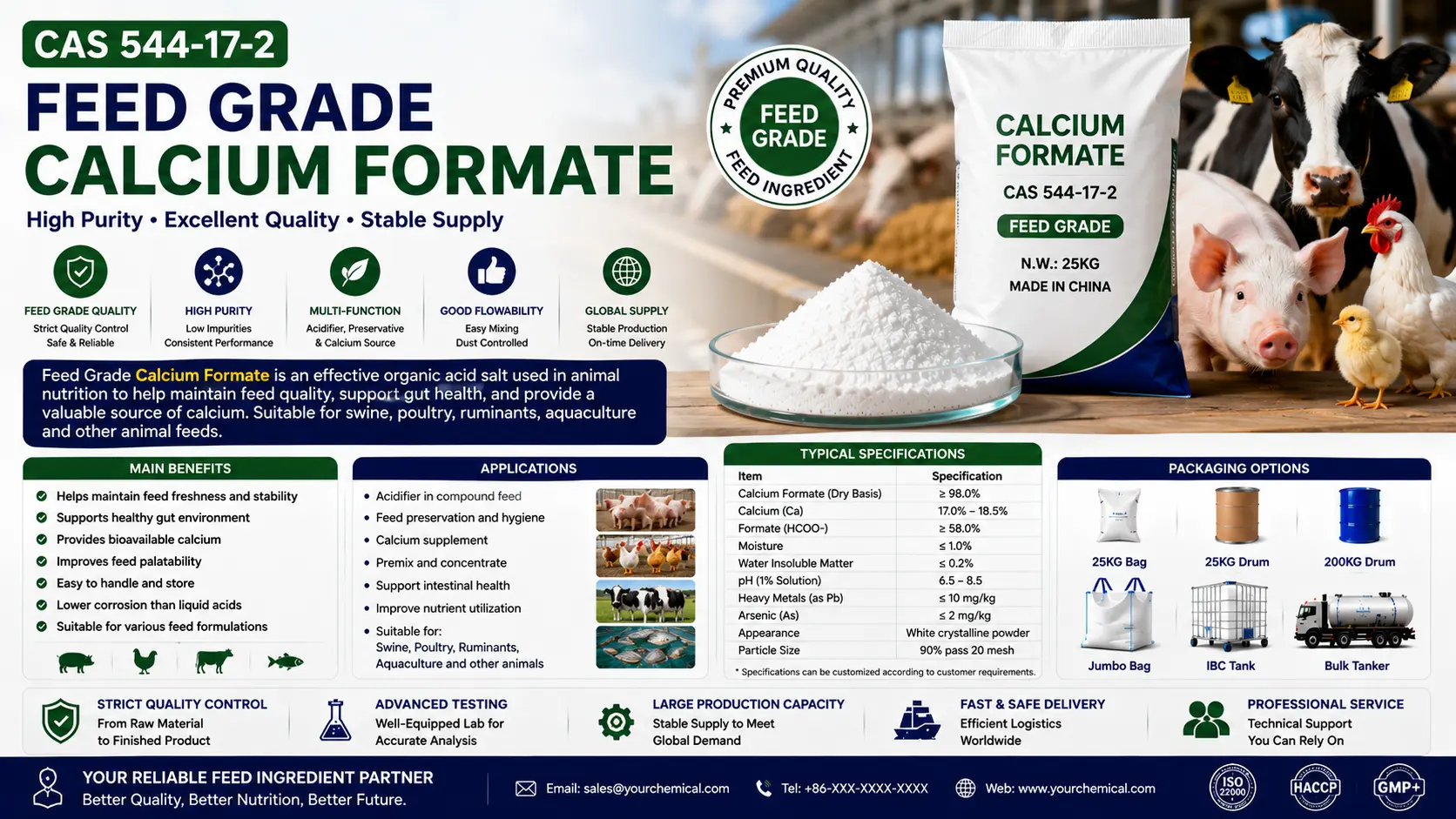
Calcium formate can be incorporated into either an acidification, preservative, mineral supplementation or feed-hygiene program. It has the potential to be useful if it is pure enough, of an appropriate particle size, has the right moisture content, contains the right amounts of calcium, formate, etc., is used in the proper formulation, is fed to the appropriate species, is fed at the right rate, is processed under the proper conditions, and is regulated for use in the target species.
Choosing a product solely based on the CAS number or price is not suitable. It is essential that the buyers verify that the material has been specially formulated and documented for feed use. Industrial or construction grade calcium formate might not meet the feed-grade quality requirements for heavy metals, contaminants, traceability, manufacturing hygiene, or regulatory documentation.
This guide describes the characteristics, possible advantages, applications, specifications, quality checks, packaging, criteria for supplier evaluation and considerations for feed grade calcium formate purchase.
What Is Feed Grade Calcium Formate?
Calcium formate is the calcium salt of formic acid. Its chemical formula is Ca(HCOO)₂, and its CAS number is 544-17-2.
Commercial feed-grade calcium formate is generally supplied as a white crystalline powder or granule.
Typical characteristics include:
- High calcium formate content
- Good flowability
- Low moisture
- Controlled particle size
- Mild organic-acid functionality
- Easier handling than liquid formic acid
- Compatibility with dry premix systems
- Stable storage under suitable conditions
Feed-grade calcium formate may provide calcium together with formate ions. Its precise nutritional and technical functions depend on the feed formulation and legally permitted use.
Feed Grade Versus Industrial Grade
A matching chemical name or CAS number does not prove that a product is suitable for animal feed.
Feed-grade material should be produced, tested, packaged, and documented according to requirements appropriate for feed applications.
Industrial-grade calcium formate may be intended for:
- Cement acceleration
- Dry-mix mortar
- Tile adhesives
- Concrete products
- Construction chemicals
- Industrial synthesis
- Deicing formulations
Feed-grade calcium formate may require tighter controls for:
- Lead
- Arsenic
- Cadmium
- Mercury
- Fluorine
- Insoluble impurities
- Microbial contamination
- Manufacturing traceability
- Cross-contamination
- Packaging cleanliness
- Regulatory documentation
Buyers should request a grade declaration and batch-specific test results rather than assuming that an industrial product can be used in feed.
Main Functions in Animal Feed
Organic-Acid Delivery
Calcium formate provides formate in a dry and relatively easy-to-handle form.
It may be included in acidifier blends designed to:
- Support feed preservation
- Help manage feed pH
- Improve formulation stability
- Support hygienic feed production
- Complement other organic acids
- Reduce reliance on highly corrosive liquid acids
Calcium formate is generally less volatile and easier to handle than concentrated formic acid.
Calcium Supplementation
Calcium formate also supplies calcium.
Calcium is important for:
- Bone development
- Skeletal strength
- Eggshell formation
- Muscle function
- Nerve transmission
- Enzyme activity
- Growth and production performance
However, calcium formate should not automatically replace conventional calcium sources without nutritional formulation. The calcium contribution must be calculated together with limestone, calcium carbonate, phosphates, and other mineral ingredients.
Feed-Preservation Support
Feed can deteriorate because of mold, yeast, bacteria, moisture, heat, and long storage periods.
Calcium formate may be used as part of a preservation program to support:
- Feed stability
- Mold-control strategies
- Storage performance
- Raw-material preservation
- Compound-feed hygiene
- Reduced nutrient deterioration
Its effectiveness depends on moisture, contamination pressure, storage temperature, inclusion rate, and combination with other preservatives.
Acidifier Formulations
Commercial feed acidifiers commonly contain several active ingredients rather than a single acid or salt.
A calcium-formate-based blend may also contain:
- Formic acid
- Propionic acid
- Lactic acid
- Citric acid
- Fumaric acid
- Benzoic acid
- Calcium propionate
- Sodium formate
- Potassium diformate
- Buffered organic-acid salts
- Carrier materials
Blending allows manufacturers to adjust acid strength, handling properties, release profile, preservation effect, and compatibility with feed-processing equipment.
Potential Benefits of Feed Grade Calcium Formate
Depending on the formulation and use conditions, potential benefits may include:
- Convenient dry handling
- Easier transportation than liquid acids
- Reduced corrosion risk compared with concentrated formic acid
- Uniform incorporation into premixes
- Support for feed-acidification programs
- Contribution of calcium
- Improved product flowability
- Stable storage in moisture-resistant packaging
- Compatibility with multi-acid formulations
- Support for feed-preservation systems
Actual animal-performance benefits should be supported by appropriate formulation knowledge, trials, and regulatory-compliant claims.
Applications in Pig Feed
Feed acidifiers are commonly evaluated in piglet and swine diets.
Calcium formate may be used in:
- Piglet starter feed
- Weaning diets
- Grower feed
- Finisher feed
- Sow feed
- Acidifier premixes
- Mineral concentrates
Potential formulation objectives include:
- Supporting feed hygiene
- Managing dietary acid balance
- Supporting digestive conditions
- Improving preservation
- Providing calcium
- Complementing organic-acid blends
Young animals may respond differently from mature animals, so dosage and formulation should be adapted to growth stage.
The total dietary calcium level must also be controlled. Excessive calcium may influence mineral balance and the utilization of phosphorus or other nutrients.
Applications in Poultry Feed
Feed-grade calcium formate may be included in selected poultry formulations for:
- Broilers
- Layers
- Breeders
- Turkeys
- Ducks
- Other poultry species
Potential roles include:
- Acidifier-blend preparation
- Feed-preservation support
- Calcium contribution
- Premix formulation
- Feed-hygiene programs
Layer diets already contain relatively high calcium levels for eggshell formation. Nutritionists should therefore calculate the calcium contribution of calcium formate carefully.
Broiler formulations may focus more strongly on feed efficiency, preservation, intestinal conditions, and balanced mineral nutrition.
Applications in Ruminant Feed
Potential ruminant applications may include:
- Dairy-cow feed
- Beef-cattle feed
- Calf starter
- Sheep feed
- Goat feed
- Mineral supplements
- Compound-feed preservatives
- Silage-related formulations
The rumen fermentation, forage quality, moisture, and complete ration composition affect ruminant nutrition. Calcium formate should be considered in conjunction with the overall feeding program.
Applications in Aquaculture Feed
Aquaculture feed has specific requirements related to:
- Pellet water stability
- Nutrient leaching
- Digestibility
- Feed attractability
- Microbial quality
- Moisture control
- Storage under warm conditions
Calcium formate may be evaluated in selected fish or shrimp feed acidifier and preservative systems.
The product should not negatively affect:
- Pellet hardness
- Water stability
- Feed intake
- Ingredient compatibility
- Extrusion behavior
- Aquatic environmental quality
Species-specific trials and local regulatory confirmation are essential.
Applications in Premixes
Premixes contain concentrated vitamins, minerals, amino acids, enzymes, preservatives, and functional ingredients.
Feed-grade calcium formate may be incorporated into:
- Acidifier premixes
- Mineral premixes
- Preservation blends
- Species-specific concentrates
- Customized functional-additive packages
Important premix considerations include:
- Particle-size compatibility
- Bulk-density differences
- Segregation risk
- Moisture sensitivity
- Mixing uniformity
- Packaging barrier
- Shelf-life stability
- Compatibility with vitamins and enzymes
A product with uncontrolled particle size may separate from other ingredients during transport or handling.
Use in Feed Preservation
Feed preservation is not determined by one ingredient alone.
Important factors include:
- Raw-material moisture
- Ambient humidity
- Storage temperature
- Mold contamination
- Storage duration
- Warehouse ventilation
- Packaging
- Pellet cooling
- Ingredient quality
- Acidifier dosage
Calcium formate may support preservation, but it should be integrated into a broader quality-management program.
High-moisture feed or heavily contaminated raw materials may require stronger preservation measures, including blended organic acids and improved storage control.
Comparison With Formic Acid
Formic acid is a strong liquid organic acid used in feed preservation and acidification.
Potential advantages of formic acid include:
- High acid activity
- Fast pH reduction
- Strong preservation capability in suitable systems
Potential handling challenges include:
- Corrosiveness
- Strong odor
- Liquid storage requirements
- Leakage risk
- Special dosing equipment
- Worker-exposure concerns
Feed-grade calcium formate offers:
- Dry handling
- Lower volatility
- Easier bagged transportation
- Simpler incorporation into powder premixes
- Reduced direct exposure to concentrated liquid acid
The two products are not identical and should not be compared only on a kilogram-for-kilogram basis. Active-acid contribution, calcium content, dosage, handling cost, and technical performance should all be considered.
Comparison With Calcium Propionate
Calcium propionate is widely used as a mold inhibitor and preservative in feed and food applications.
Calcium formate and calcium propionate differ in:
- Organic-acid source
- Molecular structure
- Preservation behavior
- Calcium content
- Effective dosage
- Target application
- Regulatory status
- Cost
Calcium propionate may be preferred for certain mold-control applications, while calcium formate may be selected for acidifier or multi-functional feed formulations.
Laboratory and storage trials can help determine the most suitable product or blend.
Comparison With Sodium Formate
Sodium formate has the CAS number 141-53-7, while calcium formate has the CAS number 544-17-2.
They differ in:
- Metal ion
- Molecular weight
- Calcium or sodium contribution
- Solubility
- Formulation effect
- Nutritional impact
- Regulatory application
Sodium formate may be used in selected preservation and acidifier formulations where authorized. Calcium formate may be preferred when calcium contribution or different handling properties are desired.
These products should not be described as interchangeable without formulation testing.
Comparison With Potassium Diformate
Potassium diformate is a double salt of formic acid and potassium formate used as a feed acidifier in selected markets.
Potential differences include:
- Formate availability
- Potassium contribution
- Acidifying behavior
- Regulatory approvals
- Recommended inclusion levels
- Cost
- Handling characteristics
The correct product should be selected according to animal species, feed formulation, legal authorization, and performance data.
Important Product Specifications
A professional feed-grade calcium formate supplier should provide measurable specifications.
Important parameters may include:
- Calcium formate assay
- Calcium content
- Formate content
- Moisture
- Water-insoluble matter
- pH
- Bulk density
- Particle size
- Appearance
- Heavy metals
- Arsenic
- Lead
- Cadmium
- Mercury
- Fluorine
- Microbial limits
- Shelf life
General claims such as “high purity” or “premium feed grade” are not sufficient for technical procurement.
Purity
Purity affects:
- Active-material value
- Dosage accuracy
- Nutritional calculation
- Product consistency
- Contaminant risk
- Total purchasing cost
Buyers should compare offers based on guaranteed assay and actual batch results.
Calcium Content
Calcium content should be included in feed-formulation calculations.
Too little calcium may fail to meet nutritional targets, while excessive total dietary calcium may affect:
- Phosphorus utilization
- Trace-mineral balance
- Feed intake
- Digestive conditions
- Pellet properties
Nutritionists should calculate calcium formate together with all other calcium sources.
Moisture
Excessive moisture may cause:
- Caking
- Reduced flowability
- Lower active concentration
- Poor premix distribution
- Packaging deterioration
- Reduced storage stability
Moisture-resistant packaging is important, particularly in humid climates.
Particle Size
Particle size influences:
- Mixing uniformity
- Flowability
- Dust generation
- Segregation
- Dissolution
- Premix compatibility
- Pellet distribution
A suitable supplier should provide a controlled particle-size range matched to the intended application.
Very fine powder may create dust, while coarse particles may separate from the premix.
Heavy-Metal Control
Feed-grade products should comply with applicable limits for undesirable substances.
Important contaminants may include:
- Lead
- Arsenic
- Cadmium
- Mercury
- Fluorine
Limits and testing requirements vary by destination market.
A supplier should provide batch-specific or periodic third-party test reports where required.
Microbiological Quality
Although calcium formate is an inorganic-organic salt, feed-grade manufacturing and packaging should still prevent contamination.
Depending on buyer and market requirements, tests may include:
- Total plate count
- Yeast and mold
- Coliforms
- Salmonella
- Escherichia coli
Microbial specifications should reflect the product risk, production method, and destination regulations.
Manufacturing Process
Feed-grade calcium formate may be produced through a controlled reaction between a calcium source and formic acid.
Potential calcium raw materials may include:
- Calcium carbonate
- Calcium hydroxide
- Calcium oxide
A general production process may involve:
- Raw-material inspection
- Controlled reaction
- Concentration
- Crystallization
- Solid-liquid separation
- Drying
- Milling or granulation
- Screening
- Quality testing
- Packaging
Process control influences purity, moisture, particle size, color, solubility, and batch consistency.
Raw-Material Control
A dependable manufacturer should control:
- Formic-acid purity
- Calcium-source quality
- Heavy metals
- Insoluble impurities
- Water quality
- Processing aids
- Packaging materials
Raw-material changes should be evaluated before routine production.
Quality Control
Feed-grade calcium formate production should include controls for:
- Raw-material identity
- Reaction conditions
- Product concentration
- Drying temperature
- Moisture
- Assay
- Calcium content
- Insoluble matter
- Particle size
- Heavy metals
- Appearance
- Packaging integrity
- Batch release
Retained samples should be stored for an appropriate period.
Batch Traceability
Each commercial shipment should be traceable through:
- Raw-material lot numbers
- Production date
- Finished-product batch number
- Laboratory results
- Packaging records
- Retained samples
- Warehouse location
- Loading records
- Shipping documentation
Strong traceability helps investigate unexpected changes in flowability, assay, mixing, or feed performance.
Laboratory Evaluation
Before purchasing a large quantity, buyers may conduct:
- Assay verification
- Calcium analysis
- Formate analysis
- Moisture testing
- Heavy-metal analysis
- Particle-size measurement
- Bulk-density testing
- Solubility evaluation
- Mixing-uniformity trials
- Storage-stability testing
- Feed-processing trials
The sample should represent normal commercial production.
Feed-Mixing Uniformity
Uniform distribution is especially important when calcium formate is included at a relatively low dosage.
Mixing performance depends on:
- Particle size
- Bulk density
- Mixer type
- Mixing time
- Addition sequence
- Carrier selection
- Premixing method
- Feed moisture
For low inclusion rates, calcium formate may first be blended with a carrier or premix before being added to the main mixer.
Pelleting and Extrusion
Feed-grade calcium formate may be exposed to heat, moisture, pressure, and shear during:
- Steam conditioning
- Pelleting
- Extrusion
- Drying
- Cooling
The supplier should provide available information on processing stability.
Feed manufacturers should evaluate:
- Pellet durability
- Die performance
- Moisture
- Product distribution
- Odor
- Finished-feed stability
- Interaction with enzymes or vitamins
Chemical Compatibility
Calcium formate may be blended with other feed ingredients, including:
- Vitamins
- Trace minerals
- Amino acids
- Enzymes
- Probiotics
- Organic acids
- Preservatives
- Antioxidants
- Toxin binders
- Carriers
Compatibility concerns may include:
- Moisture absorption
- pH interaction
- Vitamin degradation
- Enzyme stability
- Probiotic viability
- Mineral reaction
- Caking
- Odor changes
The complete premix should be evaluated during development and storage.
Recommended Dosage
There is no universal dosage suitable for all animals and feed systems.
The appropriate inclusion rate depends on:
- Animal species
- Growth stage
- Feed formulation
- Calcium level
- Acidifier objective
- Preservation target
- Other organic acids
- Raw-material quality
- Feed moisture
- Local regulations
Dosage should be determined by qualified animal-nutrition professionals and comply with applicable laws.
Suppliers should avoid presenting a single dosage as universally appropriate.
Regulatory Considerations
Feed additive regulations vary by country and region.
Buyers should confirm:
- Whether calcium formate is authorized
- Permitted animal species
- Maximum inclusion level
- Purity requirements
- Contaminant limits
- Labeling requirements
- Registration status
- Import permits
- Required documentation
- Claim restrictions
The buyer is responsible for ensuring compliance in the destination market.
Required Documents
A professional supplier should provide documentation appropriate to feed use.
Typical documents may include:
- Product specification
- Technical data sheet
- Safety data sheet
- Batch-specific certificate of analysis
- Feed-grade declaration
- Manufacturing statement
- Ingredient statement
- Heavy-metal report
- Microbiological report where required
- GMO statement where relevant
- Allergen statement where relevant
- Certificate of origin
- Commercial invoice
- Packing list
- Bill of lading
- Health or sanitary documents where required
Product names, batch numbers, quantities, specifications, and packaging information should remain consistent across all documents.
Packaging Options
Feed-grade calcium formate may be supplied in:
- 20 kg bags
- 25 kg bags
- Multi-layer paper bags
- Woven polypropylene bags with inner liners
- Moisture-resistant laminated bags
- 500 kg bulk bags
- 1,000 kg jumbo bags
- Customized private-label packaging
The most common export format is a 25 kg bag with a moisture-resistant inner liner.
Packaging should be clean, sealed, clearly labeled, and suitable for feed-industry storage.
Storage and Handling
General storage precautions include:
- Store in a cool and dry warehouse.
- Protect the product from moisture.
- Keep bags tightly sealed.
- Avoid direct contact with floors or walls.
- Store on clean pallets.
- Separate the product from hazardous chemicals.
- Prevent pest contamination.
- Use clean handling equipment.
- Follow first-in, first-out inventory control.
- Use the product within the stated shelf life.
Wet or contaminated calcium formate may cake and become difficult to mix uniformly.
Shelf Life
Shelf life depends on:
- Moisture
- Packaging barrier
- Storage temperature
- Warehouse humidity
- Bag integrity
- Contamination control
A supplier should state the recommended storage conditions and shelf life in technical documents.
Buyers should not use an expired product without reassessment.
How to Evaluate a Feed Grade Calcium Formate Supplier
Buyers should assess:
- Feed-industry experience
- Manufacturing capability
- Feed-grade production controls
- Raw-material traceability
- Laboratory capability
- Heavy-metal control
- Batch consistency
- Packaging quality
- Production capacity
- Export experience
- Regulatory documentation
- Technical communication
- Delivery reliability
- Complaint handling
The supplier should clearly state whether it is:
- The manufacturer
- An authorized distributor
- A trading company
- An integrated manufacturer and exporter
Factory Audit Checklist
A supplier or factory audit may review:
- Business and production licenses
- Feed-related approvals where applicable
- Raw-material supplier approval
- Warehouse hygiene
- Reaction and drying equipment
- Screening and packing lines
- Cross-contamination controls
- Laboratory capability
- Heavy-metal testing
- Batch traceability
- Retained samples
- Pest control
- Staff hygiene
- Cleaning procedures
- Finished-product storage
- Export records
Audit depth should reflect order size, application risk, and destination-market requirements.
Sample Evaluation Before Ordering
A representative sample should be tested before approving a commercial order.
The buyer may evaluate:
- Appearance
- Odor
- Purity
- Calcium content
- Moisture
- Insoluble matter
- Particle size
- Bulk density
- Flowability
- Heavy metals
- Feed-mixing behavior
- Storage stability
- Comparison with an approved reference
The approved sample specification should be included in the purchase contract.
How to Request an Accurate Quotation
A complete inquiry should include:
- Product name
- Feed-grade requirement
- Required assay
- Calcium specification
- Heavy-metal limits
- Particle-size requirement
- Intended animal species
- Intended application
- Order quantity
- Packaging
- Destination
- Incoterm
- Required documents
- Inspection requirements
- Delivery schedule
For example:
“Please quote Feed Grade Calcium Formate CAS 544-17-2 for piglet and poultry feed acidifier formulations, including guaranteed assay, calcium content, moisture, heavy-metal limits, particle size, 25 kg packaging, TDS, SDS, batch COA, and CIF delivery terms.”
Detailed information allows the supplier to provide a technically suitable grade and accurate quotation.
Comparing Supplier Quotations
Buyers should compare more than the price per metric ton.
Important factors include:
- Feed-grade status
- Assay
- Calcium content
- Moisture
- Insoluble matter
- Heavy-metal limits
- Particle-size control
- Batch consistency
- Packaging
- Palletization
- Freight
- Documentation
- Lead time
- Complaint handling
- Supply reliability
A lower-priced product may create higher costs if it has excessive moisture, inconsistent particle size, poor traceability, or inadequate feed-use documentation.
Total Purchasing Cost
The total purchasing cost includes:
- Product price
- Active content
- Packaging
- Palletization
- Inland transport
- Export fees
- Ocean freight
- Insurance
- Import duty
- Customs clearance
- Local delivery
- Storage
- Laboratory testing
- Registration
- Effective dosage
- Product-loss risk
The best value is provided by a product that combines suitable specifications, consistent quality, regulatory documentation, and dependable delivery.
Private Label and OEM Supply
Some suppliers provide private-label and OEM services.
Potential services include:
- Customized product names
- Buyer-designed bags
- Multilingual labels
- Customized particle size
- Blended acidifier formulations
- Customized purity specifications
- Pallet configuration
- Barcodes
- Shipping marks
- Private technical documents
Private-label projects should define responsibilities for:
- Formula ownership
- Feed-grade compliance
- Labeling
- Product registration
- Technical claims
- Quality standards
- Complaint handling
Common Purchasing Risks
Potential risks include:
- Confusing calcium formate with sodium formate
- Using the wrong CAS number
- Purchasing industrial grade for feed use
- Selecting suppliers only by price
- Ordering without sample testing
- Unclear heavy-metal limits
- Excessive moisture
- Poor particle-size control
- Weak batch traceability
- Inadequate feed-grade documents
- Damaged packaging
- Delayed shipment
- Unsupported performance claims
These risks can be reduced through detailed specifications, sample testing, supplier audits, batch-specific COAs, third-party inspection, and clear purchase contracts.
Questions to Ask Before Ordering
Buyers should confirm:
- Is the product specifically manufactured for feed use?
- Is the CAS number 544-17-2?
- Is the supplier the actual manufacturer?
- What assay can be guaranteed?
- What calcium content is available?
- What moisture limit applies?
- What heavy-metal limits are guaranteed?
- What particle-size range is supplied?
- Can representative samples be provided?
- Can recent batch COAs be supplied?
- Which feed-related documents are available?
- What packaging options are offered?
- What is the normal production lead time?
- Can third-party inspection be arranged?
- How are quality complaints handled?
Conclusion
There is a need to evaluate the chemical identity of the feed grade Calcium Formate, its feed grade status, its purity, its calcium content, its moisture content, its particle size, its heavy-metal control, its manufacturing hygiene, its batch traceability, its packaging, its regulatory documentation and its supply reliability in order to select reliable Feed Grade Calcium Formate.
Feed-grade calcium formate (CAS 544-17-2) can be used in certain acidifiers, preservation, calcium supplementation, livestock, poultry, aquaculture and premix products when permitted.
Buyers are advised to verify destination-market regulations, ask for representative samples, inspect batch-specific documentation, test key specifications, consider mixing and processing habits, and consider total delivered cost as opposed to unit price only.
An effective supplier will ensure a consistent supply of feed-grade calcium formate, measurable technical data, controlled contaminants, moisture-resistant packing, complete export paperwork, technical communications and timely response, and reliable global delivery.


Contact Us
In This Article
Related Posts
How to Choose a Reliable 2-Ethylhexanol (2-EH) Supplier in China: Quality, Packaging and Shipping
2026-10-22
Natural vs Synthetic Sodium Sulfate Anhydrous: Which Is Better for Industrial Applications?
2026-10-22
Isobutanol 99.3% Price and Supply in 2026: A Guide for Chemical Importers
2026-10-22
Sodium Sulfate Anhydrous 99% for Detergent Manufacturing: Benefits, Specifications and Bulk Supply
2026-10-22


