



Soda Ash for Pulp and Paper Manufacturing: Functions and Grade Selection
By vanchor
2026-07-20Related Posts
Custom Packaging Solutions from an Anhydrous Sodium Acetate Supplier in China
2026-09-23
Application Trends in Anhydrous Sodium Acetate for Special Chemical Manufacturing
2026-09-23
Anhydrous Sodium Acetate for Leather Tanning: Improve Dyeing Uniformity
2026-09-22
Formic Acid 85% for Textile Dyeing: Industrial Applications, Technical Benefits and Future Trends
2026-09-22
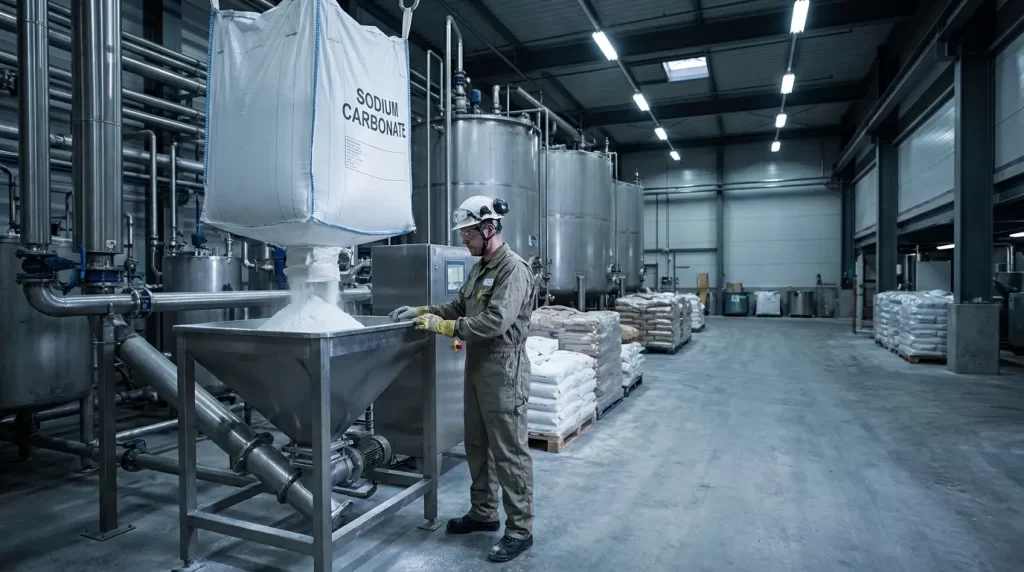
Soda ash is used in pulp and paper manufacturing as sodium carbonate, mainly for alkalinity control, pH adjustment, and specific paper-process applications such as wood pulp processing and recycled paper de-inking. This guide stays focused on how it functions in paper production and how to think about grade selection for that use case, rather than repeating the broader soda ash comparison covered in the parent guide. Soda Ash Light vs Dense: How to Choose the Right Grade (inferred)
What Soda Ash Does in Paper Manufacturing
Soda ash helps create and maintain the alkaline conditions many paper processes need. In practical terms, that means it can support pH control, help manage process chemistry, and assist in treatment steps where alkaline conditions are useful.
Vanchor’s sodium carbonate page specifically lists wood pulp processing, recycled paper de-inking, and chemical treatment in paper manufacturing as uses for its soda ash offering. That makes the paper-industry angle a verified fit for this article, not just a general market example. https://www.vanchorsc.com/product/sodium-carbonate/
For a paper buyer or process operator, the main question is not whether soda ash is “useful” in the abstract. It is where it fits in the mill, what role it plays in the chemistry, and whether the chosen grade will handle well in the specific process.
Where It Fits in the Process
In pulp and paper work, soda ash is most relevant where an alkaline environment is needed for treatment or cleaning steps. That includes wood pulp processing and recycled paper de-inking, where chemical conditions affect how fibers are treated and how contaminants are separated.
In recycled paper systems, de-inking is often the clearest use case because the chemistry has to support removal of ink and other unwanted material without creating avoidable process problems. In pulp processing, the material is more about supporting the chemical environment than acting as a stand-alone “performance” ingredient.
A useful way to think about it is simple: the process requirement determines the chemical role, and the chemical role determines how much the grade and handling behavior matter.
Choosing Light or Dense Grade
The grade choice matters most when paper plants are deciding how the product will be stored, conveyed, and fed into the process. Vanchor’s product information identifies soda ash light and soda ash dense as the available forms, and the parent guide explains the general handling differences between them. https://www.vanchorsc.com/product/sodium-carbonate/
For paper use, the practical decision usually comes down to three things:
How quickly the plant wants the material to disperse.
How the mill handles powder versus more granular material.
How much dust, storage volume, and transfer behavior matter to daily operations.
Light grade is often the better fit when easier dispersion and finer physical form are more important. Dense grade is often the better fit when bulk handling, packaging efficiency, and lower dust tendency matter more. The chemical identity is the same; the operational behavior is what changes.
When Light Grade Makes Sense
Light grade is the more natural choice when a paper process benefits from finer particles and easier dispersion. That can be useful in operations where the material needs to integrate quickly into a process stream.
If the mill is sensitive to how fast the product dissolves or disperses, light grade may be the simpler choice. It is also a familiar option when the operator wants a powder form that is straightforward to blend or meter in smaller-scale handling systems.
When Dense Grade Makes Sense
Dense grade is usually more attractive when the mill cares more about shipping efficiency, bulk storage, and lower dust generation. The larger, denser form can be easier to manage in high-volume supply chains.
That makes dense grade a sensible option for mills that want practical handling stability over the fastest possible dispersion. In other words, if the process can tolerate the physical form and the plant values cleaner transfer and bulk logistics, dense grade is often a good fit.
What Buyers Should Check Before Ordering
Paper buyers should look at the spec sheet as a process document, not just a sales page. The main checks are grade, purity, packaging, moisture protection, and whether the supplier can supply the form the mill actually wants.
For this topic, the most useful buying questions are:
Is the product light or dense grade?
Does the paper process need faster dispersion or better bulk handling?
Is the packaging appropriate for storage and transport conditions?
Is the material intended for paper processing rather than a different industrial use?
Vanchor’s product page positions its sodium carbonate as an industrial product with paper-related uses, so the commercial step here is to match the grade to the mill’s handling needs and application requirements rather than treating all soda ash as interchangeable. https://www.vanchorsc.com/product/sodium-carbonate/
When to Use the Parent Guide
If the reader is still comparing soda ash light versus dense in general, the broader grade guide is the better next step. This page is narrower by design: it answers how soda ash works in pulp and paper and how that application affects grade choice.
That boundary matters because it keeps the paper guide useful without duplicating the parent pillar. The parent page remains the place for the wider light-versus-dense comparison, while this page stays focused on the paper-industry use case.
For the broader comparison, see Soda Ash Light vs Dense: How to Choose the Right Grade (inferred). For buyers evaluating adjacent process chemicals, Sodium Formate for Pulp and Paper is a relevant related page.
Next Step for Buyers
If you are selecting soda ash for a pulp or paper application, start by defining the process step first and the grade second. Once the application is clear, the choice between light and dense becomes much easier, because the handling and dispersion requirements usually point in one direction.
For product evaluation or sourcing, review the verified industrial sodium carbonate page here: https://www.vanchorsc.com/product/sodium-carbonate/


Contact Us
In This Article
Related Posts
Custom Packaging Solutions from an Anhydrous Sodium Acetate Supplier in China
2026-09-23
Application Trends in Anhydrous Sodium Acetate for Special Chemical Manufacturing
2026-09-23
Anhydrous Sodium Acetate for Leather Tanning: Improve Dyeing Uniformity
2026-09-22
Formic Acid 85% for Textile Dyeing: Industrial Applications, Technical Benefits and Future Trends
2026-09-22


