



Formic Acid Dilution Calculator Guide: Converting 85%, 90%, 94%, and 99%
By Tonmoy
2026-09-02Related Posts
Custom Packaging Solutions from an Anhydrous Sodium Acetate Supplier in China
2026-09-23
Application Trends in Anhydrous Sodium Acetate for Special Chemical Manufacturing
2026-09-23
Anhydrous Sodium Acetate for Leather Tanning: Improve Dyeing Uniformity
2026-09-22
Formic Acid 85% for Textile Dyeing: Industrial Applications, Technical Benefits and Future Trends
2026-09-22
A formic acid dilution calculator determines how much stock solution is required to reach a target concentration and final quantity. The basic calculation is:
\[ C1V1=C2V2 \]
Rearranged for the required stock quantity:
\[ V1=\frac{C2\times V2}{C1} \]
Here, the stock and target concentrations must use the same concentration basis. For example, % w/w should not be substituted directly for % v/v. If the calculation converts between mass and volume, density and temperature are also required.
This guide explains how to use 85%, 90%, 94%, and 99% formic acid as stock inputs without treating the grades as interchangeable.
Use the Formic Acid Dilution Calculator
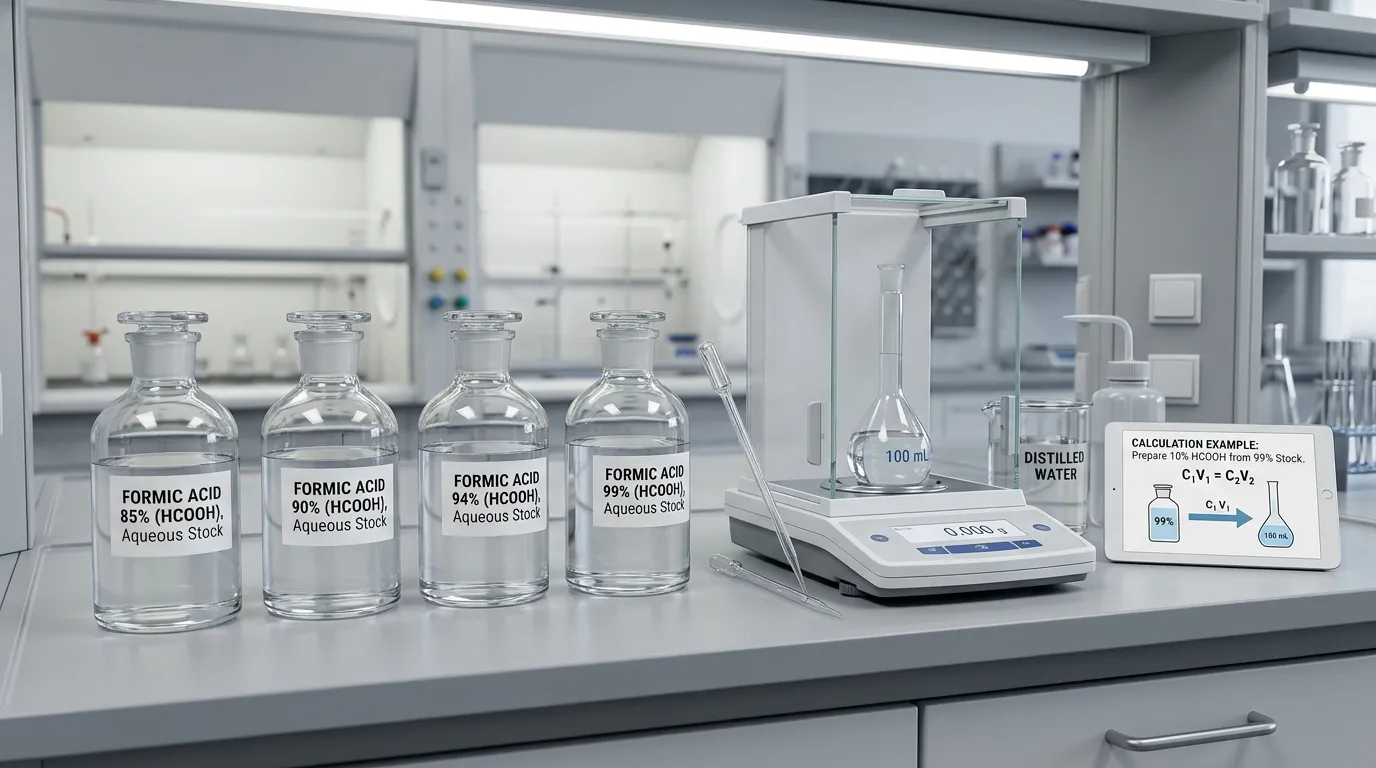
A practical calculator should ask for the following inputs:
| Input | Meaning |
|---|---|
| Stock concentration | Starting formic acid concentration, such as 85%, 90%, 94%, or 99% |
| Target concentration | Required concentration in the final solution |
| Concentration basis | % w/w, % v/v, molarity, g/L, or another defined basis |
| Final quantity | Required final mass or final volume |
| Density | Required when converting between mass and volume |
| Temperature | Required when the selected density depends on temperature |
The calculator should return:
- Required quantity of stock formic acid
- Required quantity of diluent, where the calculation basis supports that result
- The units used for each result
- Any density or concentration-basis assumptions
- A warning when the inputs are incompatible or incomplete
For industrial or formulation work, the result should be checked against the current product documentation for the exact stock grade. A grade label alone does not establish the density, assay tolerance, temperature basis, or product-specific calculation inputs.
For broader background, see the Vanchor page on formic acid. This calculator guide is narrower: it focuses on dilution calculations rather than general properties or applications.
Which Formula Does the Calculator Use?
For a direct dilution calculation using compatible concentration units:
\[ C1V1=C2V2 \]
Where:
- \(C_1\) = concentration of the stock formic acid
- \(V_1\) = quantity of stock required
- \(C_2\) = target concentration
- \(V_2\) = final quantity of the diluted solution
To calculate the stock quantity:
\[ V1=\frac{C2V2}{C1} \]
The same relationship can be applied on a mass basis:
\[ C1m1=C2m2 \]
Where \(m1\) is the mass of stock and \(m2\) is the final mass.
The formula is valid only when the concentration basis is compatible. Examples include:
- % w/w with % w/w
- % v/v with % v/v
- mol/L with mol/L
- g/L with g/L
A calculation becomes more complicated when the stock is specified by mass percentage but the user needs a volume result. In that case, density is required to convert between mass and volume.
The quantity of diluent also depends on the calculation basis. On a mass basis, the diluent mass may be calculated from the final mass minus the stock mass, provided the formulation assumptions are defined. On a volume basis, simply subtracting stock volume from final volume may not be appropriate unless the calculation method permits that assumption.
How 85%, 90%, 94%, and 99% Stock Inputs Change the Calculation
The four stock concentrations must be entered as separate inputs:
- 85% formic acid
- 90% formic acid
- 94% formic acid
- 99% formic acid
For the same target concentration and final quantity, a higher-concentration stock generally requires a smaller calculated stock quantity when the values are expressed on the same basis.
The following is an illustrative calculation using a target concentration of 10% and a final quantity of 100 units. It demonstrates the formula only; it is not a product test or a recommended formulation.
| Stock input | Calculation | Stock quantity |
|---|---|---|
| 85% | \(10 \times 100 \div 85\) | 11.76 units |
| 90% | \(10 \times 100 \div 90\) | 11.11 units |
| 94% | \(10 \times 100 \div 94\) | 10.64 units |
| 99% | \(10 \times 100 \div 99\) | 10.10 units |
These results are valid only if:
- The stock and target values use the same concentration basis.
- The final quantity uses the same unit system.
- The calculation is interpreted according to its stated mass or volume assumptions.
- The stock concentrations accurately represent the products being used.
The table does not establish that a particular Vanchor product has exactly those specifications. Product-specific values should be taken from the applicable technical documentation.
For a broader comparison of the four grades, see formic acid 85 90 94 and 99. The present page should remain focused on how those grades function as calculator inputs.
Choose the Correct Concentration Basis
The concentration basis determines which formula and inputs are appropriate.
| Basis | Meaning | Main inputs | Important limitation |
|---|---|---|---|
| % w/w | Mass of formic acid relative to total solution mass | Stock concentration and final mass | Does not directly provide a volume without density |
| % v/v | Volume of formic acid relative to final solution volume | Stock concentration and final volume | Volume behavior and product basis must be defined |
| Molarity | Moles of solute per liter of solution | Molecular weight, concentration, density or mass data, and final volume | Must use compatible molar units |
| g/L | Grams of formic acid per liter of solution | Active mass and final volume | Density or active-content conversion may be required |
Mass percentage and volume percentage are not interchangeable. A stock labeled 85% w/w cannot automatically be entered as 85% v/v.
Molarity and g/L also require careful interpretation. A supplied-product concentration is not the same as the mass of pure formic acid in the final solution. If the calculation involves active formic acid content, the product assay basis must be defined before the result is calculated.
A calculator should therefore make the concentration basis visible rather than allowing the user to enter an unlabeled percentage.
When Is Density Required?
Density is required when the calculation moves between mass and volume. Typical examples include:
- Converting a mass percentage into a stock volume
- Calculating the mass of stock needed for a specified final volume
- Converting a product specification in % w/w into a volume-based preparation
- Using molarity or g/L with a supplied liquid product
Density depends on solution composition and temperature. A density value should therefore retain its concentration and temperature conditions. A general aqueous formic acid density table, such as the one reproduced by Handymath, may be useful for understanding the relationship between concentration and density, but it should not be treated as a Vanchor product specification.
Use the following decision path:
- Are the stock and target concentrations expressed on the same basis?
- Is the required result a mass or a volume?
- If a volume is required, is a suitable density available?
- Does the density apply to the exact grade, concentration, and temperature?
- If the answer to any required input is no, should the calculation remain mass-based until the missing information is verified?
Do not transfer a density value from one grade to another without evidence. Do not publish a volume result as exact when the density is only an approximation or when the temperature basis is unknown.
Check the Result Before Using It in a Batch or Formulation
A calculated quantity should be treated as a controlled calculation output, not as proof of product performance or a substitute for process validation.
Before using the result, verify:
- Chemical identity: Confirm that the material is the intended formic acid solution.
- Stock grade: Confirm whether the starting material is 85%, 90%, 94%, or 99%.
- Concentration basis: Confirm whether the specification and target are % w/w, % v/v, molarity, g/L, or another basis.
- Final quantity: Confirm whether the target refers to final mass or final volume.
- Density: Confirm the density, concentration, and temperature when a mass-to-volume conversion is used.
- Product documentation: Compare the selected inputs with the current technical documentation for the exact product or batch.
- Site controls: Follow the applicable SDS, risk assessment, and operating procedure before handling concentrated formic acid.
A certificate of analysis or product document may establish information for a particular product or batch, but it should not automatically be treated as universal approval for every application. Similarly, a calculated result is not a tested formulation result.
Calculation Limits and Related Resources
The formic acid dilution calculator is appropriate for determining quantities from defined stock and target concentrations. It does not, by itself, determine:
- Final pH
- Neutralization requirements
- Application dosage
- Material compatibility
- Regulatory suitability
- Food, feed, pharmaceutical, or drinking-water approval
- Storage compatibility
- Process temperature or mixing time
If the concentration is being selected because of a freezing-point requirement, consult the separate resource on formic acid freezing point by concentration. For a comparable dilution tool involving another acid, see the glacial acetic acid dilution calculator.
The main calculation rule is simple: use the same concentration basis for the stock and target, preserve the units, and obtain density when converting between mass and volume. For 85%, 90%, 94%, and 99% formic acid, select the exact stock grade rather than treating all concentrated solutions as equivalent.


Contact Us
In This Article
Related Posts
Custom Packaging Solutions from an Anhydrous Sodium Acetate Supplier in China
2026-09-23
Application Trends in Anhydrous Sodium Acetate for Special Chemical Manufacturing
2026-09-23
Anhydrous Sodium Acetate for Leather Tanning: Improve Dyeing Uniformity
2026-09-22
Formic Acid 85% for Textile Dyeing: Industrial Applications, Technical Benefits and Future Trends
2026-09-22


