



Glacial Acetic Acid Dilution Calculator Guide: From 99.5% to Working Strength
By Tonmoy
2026-09-05Related Posts
Custom Packaging Solutions from an Anhydrous Sodium Acetate Supplier in China
2026-09-23
Application Trends in Anhydrous Sodium Acetate for Special Chemical Manufacturing
2026-09-23
Anhydrous Sodium Acetate for Leather Tanning: Improve Dyeing Uniformity
2026-09-22
Formic Acid 85% for Textile Dyeing: Industrial Applications, Technical Benefits and Future Trends
2026-09-22
A glacial acetic acid dilution calculator determines how much concentrated stock is needed to prepare a lower-strength solution. For a simple percentage dilution, enter the starting concentration, target concentration, and final solution volume. The calculation is valid only when both concentrations use the same basis, such as volume/volume (v/v) or weight/weight (w/w).
For a stock concentration of 99.5%, the standard dilution relationship is:
\[ C1V1=C2V2 \]
Rearranged to calculate the required stock volume:
\[ V1=\frac{C2 \times V2}{C1} \]
Where:
- \(C_1\) = starting concentration
- \(V_1\) = volume of concentrated stock required
- \(C_2\) = target concentration
- \(V_2\) = final total solution volume
The result is a mathematical calculation, not a substitute for the product specification, current SDS, site SOP, equipment review, or final batch verification.
Use the Glacial Acetic Acid Dilution Calculator
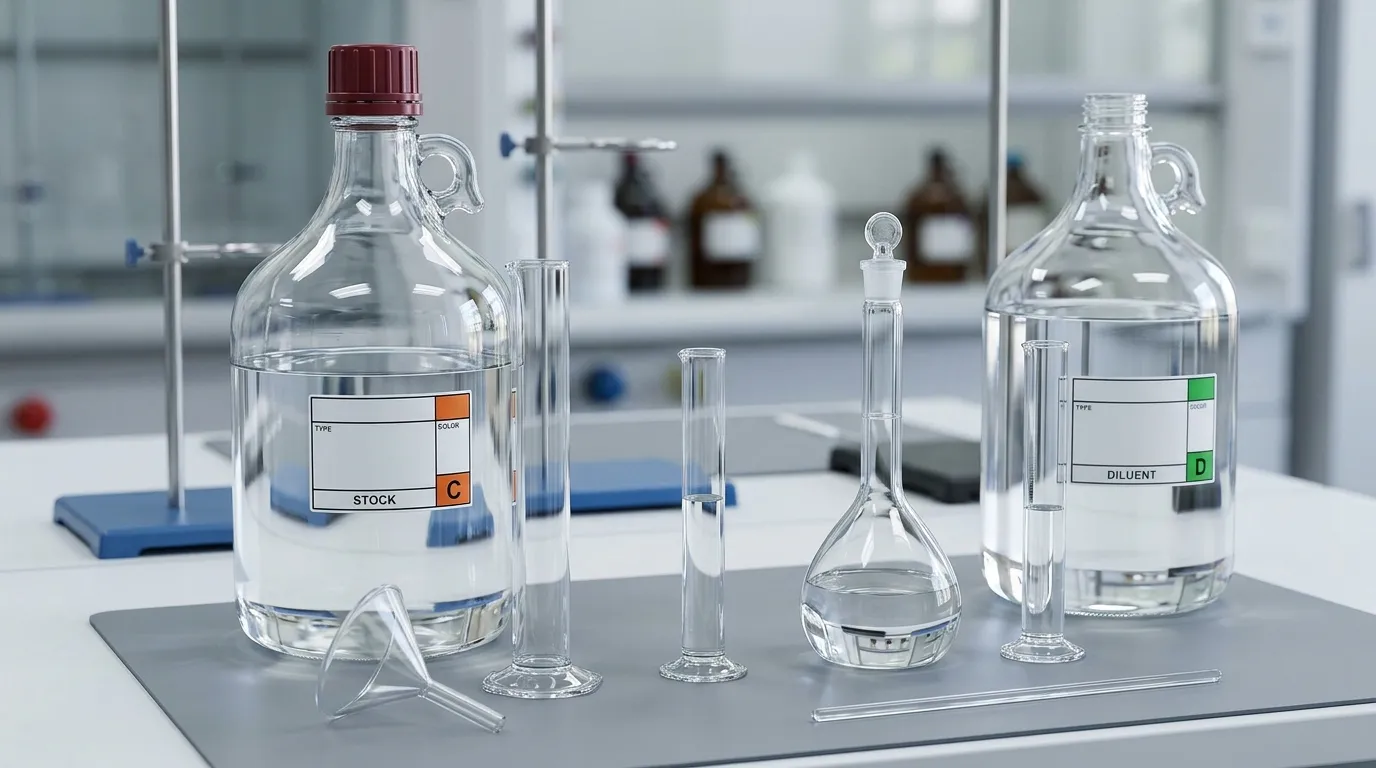
A useful calculator should make the following inputs and outputs explicit:
| Calculator field | What it represents |
|---|---|
| Starting concentration, \(C_1\) | The actual concentration of the glacial acetic acid stock |
| Target concentration, \(C_2\) | The required working strength |
| Final volume, \(V_2\) | The total volume of the finished solution |
| Concentration basis | For example, v/v or w/w |
| Stock quantity, \(V_1\) | The calculated amount of concentrated acetic acid |
| Diluent quantity | The calculated remaining quantity under the selected calculation basis |
For a dilution-only calculation, the target concentration must be lower than the starting concentration. If the target is higher, adding diluent cannot achieve it.
Before entering “99.5%,” check the actual assay and reporting basis on the product documentation. The figure should not be treated as a universal specification for every glacial acetic acid product.
The calculator should also require consistent units. For example, if the final volume is entered in liters, the calculated stock and diluent quantities should be reported in liters unless the calculation is deliberately being performed by mass.
The Dilution Formula: What the Calculator Is Solving
The basic equation is:
\[ C1V1=C2V2 \]
For the stock quantity:
\[ V1=\frac{C2V2}{C1} \]
For the target quantity, the concentrations must be expressed on the same basis. A value reported as 10% v/v is not automatically interchangeable with 10% w/w.
A simple calculator therefore solves four linked quantities:
- Starting concentration: the strength of the supplied stock.
- Target concentration: the required working strength.
- Final volume: the total finished solution volume.
- Stock quantity: the amount of concentrated solution required to reach the target.
The remaining diluent quantity is then determined from the selected calculation basis and the stated final quantity. The equation and variable definitions are also commonly presented in dilution calculator guidance from Alliance Chemical.
This formula is appropriate for a direct dilution calculation when the concentration basis is compatible. It is not, by itself, a complete method for converting between mass, volume, and molarity.
Worked Example: From 99.5% Stock to a Lower Working Strength
The following is an illustrative volume-based calculation. It is not a product test or a validated production recipe.
Example inputs:
- Starting concentration: 99.5% v/v
- Target concentration: 10% v/v
- Final solution volume: 100 L
Apply the formula:
\[ V_1=\frac{10 \times 100}{99.5} \]
\[ V_1=10.05\text{ L approximately} \]
The calculation therefore indicates approximately 10.05 L of the stated 99.5% stock for a nominal 100 L final solution at 10% v/v.
The nominal remaining volume is:
\[ 100-10.05=89.95\text{ L} \]
So, under this simplified volume-based assumption, the calculator would show approximately:
- Stock: 10.05 L
- Remaining diluent quantity: 89.95 L
- Nominal final volume: 100 L
This result must be interpreted carefully:
- It applies to the stated v/v basis.
- It assumes the final-volume calculation is being handled on that basis.
- It does not establish a w/w concentration.
- It does not account for a product-specific density.
- It does not prove that the finished batch meets its specification.
- It does not establish suitability for a particular application.
If the product is described as “99.5% minimum,” use the actual assay or the approved value required by the applicable specification. Do not replace the documented assay with a generic “100%” assumption.
For product-specific documentation, the relevant glacial acetic acid 99 5 min page may be a useful starting point, but its current assay basis and technical details should be confirmed before using it as a calculator input.
Choose the Correct Concentration Basis Before Calculating
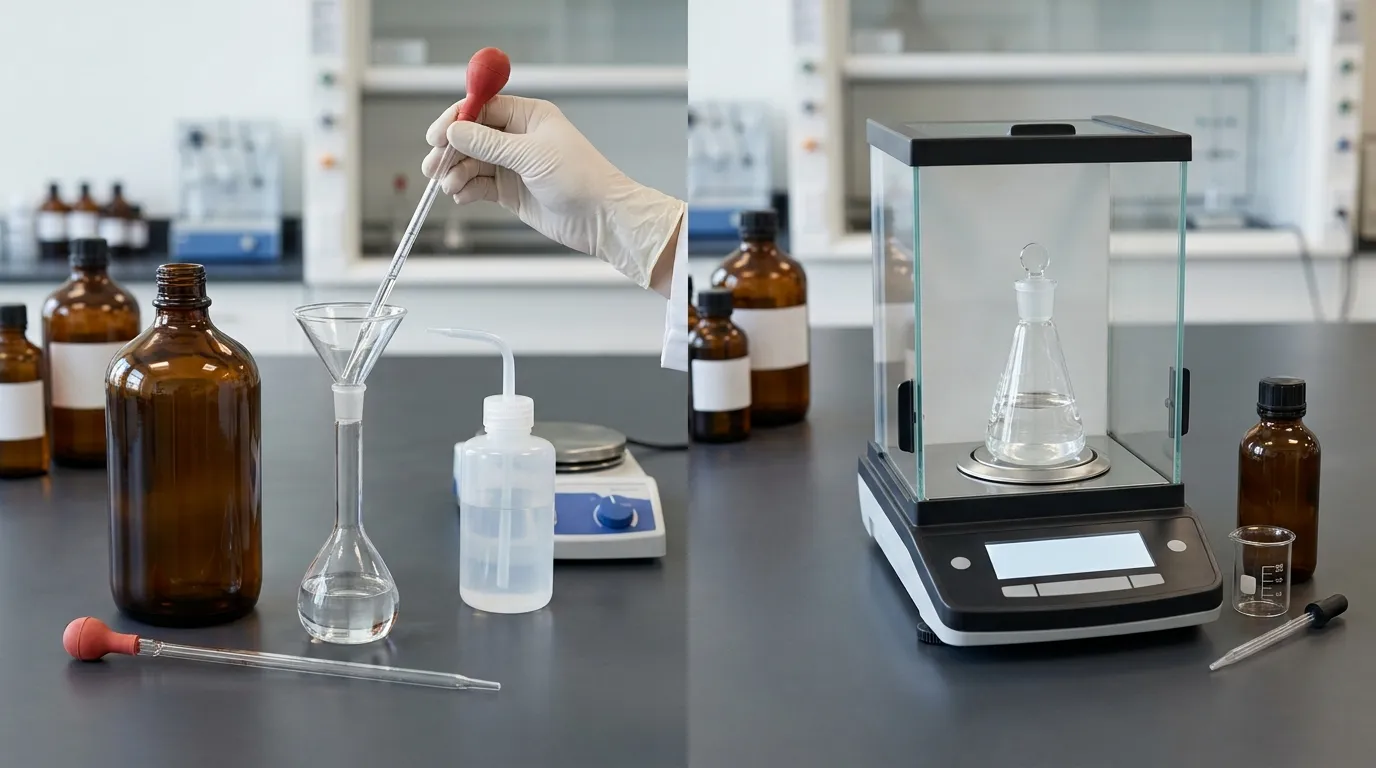
The first technical decision is whether the target is specified by volume, mass, or amount of substance.
| Basis | Typical expression | What it requires | Main calculation risk |
|---|---|---|---|
| Volume/volume | % v/v | Compatible liquid volumes and a defined final-volume basis | Treating v/v as if it were w/w |
| Weight/weight | % w/w | Mass of stock and mass of final solution | Converting the result to liters without density |
| Molarity | mol/L | Assay, molecular weight, density where required, and final volume | Using a percentage formula without the required conversion data |
Use the basis stated in the formulation, batch record, customer specification, or process SOP. If the requirement says 10% w/w, a 10% v/v result is not equivalent. If the requirement is molarity, the calculator must use the relevant amount-of-substance relationship rather than relying only on percentage dilution.
A practical decision rule is:
- Use the simple dilution equation when the starting and target concentrations use the same basis.
- Use a mass-based calculation when the specification is reported by weight.
- Use a density- and molecular-weight-based calculation when the target is molarity or when a mass result must be converted into a liquid volume.
A broader acetic acid concentration guide can provide related terminology if the concentration basis in a formulation or purchasing document is unclear.
When Density and Molecular Weight Are Required
Density becomes important whenever the calculation moves between mass and volume. Examples include:
- Converting a measured liquid volume into mass.
- Converting a required mass into a stock volume.
- Calculating molarity from a measured stock volume.
- Connecting an assay reported by mass with a volume-based target.
A calculator that supports stock-solution molarity may require the stock concentration, density, molecular weight, and target molarity. The density must correspond to the relevant product, grade, and temperature. It should not be copied from a different supplier’s specification or used as a universal value.
Molecular weight is required for molarity calculations because molarity expresses the amount of chemical substance per unit volume. Acetic acid’s chemical identity and molecular weight are distinct from the assay of a commercial glacial acetic acid product. A high assay does not remove the need to use the correct product-specific inputs.
Do not use a density value from an educational example as though it were a Vanchor specification. If the required density is not available for the actual product and temperature, the calculator should either request the missing value or restrict the calculation to a basis that does not require that conversion.
Interpret the Result and Check the Batch Inputs
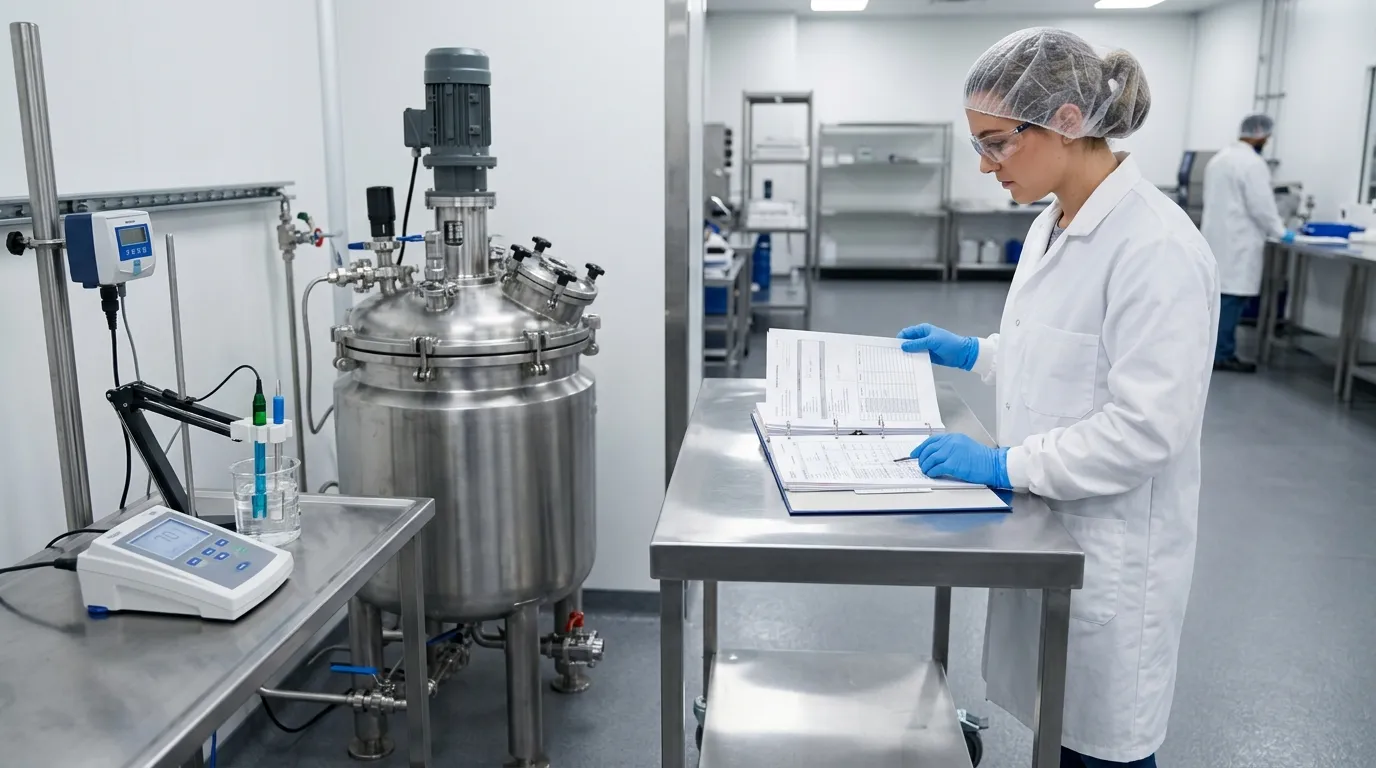
Before using a calculated quantity in a formulation or process document, check:
- The exact chemical identity: acetic acid, not another acid or acetate compound.
- The product form: liquid glacial acetic acid stock.
- The actual starting assay and its basis.
- The target concentration and its basis.
- The final total volume or final total mass.
- Consistent units throughout the calculation.
- The stock quantity shown by the calculator.
- The diluent quantity and how it was derived.
- Density and temperature, if a mass-to-volume conversion was used.
- The current SDS and applicable site SOP.
- The suitability of the vessel, transfer equipment, and wetted materials.
- The required method for checking the finished concentration under the site quality system.
Equipment suitability is a separate question from dilution mathematics. Readers working with tanks or process vessels should review acetic acid tank material compatibility rather than assuming that a vessel is suitable because the calculation is correct.
Concentrated acetic acid requires controlled handling. A general dilution guide may state that acid should be added to water rather than water to acid, but that statement does not replace the current SDS, risk assessment, site procedure, engineering controls, or competent supervision. Follow the requirements applicable to the actual product and workplace.
The calculator output should be reviewed before preparation. A calculation confirms the relationship between the entered numbers; it does not confirm the identity, purity, density, compatibility, or final quality of the material.
What This Calculator Does Not Determine
A glacial acetic acid dilution calculator does not, by itself, determine:
- Food-grade suitability.
- Feed suitability.
- Pharmaceutical suitability.
- Drinking-water suitability.
- Regulatory approval or compliance.
- Application-specific dosage.
- Cleaning or treatment performance.
- Compatibility of a particular tank, pump, hose, or seal.
- Product availability, price, stock, MOQ, lead time, or delivery.
- Whether a finished batch meets a specification without the required QA checks.
- A valid molarity when assay, density, or molecular-weight inputs are missing.
The chemical identity and calculated concentration are only part of an industrial decision. Grade, documentation, application, jurisdiction, equipment, and quality requirements must be assessed separately.
Similarly, a 99.5% starting input should not be interpreted as proof of food, pharmaceutical, feed, water, or other regulated-use suitability. Those determinations require evidence for the exact product, application, and jurisdiction.
For broader context on where the chemical may be used, see glacial acetic acid uses and applications. Detailed storage requirements should be handled through the applicable SDS and, where available, dedicated acetic acid storage handling guidance.
When a calculation depends on product-specific assay, density, concentration basis, or documentation that is not available in the standard inputs, the correct next step is to resolve those specification requirements before relying on the result.


Contact Us
In This Article
Related Posts
Custom Packaging Solutions from an Anhydrous Sodium Acetate Supplier in China
2026-09-23
Application Trends in Anhydrous Sodium Acetate for Special Chemical Manufacturing
2026-09-23
Anhydrous Sodium Acetate for Leather Tanning: Improve Dyeing Uniformity
2026-09-22
Formic Acid 85% for Textile Dyeing: Industrial Applications, Technical Benefits and Future Trends
2026-09-22


