



Formic Acid Freezing Point by Concentration: Storage and Winter Shipping Guide
By Tonmoy
2026-09-03Related Posts
Custom Packaging Solutions from an Anhydrous Sodium Acetate Supplier in China
2026-09-23
Application Trends in Anhydrous Sodium Acetate for Special Chemical Manufacturing
2026-09-23
Anhydrous Sodium Acetate for Leather Tanning: Improve Dyeing Uniformity
2026-09-22
Formic Acid 85% for Textile Dyeing: Industrial Applications, Technical Benefits and Future Trends
2026-09-22
The freezing point of formic acid depends strongly on whether the material is pure formic acid or an aqueous solution, and on how the concentration is defined.
Pure formic acid has a fusion temperature of approximately 8.35°C. Commercial solutions can remain liquid at substantially lower temperatures. However, published values for the same nominal concentration do not always agree, so a web-based number should not automatically be treated as a product specification or recommended storage temperature.
For winter storage or shipping, verify the exact concentration basis, phase-change value, current TDS/SDS, and expected minimum route temperature for the specific product.
What the freezing-point question means for formic acid solutions
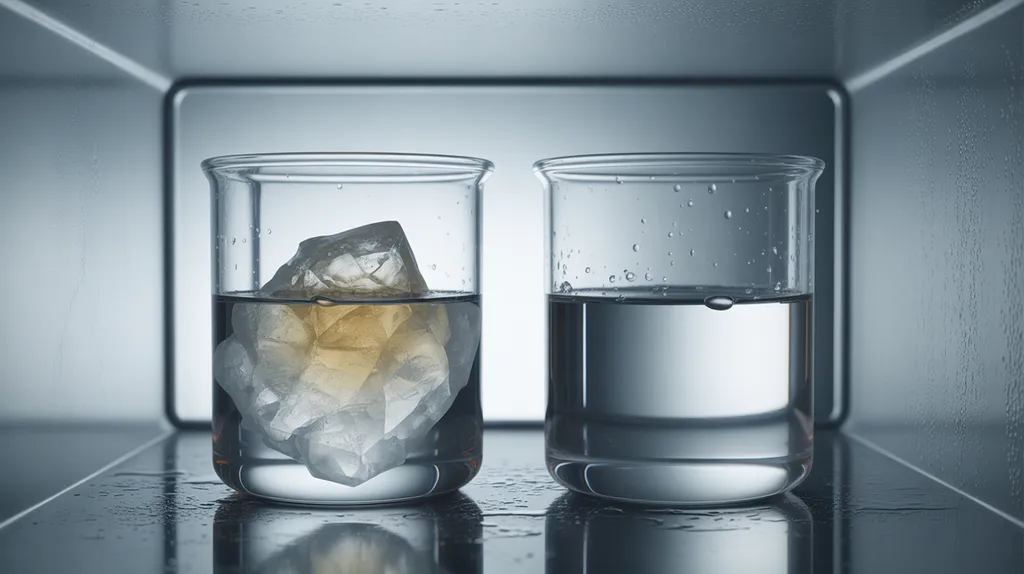
Pure formic acid and commercial aqueous formic acid solutions must be treated as different materials for phase-change planning.
Pure formic acid, identified as CAS 64-18-6, has a reported fusion temperature of approximately 281.5 K, equivalent to about 8.35°C. This is the appropriate reference for the pure compound, not for an 85%, 90%, 94%, or 99% commercial solution.
A solution’s behavior depends on the formic acid–water composition. The concentration may be reported as mass percent, mol percent, volume percent, or a commercial grade designation. These bases are not interchangeable. A value reported for 41.0 mol% formic acid, for example, cannot be directly assigned to a product labeled 41% by mass.
The terminology can also differ:
- Freezing point generally refers to the temperature at which liquid begins to form a solid phase.
- Melting point is the reverse phase transition, from solid to liquid.
- Crystallization onset may describe the first detectable formation of crystals during cooling.
- Storage temperature is an operating recommendation that may include a margin below the measured phase-change point.
The pure-compound reference should therefore be used only to establish the identity of the material. It should not be used as the freezing point for an aqueous commercial product. General formic acid information is available in Vanchor’s formic acid pillar content, while this guide focuses specifically on concentration-dependent phase behavior.
Reported freezing-point values by formic acid concentration
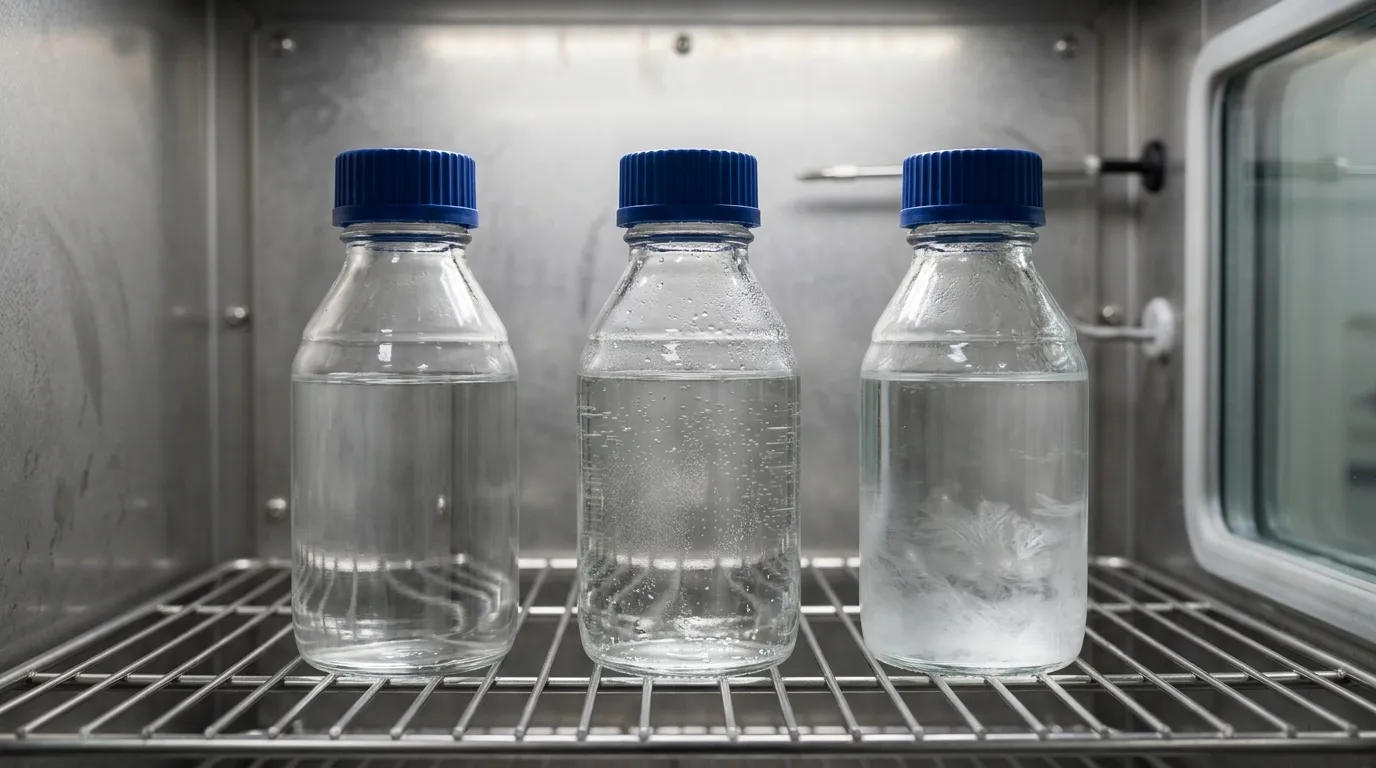
The following values are reported in the cited sources, but they should be treated as reference values rather than universal specifications. The available evidence does not consistently identify the concentration basis, measurement method, or exact product formulation.
| Nominal concentration | Reported phase-change value | Evidence status | Important limitation |
|---|---|---|---|
| Pure formic acid | Approximately 8.35°C | Reference value | Applies to the pure compound, not an aqueous commercial grade |
| 75% formic acid | Approximately −30°C | Attributed source value | Concentration basis and test method were not visible in the retrieved source |
| 85% formic acid | Approximately −20°C | Reported by NOD | Does not agree with the separate Vanchor snippet value of approximately −13.5°C |
| 85% formic acid | Approximately −13.5°C | Vanchor site-stated value | Retrieved only as a snippet and not verified as a universal product specification |
| 90% formic acid | Approximately 20°F, or −6.7°C | USDA/OSHA source evidence | Exact solution basis and method require document-level verification |
| 94% formic acid | Approximately 1.6°C | Vanchor site-stated snippet value | Do not use as a confirmed specification without the full page or current TDS |
| 99% formic acid | Approximately 4°C | Vanchor site-stated snippet value | Do not use as a confirmed specification without the full page or current TDS |
A technical discussion published by NOD reports approximately −30°C for a 75% solution and approximately −20°C for an 85% solution. The USDA technical-report search evidence and OSHA chemical-data search evidence report approximately 20°F for a 90% solution. These are useful reference points, but they are not a normalized product table.
Vanchor’s concentration comparison page also presents representative values for several grades. Its retrieved snippet explicitly indicates that such values should not be treated as universal specifications. The broader formic acid 85 90 94 and 99 comparison page should therefore be used for grade context, not as a substitute for a current grade-specific TDS.
The main practical conclusion is that nominal concentration alone is not enough to approve a winter shipment. The value must be connected to the exact product, concentration basis, test method, and document revision.
Why published freezing points can disagree
Different reported values for formic acid solutions do not necessarily mean that one source is automatically wrong. They may describe different materials or different measurement conventions.
Important causes of variation include:
- Concentration basis: A value stated in mass percent is not directly comparable with one stated in mol percent or volume percent.
- Commercial grade definition: A nominal 85% product may have an assay range, water content, or impurity profile that differs from another supplier’s nominal 85% product.
- Measurement method: Cooling curves, warming curves, visual crystal detection, and instrumental methods may identify different transition points.
- Phase-change definition: A source may report the first crystallization temperature, a freezing point, or a melting point.
- Sample history: Supercooling and crystal formation behavior can affect the observed temperature.
- Source scope: A general reference value may describe a model solution, while a supplier value may describe a specific commercial grade.
The formic acid–water system also has non-linear phase behavior. A reference source reports a eutectic near −48.5°C at 41.0 mol% formic acid. That value is an attributed phase-diagram reference, not a specification for a commercial product labeled 41%, 75%, 85%, or 90%. The molar basis must remain attached to the value.
This is why freezing-point values should not be averaged when sources disagree. A lower number is not automatically the safer number, and a nominal concentration does not establish equivalence between products.
For procurement and QA review, ask the supplier to identify:
- Concentration basis, such as mass percent or mol percent.
- Assay range and product form.
- Whether the value is a freezing point, melting point, or crystallization onset.
- Test method and measurement conditions.
- Whether the value is typical, minimum, maximum, or guaranteed.
- The current TDS or specification revision supporting the value.
Freezing point is not the same as storage temperature
A phase-change temperature is not automatically a recommended storage temperature.
If a solution begins to crystallize at a particular temperature, that does not establish that the product should be stored exactly above that temperature. Storage planning may also need to consider:
- Actual minimum warehouse temperature.
- Duration of cold exposure.
- Temperature variation within the storage area.
- Container size and thermal equilibration.
- Loading, unloading, and terminal exposure.
- Whether crystals can form locally before the bulk liquid reaches the reported value.
- Product-specific instructions for inspection, handling, and recovery.
The applicable product TDS and SDS should control storage and handling decisions. Do not infer a universal storage range from the pure-formic-acid value or from a number reported for another grade.
A practical review should identify the exact product and then compare its documented phase-change information with the lowest expected temperature. The operating margin should be defined through the company’s own QA, warehouse, and logistics procedures rather than assumed from a generic online table.
For broader handling context, consult the relevant formic acid storage resource, but retain the distinction between general storage information and the exact product documents governing a shipment.
Winter-shipping decision path for commercial formic acid
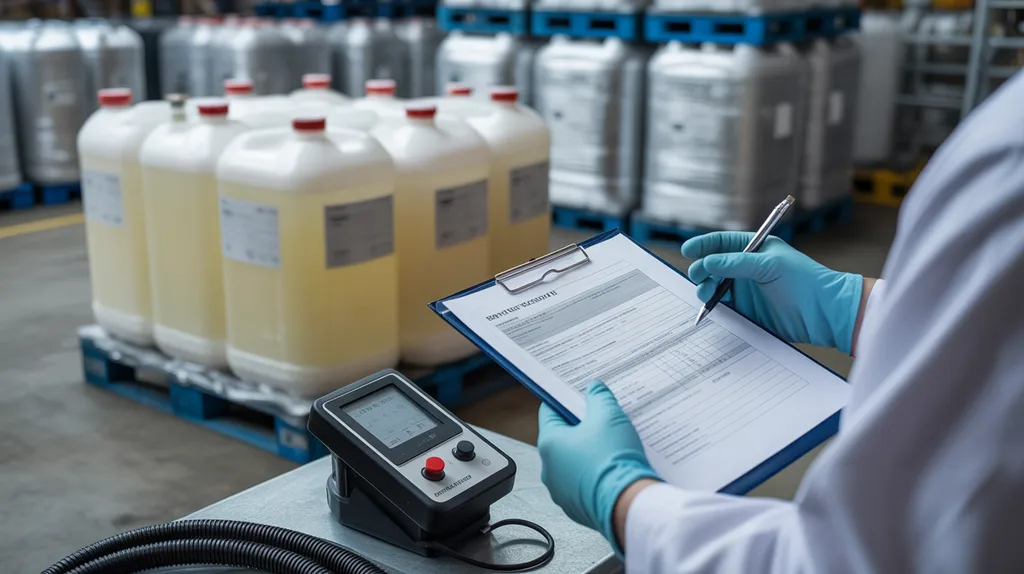
A winter-shipping review should be treated as a product-and-route verification process.
- Identify the exact material. Record the product name, concentration, grade, assay basis, physical form, and concentration unit. Confirm whether the concentration is expressed as mass percent, volume percent, mol percent, or another basis.
- Request the current technical documents. Obtain the current TDS and SDS, together with any supplier statement identifying the freezing point, crystallization onset, or minimum recommended temperature. Confirm the document revision.
- Compare the product value with the route exposure. Consider the expected minimum temperatures during loading, inland transport, port or terminal storage, ocean or road transit, customs delays, and receiving-site storage. A nominal outdoor air temperature is not necessarily the same as the product temperature, but it is relevant to exposure planning.
- Confirm packaging and transport requirements. Use the current product and jurisdiction-specific documents for packaging, handling, labeling, and transport requirements. Do not infer these requirements from concentration alone.
- Document the release decision. Record the product value used, the source document, route assumptions, expected temperature range, and the person or function approving the shipment. If the supplier data and route conditions do not align, escalate the discrepancy before shipment.
A winter RFQ or technical-document request should include:
- Exact concentration and concentration basis.
- Product grade and assay range.
- Reported freezing or crystallization temperature.
- Test method and units.
- Current TDS and SDS revision.
- Packaging and transport instructions.
- Destination country and route.
- Expected minimum temperature and exposure duration.
- Required receiving or storage conditions.
This workflow does not establish that any particular grade can be shipped at a specific temperature. It ensures that the decision is based on the exact material and documented conditions rather than on an unqualified internet value.
What to do when the available data does not match
When two sources report different values for the same nominal concentration, do not average them and do not automatically select the lowest value as a safety margin.
Instead:
- Confirm that both sources refer to the same chemical form.
- Check whether both concentrations use the same basis.
- Determine whether the values describe freezing, melting, or crystallization onset.
- Check whether the sources describe a commercial product, a laboratory mixture, or a general reference system.
- Request the supplier’s current product-specific documentation.
- Ask QA or technical personnel to resolve the discrepancy before approving the shipment.
The 85% example illustrates this issue. One retrieved technical source reports approximately −20°C, while a Vanchor search snippet reports approximately −13.5°C as a representative value. The available evidence does not establish which value should be used for every 85% product. Both should therefore remain attributed to their respective sources rather than being presented as a single universal specification.
The same principle applies to the reported 90% value of approximately −6.7°C and to any proposed value for 94% or 99% material. A product-grade document is needed before these numbers can support a release, storage, or winter-shipping decision.
Practical document check before winter storage or shipment
Before placing an order or releasing a shipment, confirm that the documentation answers these questions:
- What is the exact formic acid concentration?
- What concentration basis is used?
- Is the reported temperature a freezing point, melting point, or crystallization onset?
- Is the number typical, guaranteed, or an approximate reference value?
- What test method and units were used?
- Which product grade and document revision does it apply to?
- What storage and handling conditions are specified?
- What packaging and transport requirements apply in the destination jurisdiction?
- Does the route-temperature assessment provide an adequate operating margin?
- What procedure applies if the material arrives with crystals or unexpected phase separation?
Material and equipment considerations should be assessed separately from phase-change behavior. The related formic acid material compatibility resource can support that separate review, but compatibility information does not establish a freezing point or winter-shipping limit.
For a specific purchasing decision, identify the exact concentration, destination, and expected temperature exposure, then request the current grade-specific technical and safety documents. The concentration values in this guide are useful for initial planning and source comparison; they should not replace the applicable product specification or SDS.


Contact Us
In This Article
Related Posts
Custom Packaging Solutions from an Anhydrous Sodium Acetate Supplier in China
2026-09-23
Application Trends in Anhydrous Sodium Acetate for Special Chemical Manufacturing
2026-09-23
Anhydrous Sodium Acetate for Leather Tanning: Improve Dyeing Uniformity
2026-09-22
Formic Acid 85% for Textile Dyeing: Industrial Applications, Technical Benefits and Future Trends
2026-09-22


