



Calcium Formate Compatibility with Superplasticizers: Testing Guide
By vanchor
2026-07-24Related Posts

Custom Packaging Solutions from an Anhydrous Sodium Acetate Supplier in China
2026-09-23

Application Trends in Anhydrous Sodium Acetate for Special Chemical Manufacturing
2026-09-23

Anhydrous Sodium Acetate for Leather Tanning: Improve Dyeing Uniformity
2026-09-22

Formic Acid 85% for Textile Dyeing: Industrial Applications, Technical Benefits and Future Trends
2026-09-22
Calcium formate can be used with superplasticizers, but the pairing is formulation-dependent, so the safe approach is to test compatibility in trial mixes rather than assume it will behave the same across all cements and admixtures. If you are evaluating this for a concrete or mortar system, the question is less “Can they ever work together?” and more “Do they work together in this specific mix, at this dosage, with this cement?”
Calcium Formate Manufacturer: Production Process, Applications, And Sourcing Guide (inferred)
What Compatibility Means
In practice, compatibility means the combination still gives you usable workability, stable slump retention, acceptable setting behavior, and the early performance you need without unwanted side effects such as sudden slump loss or uncontrolled set changes. For calcium formate and superplasticizers, that matters because calcium formate is commonly used as an accelerator in cement-based systems, while the superplasticizer is meant to improve flow and water reduction; those functions can either complement each other or interfere depending on the mix.sciencedirect+3
A mix can be technically “compatible” even if it still needs dosage adjustment, but it is not compatible if the interaction causes unstable fresh properties or makes production inconsistent. That is why compatibility should be judged by measured behavior, not by a generic product claim.sciencedirect+1
Why It Can Work or Fail
The same pair of ingredients may behave differently because cement chemistry changes the way admixtures are adsorbed and released in the system. Research on superplasticizer compatibility shows that cement composition, especially factors such as C3A and sulfate balance, can strongly influence fresh performance and setting behavior.sciencedirect+2
That means one cement may tolerate the combination well, while another can show rapid slump loss, unexpected acceleration, or delayed dispersion. Dosage also matters: a small change in calcium formate level, superplasticizer level, or mixing sequence can change the result enough to move the mix from acceptable to problematic.sciencedirect+1
Variables to Watch
Cement type and chemistry.
Calcium formate dosage.
Superplasticizer type, especially if it is PCE-based.
Water content and water-to-cement ratio.
Mixing order and addition timing.
Temperature, especially in cold-weather use cases.
How to Test It
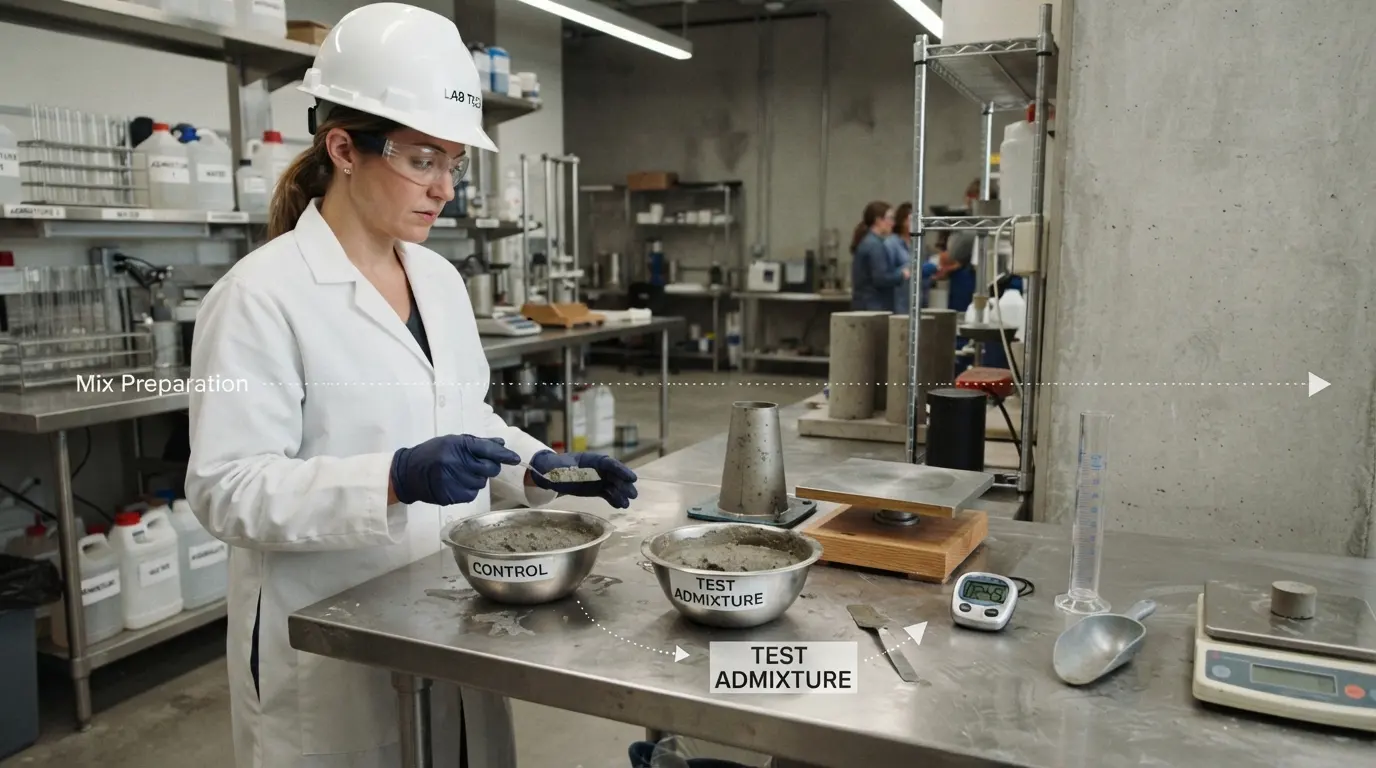
The most reliable way to check calcium formate compatibility with superplasticizers is a controlled trial mix that compares a baseline mix against one or more test mixes with the intended dosage range. The goal is to see whether the pair preserves workability and setting behavior while still delivering the early-strength benefit calcium formate is often used for.engr.psu+2
A practical trial sequence is:
Make a control mix with the cement and superplasticizer only.
Add calcium formate at the intended dosage in a separate test mix.
Keep all other variables the same.
Measure fresh behavior immediately after mixing and again after a short time interval.
Record setting and early-age results so you can compare the control and test mixes directly.
If you are evaluating a PCE superplasticizer, treat each cement source as a separate compatibility case rather than assuming results will transfer from one project to another.sciencedirect+1
What to Measure
Focus on the indicators that actually show whether the pair works in production:
Slump or flow.
Slump retention over time.
Initial and final set.
Visual stability and consistency.
Early strength, if your application depends on it.
These measurements tell you whether the mix remains placeable and whether calcium formate is helping or over-correcting the system.sciencedirect+1
How to Read the Results
If the test mix maintains workable flow, stays stable over the observation window, and gives the intended setting or early-strength response, the pairing is probably workable for that cement and dosage range. If the mix loses slump quickly, sets too fast, or becomes erratic from batch to batch, the issue may be incompatibility, dosage imbalance, or an unfavorable cement chemistry interaction.sciencedirect+3
Common failure signals include:
Rapid slump loss after mixing.
Poor dispersion or visible instability.
Setting that becomes too fast for placement.
Unexpected delay when the mix was meant to accelerate.
Inconsistent results between trial batches.
When those signals appear, the next step is not to assume the ingredients cannot be used together. Instead, retest with a different dosage, adjust the addition order, or try the same pair with a different cement source.sciencedirect+1
Where This Pairing Matters Most
This compatibility question comes up most often in mixes where early performance matters, such as cold-weather concreting, precast production, and other cementitious systems that need faster strength development without losing workability. It is also relevant in related cement-based products like dry mix mortar and tile adhesive, where flow, open time, and setting control must stay balanced.osperse.co+1
calcium formate for concrete can provide broader application context, while calcium formate for cement and calcium formate for dry mix mortar are useful if you are comparing how the same additive behaves in adjacent formulations.
What a Supplier Should Provide
For a real purchasing or formulation decision, the supplier should be able to provide at least a COA, SDS, and technical specifications so you can verify the material before testing or scale-up. Vanchor’s calcium formate manufacturer page states that these documents are available, and its site also positions calcium formate for concrete additives, tile adhesives, and dry mix mortar use. The homepage also claims ISO, AEO, and SGS compliance and consistent batch quality, which can be useful as supplier-positioning context, but those remain site claims rather than independent technical validation.ijcaonline
That documentation does not replace compatibility testing, but it gives you a better starting point for a controlled trial. If your mix depends on consistent early-age behavior, that is the point at which supplier documentation and your own lab results should be checked together.sciencedirect+2
If you want to evaluate calcium formate for a cementitious system, start with a small control-versus-test trial, measure slump and set behavior, and only then scale up to production.


Contact Us
In This Article
Related Posts
Custom Packaging Solutions from an Anhydrous Sodium Acetate Supplier in China
2026-09-23
Application Trends in Anhydrous Sodium Acetate for Special Chemical Manufacturing
2026-09-23
Anhydrous Sodium Acetate for Leather Tanning: Improve Dyeing Uniformity
2026-09-22
Formic Acid 85% for Textile Dyeing: Industrial Applications, Technical Benefits and Future Trends
2026-09-22


