



Formic Acid vs Acetic Acid: Strength, Uses, Handling, and Selection
By vanchor
2026-07-25Related Posts

Vanchor Completes Shipment of 135 MT of Calcium Formate to South America
2026-08-11

Chemical Import Landed Cost Calculation: Estimate the Full Delivered Cost
2026-08-02

Incoterms for Chemical Imports: Cost, Risk, and Responsibility Guide
2026-08-01

Caustic Soda for Pulp and Paper Manufacturing: Process Uses and Safety
2026-07-31
Formic acid is the stronger acid, while acetic acid is the milder one; that difference shapes how each behaves in use, handling, and selection. If you already know you need broader formic-acid product context, the parent guide is here: Formic Acid CAS 64-18-6: Properties, Applications, Grades, and Purchasing Guide (inferred).
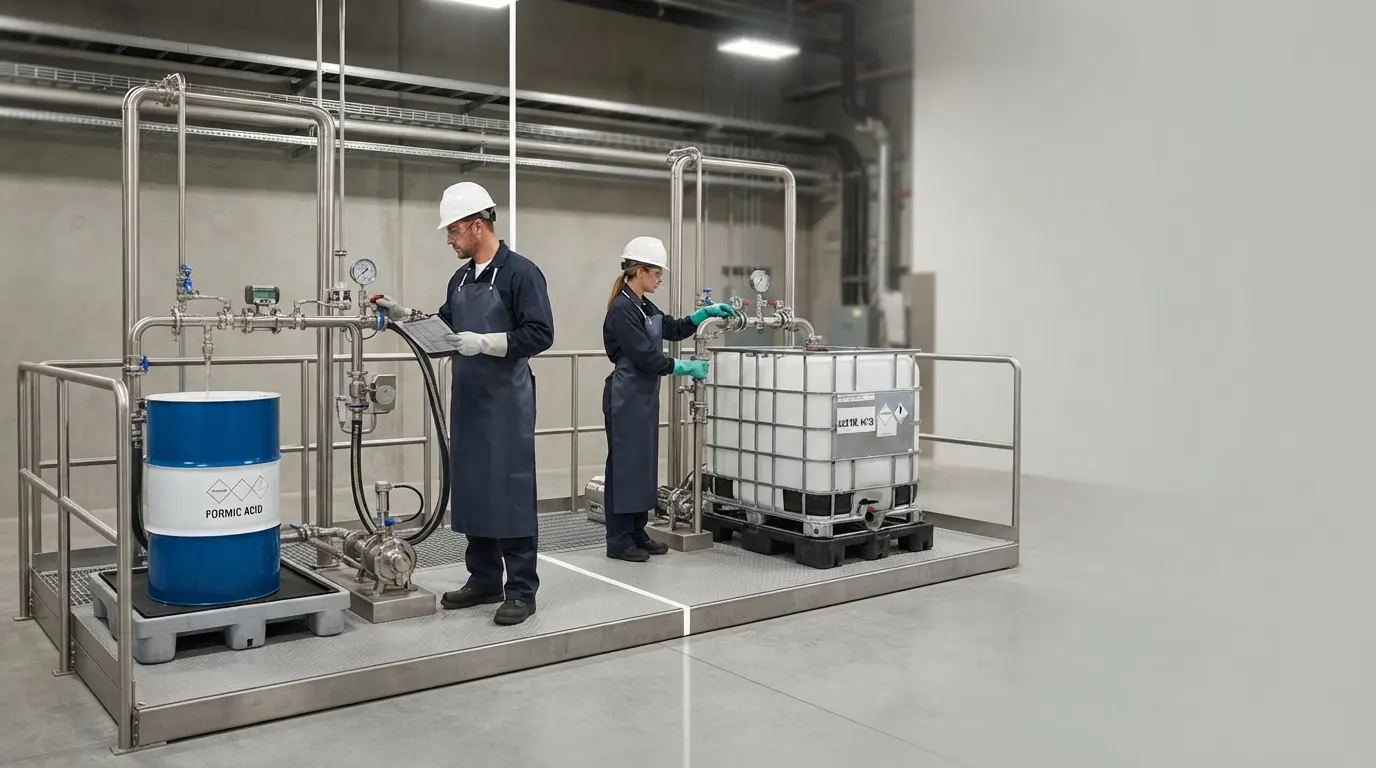
What Formic Acid and Acetic Acid Are
Formic acid and acetic acid are both carboxylic acids, but they are not interchangeable in practice. Formic acid is methanoic acid, and acetic acid is ethanoic acid; both are common organic acids, yet their structures lead to different acidity and different best-fit uses.
Formic acid has the formula HCOOH, while acetic acid is CH3COOH. That extra methyl group in acetic acid is the key reason the two acids behave differently in strength and reactivity.
Formic Acid in One Sentence
Formic acid is the simplest carboxylic acid and the stronger of the two.
Acetic Acid in One Sentence
Acetic acid is the familiar weaker comparison acid, widely used where a milder organic acid is preferred.
Why Formic Acid Is Stronger
The simplest answer is that formic acid has a more stable conjugate base than acetic acid, so it gives up a proton more easily. In acidity terms, that means formic acid has the lower pKa and therefore the stronger acid behavior.pmc.ncbi.nlm.nih
Acetic acid is weaker because its methyl group donates electron density through the inductive effect, which makes the acetate ion less favorable than the formate ion. Competitor content often states this in passing, but the useful takeaway is practical: formic acid is better when stronger acidification or greater reactivity is needed, while acetic acid is better when a milder acid is preferable.pmc.ncbi.nlm.nih+1
Strength at a Glance
| Property | Formic acid | Acetic acid |
|---|---|---|
| Common name | Formic acid | Acetic acid |
| IUPAC name | Methanoic acid | Ethanoic acid |
| Relative acidity | Stronger | Weaker |
| Main structural difference | No methyl group | Has a methyl group |
| Practical meaning | More aggressive acidification | Milder acid behavior |
How Their Properties Compare
Both acids are polar, water-compatible organic acids, but the comparison usually matters more for how they behave in process conditions than for textbook identity. Formic acid is generally more reactive, and that can be useful in applications that need stronger acid action or faster pH shift.
Acetic acid is usually the more familiar industrial and food-associated acid, especially where controlled, milder acidity is enough. For readers comparing them in a purchase or process context, the key question is not just “which is stronger?” but “which strength profile fits the application without creating unnecessary handling or compatibility issues?”
| Property | Formic acid | Acetic acid | Why it matters |
|---|---|---|---|
| Acidity | Stronger | Weaker | Affects pH control and process aggressiveness |
| Reactivity | Higher | Lower | Impacts compatibility and handling caution |
| Odor | Sharp, pungent | Vinegar-like | Useful for practical identification |
| General use profile | More industrially aggressive | More familiar and milder | Guides selection by application |
| Handling caution | Higher | Lower | Concentration and exposure risk matter |
Where Each Acid Is Used
Formic acid is used heavily in industrial settings where strong acidification and process control matter. Common examples include leather processing, textile dyeing, preservation systems, and other applications where the acid’s stronger behavior is an advantage. Vanchor’s site also positions formic acid within textile, leather, agriculture, and related industrial uses, which fits the wider comparison context.vanchorsc+2
Acetic acid is more often associated with food-related and general chemical applications, especially when milder acidity is sufficient. Vanchor’s site highlights glacial acetic acid in food and cleaning-related contexts, which reflects how acetic acid often appears in practical buyer searches. For comparison readers, the real decision is not “which acid is better overall,” but which one better matches the application’s required acidity and process tolerance.vanchorsc+1
When Formic Acid Fits Better
Use formic acid when the process needs stronger acidification, sharper pH correction, or a more forceful industrial acid profile. It is a better fit for applications such as silage preservation, leather treatment, and textile processing, where its strength can be an advantage rather than a drawback.vanchorsc+2
When Acetic Acid Fits Better
Use acetic acid when the process calls for a milder organic acid and a more familiar general-purpose profile. It is often the more natural choice in food-related, cleaning, and general chemical applications, especially where the formulation or process does not need the stronger behavior of formic acid.vanchorsc+1
How to Handle and Use Them Safely
The handling difference matters because stronger acidity usually means more caution in storage, transfer, and worker exposure. For a comparison page, the useful point is not to repeat a full safety manual, but to make clear that formic acid generally demands more care than acetic acid when concentrations are similar.
Keep the focus on compatible containers, ventilation, PPE, and concentration awareness. If the reader is looking for detailed storage guidance, that belongs on the dedicated storage page: Formic Acid Storage.
Quick Safety Differences
Formic acid generally requires a higher level of handling caution because it is stronger and more aggressive.
Acetic acid is still a corrosive chemical in concentrated form, but it is usually the milder comparison point.
Concentration matters as much as the chemical name, so always check the grade before use.
For storage specifics, use the dedicated formic-acid storage guide rather than overloading this comparison page.
Which One Should You Choose?
Choose based on the process requirement, not just on familiarity. If you need stronger acidification or a more industrially aggressive acid, formic acid is usually the better fit; if you need a milder organic acid for a more routine formulation or food-related context, acetic acid is often the better choice.
A simple decision rule works well:
Choose formic acid when the process depends on stronger pH reduction, faster acid action, or a known formic-acid application.
Choose acetic acid when milder acidity is enough and the application suits a less aggressive organic acid.
Check concentration and grade before deciding, because practical performance changes with formulation.
For acetic-acid concentration questions, the dedicated guide is the better next step: Acetic Acid Concentration Guide. For formic-acid-specific application depth, this supporting page is also useful: formic acid uses and applications.
Choose Formic Acid If…
You need stronger acidification.
Your application benefits from faster or more aggressive acid behavior.
The process is already formic-acid-aligned, such as certain industrial preservation or treatment uses.
Choose Acetic Acid If…
You need a milder organic acid.
The application is food-related, general-purpose, or less aggressive in nature.
You want a more familiar acid profile for routine use.
Optional Tests That Distinguish Them
In technical contexts, formic acid and acetic acid can be distinguished by their different chemical behavior in classic test reactions. Formic acid is the one with reducing behavior, while acetic acid does not show the same response.thegravityinstitute
This is useful background for chemistry readers, but it should not become the main focus of the page. The practical comparison matters more for most buyers and process users than the laboratory distinction itself.
Final Takeaway for Buyers and Technical Readers
Formic acid is the stronger, more reactive option; acetic acid is the milder, more familiar one. If you are choosing between them, the decision usually comes down to how much acid strength the process needs, how much handling caution is acceptable, and whether the application belongs more naturally to formic acid or acetic acid.
For broader formic-acid context, the parent guide remains the best next page: Formic Acid CAS 64-18-6: Properties, Applications, Grades, and Purchasing Guide (inferred).


Contact Us
In This Article
Related Posts
Vanchor Completes Shipment of 135 MT of Calcium Formate to South America
2026-08-11
Chemical Import Landed Cost Calculation: Estimate the Full Delivered Cost
2026-08-02
Incoterms for Chemical Imports: Cost, Risk, and Responsibility Guide
2026-08-01
Caustic Soda for Pulp and Paper Manufacturing: Process Uses and Safety
2026-07-31


