



Glacial Acetic Acid Freezing Point: Why It Crystallizes and How to Plan Storage
By Tonmoy
2026-09-13Related Posts
Custom Packaging Solutions from an Anhydrous Sodium Acetate Supplier in China
2026-09-23

Application Trends in Anhydrous Sodium Acetate for Special Chemical Manufacturing
2026-09-23
Anhydrous Sodium Acetate for Leather Tanning: Improve Dyeing Uniformity
2026-09-22

Formic Acid 85% for Textile Dyeing: Industrial Applications, Technical Benefits and Future Trends
2026-09-22
Glacial acetic acid commonly freezes or solidifies at approximately 16.6°C (61.9°F), often rounded to 17°C (62°F). Because this temperature is close to normal room temperature in some facilities and transport environments, glacial acetic acid can develop crystals during cold storage, winter transport, or exposure to unheated areas.
This value is a general physical-property reference for glacial or high-purity acetic acid. The exact specification can vary with product composition, grade, test method, and applicable standard. It should not be treated as a universal storage set point or automatically applied to diluted acetic acid solutions.
What Is the Freezing Point of Glacial Acetic Acid?
| Property | Practical reference |
|---|---|
| Commonly reported freezing or solidification point | Approximately 16.6°C |
| Rounded Celsius value | About 17°C |
| Fahrenheit equivalent | Approximately 61.9–62°F |
| Operational meaning | Crystallization may occur when the product temperature approaches or falls below this range |
Reference sources commonly report a freezing or melting point in the range of approximately 16–17°C. A glacial acetic acid product page from Columbus Chemical Industries describes solidification near 17°C, while general chemical references report approximately 16–17°C for acetic acid. These sources establish a useful general reference, not a product-specific Vanchor specification.
The key operational distinction is:
- Freezing point: the approximate temperature at which the material begins changing from liquid to solid.
- Storage operating temperature: the temperature selected for a particular product, facility, container, and handling system.
A storage plan normally needs a margin above the freezing point. Holding material exactly at the phase-change threshold leaves little protection against temperature variation, cold spots, measurement error, or short-term exposure during loading and unloading.
Why Does Glacial Acetic Acid Crystallize Near Room Temperature?
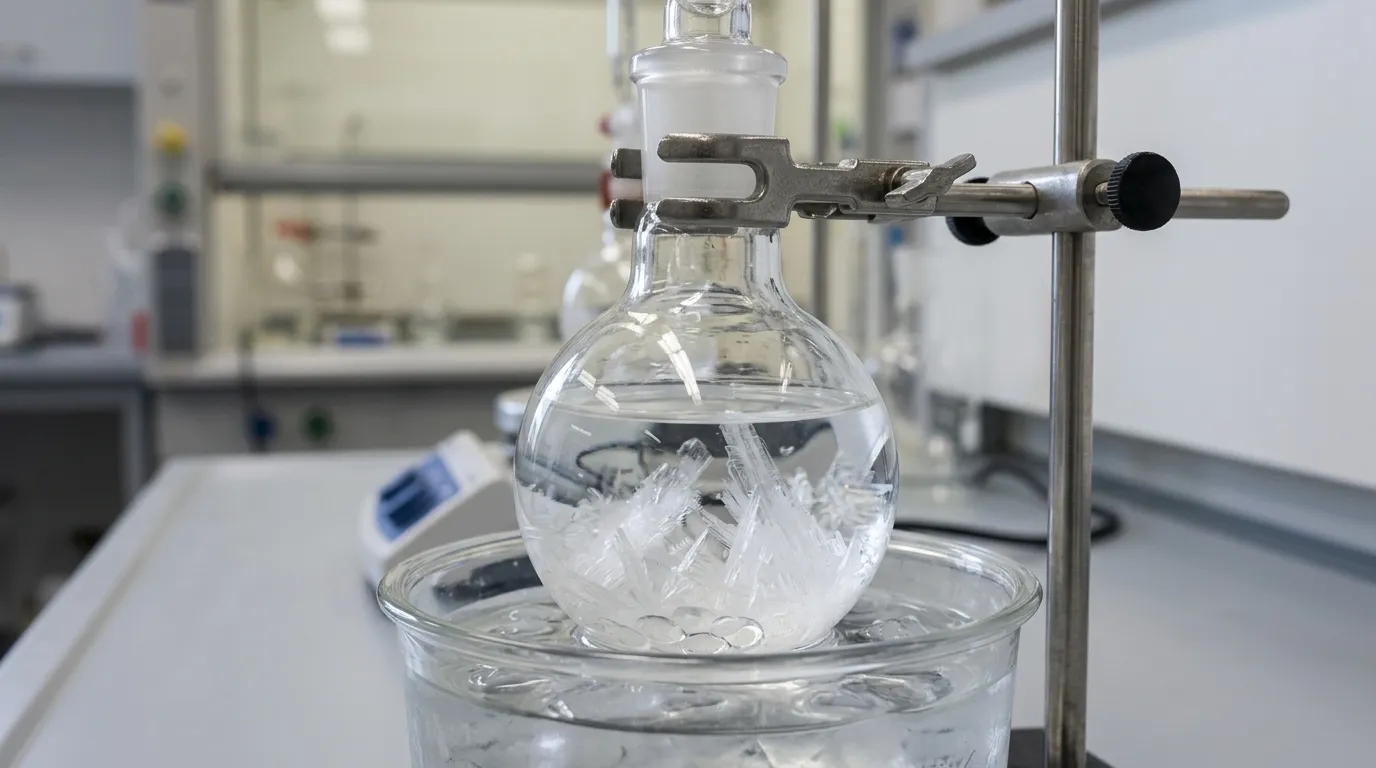
Glacial acetic acid is a concentrated, low-water form of acetic acid. Unlike ordinary dilute acetic acid solutions, it can solidify at a temperature that is not far below typical indoor conditions.
When the product cools to or below its freezing range, solid acetic acid crystals can form. The crystals may have an ice-like appearance, which is one reason the concentrated material is described as “glacial.” They are not water ice; they are solidified acetic acid.
The appearance of crystals indicates a phase change, but it does not by itself establish:
- contamination,
- incorrect assay,
- degradation,
- loss of suitability for the intended process, or
- compliance with a product specification.
The product should still be evaluated against the applicable grade documentation and site procedure. A visually clear liquid after warming is not, by itself, a complete quality release decision.
A supplier-specific source reports that crystallized material may be returned to liquid form above its freezing point within that product’s stated scope. That observation should not be converted into a universal guarantee for every grade, container, or batch. Any recovery decision should account for the product documents, container condition, contamination risk, and QA requirements.
Why Concentration and Grade Matter
The approximate 16.6–17°C value applies to glacial or high-purity acetic acid as a general reference. It does not automatically apply to acetic acid solutions containing substantial water or to every commercial grade.
Water and dilution change the phase behavior of an acetic acid mixture. As concentration changes, the temperature at which the solution begins to freeze or crystallize can also change. Therefore, the freezing point of 80% acetic acid, for example, requires concentration-specific data and should not be inferred from the glacial-acetic-acid value.
For concentration and property interpretation, readers may consult an acetic acid concentration guide or an acetic acid density concentration chart. These resources should be used for their stated scope; density or concentration information alone does not replace a product-specific freezing-point specification.
| Material category | How to interpret the freezing-point information |
|---|---|
| Glacial or high-purity acetic acid | Use approximately 16.6–17°C as a general reference, then confirm the exact grade documentation |
| Diluted acetic acid solution | Obtain concentration-specific phase-change data |
| 80% acetic acid | Treat as a separate technical question; do not use the glacial value |
| Standard- or monograph-controlled product | Follow the current applicable specification and test basis |
Standards can also define a particular grade and test requirement. For example, ASTM D3620 covers a glacial acetic acid material in a defined specification scope and includes freezing point among the properties considered. The standard’s scope and current version must be checked before applying it to a particular commercial product.
A specification acceptance criterion is not necessarily identical to a general textbook physical-property value. The product identity, assay, water content, test method, and applicable standard must remain attached to the number.
How to Plan Storage Around the Freezing Point
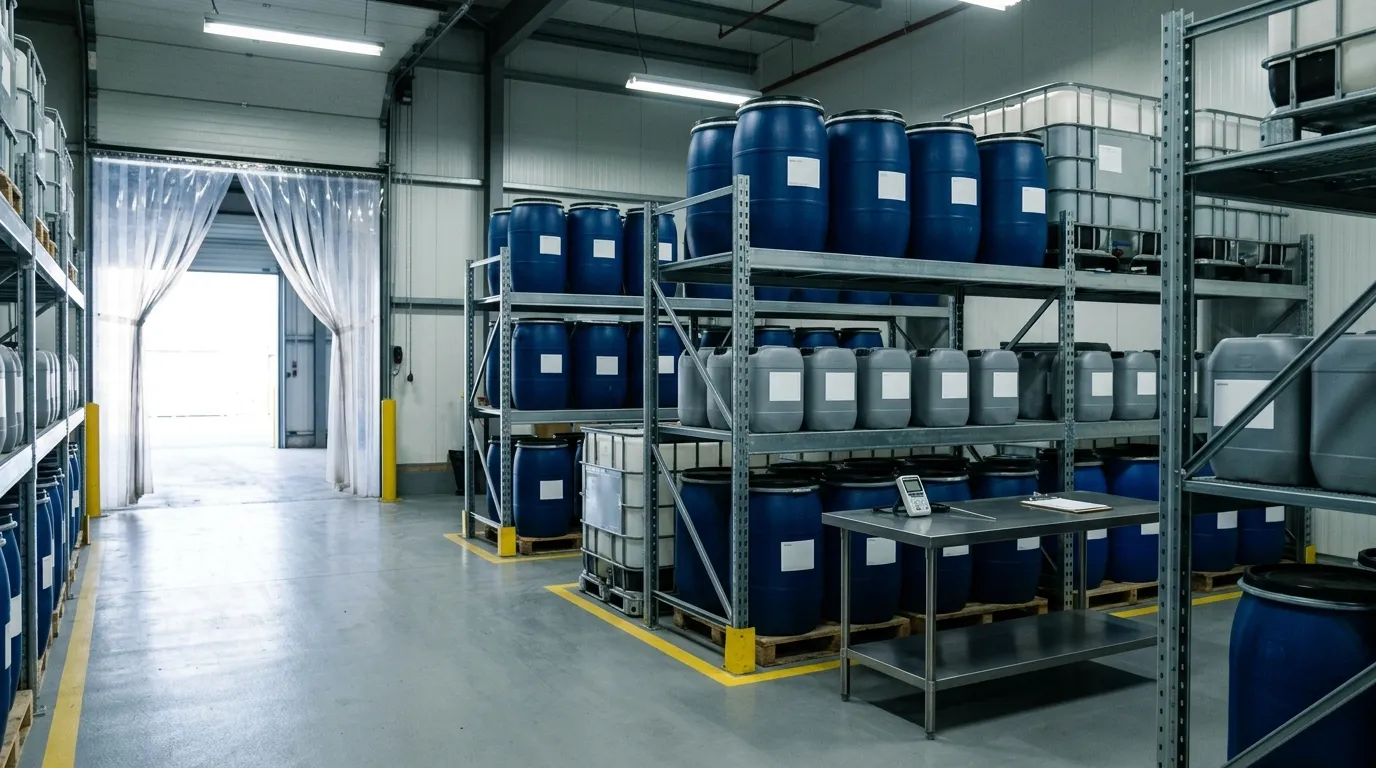
The freezing point should be treated as a crystallization-risk reference, not as a recommended universal storage temperature.
A practical storage review should consider the lowest temperature the product may experience at each stage:
- bulk storage,
- warehouse storage,
- outdoor or unheated staging,
- loading and unloading,
- road or ocean transport,
- temporary storage at the receiving site, and
- localized cold areas near doors, walls, floors, or ventilation equipment.
The product temperature may differ from the surrounding air temperature. A container exposed to a cold surface or overnight outdoor conditions can cool more substantially than a nearby room-temperature measurement suggests.
For a site-level storage decision:
- Confirm the exact acetic acid grade and concentration.
- Review the current supplier TDS, SDS, and product specification.
- Check whether the documentation gives a storage range or a freezing-point test value.
- Estimate the minimum expected product temperature, not only the average room temperature.
- Use a practical margin above the relevant freezing range rather than operating at the threshold.
- Define how warehouse and QA personnel should handle visible crystallization.
- Record unusual temperature exposure or container conditions before release.
The broader acetic acid storage handling guidance should be reviewed separately for handling and safety requirements. This article does not establish container compatibility, transport classification, a universal storage range, or a thawing procedure.
What to Check If Glacial Acetic Acid Has Crystallized
Crystallized material should be handled as a technical and QA decision, not simply as a visual problem.
Before the material is released for use, check:
- product name and exact grade;
- batch or lot identification;
- concentration or assay basis;
- applicable TDS, SDS, and specification;
- temperature history, if available;
- container integrity and closure condition;
- signs of contamination or abnormal appearance; and
- any site procedure for temperature-exposed chemicals.
If the material has only been exposed to temperatures near its expected freezing range, crystallization may be consistent with a phase change. However, visual liquefaction after warming does not prove that the batch meets every quality requirement. If the container is damaged, contamination is suspected, the material has experienced unusual conditions, or the specification status is unclear, the batch should remain under the site’s QA or technical review process.
Do not improvise a heating method, heating rate, or maximum temperature. Any procedure for returning crystallized material to liquid form must account for the chemical’s hazards, the container, ventilation, equipment, and the supplier’s or site’s approved instructions.
Which Documents Should Control the Final Storage Decision?
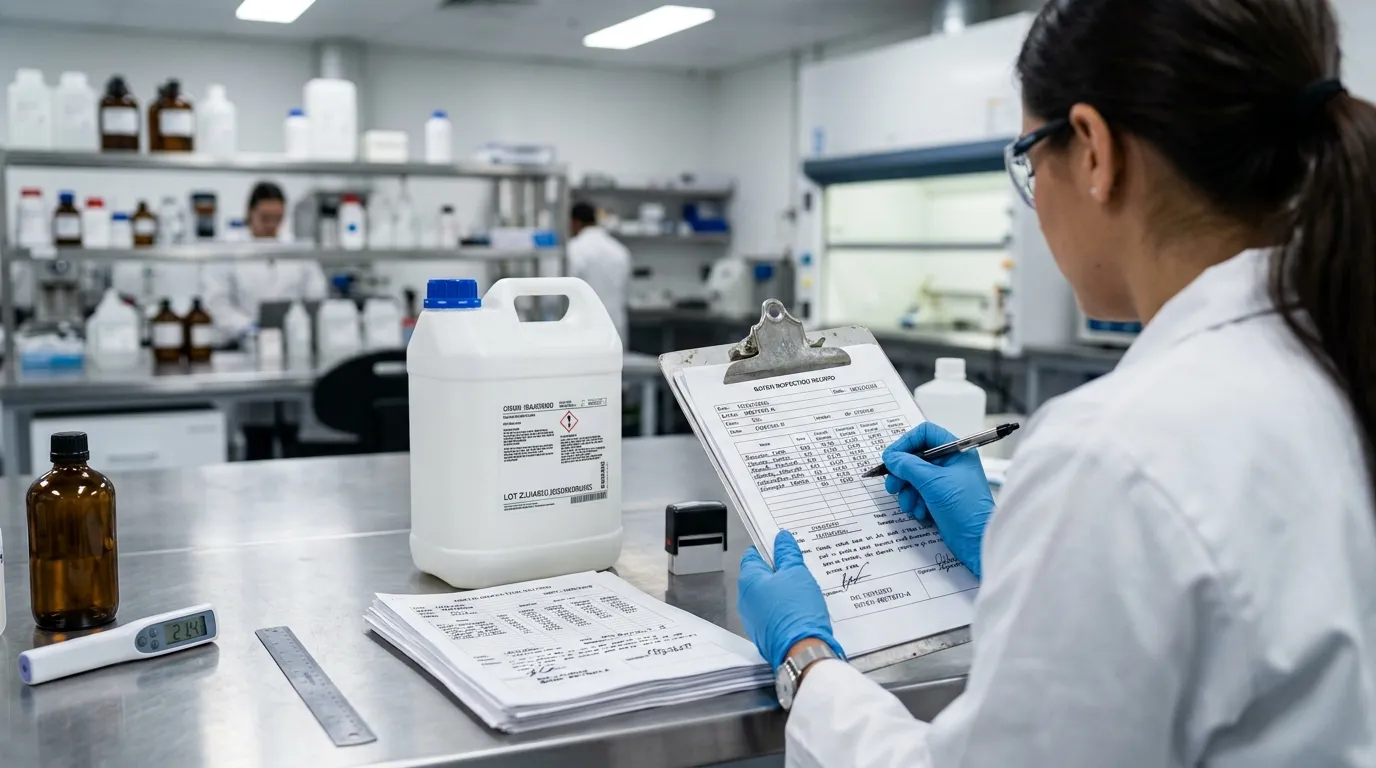
A general freezing-point reference is useful for planning, but the final decision should be based on documents for the exact product and grade.
| Document | What it may establish | What it does not establish by itself |
|---|---|---|
| TDS or product specification | Grade-specific properties, test methods, and stated storage information | Universal behavior of all acetic acid grades |
| SDS | Hazard, handling, and emergency information | Food, pharmaceutical, feed, or water suitability |
| COA | Results for a specific batch, where provided | A universal specification for every batch or product |
| ASTM standard or monograph | Defined scope, test basis, and acceptance framework | Automatic applicability to every commercial product |
When reviewing documentation, confirm the product identity, grade, units, version date, test method, and concentration basis. A standard or monograph may use a defined acceptance criterion that should not be presented as the universal freezing point of all glacial acetic acid.
If a specific Vanchor grade is under review, the relevant product documentation should control the storage decision. The glacial acetic acid 99 5 min product page may be relevant for product identification, but any freezing-point, storage, or grade claim should be taken only from the current applicable product documentation.
For readers evaluating the chemical in a wider process context, the glacial acetic acid uses and applications page provides broader application information. The central storage decision remains the same: use approximately 16.6–17°C as a general crystallization reference, then verify the exact product grade and documentation before setting operating or QA procedures.


Contact Us
In This Article
Related Posts
Custom Packaging Solutions from an Anhydrous Sodium Acetate Supplier in China
2026-09-23
Application Trends in Anhydrous Sodium Acetate for Special Chemical Manufacturing
2026-09-23
Anhydrous Sodium Acetate for Leather Tanning: Improve Dyeing Uniformity
2026-09-22
Formic Acid 85% for Textile Dyeing: Industrial Applications, Technical Benefits and Future Trends
2026-09-22


