



Leather Chemical Supplier: Products, Applications, Quality Control, and Purchasing Guide
By vanchor
2026-07-20Related Posts
How to Choose a Reliable 2-Ethylhexanol (2-EH) Supplier in China: Quality, Packaging and Shipping
2026-10-22
Natural vs Synthetic Sodium Sulfate Anhydrous: Which Is Better for Industrial Applications?
2026-10-22
Isobutanol 99.3% Price and Supply in 2026: A Guide for Chemical Importers
2026-10-22
Sodium Sulfate Anhydrous 99% for Detergent Manufacturing: Benefits, Specifications and Bulk Supply
2026-10-22
Tanneries, leather-processing factories, footwear manufacturers, auto-interior suppliers, furniture makers, and garment firms, leather-goods brands, and chemical distributors all have to make the decision of selecting a Leather Chemical Supplier.
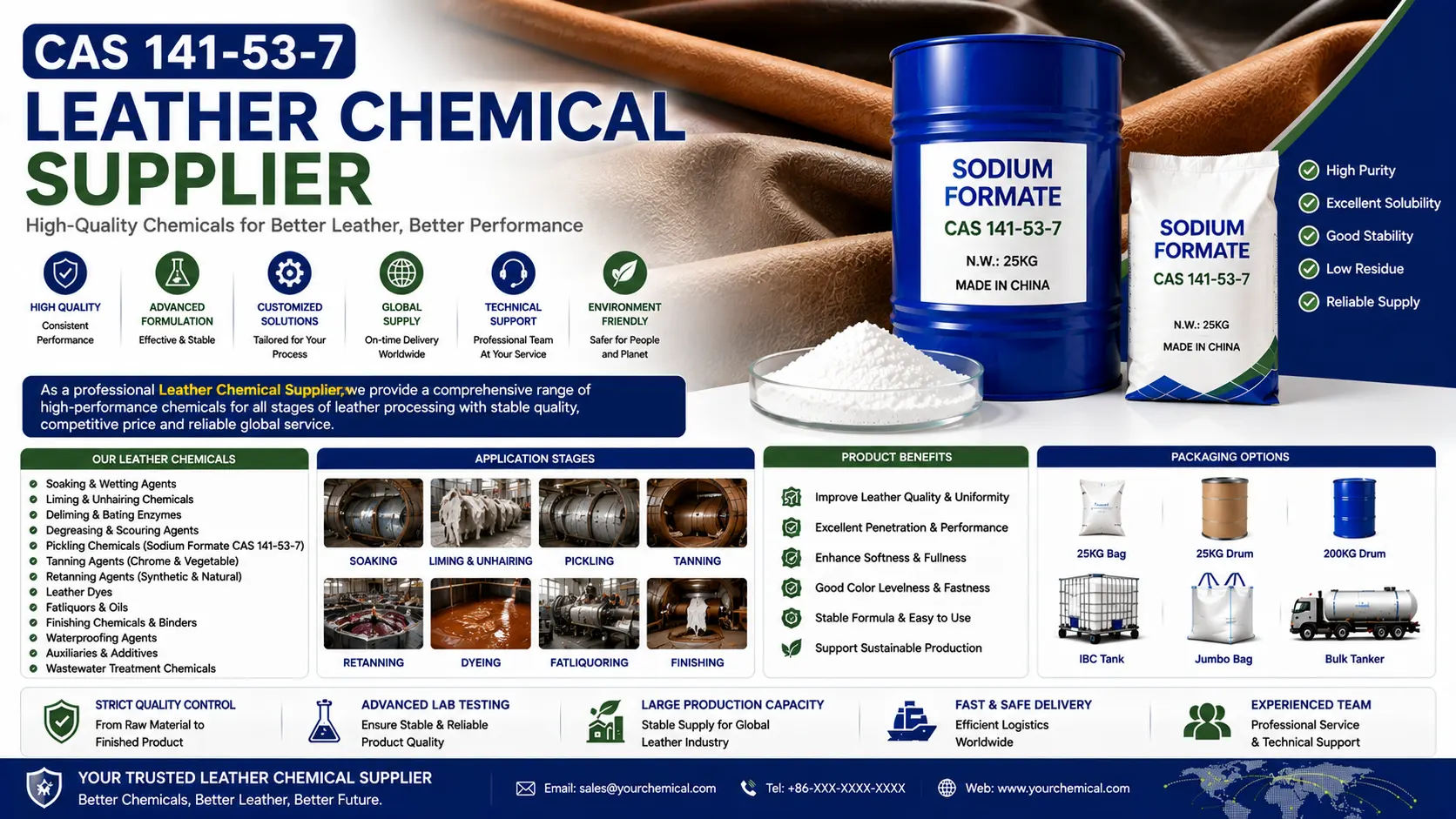
Leather production is a series of chemical and mechanical processes of animal hides that make them stable, durable, flexible and beautiful. Soaking, liming, deliming, bating, pickling, tanning, retanning, dyeing, fatliquoring, finishing, waterproofing and wastewater treatment are all areas where chemicals are used.
A reliable supplier should offer more than just a general product range or low price. The buyer also expects consistency from batch to batch, and requires the right formulations, measurable technical characteristics, instructions for use, safe packaging, comprehensive documentation, environmental support, and delivery.
The variety of raw hides, leather articles, machines, water chemistry and production goals between factories makes it necessary to determine leather chemicals by laboratory testing and controlled production trials. Not all products that are the lowest cost per kg are the most appropriate product. It is the product that provides the best leather quality at the minimum overall processing cost.
What Does a Leather Chemical Supplier Provide?
A leather chemical supplier provides products used throughout beamhouse, tanning, post-tanning, finishing, and wastewater-treatment operations.
These chemicals may help control:
- Hide cleaning
- Hair removal
- Swelling
- Fiber opening
- pH
- Enzymatic action
- Tanning stability
- Leather fullness
- Softness
- Color
- Dye penetration
- Lubrication
- Water resistance
- Surface appearance
- Adhesion
- Abrasion resistance
- Odor
- Microbial growth
- Wastewater quality
A professional supplier may provide standard products, customized formulations, trial samples, technical data sheets, safety documents, application recipes, private-label packaging, and on-site technical support.
Main Stages of Leather Processing
Leather manufacturing generally includes the following stages:
- Soaking
- Liming and unhairing
- Fleshing
- Deliming
- Bating
- Degreasing
- Pickling
- Tanning
- Neutralization
- Retanning
- Dyeing
- Fatliquoring
- Drying
- Finishing
- Final inspection
Each stage has a direct influence on leather quality.
Poor chemical selection or process control may cause:
- Uneven color
- Loose grain
- Surface damage
- Low tear strength
- Poor softness
- Excessive grease
- Weak finish adhesion
- Cracking
- Unpleasant odor
- High wastewater load
- Batch inconsistency
Beamhouse Chemicals
Beamhouse processing removes dirt, blood, salt, hair, fat, and unwanted proteins while preparing the collagen structure for tanning.
Soaking Agents
Soaking restores moisture to salted or dried hides and removes dirt, blood, salt, and soluble proteins.
Common soaking chemicals include:
- Wetting agents
- Surfactants
- Degreasers
- Enzymes
- Biocides
- Alkaline assistants
- Sequestering agents
Potential benefits include:
- Faster water penetration
- More uniform rehydration
- Improved dirt removal
- Reduced processing time
- Better hide cleanliness
- Lower risk of bacterial damage
A suitable soaking agent should clean effectively without damaging the grain or causing excessive swelling.
Wetting Agents
Wetting agents reduce surface tension and help water penetrate hides more quickly.
Important characteristics may include:
- Fast wetting
- Low foam
- Salt tolerance
- Alkaline stability
- Biodegradability
- Compatibility with enzymes
- Low odor
Excessive foam can reduce processing efficiency and interfere with drums, paddles, and wastewater treatment.
Biocides and Preservatives
Raw hides are vulnerable to bacterial degradation.
Biocides may be used during:
- Hide preservation
- Soaking
- Storage
- Wet-blue processing
- Wet-white processing
- Finished-leather storage
Potential benefits include:
- Reduced bacterial growth
- Lower risk of grain damage
- Reduced odor
- Improved storage stability
- More consistent hide quality
The selected biocide should be effective at the actual pH, temperature, salinity, and contact time.
Liming Chemicals
Liming removes hair and epidermal material while opening the fiber structure.
Common chemicals include:
- Calcium hydroxide
- Sodium sulfide
- Sodium hydrosulfide
- Sulfide-reducing auxiliaries
- Enzymatic unhairing agents
- Wetting agents
- Dispersing agents
The liming process affects:
- Hair removal
- Hide swelling
- Fiber opening
- Grain cleanliness
- Final leather fullness
- Chemical consumption
Over-liming may weaken the grain and reduce yield, while insufficient liming may produce poor hair removal and uneven processing.
Enzymatic Unhairing Agents
Enzymatic unhairing systems can reduce sulfide use and improve hair recovery.
Potential benefits include:
- Lower sulfide load
- Reduced wastewater pollution
- Improved hair recovery
- Cleaner grain
- Reduced odor
- Safer working conditions
Process control is essential because excessive enzymatic action may damage the grain or weaken leather structure.
Deliming Agents
Deliming removes lime and gradually lowers the pH after liming.
Common deliming chemicals include:
- Ammonium sulfate
- Ammonium chloride
- Organic acids
- Buffered organic salts
- Carbon-dioxide systems
- Low-ammonia deliming agents
Potential benefits include:
- Controlled pH reduction
- Uniform deliming
- Reduced lime stains
- Improved bating performance
- Better grain quality
- Lower ammonia emissions with selected systems
The deliming rate should be controlled to prevent acid swelling.
Bating Enzymes
Bating enzymes remove unwanted proteins and improve softness, flexibility, grain cleanliness, and leather handle.
Common enzymes include:
- Proteases
- Pancreatic enzymes
- Bacterial enzymes
- Fungal enzymes
- Specialty enzyme blends
Potential benefits include:
- Softer leather
- Cleaner grain
- Improved elasticity
- Better dye penetration
- More uniform fiber structure
- Reduced mechanical processing
Bating intensity should be adjusted according to hide type and final leather article.
Degreasing Agents
Natural fats can interfere with tanning, dyeing, fatliquoring, and finishing.
Degreasing chemicals may include:
- Nonionic surfactants
- Anionic surfactants
- Solvent-free degreasers
- Enzymatic degreasers
- Emulsifying agents
Applications include:
- Sheepskin
- Pigskin
- Goatskin
- Cattle hides
- Oily splits
A suitable degreaser should remove unwanted fat without extracting too much natural lubricant or damaging the grain.
Pickling Chemicals
Pickling lowers the pH before chrome tanning and controls swelling.
Typical chemicals include:
- Sulfuric acid
- Formic acid
- Sodium chloride
- Sodium formate
- Buffering salts
- Acid penetrants
- Pickle auxiliaries
Sodium formate, CAS 141-53-7, may be used in selected leather-processing formulations as a buffering or pH-control component.
Potential benefits include:
- More controlled acidification
- Improved pH distribution
- Reduced acid shock
- Better tanning uniformity
- Support for chrome penetration
The complete pickling recipe should be optimized according to hide thickness, salt level, temperature, and tanning system.
Tanning Chemicals
Tanning stabilizes collagen and converts raw hides into leather.
Chrome Tanning Agents
Basic chromium sulfate is widely used because it provides:
- High hydrothermal stability
- Good softness
- Strong physical properties
- Good dyeability
- Reliable processing
- Broad product versatility
Chrome tanning requires careful control of:
- Basicity
- Chromium concentration
- pH
- Temperature
- Penetration
- Basification
- Float length
Poor control may cause uneven tanning, surface fixation, low chromium exhaustion, and wastewater problems.
Chrome Basifying Agents
Basifying agents gradually raise the pH and support chromium fixation.
Common products include:
- Sodium bicarbonate
- Magnesium oxide
- Sodium formate
- Self-basifying chrome agents
- Controlled-release alkalies
A slow, uniform pH increase helps prevent surface precipitation and supports even chrome distribution.
Vegetable Tanning Agents
Vegetable tanning uses tannins derived from plant materials.
Common sources include:
- Mimosa
- Quebracho
- Chestnut
- Tara
- Valonia
- Myrobalan
Vegetable tanning is commonly used for:
- Sole leather
- Belting leather
- Saddlery
- Bags
- Cases
- Traditional leather goods
Vegetable tannins can provide fullness, firmness, burnishability, and a distinctive natural appearance.
Synthetic Tanning Agents
Synthetic tanning agents, also known as syntans, are used alone or with chrome and vegetable tannins.
Potential functions include:
- Improving penetration
- Lightening color
- Increasing fullness
- Improving softness
- Supporting dyeing
- Reducing loose grain
- Improving heat resistance
- Adjusting handle
Common categories include:
- Replacement syntans
- Auxiliary syntans
- Phenolic syntans
- Acrylic syntans
- Amphoteric syntans
- Resin tanning agents
Aldehyde Tanning Agents
Aldehyde tanning agents are used in chrome-free and wet-white systems.
Potential products include:
- Glutaraldehyde
- Modified aldehydes
- Oxazolidine compounds
- Polymerized aldehyde systems
Potential applications include:
- Automotive leather
- Baby-shoe leather
- Garment leather
- White leather
- Chrome-free articles
Important considerations include shrinkage temperature, color, odor, formaldehyde content, softness, and retanning compatibility.
Zirconium and Aluminum Tanning Agents
Mineral tanning agents based on zirconium or aluminum may be used in chrome-free, white, or specialty leather.
Potential benefits include:
- Light color
- High dye brilliance
- Firm grain
- Specialty performance
- Chrome-free positioning
Their processing windows may be narrower than conventional chrome tanning, so pH and penetration require careful control.
Neutralization Chemicals
Neutralization adjusts leather acidity after tanning and prepares it for retanning, dyeing, and fatliquoring.
Common neutralizing agents include:
- Sodium bicarbonate
- Sodium formate
- Sodium acetate
- Sodium citrate
- Ammonium bicarbonate
- Neutralizing syntans
- Buffered neutralizers
A suitable neutralization process should achieve the required pH without causing:
- Loose grain
- Excessive surface neutralization
- Poor dye penetration
- Weak color levelness
- Reduced leather strength
The target pH depends on leather type, tanning system, dye class, and finishing requirements.
Retanning Agents
Retanning modifies the body, fullness, grain, softness, dyeing behavior, and performance of leather.
Acrylic Retanning Agents
Acrylic polymers may provide:
- Fullness
- Grain tightness
- Improved dye levelness
- Better softness
- Reduced loose grain
- Improved area yield
- Controlled handle
Different molecular weights and functional groups create different effects.
Resin Retanning Agents
Resin tanning agents may improve:
- Filling
- Fullness
- Grain firmness
- Buffing properties
- Shape retention
- Physical strength
Common products include:
- Melamine resins
- Dicyandiamide resins
- Urea-based resins
- Modified amino resins
Low-formaldehyde or formaldehyde-free alternatives may be preferred for certain markets.
Protein Fillers
Protein-based retanning materials may be used to improve:
- Fullness
- Handle
- Grain feel
- Dyeing behavior
- Natural character
Products may be derived from collagen, casein, or other protein sources.
Polymer Fillers
Polymer fillers are used to selectively fill loose or empty leather areas.
They may improve:
- Uniformity
- Cutting yield
- Grain tightness
- Surface smoothness
- Finished appearance
The product should not cause excessive stiffness or poor dye penetration.
Leather Dyes
Leather dyes provide color during drum dyeing or surface finishing.
Common categories include:
- Acid dyes
- Direct dyes
- Metal-complex dyes
- Reactive dyes
- Basic dyes
- Pigment dispersions
Important dye properties include:
- Color strength
- Penetration
- Levelness
- Light fastness
- Migration resistance
- Heat resistance
- Rub fastness
- Compatibility with retanning agents
Dye selection depends on leather type, tanning system, desired shade, and end-use requirements.
Dyeing Auxiliaries
Dyeing auxiliaries may help improve:
- Dye penetration
- Color levelness
- Exhaustion
- Shade consistency
- Surface cleanliness
- Fixation
- Reproducibility
Common products include:
- Leveling agents
- Penetrating agents
- Dispersing agents
- Fixing agents
- pH buffers
- Sequestering agents
Production trials should confirm that auxiliaries do not reduce brightness or create color migration.
Fatliquoring Agents
Fatliquors lubricate leather fibers and influence softness, flexibility, strength, water resistance, and handle.
Common fatliquor types include:
- Sulfated oils
- Sulfited oils
- Sulfonated oils
- Phosphated oils
- Synthetic fatliquors
- Polymer fatliquors
- Lecithin-based products
- Silicone-modified products
Potential raw materials include:
- Fish oil
- Vegetable oils
- Synthetic esters
- Mineral-oil derivatives
- Natural phospholipids
A suitable fatliquor should provide the required softness without causing:
- Greasy surface
- Poor finish adhesion
- Fogging
- Odor
- Color change
- Migration
- Poor light fastness
Waterproof Fatliquors
Waterproof fatliquors provide lubrication and water resistance.
Applications include:
- Outdoor footwear
- Military boots
- Safety shoes
- Upholstery leather
- Automotive leather
- Protective gloves
Waterproofing performance should be tested after flexing, aging, and repeated exposure.
Finishing Chemicals
Leather finishing creates the final surface appearance and protects the leather.
A typical finishing system may include:
- Pigments
- Dyes
- Binders
- Waxes
- Fillers
- Penetrators
- Adhesion promoters
- Crosslinkers
- Matting agents
- Feel modifiers
- Lacquers
- Topcoats
Pigment Dispersions
Pigments provide opacity, color consistency, and surface coverage.
Important properties include:
- Color strength
- Dispersion stability
- Particle size
- Light fastness
- Heat resistance
- Rub fastness
- Compatibility with binders
- Low settling
Acrylic Binders
Acrylic binders are widely used in basecoats and intermediate coats.
They may provide:
- Flexibility
- Adhesion
- Coverage
- Film strength
- Color retention
- Weather resistance
Soft and hard acrylic binders may be blended to achieve the desired balance.
Polyurethane Binders
Polyurethane binders provide:
- High abrasion resistance
- Excellent flexibility
- Strong adhesion
- Good chemical resistance
- Improved cold-crack resistance
- Premium surface feel
They are widely used in automotive, footwear, furniture, and garment leather.
Protein Binders
Protein binders may provide:
- Natural feel
- Fine break
- Good polishing
- Clear appearance
- Traditional finishing effects
Casein-based products are commonly used in selected leather finishes.
Waxes
Leather waxes modify:
- Touch
- Polishability
- Pull-up effect
- Burnishability
- Surface smoothness
- Water resistance
- Appearance
Common waxes include:
- Carnauba wax
- Beeswax
- Paraffin wax
- Microcrystalline wax
- Synthetic wax
- Montan wax
Lacquers and Topcoats
Topcoats provide the final protective layer.
Potential properties include:
- Gloss control
- Rub resistance
- Scratch resistance
- Water resistance
- Chemical resistance
- Heat resistance
- Flexibility
- Surface feel
Common systems include:
- Nitrocellulose lacquer
- Polyurethane topcoat
- Acrylic topcoat
- Water-based topcoat
- Solvent-based topcoat
Water-based systems are increasingly used to reduce solvent emissions.
Crosslinkers
Crosslinkers improve film strength, adhesion, water resistance, solvent resistance, and durability.
Common types include:
- Polyisocyanates
- Carbodiimides
- Aziridines
- Epoxy crosslinkers
- Melamine resins
Crosslinkers require careful handling and dosage control.
Specialty Leather Chemicals
Waterproofing Agents
Waterproofing agents reduce water penetration and improve resistance to wet conditions.
Products may include:
- Silicone emulsions
- Fluorine-free water repellents
- Fluorochemical products
- Polymer dispersions
- Wax emulsions
- Reactive hydrophobic agents
Performance should be tested through dynamic waterproofing, water absorption, flexing, and aging.
Flame-Retardant Chemicals
Flame-retardant leather may be required for:
- Aircraft interiors
- Public transportation
- Automotive applications
- Protective products
- Contract furniture
Flame-retardant chemicals should be compatible with dyeing, finishing, softness, smoke requirements, and restricted-substance rules.
Anti-Mildew Agents
Anti-mildew products protect leather during storage and transport.
They are particularly important in warm and humid conditions.
Effective control also requires:
- Proper drying
- Low storage humidity
- Clean packaging
- Suitable ventilation
- Dry containers
- Moisture-resistant cartons
Odor-Control Chemicals
Odor-control products may help reduce:
- Raw-hide odor
- Fat odor
- Solvent odor
- Microbial odor
- Chemical residues
Odor problems should be addressed at the source rather than only masked with fragrance.
Anti-Squeak and Feel Modifiers
Surface modifiers may provide:
- Silky feel
- Waxy feel
- Dry touch
- Soft touch
- Anti-squeak performance
- Reduced tack
- Improved stack handling
These products are commonly used in automotive and upholstery leather.
Leather Chemicals by End-Use Application
Footwear Leather
Footwear leather may require:
- Strong flex resistance
- Good tear strength
- Water resistance
- Abrasion resistance
- Color consistency
- Finish adhesion
- Comfortable softness
Chemical systems may include retanning agents, waterproof fatliquors, dyes, binders, waxes, and durable topcoats.
Automotive Leather
Automotive leather requires demanding performance, including:
- Low fogging
- Low odor
- Heat resistance
- Light fastness
- Flex resistance
- Abrasion resistance
- Color consistency
- Low emissions
- Anti-squeak performance
Chemical selection should consider strict automotive testing requirements.
Furniture and Upholstery Leather
Furniture leather may require:
- Softness
- Fullness
- Comfortable touch
- Scratch resistance
- Light fastness
- Rub resistance
- Easy cleaning
- Consistent grain
Garment Leather
Garment leather generally requires:
- Very soft handle
- Low weight
- Good drape
- Fine grain
- High color levelness
- Dry-cleaning compatibility
- Low odor
Glove Leather
Glove leather may require:
- Softness
- High tear strength
- Good flexing
- Comfortable touch
- Low thickness
- Sweat resistance
- Low chemical residue
Bag and Leather-Goods Materials
Leather for bags and accessories may require:
- Shape retention
- Surface durability
- Scratch resistance
- Burnishability
- Color consistency
- Edge-finishing compatibility
- Attractive touch
Important Product Specifications
A professional Leather Chemical Supplier should provide measurable technical data.
Depending on the product, important specifications may include:
- Active content
- Solid content
- Density
- pH
- Viscosity
- Ionic character
- Charge
- Solubility
- Emulsion stability
- Particle size
- Color strength
- Ash content
- Moisture
- Chromium content
- Basicity
- Formaldehyde content
- VOC content
- Shelf life
General descriptions such as “leather grade” or “premium quality” are not sufficient for technical purchasing.
Laboratory Testing
Leather chemicals should be evaluated in representative leather-processing trials.
Tests may include:
- Penetration
- Exhaustion
- pH profile
- Shrinkage temperature
- Leather thickness
- Area yield
- Tear strength
- Tensile strength
- Elongation
- Flex resistance
- Rub fastness
- Light fastness
- Heat resistance
- Water absorption
- Dynamic waterproofing
- Finish adhesion
- Abrasion resistance
- Color difference
- Fogging
- Odor
- Chemical emissions
Testing should use the actual hide type, machinery, water, and processing recipe whenever possible.
Trial Production
After laboratory screening, a controlled production trial should evaluate:
- Chemical dosage
- Drum behavior
- Penetration
- Color
- Softness
- Fullness
- Grain
- Yield
- Drying behavior
- Finishing compatibility
- Physical properties
- Wastewater impact
- Total processing cost
Commercial adoption should not rely only on a small laboratory sample.
Chemical Compatibility
Leather chemicals interact throughout the process.
Important combinations include:
- Retanning agents and dyes
- Fatliquors and waterproofing chemicals
- Binders and crosslinkers
- Pigments and topcoats
- Surfactants and biocides
- Neutralizers and retanning agents
Incompatible products may cause:
- Precipitation
- Poor penetration
- Uneven color
- Surface deposits
- Weak finish adhesion
- Excessive foam
- Reduced waterproofing
- Poor physical properties
The complete recipe should be tested as a system.
Restricted Substances and Compliance
Leather manufacturers may need to control restricted substances such as:
- Chromium VI
- Formaldehyde
- Azo dyes
- Alkylphenol ethoxylates
- Certain phthalates
- Heavy metals
- Organotin compounds
- Chlorophenols
- Perfluorinated substances
- Volatile organic compounds
- Dimethyl fumarate
Requirements differ by destination market, brand, and product category.
Suppliers should provide relevant declarations and testing support where required.
Wastewater Treatment
Leather production wastewater may contain:
- Sulfide
- Chromium
- Organic matter
- Suspended solids
- Fat
- Salt
- Dyes
- Surfactants
- Nitrogen
- High chemical oxygen demand
Treatment may involve:
- Screening
- Equalization
- Sulfide oxidation
- Chromium recovery
- pH adjustment
- Coagulation
- Flocculation
- Biological treatment
- Sedimentation
- Sludge dewatering
Treatment chemicals may include:
- Coagulants
- Polyacrylamide flocculants
- Defoamers
- pH adjusters
- Oxidizing agents
- Heavy-metal precipitants
- Odor-control agents
- Sludge conditioners
A supplier serving tanneries should understand both production chemistry and wastewater impact.
Quality Control
A dependable supplier should maintain quality control throughout manufacturing and blending.
Typical procedures may include:
- Raw-material qualification
- Incoming-material inspection
- Formula verification
- Reaction monitoring
- Active-content testing
- Solid-content testing
- Density testing
- pH testing
- Viscosity testing
- Emulsion-stability testing
- Color inspection
- Finished-product evaluation
- Packaging inspection
- Batch release
- Retained samples
Stable batch quality helps tanneries maintain consistent leather performance.
Batch Traceability
Each shipment should be traceable through:
- Raw-material lots
- Production date
- Finished-product batch number
- Laboratory results
- Packaging records
- Retained samples
- Warehouse records
- Loading information
- Shipping documents
Traceability supports faster investigation if color, softness, penetration, or finish performance changes.
Packaging Options
Leather chemicals may be supplied in:
- 20 kg bags
- 25 kg bags
- 20 kg pails
- 25 kg pails
- 120 kg drums
- 200 kg drums
- 250 kg drums
- IBC tanks
- Jumbo bags
- ISO tanks
- Customized export packaging
Packaging selection depends on product form, sensitivity, monthly consumption, storage space, and handling equipment.
Powders should be protected from moisture.
Liquid products should use chemically compatible containers.
Storage and Handling
General precautions include:
- Store products in a cool and ventilated area.
- Protect powders from moisture.
- Protect emulsions from freezing.
- Avoid excessive heat and direct sunlight.
- Keep containers tightly closed.
- Separate incompatible products.
- Use clean transfer and dosing equipment.
- Follow the current safety data sheet.
- Wear suitable personal protective equipment.
- Use first-in, first-out inventory control.
Improper storage may cause separation, settling, caking, viscosity changes, microbial growth, or reduced performance.
Required Documents
A professional supplier should provide:
- Technical data sheet
- Safety data sheet
- Batch-specific certificate of analysis
- Product specification
- Application recommendation
- Restricted-substance declaration where relevant
- Commercial invoice
- Packing list
- Certificate of origin
- Bill of lading
- Transport documents
- Inspection reports when required
All documents should show consistent product names, grades, batch numbers, quantities, and packaging details.
How to Evaluate a Leather Chemical Supplier
Buyers should assess:
- Product range
- Leather-processing experience
- Laboratory capability
- Formulation knowledge
- Customized-product capability
- Quality-control procedures
- Batch consistency
- Production capacity
- Restricted-substance support
- Packaging flexibility
- Technical service
- Export experience
- Delivery reliability
- Complaint handling
A qualified supplier should request detailed information about hide type, process stage, leather article, equipment, and target performance before recommending a product.
How to Request an Accurate Quotation
A complete inquiry should include:
- Product category
- Processing stage
- Hide or skin type
- Tanning system
- Finished leather article
- Required performance
- Current recipe
- Target dosage
- Order quantity
- Packaging
- Destination
- Incoterm
- Required documents
- Delivery schedule
For example:
“Please recommend and quote retanning agents, leather dyes, fatliquors, polyurethane binders, waterproofing chemicals, and finishing auxiliaries for footwear leather, including samples, TDS, SDS, COA, recommended dosage, packaging, and delivery terms.”
Detailed information helps the supplier recommend a more suitable product and provide an accurate quotation.
Comparing Supplier Quotations
Buyers should compare more than the unit price.
Important factors include:
- Product chemistry
- Active content
- Effective dosage
- Leather performance
- Color strength
- Penetration
- Exhaustion
- Batch consistency
- Environmental profile
- Packaging
- Freight
- Lead time
- Documentation
- Technical support
A lower-priced chemical may create higher total costs if it requires more dosage, lowers leather yield, causes reprocessing, or produces inconsistent quality.
Total Processing Cost
The total cost includes more than chemical price.
Buyers should consider:
- Effective dosage
- Processing time
- Water consumption
- Energy consumption
- Leather area yield
- Reprocessing
- Color correction
- Wastewater treatment
- Rejected leather
- Customer complaints
- Technical service
- Delivery reliability
A higher-performing chemical may reduce production variation and deliver a lower total cost per square meter of finished leather.
Common Purchasing Risks
Potential risks include:
- Choosing products only by price
- Ordering without leather trials
- Unclear specifications
- Inconsistent active content
- Poor penetration
- Weak batch consistency
- Chemical incompatibility
- Restricted-substance risk
- Damaged packaging
- Incomplete documentation
- Delayed shipment
- Limited technical support
- Poor traceability
These risks can be reduced through detailed specifications, sample testing, production trials, supplier audits, batch-specific documentation, and clear purchasing agreements.
Questions to Ask Before Ordering
Buyers should confirm:
- Is the supplier a manufacturer or distributor?
- Which leather applications does the product support?
- What active content can be guaranteed?
- What dosage is recommended?
- Can representative samples be supplied?
- Can leather trials be supported?
- Can recent batch COAs be provided?
- Are restricted-substance declarations available?
- Can customized formulations be developed?
- What is the normal lead time?
- What is the monthly production capacity?
- What packaging options are available?
- Can third-party testing be arranged?
- Which export documents are included?
- How are quality complaints handled?
Conclusion
When it comes to selecting a reputable Leather Chemical Supplier, it is essential to thoroughly review their product line, leather processing expertise, formulation capabilities, technical information, limited substance lists, laboratory testing, quality management, batch consistency, packaging, documentation, technical support, and delivery schedule.
Leather chemical suppliers can offer soaking agents, enzymes, liming auxiliaries, deliming agents, tanning chemicals, retanning chemicals, dyes, fatliquors, waterproofing products, pigments, binders and waxes, topcoats, crosslinkers, preservatives and wastewater-treatment chemicals.
Buyers should ensure that they have all of the process and leather-article information before they buy, get representative samples, read technical documents, do lab and production trials, check compliance requirements, and compare total processing costs.
A reliable supplier should offer appropriate leather chemical products, consistent batches, measurable performance data, properly packaged, technical advice readily available, full export documentation and reliable global delivery.


Contact Us
In This Article
Related Posts
How to Choose a Reliable 2-Ethylhexanol (2-EH) Supplier in China: Quality, Packaging and Shipping
2026-10-22
Natural vs Synthetic Sodium Sulfate Anhydrous: Which Is Better for Industrial Applications?
2026-10-22
Isobutanol 99.3% Price and Supply in 2026: A Guide for Chemical Importers
2026-10-22
Sodium Sulfate Anhydrous 99% for Detergent Manufacturing: Benefits, Specifications and Bulk Supply
2026-10-22


