



Textile Chemical Supplier China: Products, Applications, Quality Control, and Sourcing Guide
By vanchor
2026-07-20Related Posts
How to Choose a Reliable 2-Ethylhexanol (2-EH) Supplier in China: Quality, Packaging and Shipping
2026-10-22
Natural vs Synthetic Sodium Sulfate Anhydrous: Which Is Better for Industrial Applications?
2026-10-22
Isobutanol 99.3% Price and Supply in 2026: A Guide for Chemical Importers
2026-10-22
Sodium Sulfate Anhydrous 99% for Detergent Manufacturing: Benefits, Specifications and Bulk Supply
2026-10-22
Making a choice of a Textile Chemical Supplier China is crucial for textile mill, dyeing factory, printing plant, garment factory, nonwoven factory, finishing factory, home textile company and international chemical supplier.
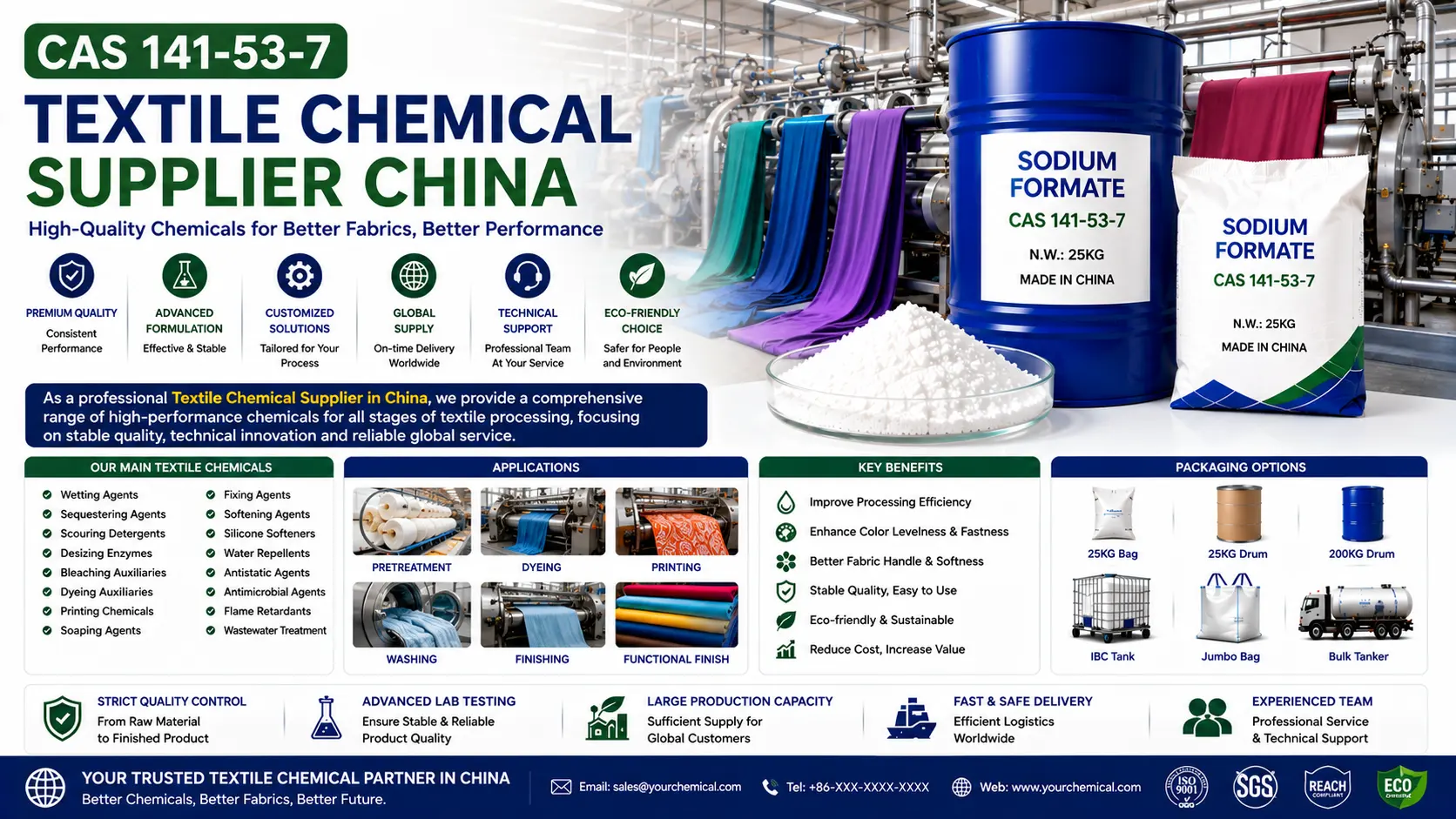
The use of textile chemicals all through fiber preparation, pretreatment, dyeing, printing, washing, finishing, coating and waterproofing, softening, antistatic treatment, flame retarding and wastewater management. Their performance directly impacts the consistency of colour, handle of the fabric, processing efficiency, durability, water usage, energy usage and environmental compliance.
Purchasers are not satisfied with just a competitive quotation. They also demand batch stability, appropriate formulation, measurable technical attributes, application assistance, secure packaging, full documentation, production capability, and reliable worldwide delivery.
China has established a wide manufacturing capability for textile auxiliaries, surfactants, dyeing chemicals, printing additives, softeners, silicone emulsions, fixing agents, water repellents, enzymes, pretreatment agents, finishing resins, defoamers, sequestering agents and chemicals for wastewater treatment.
Note, however, that choice of textile chemicals should not be made solely on the basis of the product name or price/kilogram. They are influenced by the type of fibres, fabric construction, the type of dyes, water hardness, pH, temperature, machine, process sequence, drying process, curing temperature and the customer's requirements.
This guide provides details on the primary categories of textile chemicals offered by Chinese suppliers, applications, technical specifications, quality-control specifications, packaging options, supplier-evaluation options, sourcing risks and purchasing considerations.
What Does a Textile Chemical Supplier Provide?
A textile chemical supplier provides functional products used during the wet processing, coloration, finishing, coating, and treatment of textile materials.
These chemicals may be used with:
- Cotton
- Polyester
- Nylon
- Wool
- Silk
- Acrylic
- Viscose
- Linen
- Spandex
- Blended fabrics
- Nonwoven materials
- Technical textiles
A professional supplier may provide:
- Pretreatment chemicals
- Dyeing auxiliaries
- Printing chemicals
- Finishing agents
- Coating additives
- Enzymes
- Textile softeners
- Water repellents
- Flame retardants
- Antistatic agents
- Optical brighteners
- Wastewater-treatment chemicals
- Customized formulations
- Private-label packaging
- Export documentation
The supplier should understand how chemical products interact with fibers, dyes, machinery, water, and finishing conditions.
Why Source Textile Chemicals from China?
China has one of the world’s largest textile manufacturing and chemical-processing industries.
Potential sourcing advantages include:
- Broad product availability
- Competitive manufacturing costs
- Large production capacity
- Flexible minimum order quantities
- Customized formulations
- OEM and private-label services
- Multiple packaging options
- Established export logistics
- Access to upstream surfactants, polymers, silicones, and organic chemicals
- Technical support for different textile processes
Chinese suppliers may serve textile customers in:
- Southeast Asia
- South Asia
- Europe
- The Middle East
- Africa
- South America
- Central Asia
- North America
- Australia
The value of a supplier depends on technical performance, batch consistency, compliance, and service rather than location alone.
Main Textile Chemical Categories
Wetting Agents
Wetting agents reduce surface tension and help processing liquor penetrate fibers and fabrics more rapidly.
They are used in:
- Desizing
- Scouring
- Bleaching
- Dyeing
- Printing
- Washing
- Finishing
Potential benefits include:
- Faster fabric wetting
- Improved chemical penetration
- More uniform treatment
- Reduced processing time
- Better washing efficiency
- Improved dye levelness
Important properties may include:
- Wetting speed
- Low foam
- Alkali resistance
- Acid resistance
- Electrolyte tolerance
- Temperature stability
- Biodegradability
- Compatibility with enzymes
Low-foam wetting agents are often preferred for jet-dyeing and high-speed equipment.
Detergents and Scouring Agents
Scouring agents remove oils, waxes, pectin, dirt, spinning lubricants, and processing residues.
They may be used for:
- Cotton scouring
- Synthetic-fiber washing
- Wool cleaning
- Fabric preparation
- Garment washing
- Printing-machine cleaning
Potential benefits include:
- Improved absorbency
- Cleaner fabric
- More even dyeing
- Reduced stains
- Better finishing
- Lower reprocessing rates
A suitable scouring product should provide good detergency without excessive foam or fiber damage.
Sequestering Agents
Sequestering agents bind calcium, magnesium, iron, copper, and other metal ions.
Hardness ions and metals can cause:
- Dye precipitation
- Uneven bleaching
- Catalytic fabric damage
- Scale formation
- Reduced peroxide stability
- Poor color reproducibility
- Equipment deposits
Common chemistries may include:
- EDTA derivatives
- DTPA derivatives
- Phosphonates
- Polycarboxylates
- Phosphorus-free chelating agents
- Biodegradable sequestrants
The selected product should remain effective under the required pH and temperature conditions.
Peroxide Stabilizers
Hydrogen peroxide is widely used for bleaching cotton and blended fabrics.
Peroxide stabilizers control peroxide decomposition and help prevent fiber damage.
Potential benefits include:
- More uniform bleaching
- Improved whiteness
- Reduced pinholes
- Lower fiber damage
- Better peroxide utilization
- Reduced catalytic decomposition
Stabilizers may be silicate-based, non-silicate, organic, or polymeric.
Non-silicate stabilizers may reduce scale and equipment deposits.
Defoamers
Foam can interfere with textile processing by reducing tank capacity, causing overflow, affecting circulation, and creating uneven treatment.
Textile defoamers may be based on:
- Silicone
- Polyether
- Mineral oil
- Fatty alcohol
- Hydrophobic particles
- Silicone-free blends
Applications include:
- Pretreatment
- Dyeing
- Printing
- Finishing
- Coating
- Wastewater treatment
The selected defoamer should provide effective foam control without causing oil spots, color problems, or finish defects.
Desizing Chemicals
Desizing removes sizing materials applied to warp yarns before weaving.
Common sizing materials include:
- Starch
- Modified starch
- Polyvinyl alcohol
- Acrylic sizing agents
- Carboxymethyl cellulose
- Mixed sizing formulations
Desizing chemicals may include:
- Amylase enzymes
- Oxidizing agents
- Alkali
- Surfactants
- Wetting agents
- Dispersing agents
Enzymatic desizing is widely used for starch because it can provide selective removal under relatively mild conditions.
Important process factors include:
- Enzyme activity
- Temperature
- pH
- Contact time
- Fabric absorbency
- Washing efficiency
Bleaching Chemicals
Bleaching removes natural color and prepares fabric for dyeing, printing, or white finishing.
Common bleaching systems include:
- Hydrogen peroxide
- Sodium hypochlorite
- Sodium chlorite
- Reductive bleaching agents
- Optical brightening systems
Supporting chemicals may include:
- Peroxide stabilizers
- Sequestering agents
- Wetting agents
- Alkali
- Defoamers
- Catalase enzymes
Hydrogen peroxide is widely used for cotton because it can provide high whiteness with suitable process control.
Poor bleaching control may cause:
- Fiber damage
- Uneven whiteness
- Pinholes
- Reduced strength
- Yellowing
- Residual peroxide problems
Textile Enzymes
Enzymes are used to improve processing efficiency and reduce harsh chemical treatment.
Common textile enzymes include:
- Amylase
- Cellulase
- Catalase
- Pectinase
- Lipase
- Protease
- Laccase
Amylase
Amylase removes starch-based sizing materials.
Potential benefits include:
- Selective starch removal
- Lower fiber damage
- Reduced chemical consumption
- Improved fabric absorbency
- Better dyeing performance
Cellulase
Cellulase is used for:
- Biopolishing
- Denim washing
- Surface-fiber removal
- Softening
- Pilling reduction
Potential benefits include:
- Smoother fabric surface
- Reduced fuzz
- Improved drape
- Vintage denim effects
- Better color contrast
- Reduced pilling
Excessive cellulase treatment may reduce fabric strength.
Catalase
Catalase removes residual hydrogen peroxide before dyeing.
Potential benefits include:
- Shorter washing cycles
- Reduced water consumption
- Lower energy use
- Better dye reproducibility
- Reduced chemical neutralization
Pectinase
Pectinase may be used in bioscouring to remove pectins from cotton.
Potential benefits include:
- Milder processing
- Lower alkali use
- Reduced fiber damage
- Lower water consumption
- Improved environmental performance
Dyeing Auxiliaries
Dyeing auxiliaries help achieve uniform color, improved dye uptake, better penetration, stable pH, and consistent fastness.
Common products include:
- Leveling agents
- Dispersing agents
- Retarding agents
- Penetrating agents
- Migration agents
- pH buffers
- Dye-fixing agents
- Soaping agents
- Reduction-clearing agents
- Anti-creasing agents
- Oligomer-control agents
The correct auxiliary depends on fiber type, dye class, equipment, liquor ratio, temperature, and target shade.
Leveling Agents
Leveling agents help dyes distribute evenly across the fabric.
They may work by:
- Slowing dye uptake
- Improving dye migration
- Increasing dye solubility
- Reducing local concentration differences
- Controlling fiber affinity
Applications include:
- Reactive dyeing
- Disperse dyeing
- Acid dyeing
- Metal-complex dyeing
- Cationic dyeing
An unsuitable leveling agent may reduce color yield or create poor fastness.
Dispersing Agents
Dispersing agents keep insoluble dye particles and impurities uniformly suspended.
They are especially important for disperse dyes used on polyester.
Potential benefits include:
- Improved dye dispersion
- Reduced specks
- Better color levelness
- Lower equipment deposits
- Improved high-temperature stability
- Better reproducibility
Dispersants should remain stable under heat, pressure, and electrolyte conditions.
Reactive Dyeing Chemicals
Reactive dyes are widely used for cotton, viscose, and other cellulosic fibers.
A reactive dyeing process may use:
- Salt
- Alkali
- Wetting agents
- Sequestering agents
- Leveling agents
- Anti-creasing agents
- Soaping agents
- Fixing agents
Important process factors include:
- Dye substantivity
- Salt concentration
- Alkali addition
- Temperature
- pH
- Liquor ratio
- Washing efficiency
Unfixed hydrolyzed dye must be removed effectively to improve wash fastness.
Soaping Agents
Soaping agents remove hydrolyzed and unfixed reactive dye after dyeing or printing.
Potential benefits include:
- Better wash fastness
- Reduced staining
- Cleaner white backgrounds
- Improved shade clarity
- Lower water consumption
- Reduced repeated washing
High-performance soaping agents should remove unfixed dye without stripping fixed color.
Dye-Fixing Agents
Fixing agents improve wet fastness by reducing dye migration or solubility.
Common types include:
- Cationic fixing agents
- Polyamine-based products
- Polyquaternary compounds
- Formaldehyde-free fixing agents
- Specialty polymer fixatives
Potential benefits include:
- Improved wash fastness
- Better perspiration fastness
- Reduced bleeding
- Reduced staining
- Improved color durability
Fixing agents may influence shade, light fastness, handle, and fabric yellowing.
Formaldehyde-free grades are often preferred for apparel and home textiles.
Disperse Dyeing Chemicals
Disperse dyes are mainly used for polyester and selected synthetic fibers.
Common auxiliaries include:
- Dispersing agents
- Leveling agents
- Migration agents
- Oligomer-control agents
- Acid buffers
- Anti-creasing agents
- Reduction-clearing agents
High-temperature polyester dyeing may produce oligomer deposits on fabrics and machinery.
Suitable auxiliaries can reduce:
- White powder
- Streaks
- Equipment deposits
- Poor shade reproducibility
- Surface contamination
Reduction-Clearing Agents
Reduction clearing removes unfixed disperse dye from polyester surfaces.
Traditional systems may use:
- Sodium hydrosulfite
- Caustic soda
Alternative products may include:
- Low-odor reducing agents
- Stable reduction-clearing powders
- Thiourea-dioxide-based products
- Environmentally adapted formulations
Effective reduction clearing improves:
- Wash fastness
- Rub fastness
- Shade brightness
- Fabric cleanliness
Acid Dyeing Auxiliaries
Acid dyes are used for wool, nylon, silk, and protein fibers.
Supporting chemicals may include:
- Acid donors
- Leveling agents
- Retarders
- Sequestering agents
- Lubricants
- Anti-creasing agents
- Fixing agents
The process should control dye uptake carefully to avoid barre, streaks, and uneven shades.
Textile Printing Chemicals
Textile printing requires chemicals that control paste viscosity, dye fixation, outline sharpness, color yield, and fabric handle.
Common printing chemicals include:
- Synthetic thickeners
- Natural thickeners
- Binders
- Crosslinkers
- Fixers
- Dispersants
- Defoamers
- Emulsifiers
- Penetrants
- Humectants
- Pigment dispersions
- Washing-off agents
Printing Thickeners
Printing thickeners control the rheology of printing paste.
Common types include:
- Sodium alginate
- Modified guar
- Starch derivatives
- Acrylic synthetic thickeners
- Emulsion thickeners
- Polyurethane thickeners
Important properties include:
- Viscosity
- Rheology
- Shear recovery
- Color yield
- Screen release
- Outline sharpness
- Washability
- Electrolyte tolerance
Pigment Printing Binders
Pigment printing binders attach pigment particles to the fabric surface.
Common binder chemistries include:
- Acrylic copolymers
- Styrene-acrylic polymers
- Polyurethane dispersions
- Hybrid binders
Potential benefits include:
- Good adhesion
- Soft handle
- Wash durability
- Rub resistance
- Color brightness
- Low curing temperature
The binder should balance softness and fastness.
Printing Crosslinkers
Crosslinkers improve film durability, wash resistance, and adhesion.
Common types may include:
- Melamine-based crosslinkers
- Blocked isocyanates
- Carbodiimides
- Epoxy-functional products
- Formaldehyde-free systems
The curing temperature and catalyst must be controlled carefully.
Textile Softeners
Softeners improve fabric handle, smoothness, flexibility, sewing performance, and comfort.
Common softener categories include:
- Cationic softeners
- Nonionic softeners
- Anionic softeners
- Amphoteric softeners
- Silicone softeners
- Fatty-acid condensates
- Polyethylene emulsions
Cationic Softeners
Cationic softeners provide a soft, full handle and are widely used on cotton and blended fabrics.
Potential benefits include:
- Softness
- Reduced static
- Improved sewing
- Better fabric feel
- Reduced friction
They may have compatibility limitations with anionic products.
Silicone Softeners
Silicone softeners are widely used for premium textile finishing.
Common types include:
- Amino silicone
- Hydrophilic silicone
- Block silicone
- Macro silicone emulsions
- Micro silicone emulsions
- Reactive silicone
- Silicone elastomers
Potential benefits include:
- Smoothness
- Softness
- Elasticity
- Drapability
- Reduced friction
- Improved wrinkle recovery
- Premium hand feel
Amino silicone may cause yellowing on white or light-colored fabrics if poorly selected or over-cured.
Hydrophilic Silicone Softeners
Hydrophilic silicone provides softness while maintaining or improving moisture absorbency.
Applications include:
- Towels
- Sportswear
- Underwear
- Cotton knits
- Home textiles
- Moisture-management fabrics
Important factors include hydrophilicity, yellowing, wash durability, and compatibility.
Antistatic Agents
Antistatic agents reduce static-electricity buildup in synthetic fibers and fabrics.
They may be used for:
- Polyester
- Nylon
- Acrylic
- Spandex blends
- Nonwoven fabrics
- Industrial textiles
Potential benefits include:
- Reduced static
- Improved processing
- Reduced dust attraction
- Better fabric comfort
- Improved safety in selected applications
Durable antistatic finishes may require polymeric or crosslinkable products.
Water-Repellent Chemicals
Water repellents reduce liquid-water penetration while maintaining fabric flexibility.
Common product types include:
- Fluorocarbon water repellents
- Fluorine-free water repellents
- Silicone repellents
- Paraffin emulsions
- Wax-based products
- Dendrimer formulations
- Polyurethane dispersions
Applications include:
- Outdoor clothing
- Tents
- Umbrellas
- Workwear
- Home textiles
- Technical fabrics
- Footwear materials
Fluorine-free water repellents are increasingly selected where environmental or brand restrictions apply.
Important performance tests may include:
- Spray rating
- Hydrostatic pressure
- Wash durability
- Oil repellency
- Fabric handle
- Breathability
Oil-Repellent Finishes
Oil repellency is important for:
- Workwear
- Protective clothing
- Automotive textiles
- Industrial fabrics
- Upholstery
Traditional oil-repellent products often use fluorinated chemistry.
Buyers should review applicable restrictions and market requirements carefully.
Flame-Retardant Chemicals
Flame-retardant finishes reduce ignition, flame spread, or afterglow.
Applications include:
- Curtains
- Upholstery
- Protective clothing
- Transportation textiles
- Public-building fabrics
- Industrial materials
- Children’s products where permitted
Flame-retardant chemicals may be:
- Durable
- Semi-durable
- Non-durable
- Phosphorus-based
- Nitrogen-based
- Halogen-free
- Mineral-based
- Polymer-bound
Performance should be evaluated after washing, aging, and actual finishing.
The selected product should also be checked for:
- Fabric strength
- Handle
- Shade change
- Formaldehyde
- Smoke
- Restricted substances
Wrinkle-Resistant Finishing Agents
Wrinkle-resistant finishes improve shape retention and reduce creasing.
Common chemistries may include:
- DMDHEU resins
- Low-formaldehyde resins
- Formaldehyde-free resins
- Polycarboxylic-acid systems
- Polyurethane finishes
Applications include:
- Shirts
- Bedding
- Workwear
- Home textiles
- Cotton garments
Crosslinking can improve crease recovery but may reduce fabric strength.
Catalyst, curing temperature, and resin dosage should be optimized.
Textile Binders and Coating Chemicals
Textile coatings provide functional surfaces and may improve:
- Waterproofing
- Abrasion resistance
- Air permeability control
- Adhesion
- Flame resistance
- Chemical resistance
- Mechanical strength
- Surface appearance
Common coating chemistries include:
- Acrylic polymers
- Polyurethane dispersions
- PVC plastisols
- Silicone coatings
- Styrene-butadiene latex
- Hybrid polymers
Applications include:
- Tarpaulins
- Artificial leather
- Outdoor fabrics
- Conveyor materials
- Protective textiles
- Automotive fabrics
- Medical textiles
Optical Brightening Agents
Optical brighteners absorb ultraviolet light and emit blue light, making fabrics appear whiter and brighter.
They may be used on:
- Cotton
- Polyester
- Nylon
- Acrylic
- Paper
- Detergent-treated textiles
Important properties include:
- Shade
- Affinity
- Light fastness
- Heat stability
- Chlorine resistance
- Acid or alkali stability
- Compatibility with finishing agents
Anti-Pilling Agents
Anti-pilling products help reduce fiber entanglement and surface-ball formation.
Potential chemistries include:
- Polyurethane dispersions
- Acrylic polymers
- Silicone-modified resins
- Crosslinkable polymers
Applications include:
- Knitted fabrics
- Sweaters
- Polyester blends
- Fleece
- Wool blends
The finish should improve pilling resistance without making the fabric excessively stiff.
Moisture-Management Chemicals
Moisture-management finishes help transport perspiration away from the skin and improve drying.
Applications include:
- Sportswear
- Activewear
- Underwear
- Socks
- Outdoor clothing
- Polyester fabrics
Potential benefits include:
- Improved wicking
- Faster drying
- Better comfort
- Reduced static
- Improved soil release
Antimicrobial Textile Chemicals
Antimicrobial finishes control or reduce microbial growth on textiles.
Common chemistries may include:
- Quaternary ammonium compounds
- Silver-based products
- Zinc-based products
- Chitosan
- Organic antimicrobial agents
- Polymer-bound systems
Applications include:
- Medical textiles
- Socks
- Sportswear
- Bedding
- Workwear
- Home textiles
Important considerations include:
- Wash durability
- Skin contact
- Odor control
- Regulatory claims
- Resistance development
- Environmental impact
Textile Chemicals by Fiber Type
Cotton Chemicals
Cotton processing commonly uses:
- Desizing enzymes
- Scouring agents
- Peroxide stabilizers
- Sequestering agents
- Reactive dye auxiliaries
- Soaping agents
- Fixing agents
- Softening agents
- Wrinkle-resistant resins
Polyester Chemicals
Polyester processing may use:
- Dispersing agents
- Leveling agents
- Oligomer-control agents
- Reduction-clearing agents
- Antistatic agents
- Hydrophilic finishes
- Silicone softeners
Nylon Chemicals
Nylon dyeing may require:
- Acid-dye leveling agents
- Retarders
- pH buffers
- Fixing agents
- Lubricants
- Softening agents
Wool Chemicals
Wool processing may use:
- Detergents
- Degreasers
- Enzymes
- Acid-dye auxiliaries
- Anti-felting agents
- Softening agents
- Moth-resistant chemicals
Blended Fabrics
Blended fabrics may require multi-stage or one-bath systems designed for more than one fiber.
Important blends include:
- Polyester-cotton
- Nylon-spandex
- Cotton-spandex
- Polyester-viscose
- Wool-polyester
Chemical compatibility becomes especially important in blended-fiber processing.
Important Product Specifications
A professional Textile Chemical Supplier China should provide measurable technical data.
Depending on the product, important parameters may include:
- Active content
- Solid content
- Ionic character
- Appearance
- Density
- pH
- Viscosity
- Solubility
- Emulsion stability
- Foam level
- Cloud point
- Particle size
- Charge
- Thermal stability
- Electrolyte tolerance
- Acid resistance
- Alkali resistance
- Shelf life
General descriptions such as “textile grade” or “high performance” are not enough for technical purchasing.
Laboratory Testing
Textile chemicals should be evaluated in representative laboratory dyeing, printing, washing, or finishing trials.
Common tests may include:
- Wetting time
- Absorbency
- Whiteness
- Fabric strength
- Dye uptake
- Levelness
- Color yield
- Color difference
- Wash fastness
- Rub fastness
- Perspiration fastness
- Light fastness
- Handle evaluation
- Hydrophilicity
- Spray rating
- Hydrostatic pressure
- Flame resistance
- Wrinkle recovery
- Pilling resistance
- Yellowing
- Foam control
Actual fabric, water, dyes, equipment, and processing conditions should be used whenever possible.
Production Trials
After laboratory screening, a controlled production trial should evaluate:
- Dosage
- Mixing behavior
- Foam
- Fabric penetration
- Color consistency
- Machine compatibility
- Washing efficiency
- Drying behavior
- Curing performance
- Handle
- Fastness
- Wastewater impact
- Total processing cost
A laboratory result should be confirmed under production conditions before full commercial use.
Chemical Compatibility
Textile chemicals often interact during multi-stage processing.
Important combinations include:
- Wetting agents and enzymes
- Leveling agents and dyes
- Softeners and fixing agents
- Water repellents and crosslinkers
- Pigment binders and thickeners
- Defoamers and printing pastes
- Sequestering agents and bleaching systems
Incompatible products may cause:
- Precipitation
- Foam
- Oil spots
- Uneven color
- Poor fastness
- Finish instability
- Fabric yellowing
- Equipment deposits
The complete process should be evaluated as a system.
Restricted Substances and Compliance
Textile buyers may need to control substances such as:
- Formaldehyde
- Alkylphenol ethoxylates
- Azo amines
- Heavy metals
- Phthalates
- Organotin compounds
- Chlorophenols
- Perfluorinated substances
- Volatile organic compounds
- Certain flame retardants
- Biocidal substances
Requirements differ by country, product category, brand, and end use.
Suppliers should provide relevant declarations, testing reports, and compliance support where required.
Textile Wastewater Treatment
Textile wastewater may contain:
- Dyes
- Surfactants
- Salts
- Alkali
- Acids
- Suspended solids
- Organic matter
- Oils
- Polymers
- High chemical oxygen demand
- High color
Treatment may include:
- Equalization
- pH adjustment
- Coagulation
- Flocculation
- Sedimentation
- Biological treatment
- Oxidation
- Filtration
- Sludge dewatering
- Water reuse
Treatment chemicals may include:
- Polyaluminum chloride
- Ferric salts
- Polyacrylamide
- Decolorizing agents
- Defoamers
- pH adjusters
- Oxidants
- Reducing agents
- Sludge conditioners
A textile chemical supplier may provide both production auxiliaries and wastewater-treatment chemicals.
Quality Control in Chinese Manufacturing
A dependable supplier or manufacturer should maintain quality control throughout production.
Typical procedures include:
- Raw-material qualification
- Incoming-material inspection
- Formula verification
- Controlled dosing
- Reaction monitoring
- In-process sampling
- Active-content testing
- Solid-content testing
- Density and pH testing
- Viscosity testing
- Emulsion-stability testing
- Application-performance testing
- Packaging inspection
- Batch release
- Retained-sample storage
Stable batch quality helps textile mills maintain consistent production.
Batch Traceability
Each shipment should be traceable through:
- Raw-material batch numbers
- Production date
- Finished-product batch number
- Laboratory results
- Packaging records
- Retained samples
- Warehouse records
- Loading information
- Shipping documents
Traceability supports faster investigation if color, handle, foam, or finishing performance changes.
Sample Evaluation
Before placing a large order, buyers should request representative samples.
Sample evaluation may include:
- Appearance
- Odor
- pH
- Density
- Solid content
- Solubility
- Emulsion stability
- Foam
- Fabric testing
- Dyeing trials
- Printing trials
- Finishing trials
- Fastness evaluation
- Benchmark comparison
The sample should represent the intended commercial grade.
Customized Formulations
A capable Textile Chemical Supplier China may offer customized products based on:
- Fiber type
- Fabric construction
- Dye class
- Water hardness
- Equipment
- Liquor ratio
- Temperature
- pH
- Finishing target
- Customer standards
- Environmental requirements
- Packaging preferences
Customization may include:
- Ionic-character adjustment
- Solid-content modification
- Foam-control adjustment
- Hydrophilicity improvement
- Yellowing reduction
- Softness modification
- Water-repellency optimization
- Wash-durability improvement
- Private-label packaging
Customized products should be validated through laboratory and production trials.
Packaging Options
Textile chemicals may be supplied in:
- 20 kg bags
- 25 kg bags
- 20 kg pails
- 25 kg pails
- 120 kg drums
- 200 kg drums
- 250 kg drums
- IBC tanks
- ISO tanks
- Bulk tankers
- Customized export packaging
Packaging selection depends on product form, monthly consumption, storage space, hazard classification, unloading equipment, and transport requirements.
Powder products should be protected from moisture.
Liquid emulsions should be protected from freezing and contamination.
Storage and Handling
General storage precautions include:
- Store products in a cool and ventilated area.
- Protect powders from moisture.
- Protect emulsions from freezing.
- Avoid excessive heat and direct sunlight.
- Keep containers tightly closed.
- Separate incompatible chemicals.
- Use clean transfer and dosing equipment.
- Follow the current safety data sheet.
- Wear suitable personal protective equipment.
- Use first-in, first-out inventory control.
Improper storage may cause separation, settling, caking, viscosity changes, or reduced performance.
Required Documents
A professional supplier should provide:
- Technical data sheet
- Safety data sheet
- Batch-specific certificate of analysis
- Product specification
- Application guidance
- Restricted-substance declaration where relevant
- Commercial invoice
- Packing list
- Certificate of origin
- Bill of lading
- Transport documents
- Inspection reports when required
All documents should show consistent product names, grades, batch numbers, quantities, and packaging details.
How to Evaluate a Textile Chemical Supplier in China
Buyers should assess:
- Product range
- Textile-processing experience
- Manufacturing capability
- Laboratory equipment
- Formulation knowledge
- Quality-control procedures
- Batch consistency
- Production capacity
- Customized-product capability
- Compliance support
- Packaging flexibility
- Export experience
- Technical service
- Delivery reliability
- Complaint handling
A qualified supplier should request detailed information about fiber type, process, machinery, water, dyes, and target performance before recommending a product.
Factory Audit Checklist
A factory audit may review:
- Business and manufacturing licenses
- Raw-material storage
- Production workshops
- Reaction equipment
- Blending systems
- Filling lines
- Laboratory capability
- Quality-control records
- Batch traceability
- Retained samples
- Finished-product warehouse
- Packaging process
- Safety management
- Environmental controls
- Wastewater treatment
- Export records
The buyer should also clarify whether the supplier is the actual manufacturer, a distributor, or a trading company.
How to Request an Accurate Quotation
A complete inquiry should include:
- Product category
- Fiber type
- Fabric type
- Process stage
- Dye class
- Machine type
- Required performance
- Current formulation
- Target dosage
- Order quantity
- Packaging
- Destination
- Incoterm
- Required documents
- Delivery schedule
For example:
“Please recommend and quote wetting agents, peroxide stabilizers, reactive-dye soaping agents, silicone softeners, fixing agents, and fluorine-free water repellents for cotton and polyester fabrics, including samples, TDS, SDS, COA, recommended dosage, packaging, and delivery terms.”
Detailed information helps the supplier recommend a more suitable product and provide an accurate quotation.
Comparing Supplier Quotations
Buyers should compare more than unit price.
Important factors include:
- Product chemistry
- Active content
- Effective dosage
- Textile performance
- Batch consistency
- Compliance
- Packaging
- Freight
- Lead time
- Documentation
- Technical support
- Complaint handling
A lower-priced chemical may create higher processing costs if it requires more dosage, causes reprocessing, reduces fastness, or produces inconsistent fabric quality.
Total Processing Cost
The total cost includes more than chemical price.
Buyers should consider:
- Effective dosage
- Water consumption
- Energy use
- Processing time
- First-pass quality
- Shade correction
- Re-dyeing
- Wastewater treatment
- Machine cleaning
- Fabric rejection
- Customer complaints
- Technical support
- Delivery reliability
A higher-performing chemical may reduce production variation and deliver a lower total cost per kilogram or meter of finished fabric.
Private Label and OEM Supply
Some Chinese textile chemical suppliers provide private-label and OEM services.
Potential services include:
- Customized product names
- Buyer-designed labels
- Multilingual packaging
- Formula adjustment
- Customized solid content
- Customized ionic character
- Private technical documents
- Pallet configuration
- Shipping marks
Private-label projects should clearly define responsibilities for technical claims, compliance, labeling, formulation ownership, and product registration.
Common Sourcing Risks
Potential risks include:
- Choosing suppliers only by price
- Ordering without fabric trials
- Unclear technical specifications
- Inconsistent active content
- Poor emulsion stability
- Excessive foam
- Chemical incompatibility
- Restricted-substance risk
- Damaged packaging
- Incomplete documentation
- Delayed shipment
- Limited technical support
- Poor batch traceability
These risks can be reduced through detailed specifications, representative sample testing, factory audits, production trials, batch-specific documentation, and clear purchase contracts.
Questions to Ask Before Ordering
Buyers should confirm:
- Is the supplier the manufacturer or a distributor?
- Which textile processes does the product support?
- What active content can be guaranteed?
- What ionic character does the product have?
- Can representative samples be supplied?
- Can fabric trials be supported?
- Can recent batch COAs be provided?
- Are restricted-substance declarations available?
- Can customized formulations be developed?
- What is the normal production lead time?
- What is the monthly supply capacity?
- What packaging options are available?
- Can third-party inspection be arranged?
- Which export documents are included?
- How are quality complaints handled?
Conclusion
When selecting a Textile Chemical Supplier China, it's crucial to consider several key factors, such as the business's product portfolio, their expertise in textile processing, formulation skills, technical specifications, compliance support, laboratory testing, quality management, batch consistency, packaging, documentation, technical service, and international delivery.
Wetting agents, scouring agents, peroxide stabilizers, enzymes, dyeing auxiliary agents, dispersing agents, leveling agents, soaping agents, fixing agents, printing thickeners, binders, silicone softeners, water repellents, flame retardants, antistatic agents and products for treating wastewater can be supplied by Chinese suppliers.
Buyers are advised to supply the entire process and fabric information, ask for some representative samples, read the technical documents, do laboratory trials and production trials, check compliance specifications, and compare total costs of processing.
A reliable supplier should offer appropriate textile chemical formulations, batch consistency, measurable performance data, safe packaging, technical expertise to guide, a complete export package, and reliable delivery throughout the world.


Contact Us
In This Article
Related Posts
How to Choose a Reliable 2-Ethylhexanol (2-EH) Supplier in China: Quality, Packaging and Shipping
2026-10-22
Natural vs Synthetic Sodium Sulfate Anhydrous: Which Is Better for Industrial Applications?
2026-10-22
Isobutanol 99.3% Price and Supply in 2026: A Guide for Chemical Importers
2026-10-22
Sodium Sulfate Anhydrous 99% for Detergent Manufacturing: Benefits, Specifications and Bulk Supply
2026-10-22


