



Sodium Acetate for Textile Dyeing: pH Control and Process Selection
By vanchor
2026-07-02Related Posts
Custom Packaging Solutions from an Anhydrous Sodium Acetate Supplier in China
2026-09-23

Application Trends in Anhydrous Sodium Acetate for Special Chemical Manufacturing
2026-09-23
Anhydrous Sodium Acetate for Leather Tanning: Improve Dyeing Uniformity
2026-09-22

Formic Acid 85% for Textile Dyeing: Industrial Applications, Technical Benefits and Future Trends
2026-09-22
Sodium acetate is used in selected textile dyeing processes mainly to support pH control. It is often combined with acetic acid to form an acetate buffer, which helps the dye bath resist sudden pH changes. This can support more controlled dye uptake, shade repeatability, and levelness when the dye–fiber system requires stable mildly acidic conditions.
It is not a universal dye fixative, mordant, or requirement for every textile process. Its suitability depends on the fiber, dye class, required pH profile, water chemistry, process temperature, and other chemicals in the bath.
For broader information about sodium acetate trihydrate quality, applications, manufacturing, documentation, and bulk sourcing, see Sodium Acetate Trihydrate Manufacturer: Quality, Applications, and Bulk Supply (inferred). This guide focuses specifically on textile dye-bath control and process selection.

What Sodium Acetate Actually Does in a Dye Bath
When sodium acetate dissolves in water, it provides sodium ions and acetate ions. In textile dyeing, the acetate ion is the more relevant part because it can participate in a buffer system with acetic acid.
Its direct role is therefore usually related to controlling the chemical environment of the dye bath. Depending on the process, this may help maintain a suitable pH for the dye, fiber, or auxiliary chemicals.
| Description | How accurately it describes sodium acetate |
|---|---|
| pH-control chemical | Accurate in selected textile processes |
| Buffer component | Accurate when used with acetic acid or another suitable acid source |
| Leveling aid | May be accurate indirectly when controlled pH reduces rapid or uneven dye uptake |
| Fixative | Too broad unless supported by a specific dye system |
| Mordant | Process-dependent and often used inconsistently in supplier descriptions |
| Neutralizing chemical | Relevant in some aftertreatment or finishing processes, but different from dye-bath buffering |
Sodium acetate does not directly guarantee better fixation, color fastness, brightness, softness, or dye yield. Those outcomes depend on the complete system, including the dye chemistry, fiber preparation, temperature profile, liquor movement, auxiliaries, washing, and finishing.
A more accurate statement is that sodium acetate may help create conditions under which a correctly designed dyeing process operates more consistently.
How the Acetic Acid–Sodium Acetate Buffer Controls pH

Acetic acid is a weak acid. Sodium acetate supplies acetate, its conjugate base. When both are present in the correct relationship, they form an acetate buffer.
The buffer responds to small additions of acid or alkali:
- Acetate can react with added acidic species.
- Acetic acid can respond to added alkaline species.
- Together, they reduce sudden movement away from the intended pH.
The ratio between acetic acid and acetate influences the working pH. The total amount of both components influences the buffer capacity, meaning how strongly the bath resists change.
This is why adding acetic acid alone is not identical to using an acetic acid–sodium acetate buffer. Acetic acid can lower the pH, but it may provide less resistance against later disturbances from water alkalinity, residual chemicals, fiber loading, or process additions.
The acetate system is most relevant in a mildly acidic region, although the exact operating pH must come from the selected dye, fiber, and process method. Technical textile literature from the Society of Dyers and Colourists describes the importance of pH and buffer capacity in textile coloration, including selected acrylic and disperse-dye applications.
For a broader chemical comparison outside the textile process context, see sodium acetate vs acetic acid.
Starting pH and Buffer Capacity Are Not the Same
Two dye baths can both show pH 4.5 at the beginning but behave differently during heating.
One bath may contain only enough acid to reach the starting pH. The other may contain a meaningful concentration of both acetic acid and acetate. When residual alkali or another chemical enters the system, the buffered bath will usually resist the disturbance more strongly.
That resistance can be useful when the process needs a stable pH. It can also become a limitation when the dyeing method requires the pH to decrease gradually.
A pH meter therefore shows only the current condition. It does not reveal how strongly the bath will resist later change.
Which Textile Dyeing Processes Are a Good Fit?
The correct starting point is not “Does sodium acetate work in textile dyeing?” The better question is: “Does this specific dye–fiber process benefit from an acetate-containing mildly acidic bath or buffer?”
The table below shows the main application patterns supported by textile references.
| Fiber | Dye class or process | Possible sodium acetate role | Main pH objective | Main caution |
| Wool | Acid dyes | Acetate-buffer component | Control acidic conditions and dye uptake | Different acid dyes require different exhaustion and leveling profiles |
| Silk | Acid or selected specialty dyes | Buffer component in mildly acidic dyeing | Maintain a defined pH during low-temperature or specialized processing | Published research conditions must not be treated as universal recipes |
| Nylon or polyamide | Acid dyes | Support controlled acidic conditions | Manage dye uptake at available amino sites | Nylon types and dye structures behave differently |
| Acrylic | Selected basic dyes | Acetate buffering in specific formulations | Maintain dye stability and suitable acidic conditions | Not every basic-dye recipe uses the same buffer |
| Polyester | Selected disperse dyes | pH stabilization in some mildly acidic baths | Support dye stability and process consistency | Sodium acetate is not required in every disperse-dye process |
| Wool/polyester blends | Combined dyeing systems | Process-specific buffer or pH-control component | Balance requirements of two fibers and dye classes | Blend recipes require controlled trials and supplier guidance |
Acid Dyes on Wool, Silk, and Nylon
Acid dyes are anionic, water-soluble dyes commonly associated with wool, silk, and nylon. Their interaction with the fiber depends partly on acidic conditions and the availability of positively charged sites on the fiber.
In these systems, pH influences:
- the charge developed on the fiber;
- how quickly the dye leaves the bath;
- how rapidly it attaches to available dye sites;
- migration and leveling behavior;
- final exhaustion and shade repeatability.
A sudden drop in pH can produce rapid dye strike, where the dye attaches too quickly and creates uneven coloration. A suitable buffer may reduce abrupt change and give the dye more opportunity to distribute evenly.
The effect is not identical across wool, silk, and nylon. Their structures, dye sites, thermal sensitivity, and process conditions differ.
For example, published studies have used acetic acid–sodium acetate buffers in low-temperature silk dyeing and in ultrasonic silk dyeing at controlled pH. These studies support the technical relevance of acetate buffering, but their recipes should not be transferred directly to unrelated production systems.
Selected Basic- and Disperse-Dye Processes
Sodium acetate is not limited to acid dyes.
Selected basic-dye processes on acrylic fibers may use an acetic acid–acetate system to maintain an acidic environment and protect dye stability. The exact requirement depends on the acrylic modification, dye structure, retarding system, and temperature profile.
Some disperse-dye processes for polyester or nylon also operate in mildly acidic conditions. An acetate system may be used where a stable pH supports dye stability or process consistency.
These are process-specific applications. A polyester dyeing plant should not add sodium acetate simply because another polyester recipe uses it. The dye manufacturer’s technical method, machine conditions, carriers, auxiliaries, and water quality remain decisive.
Where Sodium Acetate Should Not Be Assumed
Sodium acetate should not be described as a standard fixing chemical for every reactive dye on cotton.
Reactive-dye fixation on cellulose usually involves an alkaline stage that activates the fiber or dye reaction. That chemistry differs from the mildly acidic conditions commonly associated with acetate buffering in wool, silk, nylon, or selected acrylic processes.
Specialty formulations may use sodium acetate during another stage, but that must be supported by dye-specific technical documentation.
The same caution applies to sulfur, vat, pigment, natural-dye, and specialized printing processes. Sodium acetate may appear in selected recipes, neutralization stages, or aftertreatments, but one application does not prove universal suitability.
Choose the Required pH-Control Strategy Before Choosing the Chemical Amount
A process should not begin with a sodium acetate dosage. It should begin with the required pH behavior.
| Control method | Best-fit objective | Main advantage | Main limitation |
| Acetic acid addition | Lower the bath pH | Simple direct acidification | Limited resistance to later pH disturbance |
| Acetic acid–sodium acetate buffer | Maintain a relatively stable mildly acidic pH | Resists small acid or alkali inputs | May resist a desired pH change if the buffer is too strong |
| Pre-formulated textile buffer | Improve operational consistency | Reduces separate raw-material handling | Composition must still fit the specific dyeing method |
| Programmed or automatic acid dosing | Create a controlled pH curve during dyeing | Supports gradual pH migration | Requires suitable equipment, controls, and process development |
A fixed acetate buffer is most appropriate when the process benefits from maintaining a defined pH despite minor disturbances.
Dynamic acid dosing may be more suitable where gradual acidification is used to control exhaustion. In that case, a strong fixed buffer could oppose the intended pH decrease.
This is the practical risk of over-buffering. More sodium acetate does not automatically create a better process. Excessive buffer capacity may slow the required pH movement, reduce the expected exhaustion profile, or make later correction difficult.
The dye supplier’s method and controlled laboratory data should determine the strategy.
Process Variables That Change the Final Dye-Bath pH
A calculated acid-to-acetate ratio does not operate in isolation. The complete dye bath contributes to the final pH and buffer demand.
Important variables include:
- Water alkalinity: Bicarbonates and other alkaline components in process water can consume acid and raise chemical demand.
- Residual pretreatment alkali: Inadequate washing after scouring, bleaching, mercerizing, or another alkaline stage can shift the dye bath above its target pH.
- Fiber loading: The fiber can absorb or release chemical species and alter the bath response.
- Dyes and auxiliaries: Salts, leveling agents, carriers, dispersants, acids, and proprietary auxiliaries may influence the final pH.
- Liquor ratio: A recipe expressed per litre can behave differently when the total bath volume or fiber loading changes.
- Temperature: Both chemical equilibria and pH measurement response can change as the bath heats.
- Addition sequence: Local concentrations can become temporarily high if chemicals are added too quickly or without adequate circulation.
- Dissolution: Incomplete dissolution means the intended chemical concentration has not yet entered the bath.
These factors explain why the same nominal formula may work in one plant but drift in another.
Measure pH at Defined and Repeatable Process Points
Useful pH data requires a consistent measurement method.
A practical control routine should:
- calibrate the pH meter with suitable standards;
- define whether measurements are made in the bath or from a cooled sample;
- record water pH and alkalinity before formulation;
- measure after all main chemicals are fully mixed;
- record pH at relevant heating and dyeing stages;
- use the same sampling and temperature procedure during each trial;
- compare laboratory and production readings at equivalent process points.
A single starting measurement cannot confirm that the bath will remain within the required range throughout the dyeing cycle.
Sodium Acetate Trihydrate or Anhydrous: Textile Selection Factors
Sodium acetate is commonly supplied as sodium acetate trihydrate or anhydrous sodium acetate.
The trihydrate contains three molecules of water of crystallization for each sodium acetate unit. The anhydrous form does not contain that crystal water. As a result, one kilogram of anhydrous material provides more active sodium acetate than one kilogram of the trihydrate form.
| Selection factor | Sodium acetate trihydrate | Anhydrous sodium acetate |
| Crystal water | Present | Absent |
| Active sodium acetate per kilogram | Lower | Higher |
| Direct mass substitution | Not equivalent to anhydrous | Not equivalent to trihydrate |
| Recipe compatibility | Suitable where the formula is based on trihydrate | Suitable where the formula is based on anhydrous material |
| Cost comparison | Should be calculated by active content and delivered conditions | Should be calculated by active content and delivered conditions |
| Operational choice | Depends on storage, dissolution, dosing, and existing recipe | Depends on storage, dissolution, dosing, and existing recipe |
The correct form depends on:
- how the existing recipe expresses concentration;
- the assay basis shown in the specification;
- dosing equipment;
- storage conditions;
- moisture control;
- dissolution workflow;
- transport and delivered cost;
- the consistency required by the process.
A fuller comparison is available in sodium acetate trihydrate vs anhydrous.
Never Substitute the Two Forms Kilogram-for-Kilogram
Changing from trihydrate to anhydrous sodium acetate without recalculation will change the amount of acetate entering the bath.
Before substitution:
- confirm the exact chemical form;
- review the reported assay;
- calculate on an active or molar basis;
- update the written formulation;
- run a controlled laboratory trial;
- verify the pH profile rather than checking only the starting value.
The same rule applies when changing suppliers if their assay basis, moisture content, physical form, or specification differs.
Quality Specifications That Matter in Shade-Sensitive Dyeing
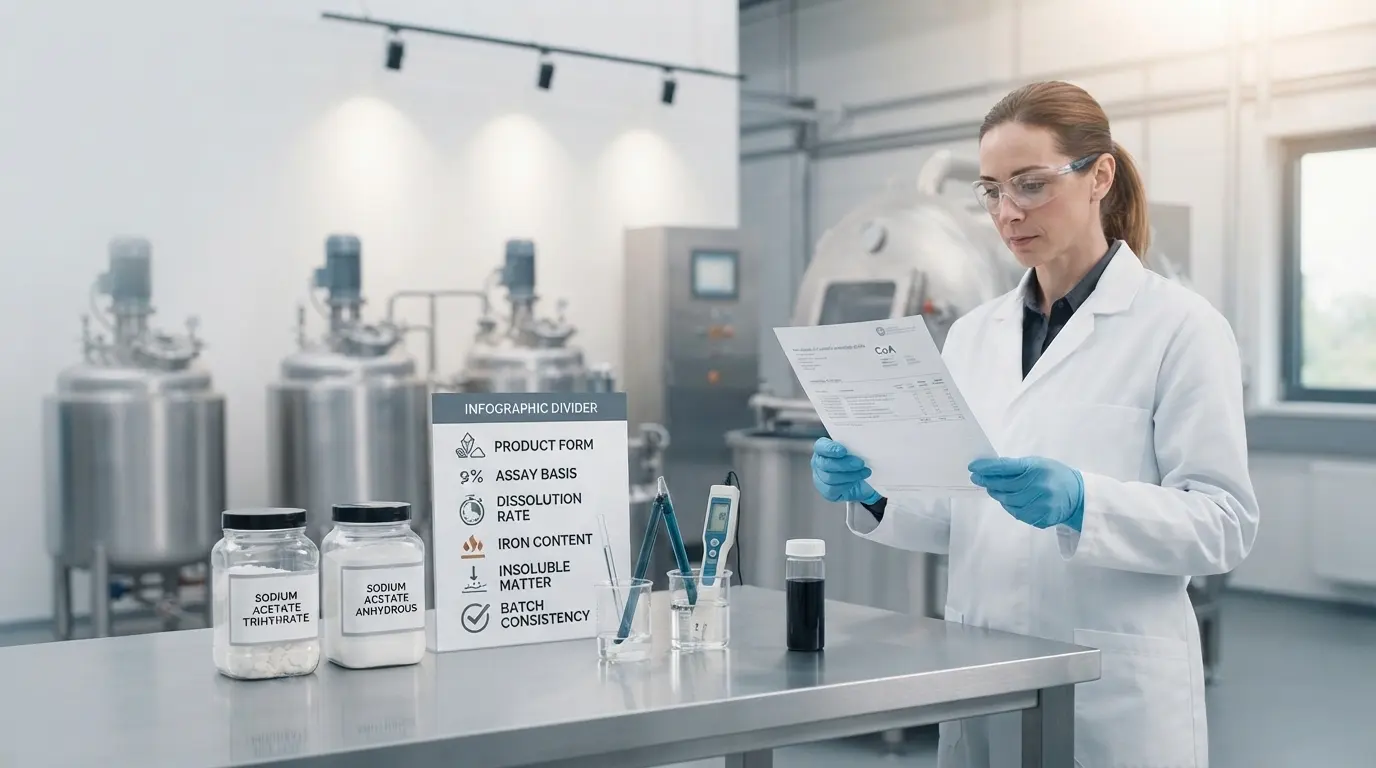
A textile buyer should not evaluate sodium acetate only by product name and price. Material consistency matters when the process is sensitive to pH, shade, deposits, or contamination.
| Specification item | Why it may matter | Where to verify it |
| Chemical form | Determines active content and recipe conversion | TDS, specification, and COA |
| Assay | Confirms the amount of stated material | Lot-specific COA |
| Assay basis | Prevents confusion between as-is and dry-basis reporting | Specification and test method |
| Iron | Trace metals may influence shade-sensitive systems | COA or agreed test report |
| Insoluble matter | May contribute to deposits, filtration issues, or visible contamination | COA and dissolution testing |
| Color and appearance | Useful for clean or visually sensitive formulations | Specification and receiving inspection |
| Chloride and sulfate | Additional ions may matter in certain formulations | COA where specified |
| Moisture | Influences active content and storage behavior | Specification and COA |
| Crystal size | Can affect handling and dissolution rate | TDS or agreed physical specification |
| Dissolution behavior | Influences solution preparation and undissolved solids | Application trial |
| Batch consistency | Supports repeatable formulation and shade control | Multiple COAs and supplier change control |
Vanchor’s parent sodium acetate trihydrate guide identifies iron, insoluble matter, color, dissolution, crystal size, and batch consistency as possible concerns for textile buyers. These are evaluation factors, not universal specification limits.
A buyer should define acceptance criteria according to the actual dyeing process. A general industrial grade may be suitable for one operation but insufficiently controlled for another shade-sensitive formulation.
Numerical limits should come from an approved purchasing specification, supported by trials and agreed test methods.
Validate the Buffer System Before Production
A laboratory trial is necessary when introducing sodium acetate, changing the buffer strategy, switching product form, or qualifying a new supplier.
A practical validation sequence is:
- Confirm the dye method. Start with the dye manufacturer’s technical recommendation, including the required pH profile and order of addition.
- Characterize the process water. Record pH, alkalinity, hardness, and any plant-specific treatment conditions relevant to the formulation.
- Check pretreatment carryover. Confirm that residual alkali is within the expected range before dyeing.
- Verify the sodium acetate. Record the form, assay basis, lot number, COA values, and preparation method.
- Prepare controlled laboratory baths. Keep liquor ratio, loading, temperature profile, mixing, and chemical sequence consistent.
- Track pH over the cycle. Measure at defined points rather than recording only the initial bath value.
- Evaluate the textile result. Review shade, levelness, exhaustion, fiber condition, wash-off behavior, and reproducibility using suitable test methods.
- Repeat critical trials. One successful sample does not establish batch repeatability.
- Scale up cautiously. Document machine circulation, addition rate, bath volume, temperature, loading, and pH response.
The goal is not merely to reach a chosen pH. The goal is to create the required pH behavior throughout the full dyeing process.
Troubleshooting Sodium Acetate in Textile Dyeing
| Symptom | Possible causes | Checks and corrective trial |
| Bath pH remains above target | High water alkalinity, residual pretreatment alkali, insufficient acid component, wrong hydrate conversion | Test water alkalinity, check rinsing, verify form and assay, repeat a controlled lab formulation |
| Bath pH falls below target | Excess acid, incorrect acid-to-acetate balance, inaccurate measurement | Recheck chemical addition records, calibrate the meter, repeat under controlled sampling conditions |
| Planned pH drop does not occur | Buffer capacity is too high or fixed buffering is unsuitable | Reduce the fixed-buffer approach in a laboratory trial or assess programmed acid dosing |
| Sodium acetate dissolves slowly | Poor mixing, low preparation temperature, large crystals, fast addition, insoluble contamination | Prepare a separate solution, improve circulation, inspect residue, compare supplier lots |
| Undissolved solids remain | Insoluble matter, contamination, incomplete solution preparation | Filter and inspect residue, review the COA, repeat a dissolution test |
| Shade changes after switching forms | Incorrect active-content conversion, changed assay basis, different impurity profile | Recalculate on an active basis, compare COAs, repeat the original and replacement products side by side |
| Shade changes after switching suppliers | Lot variation, water change, assay difference, iron or insolubles, process variation | Compare product data and plant records before assigning the cause |
| Uneven dyeing continues | Incorrect pH profile, rapid heating, inadequate circulation, poor pretreatment, unsuitable leveling system | Review the complete process rather than increasing sodium acetate automatically |
| Exhaustion is lower than expected | Excess buffering, wrong target pH, unsuitable dye method, temperature or auxiliary issue | Compare the actual pH curve with the approved method and run a controlled adjustment trial |
Sodium acetate quality is only one possible cause of a dyeing problem. Fiber preparation, dye selection, machine circulation, heating rate, water quality, and auxiliary compatibility must be investigated together.
Textile Buyer Checklist Before Selecting a Supplier
Before ordering sodium acetate for a textile process, confirm:
- the exact form: trihydrate or anhydrous;
- how assay is reported;
- the current product specification;
- a recent representative COA;
- the SDS and TDS;
- relevant impurity values, including iron and insoluble matter;
- moisture, appearance, and physical form;
- packaging and moisture protection;
- lot traceability;
- how specification or process changes are communicated;
- sample availability for application trials;
- whether the quoted cost has been compared on an active-material basis;
- whether the supplier’s claims match documented product information.
The buying specification should be written around the textile process rather than copied from a generic commodity description.
Vanchor lists sodium acetate trihydrate among its industrial chemical products. Buyers evaluating the material can review the sodium acetate trihydrate product information and request the current specification, COA, SDS, sample availability, and quotation details for their application.
Selecting Sodium Acetate for a Textile Process
A sound selection follows a clear sequence:
- Identify the fiber and dye class.
- Define the required pH profile across the full dyeing cycle.
- Decide whether the process needs fixed buffering or controlled pH movement.
- Confirm whether an acetic acid–sodium acetate system is technically appropriate.
- Select trihydrate or anhydrous material on an active-content basis.
- Establish the necessary assay, impurity, dissolution, and consistency requirements.
- Validate the complete process in laboratory trials before production approval.
Textile dye-bath use should also remain separate from the chemical’s role as a biological carbon source in sodium acetate for wastewater treatment. The same compound can serve different functions, but the process objectives and selection criteria are not interchangeable.
Once the dye–fiber system, pH strategy, chemical form, and quality requirements are defined, the supplier inquiry becomes more useful. Instead of asking only for “textile sodium acetate,” provide the intended application, required form, target specification, documentation needs, expected volume, and sample requirements.


Contact Us
In This Article
Related Posts
Custom Packaging Solutions from an Anhydrous Sodium Acetate Supplier in China
2026-09-23
Application Trends in Anhydrous Sodium Acetate for Special Chemical Manufacturing
2026-09-23
Anhydrous Sodium Acetate for Leather Tanning: Improve Dyeing Uniformity
2026-09-22
Formic Acid 85% for Textile Dyeing: Industrial Applications, Technical Benefits and Future Trends
2026-09-22


