



Sodium Hydrosulfide Supplier: Applications, Specifications, Safety, and Purchasing Guide
By vanchor
2026-07-20Related Posts

How to Choose a Reliable 2-Ethylhexanol (2-EH) Supplier in China: Quality, Packaging and Shipping
2026-10-22

Natural vs Synthetic Sodium Sulfate Anhydrous: Which Is Better for Industrial Applications?
2026-10-22

Isobutanol 99.3% Price and Supply in 2026: A Guide for Chemical Importers
2026-10-22

Sodium Sulfate Anhydrous 99% for Detergent Manufacturing: Benefits, Specifications and Bulk Supply
2026-10-22
Mining companies, various mineral-processing plants, leather manufacturers, pulp and paper mills, chemical producers, wastewater-treatment plants and international distributors are all required to choose a reliable Sodium Hydrosulfide Supplier.
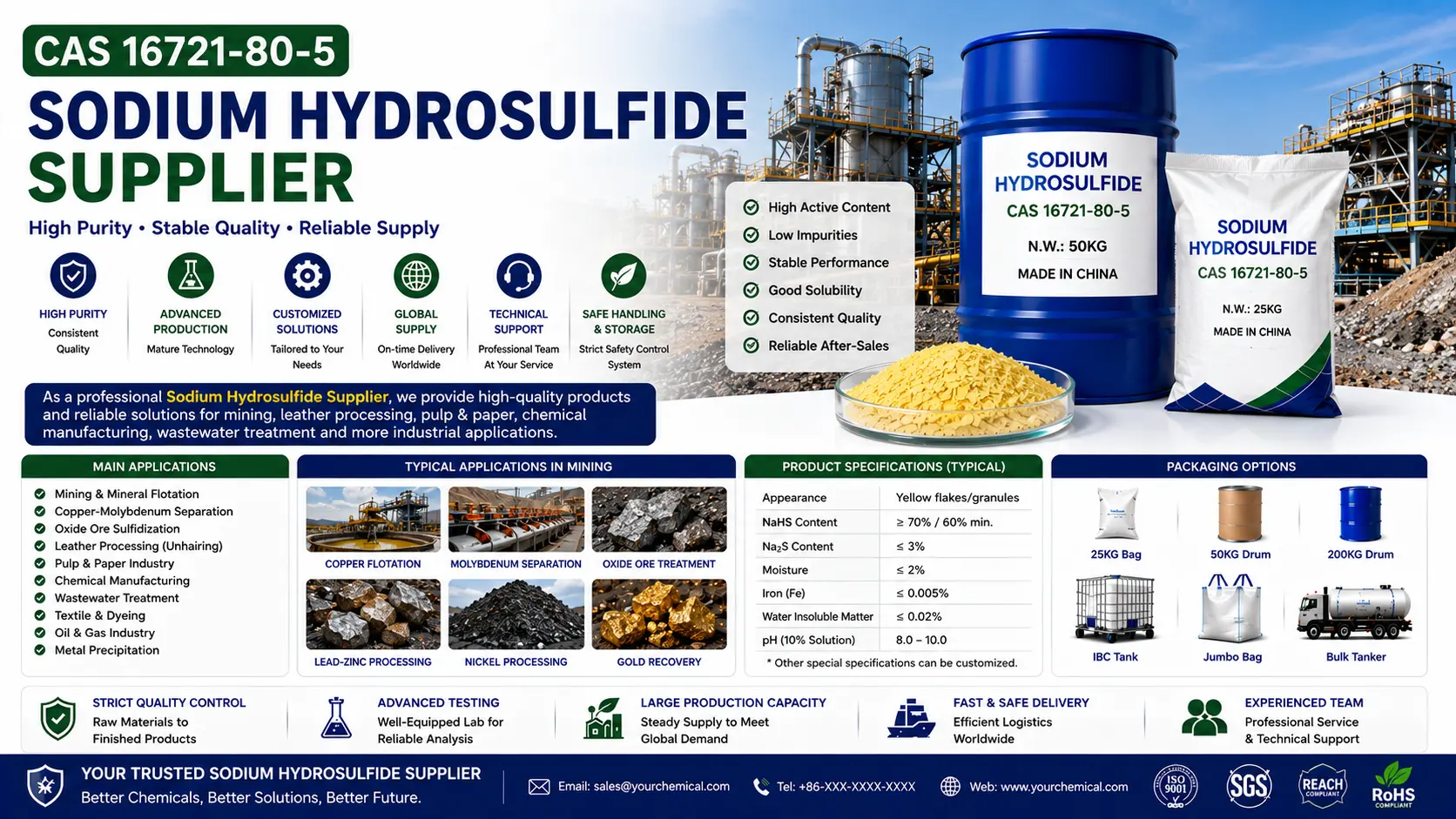
Sodium hydrosulfide (NaHS) is an inorganic sulfur compound which is used as a reducing agent, flotation reagent, dehairing chemical, sulfur source, and process additive. Its CAS number is 16721-80-5.
The product is generally available in form of yellow flakes, granules or solution in water. Buyers need to consider factors other than price because sodium hydrosulfide is corrosive and can produce toxic hydrogen sulfide gas when in contact with acids, moisture or improper storage. Key purchasing criteria include product concentration, impurity control, packaging integrity, transport compliance, technical documentation and supplier experience.
This guide details the main applications of sodium hydrosulfide, relevant specifications, options for pack, quality control requirements, safety precautions, supplier-evaluation criteria and quotation information.
What Is Sodium Hydrosulfide?
Sodium hydrosulfide is a sulfur-containing inorganic compound with the chemical formula NaHS.
Common product forms include:
- Sodium hydrosulfide flakes
- Sodium hydrosulfide granules
- Sodium hydrosulfide solid
- Sodium hydrosulfide solution
- Industrial-grade NaHS
- Mining-grade NaHS
- Leather-processing-grade NaHS
Its typical characteristics include:
- Yellow or yellow-brown appearance
- Strong alkaline behavior
- Good water solubility
- Distinct sulfur odor
- Reducing properties
- Sensitivity to air, acids, and moisture
Commercial solid sodium hydrosulfide may contain different active concentrations depending on production method, moisture content, and customer requirements.
Main Applications of Sodium Hydrosulfide
Mining and Mineral Flotation
Mining is one of the most important application areas for sodium hydrosulfide.
It may be used as:
- A sulfiding agent
- A flotation activator
- A depressant
- A reducing agent
- A mineral-surface modifier
- A reagent for copper and molybdenum separation
Sodium hydrosulfide can modify oxide-mineral surfaces by introducing sulfur-containing species. This may improve collector adsorption and support the flotation of selected minerals.
Common mining applications include:
- Copper flotation
- Molybdenum separation
- Lead-zinc processing
- Nickel processing
- Oxide-ore treatment
- Precious-metal recovery
- Sulfide precipitation
Its performance depends on:
- Ore mineralogy
- Pulp pH
- Reagent dosage
- Oxidation-reduction potential
- Water chemistry
- Collector system
- Conditioning time
- Flotation temperature
Laboratory and plant trials should be completed before establishing a commercial dosage.
Copper and Molybdenum Separation
Sodium hydrosulfide is frequently used in copper-molybdenum separation circuits.
In selected flotation systems, it can depress copper minerals while allowing molybdenite to remain floatable.
Important process variables include:
- NaHS concentration
- Addition point
- Pulp oxidation-reduction potential
- pH
- Conditioning time
- Frother dosage
- Collector chemistry
- Dissolved oxygen
Insufficient dosage may provide poor copper depression, while excessive dosage may reduce recovery or increase operating costs.
Automatic dosing and oxidation-reduction monitoring can improve process consistency.
Oxide-Ore Sulfidization
Oxide minerals may not respond effectively to conventional sulfide collectors.
Sodium hydrosulfide can be used to sulfide mineral surfaces before collector addition.
Potential applications include:
- Copper oxide ores
- Lead oxide minerals
- Zinc oxide minerals
- Mixed oxide-sulfide ores
A controlled sulfidization process may improve flotation response, but overdosing can create unstable surface conditions or poor selectivity.
Leather Processing
Sodium hydrosulfide is widely used in beamhouse operations during leather production.
Potential functions include:
- Hair removal
- Unhairing support
- Keratin breakdown
- Liming-process assistance
- Reduced swelling compared with stronger sulfide systems
- Support for cleaner grain
It may be used alone or together with:
- Sodium sulfide
- Lime
- Wetting agents
- Enzymes
- Dispersing agents
- Sulfide-control additives
The correct formulation depends on hide type, hair-saving requirements, processing time, temperature, and wastewater objectives.
Pulp and Paper Production
Sodium hydrosulfide can be used as a sulfur-containing process chemical in selected pulp and paper operations.
Potential applications include:
- Kraft-pulp chemical makeup
- Sulfur-balance adjustment
- Reducing-agent formulations
- Process-liquor preparation
- Specialty bleaching or treatment systems
Product purity and iron content may be important where final pulp brightness or process stability is sensitive to metal contamination.
Chemical Manufacturing
Sodium hydrosulfide is used as an intermediate or sulfur source in chemical manufacturing.
Potential applications include the production of:
- Organic sulfur compounds
- Thiochemicals
- Sulfur dyes
- Pesticide intermediates
- Pharmaceutical intermediates
- Rubber chemicals
- Specialty reducing agents
- Metal sulfides
Chemical manufacturers should confirm active content, impurity limits, reaction compatibility, and storage stability.
Wastewater Treatment
Sodium hydrosulfide may be used to precipitate dissolved heavy metals from industrial wastewater.
Potential target metals include:
- Copper
- Lead
- Zinc
- Nickel
- Cadmium
- Mercury
- Silver
Sulfide ions can react with dissolved metal ions to form low-solubility metal sulfides.
A typical treatment process may include:
- Wastewater analysis
- pH adjustment
- Controlled NaHS dosing
- Reaction and mixing
- Coagulation
- Flocculation
- Sedimentation
- Filtration
- Sludge dewatering
Dosage must be controlled carefully because excess sulfide can create odor, toxicity, corrosion, and discharge problems.
Textile and Dye Manufacturing
Sodium hydrosulfide may be used in selected dyeing and chemical-processing operations as a reducing agent or sulfur source.
Potential applications include:
- Sulfur-dye preparation
- Dye reduction
- Chemical synthesis
- Process-bath adjustment
- Intermediate manufacturing
The suitability of the grade should be confirmed according to textile quality, color requirements, and impurity limits.
Oil and Gas Applications
Sodium hydrosulfide may be used in selected oilfield and refinery chemical processes.
Potential applications include:
- Sulfur-containing chemical synthesis
- Metal precipitation
- Process-stream treatment
- Specialty scavenger formulations
- Catalyst or intermediate preparation
Because it can release hydrogen sulfide, use in oil and gas facilities requires strict process and safety controls.
Sodium Hydrosulfide Product Forms
Solid Flakes
Flakes are commonly selected for:
- Export shipments
- Mining operations
- Leather processing
- Chemical manufacturing
- Long-distance transportation
Potential advantages include:
- High active content
- Efficient transportation
- Flexible bag or drum packaging
- Easier storage than bulk liquid in some facilities
Potential limitations include:
- Moisture sensitivity
- Dust or exposure risk
- Manual-handling requirements
- Need for controlled solution preparation
Granular Sodium Hydrosulfide
Granules may provide improved handling and reduced dust compared with irregular flakes.
Important characteristics include:
- Particle-size distribution
- Flowability
- Caking tendency
- Dissolution rate
- Active content
- Packaging stability
Sodium Hydrosulfide Solution
Liquid sodium hydrosulfide may be selected for continuous industrial dosing.
Potential advantages include:
- No solid dissolution step
- Easier automatic dosing
- More consistent concentration
- Reduced powder handling
- Suitable for large-volume users
Potential limitations include:
- Higher freight cost because of water content
- Temperature sensitivity
- Tank-material requirements
- Greater leakage and containment concerns
- Limited storage stability in unsuitable conditions
The preferred form depends on annual consumption, equipment, storage facilities, destination, and transport regulations.
Important Technical Specifications
A professional Sodium Hydrosulfide Supplier should provide clear and measurable specifications.
Important parameters may include:
- Sodium hydrosulfide content
- Sodium sulfide content
- Moisture
- Iron
- Water-insoluble matter
- Appearance
- pH
- Density for liquid grades
- Particle size
- Solubility
- Shelf life
Common commercial specifications may vary according to grade and production method.
Buyers should not rely only on descriptions such as “high purity,” “mining grade,” or “premium quality.” Contract specifications should define exact test limits and methods.
Active Content
Active NaHS content affects:
- Effective dosage
- Reaction efficiency
- Transportation cost
- Storage requirements
- Process consistency
- Cost per unit of active chemical
When comparing quotations, buyers should calculate the cost based on active content rather than nominal product weight alone.
Iron Content
Iron may influence:
- Product color
- Chemical reactions
- Precipitation behavior
- Pulp brightness
- Dyeing performance
- Final product purity
Applications sensitive to color or contamination may require tighter iron specifications.
Moisture and Caking
Sodium hydrosulfide is sensitive to moisture.
Excessive moisture may cause:
- Caking
- Reduced active content
- Packaging damage
- Difficult dosing
- Uneven dissolution
- Increased transport cost
Moisture-resistant packaging and dry storage conditions are essential.
Quality Control
A dependable manufacturer or supplier should maintain quality control throughout production and shipment.
Typical procedures include:
- Raw-material inspection
- Process-temperature monitoring
- Concentration control
- Active-content testing
- Sodium-sulfide testing
- Iron testing
- Moisture analysis
- Insoluble-matter testing
- Appearance inspection
- Packaging checks
- Batch release
- Retained-sample storage
Each shipment should be supported by a batch-specific certificate of analysis.
Batch Traceability
Every shipment should be traceable through:
- Raw-material records
- Production date
- Finished-product batch number
- Laboratory results
- Packaging date
- Retained samples
- Warehouse location
- Loading records
- Shipping documentation
Traceability supports fast investigation if concentration, color, dissolution, or performance changes.
Packaging Options
Solid sodium hydrosulfide may be supplied in:
- 20 kg bags
- 25 kg bags
- Multi-layer moisture-resistant bags
- Woven bags with inner liners
- Plastic drums
- Steel drums
- 500 kg bulk bags
- 1,000 kg jumbo bags
- Customized export packaging
Liquid sodium hydrosulfide may be supplied in:
- Plastic drums
- IBC tanks
- ISO tanks
- Bulk tankers
- Compatible storage tanks
Packaging must be compatible with the product and suitable for applicable transport regulations.
Storage Requirements
Sodium hydrosulfide should be stored in a cool, dry, ventilated, and controlled area.
General precautions include:
- Keep containers tightly sealed.
- Protect the product from moisture.
- Keep it away from acids.
- Separate it from oxidizing agents.
- Avoid excessive heat.
- Maintain suitable ventilation.
- Use corrosion-resistant storage equipment.
- Install secondary containment for liquids.
- Restrict access to trained personnel.
- Follow local hazardous-chemical requirements.
Contact with acids can release highly toxic hydrogen sulfide gas.
Safety and Hydrogen Sulfide Risk
Sodium hydrosulfide can release hydrogen sulfide, especially under acidic conditions.
Hydrogen sulfide is:
- Highly toxic
- Flammable
- Corrosive
- Heavier than air
- Capable of accumulating in low areas
- Dangerous even when odor is no longer detectable
Facilities handling sodium hydrosulfide should consider:
- Fixed H₂S detectors
- Portable gas monitors
- Mechanical ventilation
- Closed dosing systems
- Emergency-response procedures
- Suitable respiratory protection
- Eyewash stations
- Safety showers
- Chemical-resistant personal protective equipment
- Worker training
Odor should never be used as the only warning method.
Materials Compatibility
Storage tanks, pumps, valves, pipelines, and seals should be selected according to product concentration and operating conditions.
Important factors include:
- Product temperature
- Concentration
- Moisture
- Pressure
- Storage duration
- Metal compatibility
- Elastomer compatibility
- Corrosion allowance
The supplier should provide handling guidance, but the facility remains responsible for engineering design and material selection.
Required Documents
A professional supplier should provide:
- Technical data sheet
- Safety data sheet
- Batch-specific certificate of analysis
- Product specification
- Handling guidance
- Commercial invoice
- Packing list
- Certificate of origin
- Bill of lading
- Transport classification documents
- Dangerous-goods declaration where required
- Inspection reports when requested
Product name, concentration, batch number, net weight, packaging, and transport information should remain consistent across all documents.
Sample Evaluation
Before placing a large order, buyers may request a representative sample.
Evaluation may include:
- Appearance
- Odor under controlled laboratory conditions
- Active-content analysis
- Moisture
- Sodium-sulfide content
- Iron
- Insoluble matter
- Dissolution
- Application testing
- Comparison with an approved reference product
Samples should represent the intended commercial production grade.
How to Evaluate a Sodium Hydrosulfide Supplier
Buyers should assess:
- Manufacturing or sourcing capability
- Product concentration
- Quality-control procedures
- Batch consistency
- Production capacity
- Packaging quality
- Hazardous-material experience
- Technical documentation
- Export experience
- Transport compliance
- Delivery reliability
- Complaint-handling procedures
The buyer should clarify whether the company is:
- The actual manufacturer
- An authorized distributor
- A trading company
- An integrated manufacturer and exporter
A trading company can still be a suitable partner when it provides reliable sourcing, inspection, documentation, and logistics management.
Factory Audit Checklist
A factory or supplier audit may review:
- Business and production licenses
- Hazardous-chemical permits
- Production equipment
- Raw-material storage
- Process control
- Laboratory capability
- Gas-detection systems
- Ventilation
- Emergency facilities
- Packaging lines
- Finished-product storage
- Batch traceability
- Environmental controls
- Worker training
- Export records
Audit depth should reflect order volume, product risk, and destination requirements.
How to Request an Accurate Quotation
A complete inquiry should include:
- Product name
- Required NaHS content
- Product form
- Intended application
- Required impurity limits
- Order quantity
- Packaging
- Destination port
- Incoterm
- Required documents
- Inspection requirements
- Delivery schedule
For example:
“Please quote sodium hydrosulfide CAS 16721-80-5 for copper-molybdenum flotation, including guaranteed NaHS content, sodium sulfide, iron, moisture, 25 kg moisture-resistant packaging, TDS, SDS, batch COA, dangerous-goods documents, and CIF delivery terms.”
Detailed information helps the supplier provide a more accurate quotation and suitable grade.
Comparing Supplier Quotations
Buyers should compare:
- NaHS concentration
- Sodium-sulfide content
- Moisture
- Iron
- Insoluble matter
- Effective active-material cost
- Packaging
- Palletization
- Freight
- Dangerous-goods charges
- Lead time
- Documentation
- Batch consistency
- Technical support
A lower price per metric ton may not be economical if the product has lower active content, excessive moisture, unstable quality, or inadequate packaging.
Total Purchasing Cost
The total cost includes more than the factory price.
Buyers should consider:
- Active chemical concentration
- Packaging
- Hazardous-goods handling
- Inland transport
- Port fees
- Ocean freight
- Insurance
- Import duty
- Customs clearance
- Local delivery
- Storage
- Safety equipment
- Product losses
- Effective dosage
- Process performance
The most economical product is the one that provides consistent active content, reliable application performance, safe packaging, and dependable delivery.
Common Purchasing Risks
Potential sourcing risks include:
- Choosing a supplier only by price
- Unclear active-content specifications
- Excessive moisture
- High iron content
- Weak packaging
- Product caking
- Incorrect labeling
- Incomplete dangerous-goods documents
- Poor batch traceability
- Delayed shipment
- Unsafe storage recommendations
- Limited technical support
- Unverified manufacturing sources
These risks can be reduced through detailed specifications, sample testing, supplier audits, batch-specific documentation, pre-shipment inspection, and clear contracts.
Questions to Ask Before Ordering
Buyers should confirm:
- Is the supplier the manufacturer or a distributor?
- What NaHS content can be guaranteed?
- What sodium-sulfide limit applies?
- What moisture and iron limits are available?
- Can representative samples be supplied?
- Can recent batch COAs be provided?
- What packaging protects the product from moisture?
- Is palletized packaging available?
- What is the normal production lead time?
- What is the monthly production capacity?
- Can third-party inspection be arranged?
- Which dangerous-goods documents are included?
- Which Incoterms are available?
- How should the product be stored?
- How are quality complaints handled?
Conclusion
When selecting a Sodium Hydrosulfide Supplier, it is necessary to thoroughly assess the content of the active ingredient, the control of impurities, the form of the product, the performance of the application, the manufacturing capacity, the quality management system, the packaging, the compliance with the presence of dangerous materials in the product, the documentation, technical assistance, and the reliability of the delivery.
Sodium hydrosulfide, CAS 16721-80-5, is not only applied in the flotation of minerals, separation of copper and molybdenum, sulfidization of oxide ore, unhairing of leather but also in the treatment of pulp and paper, chemical industry and in the precipitation of metals in wastewater treatment in industry.
Buyers should define application and specification specifications in detail, request samples for application, review the safety technical documents, assess the supplier’s capability, examine the packaging, and compare the total delivered costs according to the amount of active material.
A good supplier should be able to offer consistently good quality sodium hydrosulfide, measurable specifications, good batch traceability, moisture-proof packaging, full dangerous goods paperwork and ready technical communication, and reliable, worldwide delivery.


Contact Us
Related Posts
How to Choose a Reliable 2-Ethylhexanol (2-EH) Supplier in China: Quality, Packaging and Shipping
2026-10-22
Natural vs Synthetic Sodium Sulfate Anhydrous: Which Is Better for Industrial Applications?
2026-10-22
Isobutanol 99.3% Price and Supply in 2026: A Guide for Chemical Importers
2026-10-22
Sodium Sulfate Anhydrous 99% for Detergent Manufacturing: Benefits, Specifications and Bulk Supply
2026-10-22


