



Formic Acid for Silage Preservation: Acidification, Dosage Factors, and Feed-Plant Selection
By Tonmoy
2026-09-01Related Posts
Custom Packaging Solutions from an Anhydrous Sodium Acetate Supplier in China
2026-09-23
Application Trends in Anhydrous Sodium Acetate for Special Chemical Manufacturing
2026-09-23
Anhydrous Sodium Acetate for Leather Tanning: Improve Dyeing Uniformity
2026-09-22
Formic Acid 85% for Textile Dyeing: Industrial Applications, Technical Benefits and Future Trends
2026-09-22
Formic acid is used in silage preservation primarily for rapid direct acidification during ensiling. By lowering pH early, it can help restrict undesirable microbial activity and reduce plant-enzyme activity associated with quality losses.
The correct application level cannot be selected from concentration alone. Forage species, dry matter, moisture, water-soluble carbohydrates, buffering capacity, harvest condition, product formulation, and the application basis all affect the treatment decision. For a feed plant, the product label, technical data, safety documentation, and local requirements must be reviewed before implementation.
This distinction is important: formic-acid concentration, active-acid content, purity, and product-as-supplied dosage are not interchangeable terms.
How formic acid acidifies silage during ensiling
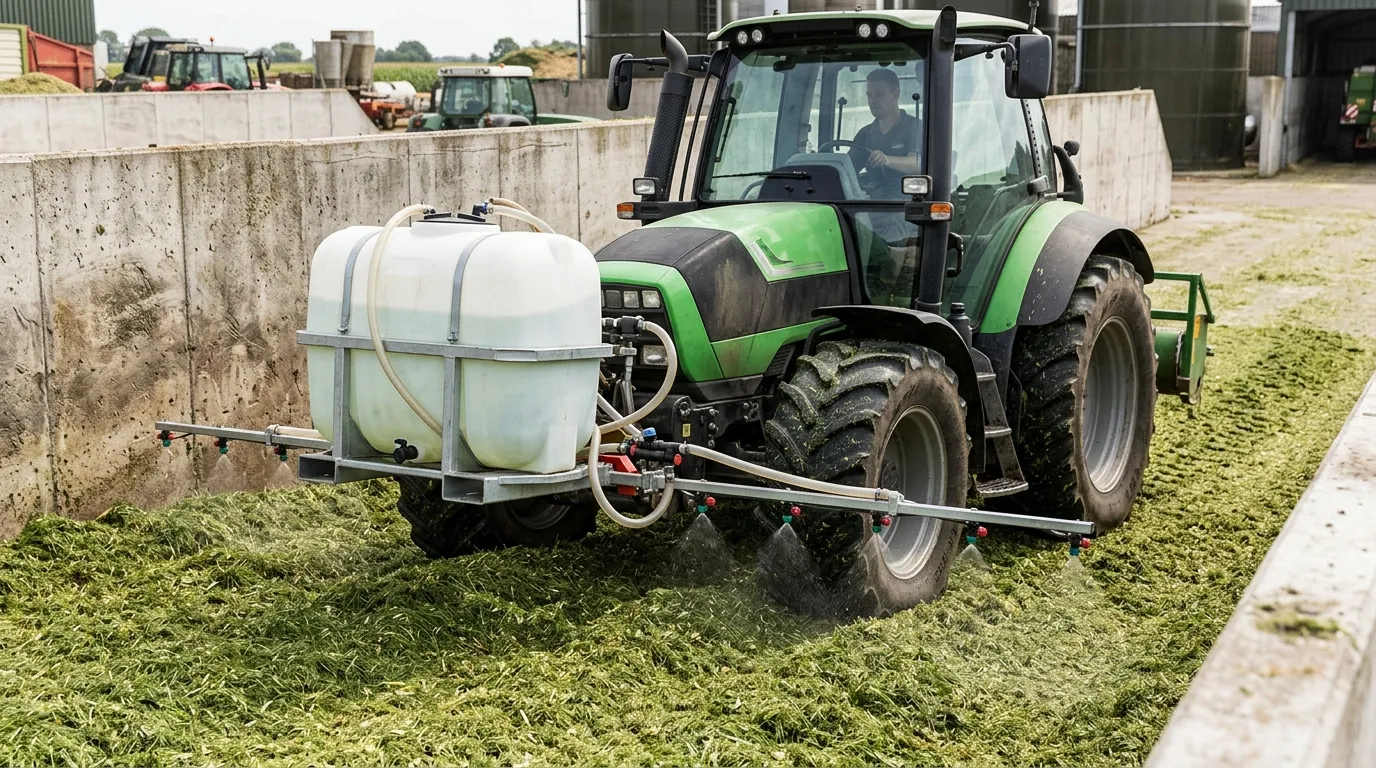
During ensiling, harvested forage is compacted and sealed to create conditions in which undesirable aerobic activity is reduced and fermentation can proceed. Formic acid contributes through direct acidification rather than relying only on the forage’s natural fermentation process.
The preservation sequence can be understood as follows:
- Formic acid is distributed through the harvested forage.
- The acid reduces pH directly in the treated material.
- The resulting conditions can inhibit some undesirable microorganisms and reduce plant proteolytic activity.
- Fermentation and storage management continue to determine the final silage quality.
This direct acidification is why formic acid is often considered when rapid control of early preservation conditions is important. Research and technical sources describe potential effects including inhibition of fungal or undesirable microbial activity, reduced plant-enzyme activity, and lower protein degradation under particular treatment conditions.
Those effects should not be treated as universal performance guarantees. Results depend on the forage, treatment rate, product formulation, application uniformity, and ensiling process. A commercial formic-acid solution should therefore be evaluated as one part of the preservation system rather than as a substitute for forage management.
For broader feed-preservative context, see formic acid feed preservative.
What determines the required formic-acid dosage?
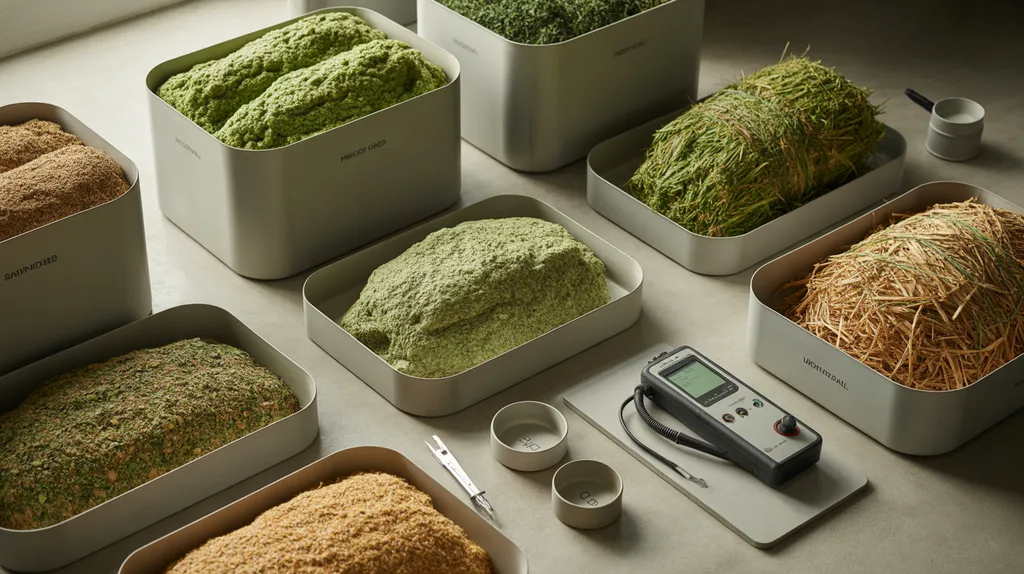
There is no single formic-acid dosage that can be applied safely to every forage or product. A supplier’s application instruction should be linked to the exact commercial product, its concentration, and the forage conditions for which the instruction was developed.
The main variables are:
| Variable | Why it matters | What the feed plant should verify |
|---|---|---|
| Forage species | Different crops can vary in moisture, buffering capacity, carbohydrate availability, and ease of ensiling | Whether the product guidance covers the specific forage |
| Dry matter and moisture | Water content affects fermentation conditions and the basis used to express treatment rates | Whether the rate is stated per tonne of fresh forage or dry matter |
| Water-soluble carbohydrates | Available fermentable carbohydrates influence the subsequent fermentation pathway | Whether the treatment objective accounts for the forage’s carbohydrate condition |
| Buffering capacity | Some forage resists pH change more strongly than others | Whether the crop’s buffering behavior has been considered |
| Harvest condition | Maturity, wilting, contamination, and field conditions can change ensilability | Which crop and harvest conditions the supplier’s guidance assumes |
| Preservation objective | Rapid acidification, reduced proteolysis, and feed-out performance are related but different objectives | Which outcome the product is intended to support |
| Product concentration | Different commercial solutions deliver different quantities of active acid at the same applied mass or volume | The exact assay or concentration basis shown on the specification |
| Application basis | A rate may be expressed on a fresh-forage, dry-matter, mass, volume, or active-acid basis | The units and calculation basis used by the label or technical document |
FAO guidance emphasizes that additive selection and effectiveness must be considered alongside forage characteristics and sound ensiling practice. It also cautions that additives cannot compensate for poor preparation, packing, sealing, or storage management. Review the FAO technical discussion of silage additives and tropical forages.
Forage type, dry matter, and moisture
Forage type is a practical starting point because it influences several other variables at the same time. Crop maturity and species can affect moisture, sugar availability, protein level, buffering capacity, and the ease with which the material reaches stable preservation conditions.
Dry matter and moisture also need to be recorded before applying a treatment recommendation. A rate expressed per tonne of fresh forage is not directly interchangeable with a rate expressed per tonne of dry matter. The same is true when one document refers to kilograms of commercial solution and another refers to the amount of active acid.
A feed plant should not transfer a rate from one forage to another simply because both are described as “grass,” “forage,” or “silage.” The source conditions and product instructions must remain attached to the recommendation.
Water-soluble carbohydrates and buffering capacity
Water-soluble carbohydrates provide substrates for fermentation, while buffering capacity affects how readily the forage responds to added acid. These variables help explain why two forage batches with similar moisture content may still require different treatment considerations.
They are particularly relevant when comparing harvest lots, seasonal conditions, or different suppliers’ guidance. A dosage recommendation without the underlying crop and process assumptions is incomplete.
Product concentration is not the dosage
A commercial product’s concentration describes the amount of formic acid in the supplied solution under the stated specification basis. It does not, by itself, establish how much product should be applied to forage.
For example, two products with different concentrations cannot be compared by volume alone. The buyer must know:
- The exact concentration or assay.
- Whether the value is minimum, maximum, or typical.
- Whether the rate is based on product as supplied or active acid.
- Whether the units refer to fresh forage or dry matter.
- Whether the instruction applies to the same forage and preservation objective.
A comparison of available concentration categories may be useful for procurement, but a listed concentration should never be treated as proof of silage suitability or regulatory acceptance. Vanchor’s formic acid 85 90 94 and 99 resource should be used only for the scope actually stated on that page.
Read concentration, active content, and application rate correctly
Technical and procurement teams should use the following distinctions when reviewing a formic-acid quotation or specification:
| Term | What it describes | What it does not establish |
|---|---|---|
| Assay or concentration | The chemical content of the supplied product under a stated basis | The correct silage application rate |
| Active-acid quantity | The amount of formic acid delivered to the forage | Product handling, storage, or regulatory suitability |
| Product-as-supplied rate | The amount of commercial solution applied | A universal performance result |
| Purity | The proportion of the named chemical relative to specified impurities or other components | Feed-use approval or crop-specific suitability |
A calculation should identify all of the following before it is used operationally:
- Product concentration.
- Quantity of forage.
- Fresh-forage or dry-matter basis.
- Mass or volume units.
- Desired active-acid quantity, if applicable.
- Source of the recommended rate.
- Assumptions and rounding method.
Do not use a dilution calculation to create a treatment recommendation. A calculator can help convert verified inputs, but it cannot establish whether the resulting application is appropriate for a particular forage or jurisdiction. The formic acid dilution calculator should only be used within the formula and input limits provided on that page.
What a feed plant should verify before selecting a formic-acid product
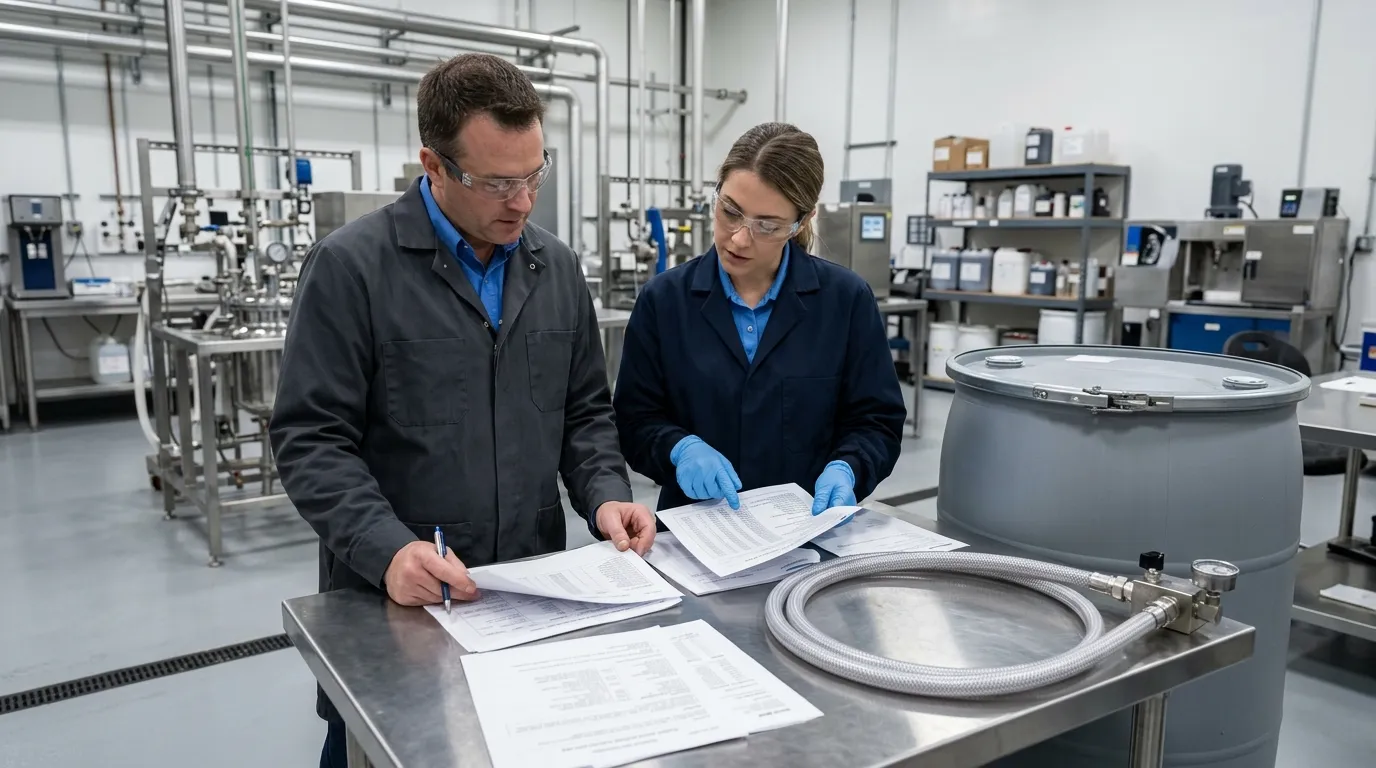
Selection should begin with the exact product identity rather than with a generic request for “formic acid.” A feed plant should be able to connect the quotation, specification, label, shipment documents, and operating instruction to the same product and concentration.
Product identity and specification
Request and review:
- Chemical name and, where relevant, CAS identity.
- Exact concentration or assay basis.
- Solution form and any declared formulation components.
- Minimum, maximum, or typical specification values.
- Test methods and document version.
- Batch or lot identification where quality documentation is supplied.
A catalog listing alone does not establish feed-use suitability, current availability, manufacturing status, or regulatory approval.
Application fit
Confirm:
- The intended silage or forage application.
- The forage types covered by the application guidance.
- The units and basis used for dosage.
- Whether the instruction concerns commercial product or active formic acid.
- The required application equipment and metering arrangement.
- Whether the product is intended for the plant’s operating conditions.
If a supplier provides a rate, the feed plant should ask which forage, moisture level, dry-matter basis, and preservation objective support that rate. A number without those conditions is difficult to evaluate or compare.
QA and regulatory documentation
The document package may need to include:
- Technical data sheet.
- Safety data sheet.
- Certificate of analysis or equivalent batch-quality document.
- Product label or application instructions.
- Jurisdiction-specific evidence for the intended feed or silage use.
- Packaging and transport information where relevant to the plant’s receiving process.
These documents serve different purposes. An SDS supports hazard communication and handling controls; it does not by itself establish feed suitability. A COA describes a tested batch or lot; it does not establish universal product approval. Likewise, high assay does not automatically establish suitability for a regulated feed application.
Operations and safety
Before installation or use, the plant should review the applicable SDS and technical documentation for:
- Storage conditions.
- Transfer and dispensing controls.
- Worker-protection measures.
- Spill and emergency procedures.
- Equipment and materials compatibility.
- Metering and application-system requirements.
- Segregation from incompatible materials.
Do not select storage tanks, pumps, lines, or seals based only on the chemical name. Compatibility depends on the product concentration, temperature, equipment materials, and operating conditions. The formic acid storage resource may provide related handling information, but the applicable product SDS and plant review remain controlling.
Formic acid does not replace good ensiling and feed-out control
Formic acid can support rapid acidification, but it cannot correct every process weakness. Chopping, uniform application, packing, sealing, anaerobic storage, and controlled feed-out remain important.
A feed plant should therefore evaluate chemical treatment together with process controls:
- Is the forage prepared consistently?
- Can the application system distribute the product uniformly?
- Is the material packed and sealed effectively?
- Are storage conditions controlled?
- Is the silo opened and managed to limit avoidable exposure?
- Are quality checks linked to the preservation objective?
Early acidification and post-opening stability are not identical objectives. A treatment that supports the initial preservation phase should not automatically be described as guaranteeing aerobic stability after the silo is opened.
Formic acid compared with other silage-acid options
Formic acid should not be treated as interchangeable with acetic acid, propionic acid, or multi-acid blends. The relevant comparison depends on the intended preservation objective, forage condition, product formulation, and application instruction.
| Decision criterion | Formic-acid question | What must be verified |
|---|---|---|
| Primary objective | Is rapid direct acidification required? | Product guidance and forage condition |
| Product basis | What concentration and formulation are supplied? | TDS, label, and quality documents |
| Stability objective | Is post-opening stability also a priority? | Product evidence and feed-out controls |
| Application fit | Can the plant meter and distribute the product uniformly? | Equipment and compatibility information |
| Compliance | Is the intended use permitted in the target market? | Current jurisdiction-specific authority |
The relevant choice is therefore conditional rather than universal. A product should be compared on an equivalent basis, with concentration, units, forage conditions, and application objective kept consistent. Vanchor’s formic acid vs acetic acid page may be relevant for comparison, but its claims should be interpreted within the scope of that page and not extended to every silage formulation.
A practical selection checkpoint for feed plants
Before approving a formic-acid product for a silage program, use this sequence:
- Define the forage and process conditions. Record forage type, harvest condition, moisture or dry matter, and the preservation objective.
- Identify the exact product. Confirm chemical form, concentration, assay basis, and whether the quoted rate is for product as supplied or active acid.
- Review the documents. Obtain the applicable technical data, safety data, label or application instruction, and batch-quality documentation.
- Check the application system. Confirm metering, distribution, storage, transfer, and materials compatibility using product-specific information.
- Review local requirements. Check the rules that apply to the exact product, use, and market.
- Validate the treatment instruction. Ensure that the recommendation covers the actual forage and operating conditions rather than relying on a generic rate.
- Monitor the process. Evaluate chemical treatment together with packing, sealing, storage, and feed-out controls.
For a chemical sourcing discussion, the useful next step is to define the exact concentration, forage application, units, and documentation required before requesting a product recommendation or quotation. This gives formulation, QA, operations, and procurement teams a common basis for evaluating formic acid for silage preservation.


Contact Us
In This Article
Related Posts
Custom Packaging Solutions from an Anhydrous Sodium Acetate Supplier in China
2026-09-23
Application Trends in Anhydrous Sodium Acetate for Special Chemical Manufacturing
2026-09-23
Anhydrous Sodium Acetate for Leather Tanning: Improve Dyeing Uniformity
2026-09-22
Formic Acid 85% for Textile Dyeing: Industrial Applications, Technical Benefits and Future Trends
2026-09-22


