



Formic Acid vs Sulfuric Acid in Leather Pickling: Process and Handling Tradeoffs
By Tonmoy
2026-09-04Related Posts
Custom Packaging Solutions from an Anhydrous Sodium Acetate Supplier in China
2026-09-23

Application Trends in Anhydrous Sodium Acetate for Special Chemical Manufacturing
2026-09-23
Anhydrous Sodium Acetate for Leather Tanning: Improve Dyeing Uniformity
2026-09-22

Formic Acid 85% for Textile Dyeing: Industrial Applications, Technical Benefits and Future Trends
2026-09-22
Formic acid and sulfuric acid are both established acidifying agents for leather pickling before tanning. The better choice is not determined by acid name or final bath pH alone. It depends on the complete pickle system: hide characteristics, salt level, acid concentration, addition sequence, process control, downstream tanning, equipment, and handling requirements.
A practical comparison therefore has three parts:
- how each acid fits the acidification step;
- how the acid interacts with salt and collagen swelling; and
- whether the supplied product and plant controls support consistent, safe operation.
Sulfuric acid and formic acid may also be used in combination, so the decision is not always a strict either-or choice. Formic acid for leather pickling should be evaluated as part of the full process rather than as an isolated chemical input.
What the comparison is actually deciding in a leather pickle

Pickling acidifies hides or skins before a subsequent tanning treatment. This prepares the collagen structure for the next stage by changing the condition of the hide and supporting the required tanning chemistry. Leather-processing references identify both sulfuric acid and formic acid among the acids used for this purpose.
The important process question is not simply:
Which acid produces the lower pH?
It is:
Which acid system provides the required acidification and swelling control for this hide, process sequence, and tanning system?
A fair comparison should keep the following variables visible:
- hide or skin type and condition;
- acid identity and supplied-product concentration;
- salt type and level;
- acid addition sequence;
- bath temperature and process time;
- pH measurement method and endpoint;
- equipment and transfer controls; and
- the subsequent tanning process.
A nominally similar pH does not prove that two acid systems will behave identically. Acid concentration, dissociation behavior, salt conditions, hide structure, and process sequence can all influence the result.
Vanchor’s leather-chemical supplier information describes pickling as a step that lowers pH before chrome tanning and helps control swelling. This is a site-stated description of the process, not evidence that a particular Vanchor product grade will deliver a defined result under every tannery condition.
Formic acid and sulfuric acid: a like-for-like process comparison
| Comparison point | Formic acid | Sulfuric acid | What the tannery should verify |
|---|---|---|---|
| Role in pickling | Used as an acidifying agent in leather pickling | Used as an acidifying agent in leather pickling | Exact concentration and process basis |
| Chemical category | Organic acid | Mineral acid | Product identity and supplied form |
| Swelling control | Must be evaluated with the salt system and process conditions | Requires particular attention to acid-induced swelling and salt control | Hide response across the full pickle |
| Use in blends | May be used with other pickling acids | May be used with other pickling acids | Addition sequence and validated blend conditions |
| pH interpretation | Final pH does not by itself define performance | Final pH does not by itself define performance | pH method, endpoint, and process response |
| Penetration and speed | No universal superiority is established by the available evidence | No universal inferiority or superiority is established by the available evidence | Matched comparative trials |
| Procurement basis | Concentration, impurities, SDS, TDS, and COA should be checked | Concentration, impurities, SDS, TDS, and COA should be checked | Equivalent documentation for both products |
Technical sources describe both acids as conventional materials for acid pickling, and published research has examined formic- and sulfuric-acid systems together with sodium chloride. However, the available evidence does not support a universal statement that one acid always gives faster penetration, better leather quality, or more consistent production.
The comparison must also distinguish the acid from the product supplied to the tannery. A concentrated acid solution, a diluted commercial product, and an application formulation are not interchangeable descriptions. Product concentration, assay basis, impurities, and test method should be recorded before process performance is compared.
Why salt and swelling control can outweigh the acid name
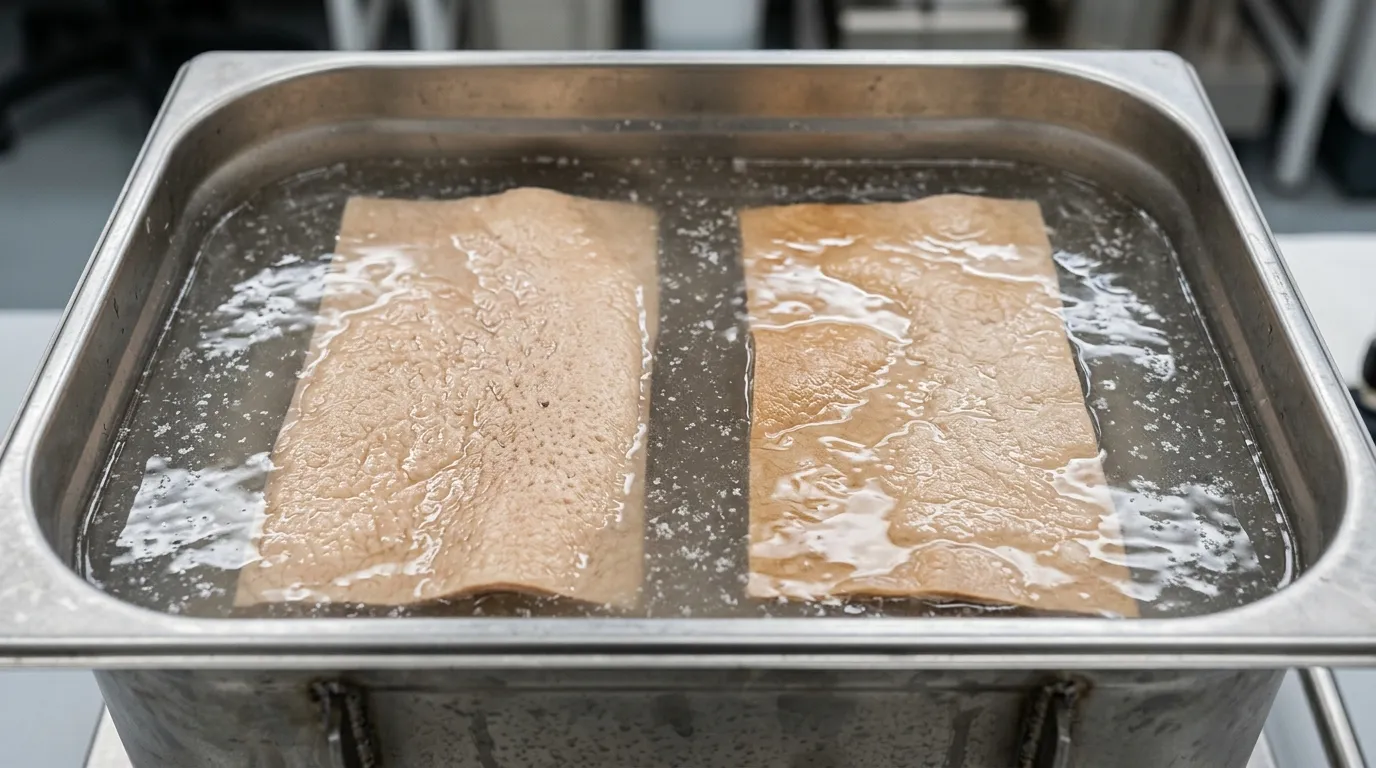
Acidification changes the charge state of collagen and can influence swelling in the hide. For that reason, salt is a central part of many acid-pickling systems. Leather-processing guidance identifies salt concentration as critical for limiting acid swelling, while technical literature describes the relationship between acidification, collagen protonation, and swelling control.
The cited leather-pickling patent provides a useful illustration of this interaction. In its stated process context, sulfuric acid used without the corresponding salt control produced substantial swelling, while the salt/sulfuric-acid system produced a different swelling response. That observation should remain attached to the patent’s conditions; it is not a universal production value or a substitute for tannery trials.
The practical implication is that a tannery should not compare formic acid and sulfuric acid by looking at acid addition alone. Review the following variables together:
- acid concentration on a clearly defined basis;
- salt concentration and addition point;
- hide moisture and pretreatment history;
- bath temperature and duration;
- mixing and circulation;
- pH measurement method;
- hide thickness and variation; and
- the required condition before tanning.
Salt can moderate acid-induced swelling, but it does not make every acid system equivalent. A change in acid may require a review of the complete pickle balance rather than a simple substitution at the same product volume.
Process tradeoffs to validate before changing acids
Claims about penetration, speed, softness, grain, or finished-leather quality should be treated cautiously unless they come from a controlled comparison. A useful comparison uses the same hide category, comparable salt conditions, equivalent measurement methods, and the same downstream tanning sequence.
Before changing from one acid to another, process and QA teams should ask:
- Does the new acidification profile fit the existing hide type?
- Is the pH response repeatable from batch to batch?
- Is swelling controlled throughout the pickle, not only at the endpoint?
- Does the acid distribute consistently through different hide thicknesses?
- Does the system remain compatible with the following tanning stage?
- Are performance claims based on controlled testing or on informal operator experience?
- Will the change alter dosing, transfer, storage, or wastewater-control requirements?
The available research does not establish that formic acid always penetrates faster than sulfuric acid, or that sulfuric acid always produces inferior leather. Those outcomes depend on the complete formulation and operating conditions. A supplier statement such as “faster,” “milder,” or “better penetration” should therefore be treated as a claim requiring defined test conditions.
A controlled plant evaluation should compare the two systems using documented inputs and agreed measurements. The purpose is not to prove that one acid is universally better, but to determine whether the selected system meets the tannery’s own requirements for swelling control, process consistency, downstream tanning, and finished-leather quality.
Handling tradeoffs: compare the operating controls, not just the acid names
Handling decisions should be based on the exact product supplied, not only on the chemical name. The concentration, impurities, packaging, equipment, and local operating procedures all affect how an acid is received and used.
For either formic acid or sulfuric acid, the technical and procurement review should cover:
- exact chemical identity and supplied form;
- commercial concentration or assay basis;
- relevant impurity limits;
- current Safety Data Sheet (SDS);
- Technical Data Sheet (TDS);
- batch-specific or representative Certificate of Analysis (COA);
- packaging and storage information;
- transfer and dosing arrangements;
- compatibility of tanks, pumps, lines, seals, and fittings;
- spill-response procedures;
- operator training; and
- change-control requirements before a process substitution.
The documents serve different purposes:
| Document | What it can establish | What it cannot establish by itself |
|---|---|---|
| SDS | Hazard, handling, storage, emergency, and exposure-related information for the exact product | Leather-pickling performance or application approval |
| TDS | Supplier-stated specification, test parameters, and technical properties | Universal performance in every tannery |
| COA | Batch-specific test results against stated parameters | Permanent product approval or finished-leather quality |
| Plant trial report | Results under the tannery’s defined conditions | Performance under unrelated hides, equipment, or recipes |
The applicable SDS should govern product-specific handling decisions. Generic information about formic acid or sulfuric acid should not replace a current SDS for the actual commercial grade and concentration. Hazard classification, storage compatibility, transport status, and required controls can depend on the supplied product and jurisdiction.
For broader sourcing context, a leather chemical supplier should be assessed on the quality and relevance of the product documentation, not only on a catalog listing.
How to choose between formic acid, sulfuric acid, or an acid blend
A conditional decision approach is more reliable than naming one acid as the universal best option.
If the existing pickle is consistent: Prioritize process continuity and batch data. A chemical change should be treated as a controlled process change, even when the replacement acid is intended to perform the same basic function.
If swelling control is the main concern: Review the acid and salt system together. Do not assume that changing acid while keeping every other input unchanged will preserve the same collagen response.
If the process uses an acid blend: Verify the actual blend composition, addition sequence, and downstream tanning compatibility. The existence of documented acid blends does not establish a universal blend ratio or operating procedure.
If the tannery is considering a switch: Use matched trials with comparable hides, salt conditions, acid basis, measurement methods, and downstream tanning. Record both process behavior and finished-leather results.
If the main concern is penetration or speed: Require defined test conditions. Terms such as “fast,” “deep,” or “mild” are not sufficiently precise for a procurement or process decision without supporting data.
If the decision is being made by procurement: Compare exact commercial products rather than comparing chemical names alone. Concentration, impurities, batch consistency, documentation, packaging, and supply conditions should be part of the technical review.
If the process team and supplier disagree: Separate supplier-stated suitability from independent or plant-validated performance. A product document can define a specification without proving the result on every hide type and process line.
This approach allows a tannery to select formic acid, sulfuric acid, or a blend according to its own validated requirements instead of relying on a universal ranking.
What to request before approving an industrial leather-pickling acid
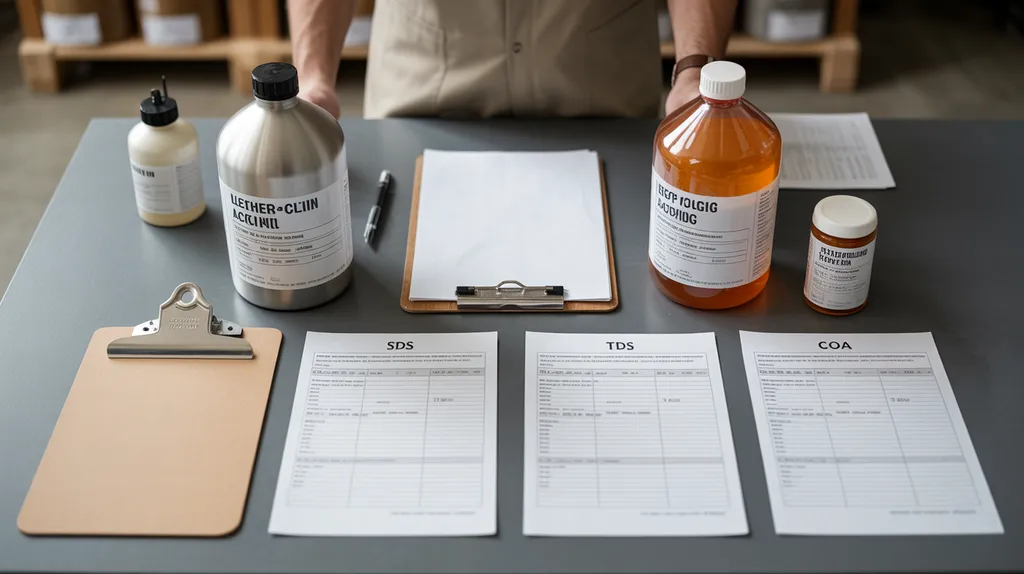
Before approving a product for routine use, request and compare:
- exact chemical name and supplied form;
- concentration or assay basis;
- impurity limits relevant to the application;
- current SDS;
- TDS with test methods;
- minimum, maximum, or typical values clearly identified;
- representative or batch-specific COA;
- packaging and storage information;
- batch traceability;
- recommended application scope, if supplied;
- documented limitations;
- and any available application data under comparable leather-processing conditions.
The documentation review should also distinguish what each document proves. A COA can show whether a particular batch met stated test parameters; it does not establish universal leather-pickling performance. An SDS can support handling decisions; it does not prove suitability for a specific tanning process. A supplier’s application statement should be treated as a stated position unless supported by appropriately matched technical evidence.
Where the selected product is formic acid, the formic acid storage resource may provide additional storage-related context, but product-specific decisions still require the current SDS for the exact grade and concentration. If the tannery is reviewing the broader chemistry, the formic acid reference can provide general product context without replacing leather-process validation.
Bottom line for process and handling decisions
Formic acid and sulfuric acid are both relevant options for leather pickling, and neither can be identified as the universal winner from the available evidence. The most important comparison is the complete acid-pickle system: acid identity, supplied concentration, salt-controlled swelling, hide characteristics, process sequence, pH measurement, downstream tanning, equipment, and operator controls.
Sulfuric-acid swelling concerns should be considered within the conditions of the cited process evidence, not generalized into a blanket rejection. Formic acid should likewise not be assumed to provide superior penetration, speed, safety, or leather quality without matched supporting data.
For an industrial decision, compare exact products, obtain the applicable SDS, TDS, and COA, and validate the selected system under the tannery’s own process conditions before making a routine change.


Contact Us
In This Article
Related Posts
Custom Packaging Solutions from an Anhydrous Sodium Acetate Supplier in China
2026-09-23
Application Trends in Anhydrous Sodium Acetate for Special Chemical Manufacturing
2026-09-23
Anhydrous Sodium Acetate for Leather Tanning: Improve Dyeing Uniformity
2026-09-22
Formic Acid 85% for Textile Dyeing: Industrial Applications, Technical Benefits and Future Trends
2026-09-22


