



Sodium Acetate Trihydrate for Heat Packs: Chemistry, Activation, and Safety
By vanchor
2026-07-01Related Posts
Custom Packaging Solutions from an Anhydrous Sodium Acetate Supplier in China
2026-09-23

Application Trends in Anhydrous Sodium Acetate for Special Chemical Manufacturing
2026-09-23
Anhydrous Sodium Acetate for Leather Tanning: Improve Dyeing Uniformity
2026-09-22

Formic Acid 85% for Textile Dyeing: Industrial Applications, Technical Benefits and Future Trends
2026-09-22
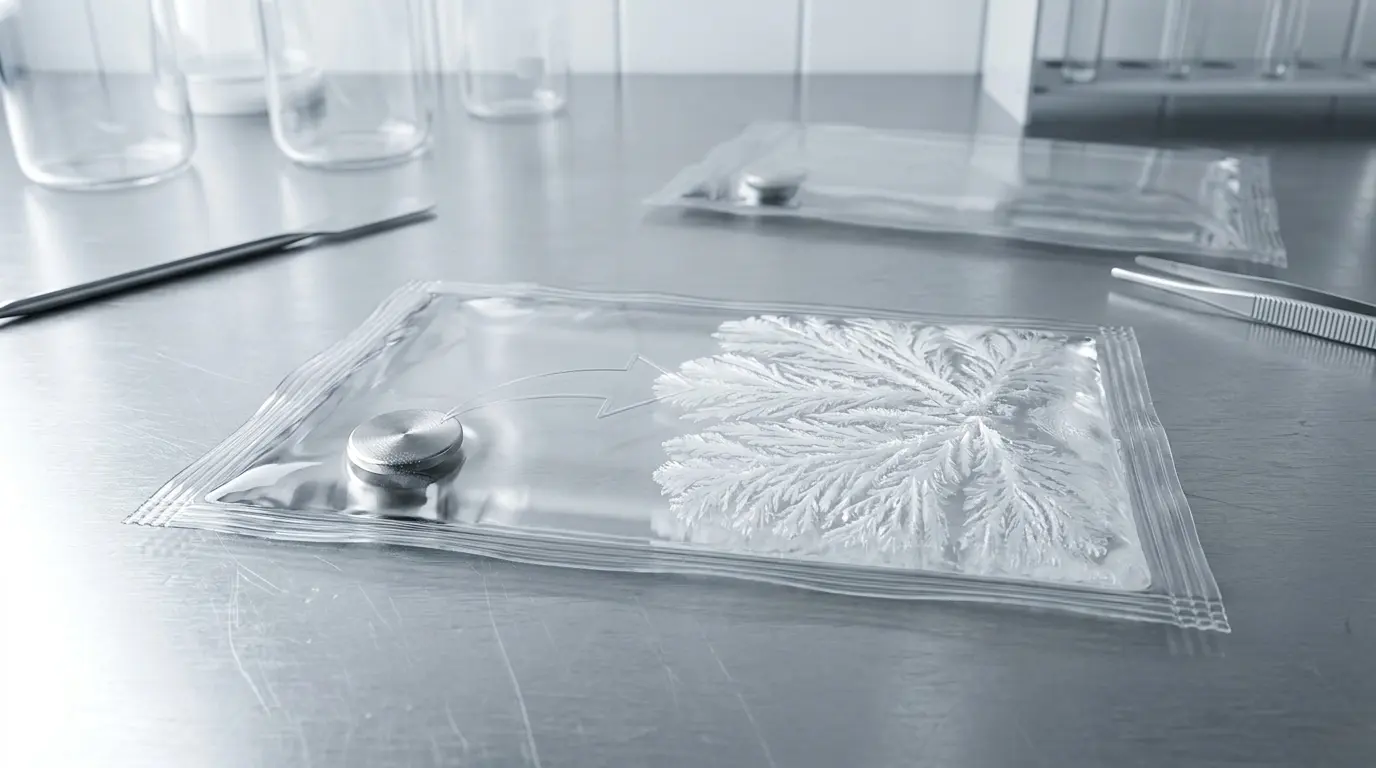
Sodium acetate trihydrate heat packs work by storing thermal energy in a liquid, metastable state. Clicking the metal disc starts nucleation, the liquid rapidly crystallizes, and the phase change releases heat. The pack becomes solid during use, then returns to a reusable liquid state after controlled heating.
The disc itself does not create the useful heat through friction. Its role is to trigger crystal formation inside the supersaturated sodium acetate solution. Heat-pack performance still depends on the formulation, fill mass, pouch construction, activator design, and operating conditions—not only on the chemical name.
For broader information about grades, specifications, documentation, samples, packaging, and bulk supply, see Sodium Acetate Trihydrate Manufacturer: Quality, Applications, and Bulk Supply (inferred).
What Sodium Acetate Trihydrate Is and Why Heat Packs Use It
Sodium acetate trihydrate is the hydrated form of sodium acetate, with the formula CH₃COONa·3H₂O and CAS number 6131-90-4. The “trihydrate” designation means that three water molecules are incorporated into the crystalline structure for each sodium acetate formula unit.
This hydrated structure allows the material to act as a salt-hydrate phase-change material. It can absorb energy when heated into a liquid state and release energy when it crystallizes again.
| Material fact | Why it matters in a heat pack |
|---|---|
| Sodium acetate is present in its trihydrate form | The crystal water supports the low-temperature phase-change behavior used by reusable packs |
| The material can remain liquid after cooling | This creates a trigger-ready, metastable state |
| Crystallization is reversible | The pack can be reset by heating it again |
| Heat is released during crystal formation | The phase transition produces the warming effect |
The anhydrous form is chemically related, but it is not a direct substitute for the hydrated material in this type of low-temperature reusable pack. A more complete comparison is available in sodium acetate trihydrate vs anhydrous.
Chemical identity data for sodium acetate trihydrate, including its formula and molecular weight, are available through PubChem.
How a Sodium Acetate Heat Pack Works
A reusable sodium acetate heat pack moves through a repeatable sequence of physical states.
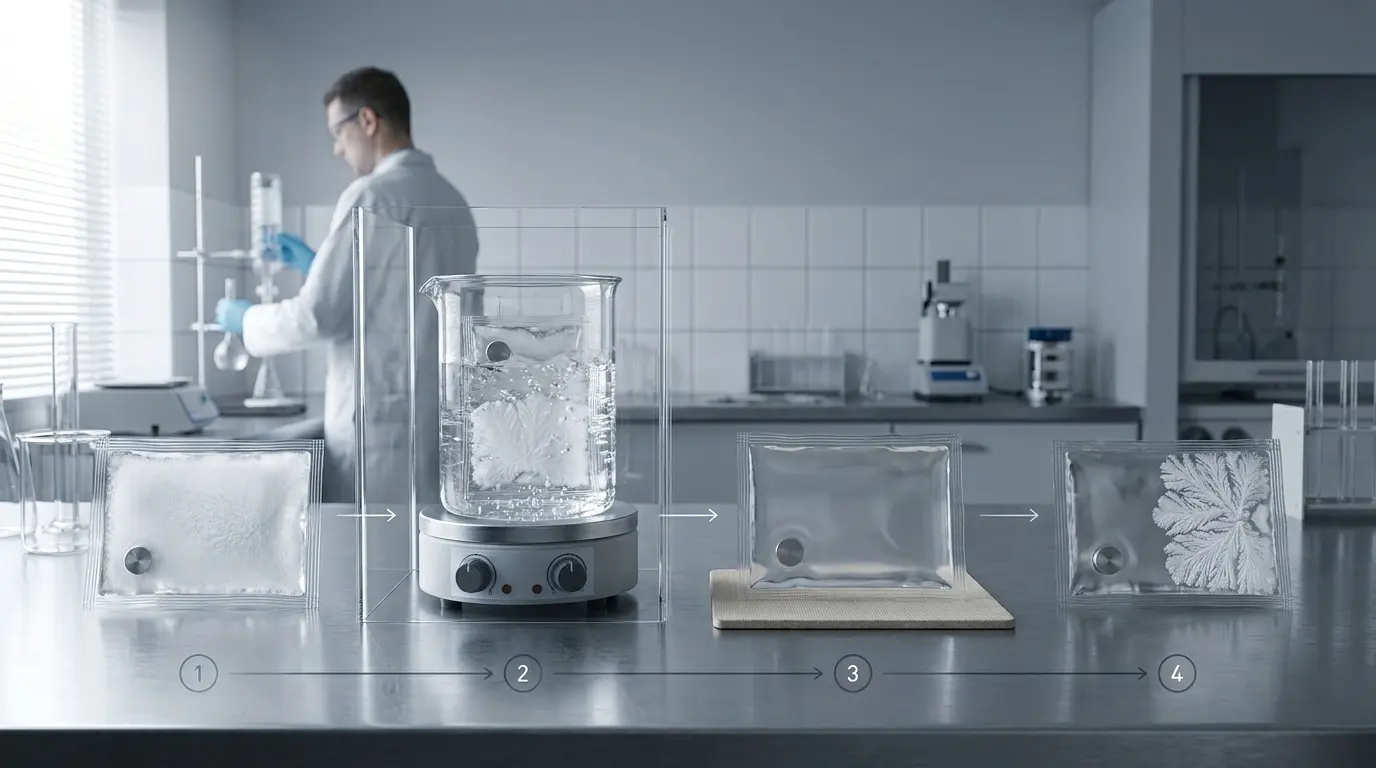
- The used pack is solid.
After activation, most of the contents have crystallized into sodium acetate trihydrate. - Heating restores the liquid state.
The solid pack is heated according to the finished-product instructions until the crystals disappear and the contents become homogeneous. - The liquid cools without crystallizing.
As the pack cools, it can remain liquid even below its normal equilibrium transition range. This is a metastable, supersaturated state. - The disc initiates nucleation.
Flexing the activator disc provides a starting point for crystal growth. - Crystallization spreads through the pack.
The visible crystal front moves through the liquid, releasing latent heat as the material returns to its solid state.
| Stage | Physical state | What happens | Energy direction | Visible result |
| After use | Crystalline solid | The phase transition is complete | Heat has been released | Firm or solid pack |
| During reset | Heated liquid | Crystals melt or dissolve into a uniform liquid | Heat enters the material | Clear liquid develops |
| After cooling | Metastable liquid | The liquid remains uncrystallized | Energy remains stored | Flexible liquid pack |
| After activation | Crystallizing mixture | Nucleation starts and crystals spread | Latent heat is released | Pack warms and becomes solid |
The Four Physical States Inside the Pack
The pack does not simply switch between “hot” and “cold.” Its behavior depends on its physical state.
- Crystalline state: The material is solid and has already released its stored phase-change heat.
- Heated liquid state: External heat has returned the material to a homogeneous liquid.
- Cooled metastable state: The liquid is cooler but has not yet formed crystals.
- Active crystallization state: Crystal growth is moving through the pouch and releasing heat.
This state sequence explains why the pack can remain liquid for storage and then warm rapidly after a small mechanical trigger.
Is It a Chemical Reaction or a Phase Change?
The useful heating process is principally a reversible phase transition, not combustion and not the same kind of one-way reaction used by many disposable warmers.
The material changes from a metastable liquid into sodium acetate trihydrate crystals. That crystal formation releases energy as latent heat. During resetting, external heat reverses the process and restores the liquid state.
Calling the process “exothermic crystallization” is more accurate than saying the disc creates heat or that the pack burns a chemical fuel.
What the Metal Activator Disc Actually Does
The activator disc starts crystallization, but it is not the heat source.
Scientific investigation published in the American Journal of Physics supports a mechanism involving tiny retained seed crystals associated with the contacting metal surfaces of the flexed disc.
When the disc bends or snaps:
- The movement exposes or releases a suitable crystal seed.
- That seed creates a stable nucleation site.
- Sodium acetate molecules begin arranging into the crystalline structure.
- The crystal front spreads through the metastable liquid.
- Heat is released as more of the material crystallizes.
Myth: The disc warms the pack through friction.
Fact: The disc initiates nucleation. The useful heat comes from crystallization throughout the sodium acetate trihydrate mixture.
This distinction matters because it explains why a tiny mechanical trigger can activate a much larger volume of material. The disc starts the transition; it does not supply most of the thermal energy.
Why Crystallization Produces Heat
The liquid inside a reset pack stores energy relative to the crystalline state. Once nucleation begins, the material reorganizes into a lower-energy crystal structure. The energy difference is released as latent heat.
Resetting reverses that energy flow:
- Heating the solid pack adds energy.
- The crystalline structure disappears.
- The liquid cools into a metastable state.
- Crystallization later releases the stored phase-change energy.
Thermochemical data for sodium acetate trihydrate are available through the NIST Chemistry WebBook. Published values should be interpreted carefully because transition temperature and enthalpy can vary with composition, test method, purity, and formulation.
The material’s phase-transition range is also not the same as the exact surface temperature of a finished heat pack.
| Material property | Finished-pack result |
| Phase-transition temperature | Indicates where the material changes phase under defined conditions |
| Latent heat | Indicates the energy associated with the transition |
| Fill mass | Affects the total heat available |
| Pouch thickness and material | Affect how quickly heat reaches the outer surface |
| Pack geometry | Influences heat distribution |
| Ambient conditions | Affect heat loss and duration |
| Contact pressure and exposure time | Influence the temperature experienced by the user |
A raw-material property alone cannot guarantee a specific skin-contact temperature, warming duration, or activation speed.
How to Reset a Reusable Sodium Acetate Heat Pack
A used pack must be returned from the crystalline state to a homogeneous liquid before it can be activated again.
Always follow the finished-product manufacturer’s instructions, because pouch materials and reset methods vary. The general process is:
- Inspect the pouch first.
Do not reset a pack that is leaking, swollen, split, or visibly damaged. - Heat the pack as directed.
The goal is to remove the crystalline structure and restore a uniform liquid. - Continue until all visible crystals disappear.
Remaining crystals can act as nucleation seeds. - Avoid damaging the pouch.
Do not assume every pack tolerates direct contact with a pan, unrestricted boiling, or microwave heating. - Allow it to cool undisturbed.
After cooling, the pack should remain liquid until intentional activation.
The exact heating time cannot be generalized. It depends on pack size, pouch construction, heating method, initial temperature, and the manufacturer’s validated instructions.
Why All Crystals Must Disappear
Even one remaining sodium acetate crystal can become a seed for further crystallization.
A partially reset pack may:
- solidify immediately after removal from heat;
- start crystallizing during cooling;
- appear cloudy rather than uniformly liquid;
- fail to remain ready for later activation.
If visible particles remain after the recommended reset process, do not assume that longer heating is always safe. Check the product instructions and inspect the pouch for damage, discoloration, or contamination.
Common Activation and Reset Problems
| Symptom | Possible explanation | Safe response | Stop using the pack when |
| The pack solidifies again immediately after heating | Residual crystals remained inside | Reset again only according to the product instructions | The pouch shows heat damage, swelling, or leakage |
| Crystals remain after the normal reset process | Incomplete heating, uneven heat transfer, or altered contents | Follow the validated reset procedure; do not improvise with excessive heat | Crystals persist together with pouch deformation or discoloration |
| The pack activates without clicking | Residual seed crystals, disturbance, contamination, or unstable formulation behavior | Reset only if the pouch is intact and the instructions permit it | Spontaneous activation becomes frequent or the pouch condition changes |
| The disc clicks but nothing happens | Trigger malfunction, unsuitable temperature, formulation issue, or product aging | Allow the pack to reach the recommended condition and follow product guidance | The trigger is damaged or the pouch is leaking |
| Crystallization spreads unevenly | Localized nucleation, pouch geometry, formulation variation, or partial reset | Avoid squeezing or puncturing the pack; follow instructions | Hard lumps, swelling, or seal damage appear |
| The liquid becomes cloudy or discolored | Residual crystals, impurities, contamination, or material degradation | Treat the cause as uncertain unless the manufacturer provides guidance | The appearance changes significantly or leakage occurs |
| The pouch leaks | Seal or film failure | Avoid direct contact with the contents and discontinue use | Immediately |
A reusable phase transition does not mean every component lasts indefinitely. The chemical cycle may be reversible, while the pouch, seal, disc, additives, or formulation performance can still degrade over repeated use.
Sodium Acetate Heat-Pack Safety: Chemical, Thermal, and Product Risks
Safety should be considered in three separate categories: the raw chemical, the heat produced, and the integrity of the finished pouch.
| Safety area | Main concern | Practical implication |
| Chemical handling | Eye, skin, respiratory, or ingestion exposure | Avoid intentional contact with leaked contents and follow the SDS |
| Thermal use | Excessive temperature or prolonged contact | Limit exposure according to the product instructions |
| Product integrity | Leakage, damaged seals, swelling, or pouch failure | Stop using a damaged pack |
PubChem may report sodium acetate trihydrate as not classified under its summarized hazard information, but this should not be rewritten as “harmless.” Safety data sheets can still recommend precautions for eye contact, skin exposure, inhalation of dust, or ingestion.
A sodium acetate trihydrate safety data sheet should guide handling of the raw material. The finished pack also creates risks that a raw-material SDS cannot evaluate, including:
- surface temperature;
- prolonged contact with skin;
- pouch film performance;
- seal strength;
- activator-disc condition;
- leakage during resetting;
- damage from an unsuitable heating method.
Do not use a leaking pack. Avoid ingesting the contents or applying leaked liquid directly to skin. Exact cleaning, disposal, reset, and use instructions should come from the finished-product manufacturer.
Why “Not Classified as Hazardous” Does Not Mean Harmless
Hazard classifications use defined criteria. A substance may fall outside a particular hazardous classification while still requiring sensible handling precautions.
The finished heat pack creates additional concerns that are separate from the chemical classification:
- A warm pouch can cause discomfort or burns if contact is excessive.
- A damaged seal can expose the contents.
- Repeated heating can stress the pouch.
- People with reduced heat sensation may not notice excessive exposure quickly.
For that reason, chemical documentation and finished-product safety testing serve different purposes.
Trihydrate or Anhydrous Sodium Acetate for Heat Packs?
For a conventional reusable click heat pack, sodium acetate trihydrate is the relevant form because its hydrated crystal structure supports the low-temperature melting and crystallization cycle.
| Form | Heat-pack relevance |
| Sodium acetate trihydrate | Provides the hydrated phase-change behavior used in reusable crystallization packs |
| Anhydrous sodium acetate | Chemically related but not a direct drop-in equivalent for the same cycle |
Changing the hydration state also changes the material basis, formulation calculations, and phase behavior. The two forms should not be treated as interchangeable merely because both are sodium acetate.
For a broader comparison of composition, handling, active content, and application selection, see sodium acetate trihydrate vs anhydrous.
What Heat-Pack Developers Should Verify Before Selecting a Grade
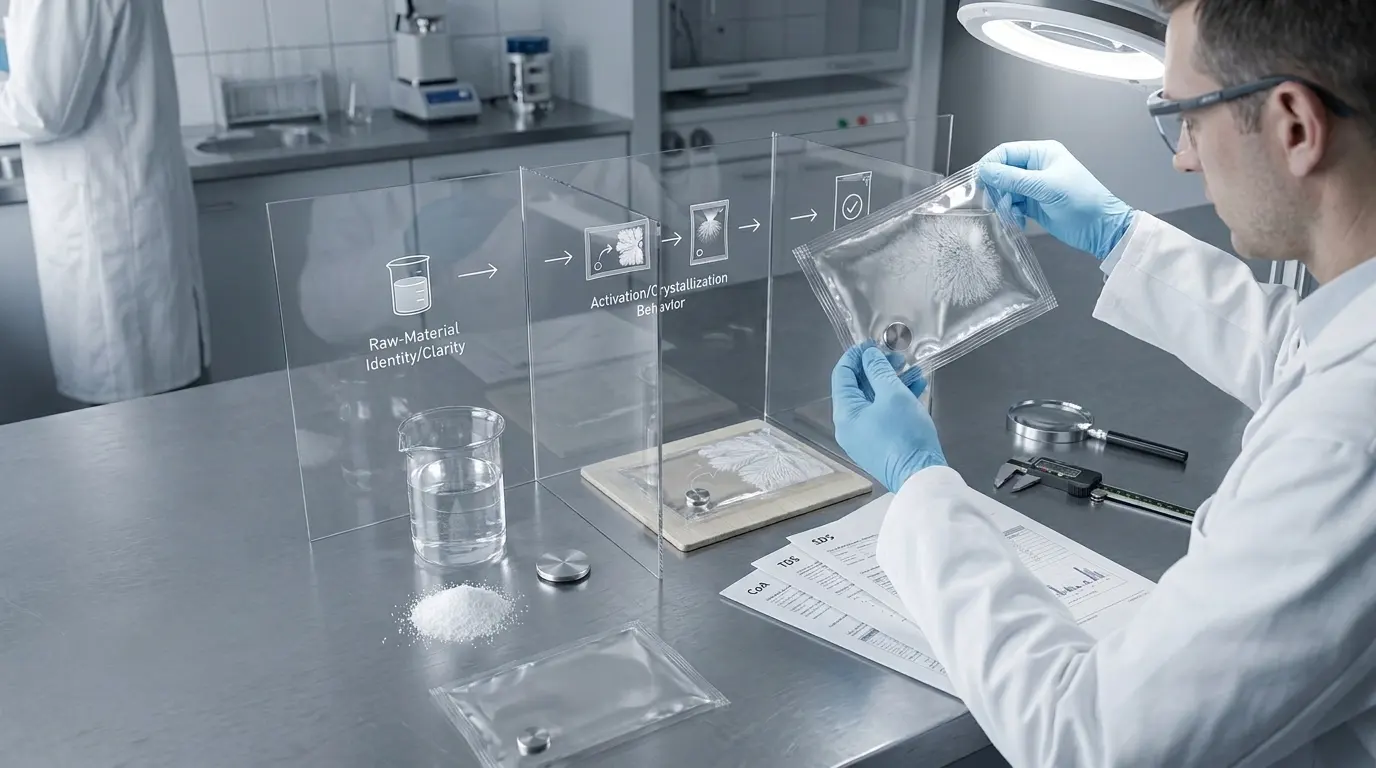
Heat-pack performance cannot be established from assay alone. Product developers should evaluate the material inside the actual formulation and pouch system.
A practical review should include:
- exact trihydrate identity;
- assay basis and test method;
- crystal purity;
- insoluble matter;
- color and solution clarity;
- impurity profile;
- nucleation behavior;
- phase-change consistency;
- repeated thermal cycling;
- compatibility with formulation additives;
- compatibility with the activator disc;
- pouch and seal performance during resetting;
- long-term storage behavior.
Vanchor states that heat-pack-related considerations may include crystal purity, nucleation behavior, phase-change consistency, cycling stability, insoluble particles, color, additive compatibility, and storage behavior. It also notes that conventional industrial grade may not automatically satisfy finished thermal-product requirements.
Before a bulk decision, buyers should normally request:
- technical data sheet;
- safety data sheet;
- product specification;
- certificate of analysis;
- packaging information;
- representative sample;
- application testing using the intended formulation and finished-pack design.
Research has also examined modified sodium acetate trihydrate phase-change formulations, including composite systems for heat-pack applications. Such studies can show how additives affect performance, but a published experimental formulation should not be assumed to represent a supplier’s commercial grade or a validated finished product. One example is the peer-reviewed Scientific Reports study on sodium acetate trihydrate composite phase-change materials.
Raw-Material Conformity Is Not Finished-Pack Validation
A raw-material supplier, formulator, and finished-product manufacturer verify different parts of the system.
| Responsible party | What it can reasonably verify |
| Raw-material supplier | Chemical identity, assay, impurity limits, batch conformity, documents, and packaging |
| Formulator or product developer | Concentration, additives, nucleation behavior, phase consistency, and cycling |
| Finished-product manufacturer | Surface temperature, warming duration, activation reliability, pouch integrity, seal performance, user instructions, and product lifecycle |
A COA can show whether a batch meets specified raw-material parameters. It cannot prove the exact activation time, skin-contact temperature, heat duration, cycle life, or pouch safety of a finished pack.
Those outcomes must be tested with the actual fill mass, formulation, activator disc, pouch film, seal design, and intended operating conditions.
Related Sodium Acetate Guides
Sodium acetate behaves differently across applications, so heat-pack guidance should not be applied directly to unrelated processes.
- Sodium Acetate for Textile Dyeing covers its separate role in textile processing.
- sodium acetate for wastewater treatment addresses use as an external carbon source in biological treatment.
- sodium acetate vs acetic acid explains the distinction between the salt and its parent acid.
For a heat-pack project, the most useful next step is to define the intended formulation, pouch design, activation method, performance target, and testing plan before selecting a bulk grade. Qualified buyers can use Vanchor’s contact page to request specifications, safety documentation, a certificate of analysis, packaging information, or a representative sample for application testing.


Contact Us
In This Article
Related Posts
Custom Packaging Solutions from an Anhydrous Sodium Acetate Supplier in China
2026-09-23
Application Trends in Anhydrous Sodium Acetate for Special Chemical Manufacturing
2026-09-23
Anhydrous Sodium Acetate for Leather Tanning: Improve Dyeing Uniformity
2026-09-22
Formic Acid 85% for Textile Dyeing: Industrial Applications, Technical Benefits and Future Trends
2026-09-22


